Welcome
to Continental Lodge #287's Home Page. We Fraternally invite you to
view our Communication and visit us on our regular meeting night. We
meet on the first Wednesday of the month at Grand Lodge, 71 West 23rd
Street in the Renaissance Room on the 6th Floor at 7:30PM. Our
Brothers meet for dinner prior to the meetings. Check the
Communication for location and feel free to join us..... Dutch of
course!!
Be Well, God Bless and let our Brotherly Love Spread Around the
World!!!
If you are not already a member
of our ancient & honorable fraternity, and would like additional
information, please contact this Lodg or any of our fraternity.
Although we cannot directly solicit members, we will be pleased to
respond to your interest by answering your questions and will gladly
provide a petition at your request.
Paul Revere was born on January 1, 1735 in Boston, Massachusetts. He studied at the
North Grammar School in Boston. He served for a short time
in the French and Indian War. After the war, he married Sarah Orne and entered his
father's silversmith business.
Paul Revere soon became interested in the issue of American liberty. He received lots of
attention from political cartoons he drew. Paul Revere was a member of the "Sons of
Liberty." On December 16, 1773, he took part in the Boston Tea Party.
On April 18, 1775, Revere and William Dawes were sent to warn Samuel Adams and John
Hancock of British plans to march from Boston to seize patriot military stores at Concord.
A signal was established to warn if the British were coming by land or by sea. From the
steeple of the Old North Church in Boston, two lanterns would mean the British were coming
by sea, and one would mean by land. One lantern was lit. The British were coming by land.
Revere left Boston around 10 PM. Along the road to Lexington, he warned residents that
"the British are coming!" He arrived in Lexington around midnight riding a
borrowed horse. At 1 AM, Revere, William Dawes, and Dr. Samuel Prescott left for Concord.
Revere was captured. Only Prescott got through to Concord.
Revere was released without his horse and returned to Lexington. At Lexington he joined
Adams and Hancock and fled into safety in Burlington. Revere returned to rescue valuable
papers in Hancock's trunk. When the British arrived on April 19, the minutemen were
waiting for them. In 1778 and 1779, Revere commanded a garrison at Castle Williams in
Boston Harbor. Revere left the service in disrepute.
During and after the war, Revere continued his silversmith trade in Boston. He died on May
10, 1818. Return To Last Page
1725–83, American colonial political leader, b. Barnstable co., Mass. A lawyer
first in Plymouth and then in Boston, he won
great distinction and served (1756–61) as advocate general of the vice admiralty
court. He resigned to oppose the issuing of writs of assistance by the superior court of
Massachusetts; the writs, which authorized customs officials to search for smuggled goods,
were virtually general search warrants. Arguing eloquently before the court, Otis claimed
that the writs violated the natural rights of the colonials as Englishmen and that any act
of Parliament violating those rights was void. Otis lost the case but soon became the
leader of the radical wing of the colonial opposition to British measures. He was elected
(1761) to the colonial assembly and was made head (1764) of the Massachusetts committee of
correspondence. In his speeches and pamphlets, Otis defined and defended colonial rights.
He proposed and participated in the Stamp Act Congress (see Stamp Act), and his ideas were
used in the protests drafted by that body. Hated by the conservatives, his election (1766)
as speaker of the assembly was vetoed by the royal governor. After the passage of the
Townshend Acts (1767) Otis helped Samuel Adams draft the Massachusetts circular letter to
the other colonies denouncing the acts. In 1769, Otis was struck on the head during a
quarrel with a commissioner of customs. He subsequently became insane and took no further
part in political affairs. Return To Last Page
Marquis de Lafayette was born on September 6, 1757. His given name was Marie Joseph
Paul Yves Roch Gilbert du Mothier. His father died when he was 2 years
old, and when his mother and grandfather died 11 year later, he inherited a large fortune.
Lafayette, who came from a long line of solders, studied at the Military Academy in
Versailles and became a captain in the French cavalry at age 16.
In 1777 he purchase a ship, and with a crew of adventurers set sail for America to
fight in America's Revolution against the British. He was made a major general and
assigned to the staff of George Washington. Lafayette served with distinction, leading
America forces to several victories. On a return visit to France in 1779 he persuaded the
French government to send aid to the Americans. After the British surrender at Yorktown,
Lafayette returned home to Paris. He had become a hero to the new nation. At home he
cooperated closely with Ambassadors Benjamin Franklin, and then Thomas Jefferson in behalf
of American interests.
After 1782 Lafayette became absorbed with questions of reform in France. He was one of
the first to advocate a National Assembly, and worked toward the establishment of a
constitutional monarchy during the years leading up to the French Revolution of 1791.
These efforts cost him much of his support from the French nobility. As commander of the
French National Guard Lafayette was forced to use force to put down crowd violence. By the
1791 he had lost most of his popularity with the people.
In 1792 he tried unsuccessfully to curb radicalism against the monarchy. The King and
Queen would not accept his assistance, and the troops he tried to turn on the Paris mob
would not follow his orders. He was denounced as a traitor and fled the country. Lafayette
returned to France in 1800 and found his personal fortune had been confiscated. In 1815 he
was elected to the Chamber of Deputies. As one of its vice presidents, he worked for
Napoleon's abdication after the Battle of Waterloo.
Lafayette became a focal point of resistance to the Bourbon kings. In 1830 be became
the leader of a Revolution that dethroned the Bourbons. He refused the popular demand that
he become president of the new republic, and instead helped make Louis Philippe the
constitutional monarch of France. Just before his death in 1834 he began to regret his
support of Philippe and support the move to a pure republic in France Return To Last Page
atrick Henry embodied the spirit of American courage and patriotism. He is
recognized today, as he was among his contemporaries, as the "Orator of
Liberty". His compelling speeches kindled the fires of the Revolution and fueled the
effort to secure freedom.
During his early life, Patrick Henry made several unsuccessful attempts to find the
career that would best utilize his unique talents. He was unsuccessful in the mercantile
business before taking up the study of law.
At the age of 27, his genius as an orator burst forward in a brilliant display of
eloquence in the case of the Parson's Cause (below). In this case, he was fighting against
taxation without representation in which the parsons of the Church of England tried to tax
colonists who believed in other religions. Although many doubted his ability to succeed at
law, he stunned the spectators and jury by the fire and eloquence of his words. The people
carried him out of the courtroom in triumph. Following this case, he rose to the head of
his profession.
Henry's was the first voice raised against England in her attempt to raise taxation
without representation. He rose to his full stature in attacking the infamous Stamp Act,
which was hotly debated at the House of Burgesses in Williamsburg in 1765. The other
delegates quailed when Henry hurled defiance at George III with the challenge, "If
this be treason, make the most of it."
During the Second Virginia Convention, his most famous speech was delivered on March
23, 1775 at St. John's Church in Richmond. His words became the clarion call that led the
colonies into Revolution. With courage and eloquence, he cried, "I know not what
course others may take, but as for me, give me liberty or give me death.".
Henry's leadership did not end once the revolution was won. Perhaps his greatest
contribution to the nation was in working toward the adoption of the Bill of Rights. While
desiring a more effective government, he was adamant in demanding protection of basic
civil liberties.
The first governor of Virginia, Henry served five exhausting terms. In 1794, he retired
to Red Hill and resumed his private legal practice.
While living at Red Hill he was among the 100 wealthiest landowners in Virginia. Henry
first purchased 700 acres at Red Hill; additional acquisitions brought the total acreage
of the plantation to 2920. Tobacco was the chief crop at Red Hill, and corn and wheat were
also grown. He owned 66 plantation slaves, 21 horses, 167 cattle, 155 hogs, and 60 sheep.
Patrick Henry was a family man, having 17 children in all. Two of these children were
born at Red Hill. At least six sons attended Hampden-Sydney College near Farmville,
Virginia.
Patrick Henry continued his successful law practice while at Red Hill. Traveling to
courthouses such as Prince Edward, Charlotte, and New London, he tried both civil and
criminal cases.
George Washington persuaded Patrick Henry to become a candidate for the state
legislature in 1799. The foundations of the young republic were endangered by the
rumblings of men who argued that any state has the power to nullify acts of the Federal
Government. Bowed with age and his health deteriorating, Henry delivered his last public
oration. It was an inspirational, non-partisan, patriotic appeal for unity to preserve the
nation. Historian Henry Adams declared that nothing in Henry's life was more noble than
his last public act.
Three months later, on June 6, 1799, death came to Patrick Henry. The "Voice of
the Revolution" was silenced forever. Return To Last Page
The events leading to the declaration of independence, which have been rapidly passed
in review, in the preceding pages, have brought us to the more particular notice
of those distinguished men, who signed their names to that instrument, and thus identified
themselves with the glory of this American republic.
If the world has seldom witnessed a train of events of a more novel and interesting
character, than those which led to the declaration of American independence, it has,
perhaps, never seen a body of men, placed in a more difficult and responsible situation,
than were the signers of that instrument. And certainly, the world has never witnessed a
more brilliant exhibition of political wisdom, or a brighter example of firmness and
courage.
The first instant the American colonies gave promise of future importance and
respectability, the jealousy of Great Britain was excited, and the counsels of her
statesmen were employed to keep them in humble subjection. This was the object, when
royalty grasped at their charters; when restrictions were laid upon their commerce and
manufactures; when, by taxation, their resources were attempted to be withdrawn, and the
doctrine inculcated, that it was rebellion for them to think and act for themselves.
It was fortunate for the Americans, that they understood their own rights, and had the
courage to assert them. But even at the time of the declaration of independence, just ash
was the cause of the colonies, it was doubtful how the contests would terminate. The
chance of eventual success was against them. Less than three millions of people
constituted their population, and these were scattered over a widely extended territory.
They were divided into colonies, which had no political character, and no other bond of
union than common sufferings, common danger, and common necessities. They had no veteran
army, no navy, no arsenals filled with the munitions of war, and no fortifications on
their extended coast. They had no overflowing treasuries; but in the outset, were to
depend upon loans, taxation, and voluntary contributions.
Thus circumstances, could success in such a contest be reasonably anticipated? Could
they hope to compete with the parent country, whose strength was consolidated by the lapse
of centuries, and to whose wealth and power so many millions contributed? That country
directed, in a great measure, the destinies of Europe: her influence extended to every
quarter of the world. Her armies were trained to the art of war; her navy rode in triumph
on every sea; her statesmen were subtle and sagacious; her generals skilful and practiced.
And more than all, her pride was aroused by the fact, that all Europe was an interested
spectator of the scene, and was urging her forward to vindicate the policy she had
adopted, and the principles which she had advanced.
But what will not union and firmness, valor and patriotism, accomplish? What will not
faith accomplish? The colonies were, indeed, aware of the crisis at which they had
arrived. They saw the precipice upon which they stood. National existence was at stake.
Life, and liberty, and peace, were at hazard; not only of this generation which then
existed, but of the unnumbered millions which were yet to be born. To heaven they could,
with pious confidence, make their solemn appeal. They trusted in the arm of HIM, who had
planted their fathers in this distant land, and besought HIM to guide the men, who in his
providence were called to preside over their public councils.
It was fortunate for them, and equally fortunate for the cause of rational liberty,
that the delegates to the congress of 1776, were adequate to the great work which devolved
upon them. They were not popular favorites, brought into notice during a season of tumult
and violence; nor men chosen in times of tranquillity, when nothing is to be apprehended
from a mistaken selection. "But they were men to whom others might cling in times of
peril, and look up to in the revolution of empires; men whose countenances in marble, as
on canvass, may be dwelt upon by after ages, as the history of the times. "They were
legislators and senators by birth, raised up by heaven for the accomplishment of a special
and important object; to rescue a people groaning under oppression; and with the aid of
their illustrious compeers, destined to establish rational liberty on a new basis, in an
American republic.
They, too, well knew the responsibility of their station, and the fate which awaited
themselves, if not their country, should their experiment fail. They came, therefore, to
the question of a declaration of independence, like men who had counted the cost; prepared
to rejoice, without any unholy triumph, should God smile upon the transaction; prepared
also, if defeat should follow, to lead in the way to martyrdom.
A signature to the declaration of independence, without reference to general views,
was, to each individual, a personal consideration of the most momentous import. It would
be regarded in England as treason, and expose any man to the halter or the block. The only
signature, which exhibits indications of a trembling hand, is that of Stephen Hopkins, who
had been afflicted with the palsy. In this work of treason, John Hancock led the way, as
president of the congress, and by the force with which he wrote, he seems to have
determined that his name should never be erased.
This gentleman, who, from his conspicuous station in the continental congress of 1776,
claims our first notice, was born in the town of Quincy, in the state of Massachusetts, in
the year 1737. Both his father and grandfather were clergy-men, distinguished for great
devotion to the duties of their profession, and for the happy influence which they
exercised over those to whom they ministered. Of his father it is recorded, that he
evinced no common devotion to learning, to which cause he rendered essential service, by
the patronage that he gave to the literary institutions of his native state.
Of so judicious a counselor, young Hancock was deprived, while yet a child, but happily
he was adopted by a paternal uncle, Thomas Hancock, the most opulent merchant in Boston,
and the most enterprising in New-England. Mr. Thomas Hancock was a man of enlarged views;
and was distinguished by his liberality to several institutions, especially to Harvard
college, in which he founded a professorship, and in whose library his name is still
conspicuous as a principal benefactor.
Under the patronage of the uncle, the he received a liberal education in the above
university, where he was graduated in 1754. During his collegiate course, though
respectable as a scholar, he was in no wise distinguished, and at that time, gave little
promise of the eminence to which he afterwards arrived.
On leaving college, he was entered as a clerk in the counting house of his uncle, where
he continued till 1760; at which time he visited England, both for the purposes of
acquiring information, and of becoming personally acquainted with the l distinguished
correspondents of his patron. In 1764, he returned to America; shortly after which his
uncle died, leaving to his nephew his extensive mercantile concerns, and his princely
fortune, then the largest estate in the province. To a young man, only twenty-seven, this
sudden possession of wealth was full of danger; and to not a few would have proved their
ruin. But Hancock became neither giddy, arrogant, nor profligate; and he continued his
former course of regularity, industry, and moderation. Many depended upon him, as they had
done upon his uncle, for employment. To these he was kind and liberal; while in his more
extended and complicated commercial transactions, he maintained a high reputation for
honor and integrity.
The possession of wealth, added to the upright and honorable character which he
sustained, naturally gave him influence in the community, and rendered him even popular.
In the legislature of Massachusetts, and this event seems to have given a direction to his
future career.
He thus became associated with such individuals as Otis, Cushing, and Samuel Adams, men
of great political distinction, acute discrimination, and patriotic feeling. In such an
atmosphere, the genius of Hancock brightened rapidly, and he soon became conspicuous among
his distinguished colleagues. It has, indeed, been asserted, that in force of genius, he
was inferior to many of his contemporaries; but honorable testimony was given, both to the
purity of his principles, and the excellence of his abilities, by his frequent nomination
to committees, whose deliberations deeply involved the welfare of the community.
The arrival of a vessel belonging to Mr. Hancock, in the year 1768, which was said to
be loaded contrary to the revenue laws, has already been noticed in our introduction. This
vessel was seized by the custom-house officers, and placed under the guns of the Romney,
at that time in the harbor, for security. The seizure of this vessel greatly exasperated
the people, and in their excitement, they assaulted the revenue officers with violence,
and compelled them to seek their safety on board the armed vessel, or in a neighboring
castle. The boat of the collector was destroyed, and several houses belonging to his
partisans were razed to their foundation.
In these proceedings, Mr. Hancock himself was in no wise engaged; and he probably
condemned them as rash and unwarrantable. But the transaction contributed greatly to bring
him into notice, and to increase his popularity. This, and several similar occurrences,
served as a pretext to the governor to introduce into Boston, not long after, several
regiments of British troops; a measure which was fitted more than all others to irritate
the inhabitants. Frequent collisions, as might be expected, soon happened between the
soldiers and the citizens, the former of whom were insolent, and the latter independent.
These contentions not long after broke out into acts of violence. An unhappy instance of
this violence occurred on the evening of the 5th of March, 1770, at which time, a small
party of British soldiers was assailed by several of the citizens, with balls of snow, and
other weapons. The citizens were fired upon by order of the commanding officer: a few were
killed, and several others were wounded.
Although the provocation was given by the citizens, the whole town was simultaneously
aroused to seek redress. At the instigation of Samuel Adams, and Mr. Hancock, an assembly
of the citizens was convened the following day, and these two gentlemen, with some others,
were appointed a committee to demand of the governor the removal of the troops. Of this
committees Mr. Hancock was the chairman.
A few days after the above affray, which is usually termed " the Boston
massacre," the bodies of the slain were buried with suitable demonstrations of public
grief In commemoration of the event, Mr. Hancock was appointed to deliver as address.
After speaking of his attachment to a righteous government, and of his enmity to tyranny,
he proceeded in the following animated strain: "The town of Boston, ever faithful to
the British crown, has been invested by a British fleet; the troops of George the third
have crossed the Atlantic, not to engage an enemy, but to assist a band of traitors in
trampling on the rights and liberties of his most loyal subjects; those rights and
liberties, which, as a father, he ought ever to regard, and as a king, he is bound in
honor to defend from violation, even at the risk of his own life.
These troops, upon their first arrival, took possession of our senate house, pointed
their cannon against the judgment hall, and even continued them there, whilst the supreme
court of the province was actually sitting to decide upon the lives and fortunes of the
king's subjects. Our streets nightly resounded with the noise of their riot and
debauchery; our peaceful citizens were hourly exposed to shameful insults, and often felt
the effects of their violence and outrage. But this was not all; as though they thought it
not enough to violate our civil rights, they endeavored to deprive us of the enjoyment of
our religious privileges; to vitiate our morals, and thereby render us deserving of
destruction. Hence the rude din of arms, which broke in upon your solemn devotions in your
temples, on that day hallowed by heaven, and set apart by God himself for his peculiar
worship. Hence, impious oaths and blasphemies, so often tortured your unaccustomed ear.
Hence, all the arts which idleness and luxury could invent, were used to betray our youth
of one sex into extravagance and effeminacy, and of the other to infamy and ruin; and have
they not succeeded but too well? Has not a reverence for religion sensibly decayed? Have
not our infants almost learned to lisp curses, before they knew their horrid import? Have
not our youth forgotten they were Americans, and regardless of the admonitions of the wise
and aged, copied, with a servile imitation, the frivolity and vices of their tyrants? And
must I be compelled to acknowledge, that even the noblest, fairest part of all creation,
have not entirely escaped their cruel snares? -- or why have I seen an honest father
clothed with shame; why a virtuous mother drowned in tears?
"But I forbear, and come reluctantly to the transactions of that dismal night,
when in such quick succession we felt the extremes of grief, astonishment, and rage; when
heaven in anger, for a dreadful moment suffered hell to take the reins when Satan, with
his chosen band, opened the sluices of New-England's blood, and sacrilegiously polluted
our land with the dead bodies of her guiltless sons.
"Let this sad tale of death never be told, without a tear; let not the heaving
bosom cease to burn with a manly indignation at the relation of it, through the long
tracks of future time; let every parent tell the shameful story to his listening children,
till tears of pity glisten in their eyes, or boiling passion shakes their tender frames.
"Dark and designing knaves, murderers, parricides! How dare you tread upon the
earth, which has drunk the blood or slaughtered innocence shed by your hands? How dare you
breathe that air, which wafted to the ear of heaven the groans of those who fell a
sacrifice to your accursed ambition? -- But if the laboring earth doth not expand her
jaws; if the air you breathe is not commissioned to be the minister of death; yet, hear
it, and tremble! The eye of heaven penetrates the darkest chambers of the soul; and you,
though screened from human observation, must be arraigned, must lift your hands, red with
the blood of those whose death you have procured, at the tremendous bar of God.
"But I gladly quit this theme of death -- I would not dwell too long upon the
horrid effects, which have already followed, from quartering regular troops in this town;
let our misfortunes instruct posterity to guard against these evils. Standing armies are
sometimes, (I would by no means say generally, much less universally,) composed of persons
who have rendered themselves unfit to live in civil society; who are equally indifferent
to the glory of a George, or a Louis; who for the addition of one penny a day to their
wages, would desert from the Christian cross, and fight under the crescent of the Turkish
sultan; from such men as these what has not a state to fear? With such as these, usurping
Caesar passed the Rubicon; with such as these he humbled mighty Rome, and forced the
mistress of the world to own a master in a traitor. These are the men whom sceptred
robbers now employ to frustrate the designs of God, and render vain the bounties which his
gracious hand pours indiscriminately upon his creatures."
Previously to this address, doubts had been entertained by some, as to the perfect
patriotism of Mr. Hancock. It was said that the governor of the province had, either by
studied civilities, or by direct overtures, endeavored to attach him to the royal cause.
For a time insinuations of this derogatory character were circulated abroad, highly
detrimental to his name. The manners and habits of Mr. Hancock had, not a little,
contributed to countenance the malicious imputations. His fortune was princely. His
mansion displayed the magnificence of a courtier, rather than the simplicity of a
republican. Gold and silver embroidery adorned his garments and on public occasions, his
carriage and horses, and servants. Livery, emulated the splendor of the English nobility.
The eye of envy saw not this magnificence with indifference; nor was it strange that
reports unfriendly to his patriotic integrity should have been circulated abroad;
especially as from his wealth and fashionable intercourse, he had more connection with the
governor and his party than many others.
The sentiments, however, expressed by Hancock in the above address, were so explicit
and so patriotic, as to convince the most incredulous; and a renovation of his popularity
was the consequence.
Hancock, from this time, became as odious to the royal governor as his adherents, as he
was dear to the republican party. It now became an object of some importance to the royal
governor, to get possession of the persons of Mr. Hancock and Samuel Adams; and this is
said to have been intended in the expedition to Concord, which led to the memorable battle
of Lexington, the opening scene of the revolutionary war. Notwithstanding the secrecy with
which that expedition was planned, these patriots, who were at the time members of the
provincial congress at Concord, fortunately made their escape; but it was only at the
moment the British troops entered the house where they lodged. Following this battle,
Governor Gage issued his proclamation, offering a general pardon to all who should
manifest a proper penitence for their opposition to the royal authority, excepting the
above two gentlemen, whose guilt placed them beyond the reach of the royal clemency.
In October, 1774, Hancock was unanimously elected to the presidential chair of the
provincial congress of Massachusetts. The following year, the still higher honor of the
presidency of the continental congress was conferred upon him. In this body, were men of
superior genius, and of still greater experience than Hancock. There were Franklin, and
Jefferson, and Dickinson, and many others, men of pre-eminent abilities and superior
political sagacity; but the recent proclamation of Governor Gage, proscribing Hancock and
Adams, had given those gentlemen great popularity, and presented a sufficient reason to
the continental congress, to express their respect for them, by the election of the former
to the presidential chair.
In this distinguished station Hancock continued till October 1777; at which time, in
consequence of infirm health, induced by an unmerited application to business, he resigned
his office, and, with a popularity seldom enjoyed by any individual, retired to his native
province.
Of the convention, which, about this time, was appointed to frame a constitution for
the state of Massachusetts, Hancock was a member. Under this constitution, in 1780, he was
the first governor of the commonwealth, to which office he was annually elected, until the
year 1785, when he resigned. After an interval of two years, he was re-elected to the same
office, in which he was continued to the time of his death, which took place on the 8th of
October, 1793, and in the 55th year of his age.
Of the character of Mr. Hancock, the limits which we have prescribed to ourselves, will
permit us to say but little more. It was an honorable trait in that character, that while
possessed a superfluity of wealth, to the unrestrained enjoyment of which he came at an
unguarded period of life, he avoided excessive indulgence and dissipation. His habits,
through life, were uniformly on the side of virtue. In his disposition and manners, he was
kind and courteous. He claimed no superiority from his advantages, and manifested no
arrogance on account of his wealth. His enemies accused him of an excessive fondness for
popularity; to which fondness, envy and malice were not backward in ascribing his
liberality on various occasions. Whatever may have been the justice of such an imputations
many examples of the generosity of his character are recorded. Hundreds of families, it is
said, in times of distress, were daily fed from his munificence. In promoting the
liberties of his country, no one, perhaps, actually expended more wealth, or was willing
to make greater sacrifices. An instance of his public spirit, in 1775, is recorded, much
to his praise. At that time, the American army was besieging Boston, to expel the British,
who held possession of the town. To accomplish this object, the entire destruction of the
city was proposed by the American officers. By the execution of such a plan, the whole
fortune of Mr. Hancock would have been sacrificed. Yet he immediately acceded to the
measure, declaring his readiness to surrender his all, whenever the liberties of his
country should require it.
It is not less honorable to the character of Mr. Hancock, that while wealth and
independence powerfully tempted him to a life of indolence, he devoted himself for many
years, almost without intermission, to the most laborious service of his country.
Malevolence, during some periods of his public life, aspersed his character, and imputed
to him motives of conduct to which he was a stranger. Full justice was done to his memory
at his death, in the expressions of grief and affection which were offered over his
remains, by the multitudes who thronged his house while his body lay in state, and who
followed his remains to the grave. Return
To Last Page
George Walton, the last of the Georgia delegation, who signed the
declaration of independence, and with an account of whom we shall
conclude these biographical notices, was born in the county of Frederick, Virginia, about
the year 1740. He was early apprenticed to a carpenter, who being a man of selfish and
contracted views, not only kept him closely at labor during the day, but refused him the
privilege of a candle, by which to read at night.
Young Walton possessed a mind by nature strong in its
powers, and though uncultivated, not having enjoyed even the advantages of a good
scholastic education, he was ardently bent on the acquisition of knowledge; so bent, that
during the day, at his leisure moments, he would collect light wood, which served him at
night instead of a candle. His application was close and indefatigable; his acquisitions
rapid and valuable.
At the expiration of his apprenticeship, he removed to
the province of Georgia, and entered the office of a Mr. Young, with whom he pursued the
preparatory studies of the profession of law, and in 1774, he entered upon its duties.
At this time the British government was in the
exercise of full power in Georgia. Both the governor and his council were firm supporters
of the British ministry. It was at this period that George Walton, and other kindred
spirits, assembled a meeting of the friends of liberty, at the liberty pole, at
Tondee's tavern in Savannah, to take into consideration the means of preserving the
constitutional rights and liberties of the people of Georgia, which were endangered by the
then recent acts of the British parliament.
At this meeting, Mr. Walton took a distinguished part. Others,
also, entered with great warmth and animation into the debate. It was, at length,
determined, to invite the different parishes of the province, to come into a general union
and co-operation with the other provinces of America to secure their constitutional rights
and liberties.
In opposition to this plan, the royal governor and his
council immediately and strongly enlisted themselves, and so far succeeded by their
influence, as to induce another meeting, which was held in January, 1775, to content
itself with preparing a petition to be presented to the king. Of the committee appointed
for this purpose, Mr. Walton was a member. The petition, however, shared the fate of its
numerous predecessors.
In February, 1775, the committee of safety met at
Savannah. But notwithstanding that several of the members advocated strong and decisive
measures, a majority were for, pursuing, for the present, a temporizing policy.
Accordingly, the committee adjourned without concerting any plan for the appointment of
delegates to the continental congress. This induced the people of the parish of St. John,
as noticed in the preceding memoir, to separate, in a degree, from the provincial
government, and to appoint Mr. Hall a delegate to represent them in the national
legislature.
In the month of July, 1775, the convention of Georgia
acceded to the general confederacy, and five delegates, Lyman Hall, Archibald Bullock,
John Houston, John J. Zubly, and Noble W. Jones, were elected to represent the state in
congress.
In the month of February, 1776, Mr. Walton was
elected, to the same honorable station, and in the following month of October, was
re-elected. From this time, until October, 1781, he continued to represent the state of
Georgia at the seat of government, where he displayed much zeal and intelligence, in the
discharge of the various duties which were assigned him. He was particularly useful on a
committee, of which Robert Morris and George Clymer were his associates, appointed to
transact important continental business in Philadelphia, during the time that congress was
obliged to retire from that city.
In December, 1778, Mr. Walton received a colonel's
commission in the militia, and was present at the surrender of Savannah to the British
arms. During the obstinate defense of that place, Colonel Walton was wounded in the thigh,
in consequence of which he fell from his horse, and was made a prisoner by the British
troops. A brigadier-general was demanded in exchange for him; but in September, 1779, he
was exchange for a captain of the nave.
In the following month, Colonel Walton was appointed
governor of the state; and in the succeeding January, was elected a member of congress for
two years.
The subsequent life of Mr. Walton was filled up in the
discharge of the most respectable offices within the gift of the state. In what manner he
was appreciated by the people of Georgia, may be learnt from the fact that he was at six
different times elected a representative to congress; twice appointed governor of the
state; once a senator of the United States; and at four different periods a judge of the
superior courts, which last office he held for fifteen years, and until the time of his
death.
It may be gathered from the preceding pages,
respecting Mr. Walton, that he was no ordinary man. He role into distinction by the force
of his native powers. In his temperament he was ardent, and by means of his enthusiasm in
the great cause of liberty, rose to higher eminence, and secured a greater share of public
favor and confidence, than he would otherwise have done.
Mr. Walton was not without his faults and weaknesses.
He was accused of a degree of pedantry, and sometimes indulged his satirical powers beyond
the strict rules of propriety. He was perhaps, also, too contemptuous of public opinion,
especially when that opinion varied from his own.
The death of Mr. Walton occurred on the second day of
February, 1804. During the latter years of his life, he suffered intensely from frequent
and long continued attacks of the gout, which probably tended to undermine his
constitution, and to hasten the event of his dissolution. He had attained however to a
good age, and closed his life, happy in having contributed his full share towards the
measure of his country's glory. Return To Last Page
Benjamin Rush was born on the 24th of December, 1745, 0. S. in the township of Byberry,
twelve or fourteen miles northeast of Philadelphia. His ancestors emigrated front
England to Pennsylvania, about the year 1683.
The father of young Rush died when he was six years of age. The
care of his education therefore devolved upon his mother, who well understood the
importance of knowledge, and early took measures to give her son a liberal education.
Young Rush was sent to the academy at Nottingham, in Maryland, about sixty miles southeast
from Philadelphia. This academy had long been conducted, with great reputation, by the
Reverend Dr. Finley, afterwards president of Princeton college, in New-Jersey.
Under the care of this excellent man, and among the people of
Nottingham, who were remarkable for their simplicity, industry, morality, and religion,
Rush spent five years, in acquiring a knowledge of the Greek and Latin languages. In this
retired spot, and at this early age, he is said to have been deeply impressed with a
reverence for religion, with the importance of a regular life, and of diligence, industry,
and a punctual attention to business; and in general, of such steady habits, as stamped a
value on his character through life. The solid foundation which was thus laid for correct
principles and an upright conduct, was chiefly the work of the learned and pious Dr.
Finley. He was an accomplished instructor of youth. He trained his pupils for both worlds,
having respect in all his intercourse with them, to their future, as well as present state
of existence.
After finishing his preparatory studies at Nottingham, he was
entered in 1759, a student in the college of Princeton, then under the superintendence of
President Davies. Such had been his progress in his classical studies at Nottingham, that
he obtained the degree of bachelor of arts in 1760, and before he had completed his
fifteenth year.
On leaving college, he commenced the study of medicine, under the
direction of the eminent Dr. Redman, of Philadelphia. He was also one of Dr. Shippen's ten
pupils, who attended the first course of anatomical lectures given in this country. In
1766, he went to Edinburgh, where he spent two years at the university in that city, and
from which he received the degree of M. D. in 1768.
The next winter after his graduation he spent in London; and the
following spring having visited France, in the autumn of the same year he returned to
Philadelphia, and commenced the practice of medicine.
In 1769, he was elected professor of chemistry in the college of
Philadelphia. This addition to Drs. Shippen, Morgan, Kuhn, and Bond, who had begun to
lecture a few years before, completed the various departments, and fully organized this
first medical school in America. By a subsequent arrangement in 1791, the college was
merged in a university, and Dr. Rush was appointed professor of the institutes and
practice of medicine, and of clinical practice, in the university of Pennsylvania.
As a lecturer on chemistry, and a practitioner, Dr. Rush became
deservedly popular. During his residence abroad, his professional attainments were much
enlarged, and he was successful in introducing several, valuable improvements. He was
particularly attached to the system of depletion, and resorted to bleeding in many new
cases. Next to the lancet, he used cathartics; and upon these two remedies he chiefly
depended for the cure of diseases. About the year 1790, twenty years after Dr. Rush had
been a practitioner, and professor of medicine, he began to publish his new principles of
medicine. These were more or less developed by him in his successive annual course of
lectures, for the subsequent twenty-three years of his life.
It is not our province to settle the merits of that system. which
Dr. Rush adopted. He applied his principles of medicine to the cure of consumption,
dropsies, hydrocephalus, apoplexy gout, and other diseases of the body, and also to
madness, and the diseases of the mind. He depended chiefly upon the lancet, and strongly
urged the use of calomel, to which he gave the name of "the Sampson of the Materia
Medica."
It was not to be expected that a system, in many respects so novel,
should be adopted by every one. It had its strong opposers, and these opposers exist at
the present day. They objected to the system of depletion, but agreed with Doctor Rush,
that calomel was well entitled to the name of "Sampson," not for the reason
which he assigned, but "because," said they, "it has slain its
thousands."
In the year 1793, Dr. Rush had an opportunity of applying his
principles, in the treatment of yellow fever. In that year, Philadelphia was desolated by
that tremendous scourge, after an interval of thirty-one years. The disease baffled the,
skill of the oldest and most judicious physicians; and they differed about the nature, and
the treatment of it. "This general calamity lasted for about one hundred days,
extending from July till November. The deaths in the whole of this distressing period,
were four thousand and forty-four, or something more than thirty-eight each day, on an
average. Whole families were confined by it. There was a great deficiency of nurses for
the sick. There was likewise a great deficiency of physicians, from the desertion of some,
and the sickness and death of others. At one time, there were but three physicians, who
were able to do business out of their houses, and at this time there were probably not
less than six thousand persons ill with the fever."
"A cheerful countenance was scarcely to be seen for six weeks.
The streets every where discovered marks of the distress that pervaded the city. In
walking for many hundred yards, few persons were met, except such as were in quest of a
physician, a nurse, a bleeder, or the men who buried the dead. The hearse alone kept up
the remembrance of the noise of carriages, or carts, in the streets. A black man leading
or driving a horse, with a corpse, on a pair of chair wheels, met the eye in most of the
streets of the city, at every hour of the day; while the noise of the same wheels passing
slowly over the pavement kept alive anguish and fear in the sick and well, every hour of
the night."
For some time after the commencement of the disease, all the
physicians were nearly alike unsuccessful in the management of it. At this time, Dr. Rush
resorted to gentle evacuants as had been used in the yellow fever of 1762 ; but finding
these unavailing, he applied himself to an investigation if the disease, by means of the
authors who had written on the subject. He ransacked his library, and pored over every
book which treated of the yellow fever. At length he took up a manuscript, which contained
an account of the disease, as it prevailed in Virginia, in 1741, and which was given to
him by Dr. Franklin, and had been written by Dr. Mitchell of Virginia. In this manuscript
the propriety and necessity of powerful evacuants were stated and urged, even in cases of'
extreme debility.
These ideas led Dr. Rush to an alteration in his practice. He
adopted the plan of Dr. Mitchell. He administered calomel and jalap combined, and had the
happiness of curing four of the first five patients to whom he administered this medicine,
notwithstanding some of them were advanced several days in the disease.
"After such a pledge of the safety and success of this new
medicine," says Dr. Thatcher, in his biographical sketch of Dr. Rush, "he
communicated the prescription to such of the practitioners as he met in the streets. Some
of them, he found, had been in the use of calomel for several days; but as they had given
it in single doses only, and had followed it by large doses of bark, wine, and laudanum,
they had done little or no good with it. He imparted the prescription to the college of
physicians, on the third of September, and endeavored to remove the fears of his fellow
citizens, by assuring them that the disease was no longer incurable. The credit his
prescription acquired, brought him an immense accession of business. It continued to be
almost uniformly effectual, in nearly all those cases which he was able to attend, either
in person, or by his pupils. But he did not rely upon purges alone to cure the disease.
The theory which he had adopted led him to use other remedies, to abstract excess of
stimulus from the system. These were blood letting, cool air, cold drinks, low diet, and
application of cold water to the body. He began by drawing a small quantity of blood at a
time. The appearance of it when drawn, and its effects upon the system, satisfied him of
its safety and efficacy, and encouraged him to proceed. Never did he experience such
sublime joy as he now felt, in contemplating the success of his remedies. It repaid him
for all the toils and studies of his life. The conquest of this formidable disease was not
the effect of accident, nor of the application of a single remedy ; but it was the triumph
of a principle in medicine. In this joyful state of mind, he entered in his -note book,
dated the 10th of September, 'Thank God, out of one hundred patients whom I have visited
or prescribed for this day, I have lost none.'
"Being unable to comply with the numerous demands which were
made upon him, for the purging powders, notwithstanding he had employed three persons to
assist his pupils in putting them up, and finding himself unable to attend all the persons
who sent for him, he furnished the apothecaries with the receipt for the mercurial purges,
together with printed directions for giving them, and for the treatment of the disease.
Had he consulted his own interest, he would silently have pursued his own plans of cure,
with his old patients, who still. confided in him and his new remedies; but he felt, at
this season of universal distress, his professional obligations to all the citizens of
Philadelphia, to be superior to private and personal considerations; and therefore
determined, at, every hazards to do every thing in his power to save their lives. Under
the influence of this disposition, he addressed a letter to the college of physicians, in
which he stated his objections to Dr. Stevens's remedies, and defended those he had
recommended. He likewise defended them in the public papers, against the attacks that were
made upon them by several of the physicians of the city, and occasionally addressed such
advice to the citizens as experience had suggested to be useful to prevent the disease. In
none of the recommendations of his remedies did he claim the credit of their discovery. On
the contrary, he constantly endeavored to enforce their adoption by mentioning precedents
in favor of their efficacy, from the highest authorities in medicine. This controversy was
encouraged merely to prevent the greater evil of the depopulation of Philadelphia, by the
use of remedies which had been prescribed by himself as well as others, not only without
effect, but with evident injury to the sick. The repeated and numerous instances of their
inefficacy, and the almost uniform success of the depleting remedies, after a while
procured submission to the latter, from nearly all the persons who were affected by the
fever.
"Many whole families, consisting of five, six, and, in three
instances, of nine members, were recovered by plentiful purging and bleeding. These
remedies were prescribed with great advantage by several of the physicians of the city.
But the use of them was not restricted to the physicians alone; the clergy, the
apothecaries, many private citizens, several intelligent women, and two black men,
prescribed them with great success. Nay, more, many persons prescribed them to themselves.
It was owing to the almost universal use of these remedies, that the mortality of the
disease diminished in proportion as the number of persons who were affected by it
increased. It is probable that not less than six thousand of the inhabitants of
Philadelphia were saved from death by bleeding and purging; during the autumn of 1793.
The credit which this new mode of treating the disease acquired in
all parts of the city, produced an immense influx of patients to Dr. Rush. His pupils were
constantly employed at first in putting up purging powders, but after a while only in
bleeding and visiting the sick.
Between the 8th and 15th of September, Dr. Rush visited and
prescribed for a hundred and a hundred and twenty patients a day. In the short intervals
of business, which he spent at his meals, his house was filled with patients, chiefly the
poor, waiting for advice. For many weeks he seldom ate without prescribing for numbers as
he sat at table. To assist him, three of his pupils, Mr. Stall, Mr. Fisher, and Mr. Cox,
accepted of rooms in his house, and became members of his family. Their labors now had no
remission. He employed every moment in the interval of his visits to the sick, in
prescribing in his house for the poor, or in sending answers to messages from his
patients. Unable to comply with the numerous applications that were made to him, he was
obliged to refuse many every day. His sister counted forty-seven applicants for medical
aid turned off in one forenoon, before eleven o'clock. In riding through the streets, he
was often forced to resist the entreaties of parents, imploring a visit to their children,
or of children to their parents. He was sometimes obliged to tear himself from persons who
attempted to stop him, and to urge his way by driving his chair as speedily as possible
beyond the reach of their cries. While he was thus overwhelmed with business, and his own
life endangered, without being able to answer the numerous calls made on him, he received
letters from his friends in the country, pressing him, in the strongest terms, to leave
the city. To one of these letters he replied, "that he had resolved to stick to his
principles, his practice, and his patients, to the last extremity."
The incessant labors of Dr. Rush, both of body and mind, during
this awful visitation, nearly overpowered his health, and for a time his useful life was
despaired of. By a timely application of remedies, however, he was restored, and able to
return to the duties of his profession. But ill health was not the only evil he suffered,
as the consequence of his activity, during the prevalence of the yellow fever in
Philadelphia. His mode of treatment was called in question by many of his contemporaries,
notwithstanding the great success which attended it. At length the prejudices against him
infected not only physicians, but a considerable part of the community. The public
journals were enlisted against him and in numerous pamphlets his system was attacked with
great severity. He was even called a murderer, and was at length threatened to be
prosecuted and expelled the city.
The benefactors of mankind have not infrequently been treated in a
similar manner. They suffer for a time; but justice is at length done them. Dr. Harvey, as
a consequence of publishing his account of the circulation of the blood, lost his
practice; and the great Dr. Sydenham suffered in a similar manner, for introducing
depleting medicine in cases of inflammatory fevers. On the termination of the fever in
Philadelphia, a motion was made in a public meeting of the citizens in that city, to thank
the physicians for their services during the prevalence of the fever, but no one would
second it. This was high ingratitude, and especially when it is considered that eight out
of thirty-five of the physicians, who continued in the city, died; and of those who
remained, but three escaped the fever.
Notwithstanding the great labors of Dr. Rush as a lecturer and
practitioner, he was a voluminous writer. His printed works consisted of seven volumes,
six of which treat of medical subjects. One is a collection of essays, literary, moral,
and philosophical. It is a matter of wonder how a physician, who had so many patients to
attend -- a professor, who had so many pupils to instruct -- could find leisure to write
so much, and at the same time so well. Our wonder will cease, when it is known that he
suffered no fragments of time to be wasted, and that be improved every opportunity of
acquiring knowledge, and used all practicable means for retaining and digesting what he
had acquired. In his early youth he had the best instructors, and in every period of his
life, great opportunities for mental improvement. He was gifted from heaven with a lively
imagination, a retentive memory, a discriminating judgment, and be made the most of all
these advantages. From boyhood till his last sickness, he was a constant and an
indefatigable student. He read much, but thought more. His mind was constantly engrossed
with at least one literary inquiry, to which, for the time, he devoted his undivided
attention. To make himself master of that subject, he read, he meditated, he conversed. It
was less his custom to read a book through, than to read as much of all the authors within
his reach as bore on the subject of his present inquiry. His active mind brooded over the
materials thus collected, compared his ideas, and traced their relations to each other,
and from the whole drew his own conclusions. In these, and similar mental exercises, be
was habitually and almost constantly employed, and daily aggregated and multiplied his
intellectual stores. In this manner his sound judgment was I to form those new
combinations, which constitute principles in science. He formed acquaintances with his
literary fellow-citizens, and all well informed strangers, who visited Philadelphia; and
drew from them every atom of information he could obtain, by conversing on the subjects
with which they were best acquainted. He extracted so largely from the magazine of
knowledge deposited in the expanded mind of Dr. Franklin, that he once mentioned to a
friend, his intention to write a book with the title of Frankliniana, in which he proposed
to collect the fragments of wisdom, which he had treasured in his memory as they fell in
conversation from the lips of this great original genius. To Dr. Rush, every place was a
school, every one with whom he conversed was a tutor. He was never without a book, for,
when he had no other, the book of nature was before him, and engaged his attention. In his
lectures to his pupils, he advised them, 'to lay every person they met with, whether in a
packet boat, a stage wagon, or a public road, under contribution for facts on physical
subjects.' What the professor recommended to them, he practiced himself. His eyes and ears
were open to see, hear, and profit by every occurrence. The facts he received from persons
of all capacities he improved to some valuable purpose. He illustrates one of his medical
theories by a fact communicated by a butcher; another from an observation made by a
madman, in the Pennsylvania Hospital. In his scientific work on the diseases of the mind,
he refers frequently to poets, and particularly to Shakespeare, to the history of madness,
and apologizes for it in the following words. 'They (poets) view the human mind in all its
operations, whether natural or morbid, with a microscopic eye, and hence many things
arrest their attention, which escape the notice of physicians.' It may be useful to
students to be informed, that Dr. Rush constantly kept by him a note book, consisting of
two parts, in one of which he entered facts as they occurred; in the other, ideas and
observations, as they arose in his own mind, or were suggested by others in conversation.
His mind was under such complete discipline, that he could read or write with perfect
composure, in the midst of the noise of his children, the conversation of his family, and
the common interrogatories of his visiting patients. A very moderate proportion of his
time was devoted to sleep, and much less to the pleasures of the table. In the latter
case, sittings were never prolonged, but in conversation on useful subjects, and for
purposes totally distinct from the gratification's of appetite. In the course of nearly
seventy years spent in this manner, he acquired a sum of useful practical knowledge that
has rarely been attained by one man, in any age or country."
Medical inquiries were the primary objects of Dr. Rush's attention;
yet he by no means neglected other branches of knowledge. In the earlier part of his life,
he paid great attention to politics. The subjects of a political character, which chiefly
engrossed his mind, were the independence of his country, the establishment of wise
constitutions for the states generally, and for his own state particularly, and the
diffusion of knowledge among the American people. On these subjects he usefully employed
his pen in numerous essays, which were published under a variety of names.
This political knowledge, and political integrity, were so well
appreciated, that sundry offices were conferred upon him. He was a member of the
celebrated congress of 1776, which declared these states free and independent. This event
Dr. Rush perceived to be the harbinger of important blessings to the American people. He
was not one of those, who thought so much of commerce, of the, influx of riches, or high
rank among the nations. These, indeed, he well knew were consequences which would result
from the declaration of independence. But these he viewed as a minor consideration,
compared with the increase of talents and knowledge. The progress of eloquence, of
science, and of mind, in all its various pursuits, was considered by him as the necessary
effect of republican constitutions, and in the prospect of them he rejoiced. Nor was he
disappointed for in a lecture, delivered in November, 1799, he observes "from a
strict attention to the state of mind in this country, before the year 1774, and at the
present time, I am satisfied the ratio of intellect is as twenty are to one, and of
knowledge as a hundred are to one, in these states, compared with what they were before
the American revolution." In 1777, lie was appointed physician general of the
military hospital in the middle department, sometime after which he published his
observations on our hospitals, army diseases, and the effects of the revolution on the
army and people.
In 1787, he became a member of the convention of Pennsylvania for
the adoption of the federal constitution. This constitution received his warmest
approbation. He pronounced the federal government a masterpiece of human wisdom. From it
he anticipated a degree of felicity to the American people which they have not, and
probably never will, experience.
For the last fourteen years of his life, he was treasurer for the
United States mint, by appointment of President Adams; an office which was conferred upon
him, as a homage to his talents and learning, and by means of which something was added to
his revenue.
Dr. Rush took a deep interest in the many private associations, for
the advancement of human, happiness, with which Pennsylvania abounds. In the establishment
of the Philadelphia Dispensary, the first institution of the kind in the United States, he
led the way. He was the principal agent in founding Dickinson College, in Carlisle; and
through his influence, the Rev. Dr. Nisbet, of Montrose, in Scotland, was induced to
remove to America to take charge of it. For some years, he was president of the society
for the abolition of slavery, and, also, of the Philadelphia Medical Society. He was a
founder of the Philadelphia Bible Society, and one of its vice presidents, and a vice
president of the American Philosophical Society. He was an honorary member of many of the
literary institutions, both of this country and of Europe. In 1805, he was honored by the
King of Prussia, with a medal, for his replies to certain questions on the yellow fever.
On a similar account, he was presented with a gold medal in 1807, from the Queen of
Etruria; and in 1811, the Emperor of Russia sent him a diamond ring, as a testimony of his
respect for his medical character.
Dr. Rush was a public writer for forty-nine years, and from the
nineteenth to the sixty-eighth year of his age. His works, which were quite numerous, show
much reading, deep investigation, and tried experience. He seems to have combined the most
useful in physical science, with the most elegant in literature. Instead of being a mere
collator of the, opinions of others, he was constantly making discoveries and improvements
of his own; and from the result of his individual experience and observation, established
more principles, and added more facts to the science o medicine, than all who had preceded
him in his native country. The tendency of all his writings was decidedly good.
He powerfully, and to some extent successfully, employed his pen
against some of the habits and vices of mankind. His "Inquiry into the effects of
ardent spirits upon the human body and mind," has been more read than any of his
works. All the medical philosophy that was pertinent to the subject, was incorporated with
it. Striking descriptions of the personal and family distress occasioned by that vice, and
of its havoc on the minds, bodies and estates of its unhappy votaries, were given, and the
means of prevention and cure pointed out. The whole was illustrated by a scale, graduated
like a thermometer, showing at one view the effects of certain enumerated liquors on the
body, the mind, and the condition in society of those who are addicted to them. In the
last year of Dr. Rush's life, he presented to the general assembly of the Presbyterian
church in the United States, one thousand copies of this popular pamphlet, to be given
away among the people of their respective congregations. About the same time, that
numerous and respectable body passed a resolution, enjoining on their members to exert
themselves in counteracting this ruinous vice.
In his "Observations upon the influence of the habitual use of
tobacco upon health, morals, and property," Dr. Rush employed his eloquent pen in
dissuading from practices, which insensibly grow into habits productive of many unforeseen
evils.
Dr. Rush was a great practical physician. In the treatment of
diseases he was eminently successful. and in describing their symptoms and explaining
their causes, he was uncommonly accurate. Nor is this matter of wonder, for he was
minutely acquainted with the histories of diseases of all ages, countries, and
occupations. The annals of medicine cannot produce an account of any great epidemic
disease, that has visited our earth, in any age, or country, which is more minute,
accurate, and completely satisfactory, than Dr. Rush's description of the yellow fever of
1793, in Philadelphia. Had he never written another line, this alone would have
immortalized his name. He was a physician of no common cast. His prescriptions were not
confined to doses of medicine, but to the regulation of the diet, air, dress, exercise,
and mental actions of his patients, so as to prevent disease, and to make healthy men and
women from invalids. His pre-eminence as a physician, over so many of his contemporaries,
arose from the following circumstances:
He carefully studied the climate in which he lived, and the
symptoms of acute and chronic diseases therein prevalent; the different habits and
constitutions of his patients, and varied his prescriptions with their strength, age, and
sex.
He marked the influence of different seasons, upon the same
disease; and varied his practice accordingly. He observed and recorded the influence of
successive epidemic diseases upon each other, and take hurtful as well as salutary effects
of his remedies, and thereby acquired a knowledge of the character of the reigning disease
in every successive season. His notes and records of the diseases, which have taken place
in Philadelphia for the last forty-four years, must be of incalculable value to such as
may have access to them. In attendance upon patients, Dr. Rush's manner was so gentle and
sympathizing that pain and distress were less poignant in his presence. On all occasions
he exhibited the manners of a gentleman, and his conversation was sprightly, pleasant, and
instructive. His letters were peculiarly excellent; for they were dictated by a feeling
heart, and adorned with the effusions of a brilliant imagination. His correspondence was
extensive, and his letters numerous ; but every one of them, as far as can be known to an
individual, contained something original, pleasant, and sprightly. I can truly say,
remarks Dr. Ramsay, that in the course of thirty-five years correspondence and friendly
intercourse, I never received a letter from him without being delighted and improved; nor
left his company without learning something. His observations were often original, and
when otherwise, far from insipid: for he had an uncommon way of expressing common
thoughts. He possessed in a high degree those talents which engage the heart. He took so
lively an interest in every thing that concerned his pupils, that each of them believed
himself a favorite, while his kind offices to all proved that he was the common friend and
father of them all.
In lecturing to his class, Dr. Rush mingled the most abstruse
investigation with the most agreeable eloquence; the, sprightliest sallies of imagination,
with the most profound disquisition; and the whole was enlivened with anecdotes, both
pleasant and instructive. His language was simple and always intelligible, and his method
so judicious, that a consistent view of the subject was communicated, and the recollection
of the whole rendered easy. His lectures were originally written on leaves alternately
blank. On the blank side he entered from time to time, every new fact, idea, anecdote, or
illustration, that he became possessed of, from any source whatever. In the course of
about four years, the blank was generally so far filled up, that he found it expedient to
make a new set of lectures. In this way he not only enlightened the various subjects, on
which it was his province to instruct his class; but the light which he cast on them, for
forty-four successive years, was continually brightening. The instructions he gave to his
pupils by lectures, though highly valuable, were less so than the habits of thinking and
observation he, in some degree, forced upon them. His constant aim was to rouse their
minds from a passive to an active state, so as to enable them to instruct themselves.
Since the first institution of the medical school in Pennsylvania, its capital,
Philadelphia, has been the very atmosphere of medicine, and that atmosphere has been
constantly clearing from the fogs of error, and becoming more luminous from the successive
and increasing diffusion of the light of truth. A portion of knowledge floated about that
hallowed spot, which was imbibed by every student, without his being conscious of it, and
had an influence in giving to his mind a medical texture. To this happy state of things
all the professors contributed. Drs. Wistar, Barton, Physick, Dorsey, Coxe, and James, the
survivors of that illustrious and meritorious body, will acknowledge that their colleague,
Professor Rush, was not deficient in his quota.
We have hitherto viewed Dr. Rush as an author, a physician, a
professor, and a philosopher; let us now view him as a man. From him we may learn to be
good, as well as great. Such was the force of pious example and religious education in the
first fifteen years of his life, that though he spent the ensuing nine in Philadelphia,
Edinburgh, London, and Paris, exposed to the manifold temptations which are inseparable
from great cities, yet he returned, at the age of twenty-four, to his native country, with
unsullied purity of morals. The sneers of infidels, and the fascinations of pleasure, had
no power to divert him from the correct principles and virtuous habits which had been
engrafted on his mind in early youth. He came home from his travels with no excessive
attachment but to his books; no other ambition than that of being a great scholar; and
without any desire of making a stepping-stone of his talents and education, to procure for
him the means of settling down in inglorious ease, without the farther cultivation and
exertion of his talents. In a conversation which he held with Dr. Ramsay, thirty-five
years ago, Dr. Rush observed, that as he stepped from the ship that brought him home from
Europe, he resolved that " no circumstances of personal charms, fortune, or
connections, should tempt him to perpetrate matrimony, (his own phrase,) till he had
extended his studies so far that a family would be no impediment to his farther
progress." To this resolution of sacrificing every gratification to his love for
learning, and his desire of making a distinguished figure in the republic of letters, he
steadily adhered. For this he trimmed the midnight lamp; for this, though young, gay,
elegant in person and manners, and possessed of the most insinuating address, he kept
aloof from all scenes of dissipation, enervating pleasure, and unprofitable company,
however fashionable ; and devoted himself exclusively to the cultivation of those powers
which God had given him.
Piety to God was an eminent trait in the character of Dr. Rush. In
all his printed works, and in all his private transactions, he expressed the most profound
respect and veneration for the great Eternal. At the close of his excellent observations
on the pulmonary consumption, he observes, "I cannot conclude this inquiry without
adding, that the author of it derived from his paternal ancestors a predisposition to
pulmonary consumption; and that, between the eighteenth and forty-third year of his age,
he has occasionally been afflicted with many of the symptoms of that disease which he has
described. By the constant and faithful use of many of the remedies which be has now
recommended, be now, in the sixty-first year of his age, enjoys nearly an uninterrupted
exemption from pulmonary complaints. In humble gratitude, therefore, to that Being who
condescends to be called the 'preserver of men,' he thus publicly devotes the result of
his experience and inquiries to the benefit of such of his fellow creatures as may be
afflicted with the same disease, sincerely wishing that they may be as useful to them as
they have been to the author."
It was not only by words, but in deeds, that he expressed his
reverence for the Divine character. It was his usual practice to close the day by reading
to his collected family a chapter in the Bible, and afterwards by addressing his Maker in
prayer, devoutly acknowledging his goodness for favors received, and humbly imploring his
continued protection and blessing. His respect for Jehovah, led him to respect his
ministers, who acted consistently with their high calling. He considered their office of
the greatest importance to society, both in this world and that which is to come. He
strengthened their hands, and was always ready and willing to promote and encourage
arrangements for their comfortable support, and for building churches, and for propagating
the gospel. In an address to ministers of every denomination, on subjects interesting to
morals, he remarks, "If there were no hereafter, individuals and societies would be
great gainers by attending public worship every Sunday. Rest from labor in the house of
God winds up the machine of both soul and body better than any thing else, and thereby
invigorates it for the labors and duties of the ensuing week." Dr. Rush made his
first essay as an author, when an apprentice to Dr. Redman, by writing an eulogy on the
Rev. Gilbert Tennent, who had been the friend and fellow Laborer of the celebrated George
Whitfield, and an active, useful, animated preacher of the gospel, from 1725 till 1764. On
the 27th of May, 1809, he wrote to his cousin, Dr. Finley, to this effect: "The
general assembly of the Presbyterian church is now in session in Philadelphia. It is
composed of many excellent men, some of whom are highly distinguished by talents and
learning, as well as piety. I have had some pleasant visits from a number of them, and
have been amply rewarded for my civilities to them, by their agreeable and edifying
conversation. They remind me of the happy times when their places in the church were
filled by your venerable father, and his illustrious contemporaries and friends, Messrs.
Tennent, Blair, Davies, and Rodgers."
The life of Dr. Rush was terminated on the 19th of April, in the
68th year of his age. During his illness, which was ,of but few days continuance, his
house was beset with crowds of citizens, such was the general anxiety in respect to the
life of this excellent man. When, at length he died, the news of his decease spread a deep
gloom over the city, and expressions of profound sympathy were received from all parts of
the country. Return To Last Page
Signer of the Declaration of Independence, was a native of Boston. After graduation
from the Boston Latin School, he entered Harvard College and graduated in 1760. He was
admitted to the bar in 1764 and went to Wilmington, N. C. in 1764. In 1767 he married Anne
Clark. In 1773 he was elected to the Assembly. He was elected to the Continental Congress
and remained a member of that body until 1777, serving on many important committees. He
was absent when independence was voted but he returned in time to sign the Declaration. On
Apr.29, 1777, Hooper resigned from Congress and retired to "Finian," his home
near Wilmington. He was eager to restore his fortune, ruined by his public service. The
impending capture of Wilmington forced him to flee, and he left his family in Wilmington
in preference to exposing them to danger from the British. His family was finally restored
to him, but much of his property was destroyed and he had become dangerously ill with
malaria. In 1782 he moved to Hillsboro and two years later he was again in the House of
Commons. After several years of painful decline, he died in Hillsboro. Return To Last Page
The first of the New-Jersey delegation, who signed the Declaration of Independence, was
Richard Stockton. He was born near Princeton, on the 1st day of October, 1730. His family
was ancient and respectable. His great grandfather, who bore the same name, came from
England, about the year 1670, and after residing a few years on Long Island, removed with
a number of associates to an extensive tract of land, of which the present village of
Princeton is nearly the center. This tract consisted of six thousand and four hundred
acres. This gentleman died in the year 1705, leaving handsome legacies to his several
children; but the chief portion of his landed estate to his son, Richard. The death of
Richard followed in 1720. He was succeeded in the family seat by his youngest son, John; a
man distinguished for his moral and religious character, for his liberality to the college
of New-Jersey, and for great fidelity in the discharge of the duties of public and private
life.
Richard Stockton, the subject of the present memoir, was the eldest son of the last
mentioned gentleman. His early education was highly respectable, being superintended by
that accomplished scholar, Rev. Dr. Samuel Finley, in a celebrated academy at
West-Nottingham. His preliminary studies being finished, he entered the college of
New-Jersey, whose honors he received in 1748. He was even at this time greatly
distinguished for intellectual superiority; giving promise of future eminence in any
profession he might choose.
On leaving college, he commenced the study of law with the honorable David Ogden, of
Newark, at that time at the head of the legal profession in the province. At length, Mr.
Stockton was admitted to the bar, and soon rose, as had been anticipated, to great
distinction, both as a counselor and an advocate. He was an able reasoner, and equally
distinguished for an easy, and, at the same time, impressive eloquence.
In 1766 and 1767, he relinquished his professional business, for the purpose of
visiting England, Scotland, and Ireland. During his tour through those countries, he was
received with that attention to which he was eminently entitled, by the estimable
character which he had sustained at home, and his high professional reputation. He was
presented at court, by administer of the king, and had the honor of being consulted on
American affairs, by the Marquis of Rockingham, by the Earl of Chatham, and many other
distinguished personages.
On visiting Edinburgh, he was received with still greater attention. He was
complimented with a public dinner, by the authorities of that city, the freedom of which
was unanimously conferred upon him, as a testimony of respect for his distinguished
character.
A short time previous, the presidency of New-Jersey college had been conferred upon the
Reverend Dr. Witherspoon, a distinguished divine, of the town of Paisley, in the vicinity
of Glasgow. This appointment Dr. Witherspoon had been induced to decline, by reason of the
reluctance of the female members of his family to emigrate to America. At the request of
the trustees of the College, Mr. Stockton visited Dr. Witherspoon, and was so fortunate in
removing objections, that not long after the latter gentleman accepted the appointment,
and removed to America, where he became a distinguished supporter of the college over
which he presided, a friend to religion and science in the country, and one of the strong
pillars in the temple of American freedom.
The following instances in which Mr. Stockton narrowly escaped death,. during his
absence, deserve notice. While he was in the city of Edinburgh, he was waylaid one night
by a furious robber. He defended himself, however, by means of a small sword, and even
succeeded in wounding the desperado. He was not materially injured himself, but was not so
fortunate as to prevent the escape of his assailant. In the other case, he was designing
to cross the Irish channel, and had actually engaged a passage in a packet for that
purpose. The unseasonable arrival of his baggage, however, detained him, and fortunate it
was that he was thus detained, for the packet, on her voyage, was shipwrecked during a
storm, and both passengers and crew found a watery grave.
The following year he was appointed one of the royal .In judges of the province, and a
member of the executive council. At that time he was high in the royal favor, and his
domestic felicity seemed without alloy. He possessed an ample fortune, was surrounded by a
family whom he greatly loved, and held a high and honorable station under the king of
Great Britain.
But the time at length arrived, when the question arose, whether he should renounce his
allegiance to his sovereign, and encounter the sacrifices which such a step must bring
upon him, or continue that allegiance, and forfeit his character as a friend to his
country.
Situated as was Mr. Stockton, the above question could not long remain unsettled; nor
was it for any length of time doubtful into which scale he would throw the weight of his
influence and character. The sacrifices which he was called upon to make, were cheerfully
endured. He separated himself from the, royal council, of which be was a member in
New-Jersey, and joyfully concurred in all those measures of the day, which had for their
object the establishment of American rights, in opposition to the arbitrary and oppressive
acts of the British ministry.
On the twenty-first of June, 1776, he was elected by the provincial congress of
New-Jersey a delegate to the general congress, then sitting in the city of Philadelphia.
On the occurrence of the question relating to a declaration of independence, it is
understood that he had some doubts as to the expediency of the measure. These doubts,
however, were soon dissipated by the powerful and impressive eloquence of John Adams, the
great Colossus on this subject on the floor of congress. Mr. Stockton was not only
convinced of the importance of the measure, but even addressed the house in its behalf,
before the close of the debate. It is needless to detain the reader by a particular
mention of the many important services which Mr. Stockton rendered his country, while a
member of congress. In all the duties assigned to him, which were numerous and often
arduous, he acted with an energy and fidelity alike honorable to him as a man and a
patriot.
On the thirtieth of November he was unfortunately taken prisoner by a party of refugee
royalists. He was dragged from his bed by night, and carried to New-York. During his
removal to the latter place he was treated with great indignity, and in New-York he was
placed in the common prison, where he was in want of even the necessaries of life. The
news of his capture and sufferings being made known to congress, that body unanimously
passed the following resolution:
"Whereas congress hath received information that the Honorable Richard Stockton,
of New-Jersey, and a member of this congress, hath been made a prisoner by the enemy, and
that he hath been ignominiously thrown into a common goal, and there detained-Resolved,
that General Washington be directed to make immediate inquiry into the truth of this
report, and if he finds reason to believe it well founded, that he send a flag to General
Howe, remonstrating against this departure from that humane procedure which has marked the
conduct of these states to prisoners who have fallen into their hands; and to know of
General Howe whether he chooses this shall be the future rule for treating all such, on
both sides, as the fortune of war may place in the hands of either party."
Mr. Stockton was at length released; but his confinement had been so strict, and his
sufferings so severe, that his constitution could never after recover the shock. Besides
this, his fortune, which had been ample, was now greatly reduced. His lands were
devastated; his papers and library were burnt; his implements of husbandry destroyed; and
his stock seized and driven away. He was now obliged to depend, for a season, upon the
assistance of friends, for even the necessaries of life. From the time of his imprisonment
his health began to fail him; nor was it particularly benefited by his release, and a
restoration to the society of his friends. He continued to languish for several years, and
at length died at his residence, at Princeton, on the 28th of February, 1781, in the
fifty-third year of his age.
His death made a wide chasm among the circle of his friends and acquaintance. He was,
in every respect, a distinguished man ; an honor to his country, and a friend to the cause
of science, freedom, and religion, throughout the world. The following extract from the
discourse delivered on the occasion of his interment, by the Rev. Dr. Samuel S. Smith,
will convey to the reader a just account of this distinguished man:
"Behold, my brethren, before your eyes, a most sensible and affecting picture of
the transitory nature of mortal things, in the remains of a man who hath been long among
the foremost of his country for power, for wisdom, and for fortune; whose eloquence only
wanted a theatre like Athens, to have rivaled the Greek and the Roman fame; and who, if
what honors this young country can bestow, if many and great personal talents, could save
man from the grave, would not thus have been lamented here by you. Behold there 'the end
of all perfection.'
"Young gentlemen, (the students of the college,) another of the fathers of
learning and eloquence is gone. He went before in the same path in which you are now
treading, and hath since long presided over, and helped to confirm the footsteps of those
who were here laboring up the hill of science and virtue. While you feel and deplore his
loss as a guardian of your studies, and as a model upon which you might form yourselves
for public life, let the memory of what he was excite you to emulate his fame; let the
sight of what he is, teach you that every thing human is marked with imperfection.
"At the bar he practiced for many years with unrivalled reputation and success.
Strictly upright in his profession, be scorned to defend a cause that he knew to be
unjust. A friend to peace and to the happiness of mankind, be has often with great pains
and attention reconciled contending parties, while he might fairly, by the rules of his
profession, have drawn from their litigation no inconsiderable profit to himself.
Compassionate to the injured and distressed, he hath often protected the poor and helpless
widow unrighteously robbed of her dower, hath heard her with patience, when many wealthier
clients were waiting, and hath zealously promoted her interest, without the prospect of
reward, unless he could prevail to have right done to her, and to provide her an easy
competence for the rest of her days.
"Early in his life, his merits recommended him to his prince and to his country,
under the late constitution, who called him to the first honors and trusts of the
government. In council be was wise and firm, but always prudent and moderate. Of this be
gave a public and conspicuous instance, almost under your own observation, when a
dangerous insurrection in a neighboring county had driven the attorneys from the bar, and
seemed to set the laws at defiance. Whilst all men were divided betwixt rash and timid
counsels, he only, with wisdom and firmness, seized the prudent mean, appeased the
rioters, punished the ringleaders, and restored the laws to their regular course.
"The office of a judge of the province, was never filled with more integrity and
learning than it was by him, for several years before the revolution. Since that period,
he hath represented New-Jersey in the congress of the United States. But a declining
health, and a constitution worn out with application and with service, obliged him,
shortly after, to retire from the line of public duty, and hath at length dismissed him
from the world.
"In his private life, he was easy and graceful in his manners; in his
conversation, affable and entertaining, and master of a smooth and elegant style even in
his ordinary discourse. As a man of letters, be possessed a superior genius, highly
cultivated by long and assiduous application. His researches into the principles of morals
and religion were deep and accurate, and his knowledge of the laws of his country
extensive and profound. He was well acquainted with all the branches of polite learning;
but he was particularly admired for a flowing and persuasive eloquence, by which lie long
governed in the courts of justice.
"As a Christian, you know that, many years a member of this church, he was not
ashamed of the gospel of Christ. Nor could the ridicule of licentious wits, nor the
example of vice in power, tempt him to disguise the profession of it, or to decline from
the practice of its virtues. He was, however, liberal in his religious principles.
Sensible, as became a philosopher, of the rights of private judgment, and of the
difference in opinion that must necessarily arise from the variety of human intellects; he
was candid, as became a Christian, to those who differed from him, where he observed their
practice marked with virtue and piety. But if we follow him to the last scene of his life,
and consider him under that severe and tedious disorder which put a period to it, there
the sincerity of his piety, and the force of religion to support the mind in the most
terrible conflicts, was chiefly visible. For nearly two years be bore with the utmost
constancy and patience, a disorder that makes us tremble only to think of it. With most
exquisite pain it preyed upon him, until it reached the passages by which life is
sustained: yet, in the midst of as much as human nature could endure, he always discovered
a submission to the will of heaven, and a resignation to his fate, that could only flow
from the expectation of a better life.
"Such was the man, whose remains now lie before us, to teach us the most
interesting lessons that mortals have to learn, the vanity of human things; the importance
of eternity; the holiness of the divine law; the value of religion; and the certainty and
rapid approach of death." Return
To Last Page
William Ellery, the son of a gentleman of the same name, was born at Newport, on the
22d day of December, 1727. His ancestors were originally from Bristol, in
England, whence they emigrated to America during the latter part of the seventeenth
century, and took up their residence at Newport, in Rhode Island.
The early education of the subject of this memoir, was received almost exclusively from
his father, who was a graduate of Harvard university; and who although extensively engaged
in mercantile pursuits, found leisure personally to cultivate the mind of his son. At the
age of sixteen, he was qualified for admission to the university, of which his father had
been a member before him. In his twentieth year, he left the university, having sustained,
during his collegiate course, the character of a faithful and devoted student. In a
knowledge of the Greek and Latin languages, he is said to have particularly excelled, and
through the whole bustle of his active life, until the very hour of dissolution, he
retained his fondness for them.
On his return to Newport, he commenced the study of the law, and after the usual
preparatory course, he entered upon the practice, which for twenty years he pursued with
great zeal. During this period, no other particulars have been recorded of him, than that
he succeeded in acquiring a competent fortune, and receiving the esteem and confidence of
his fellow citizens.
At an early period of the controversy between Great Britain and the colonies, Rhode
Island strongly enlisted herself in the patriotic cause. She was not backward in
expressing her disapprobation of the arbitrary measures of the parent country. Indeed, it
is doubtful whether Rhode Island is not equally entitled, with Virginia and Massachusetts,
to the honor which they claim, of being earliest in the measures leading to the
revolution. Among the great scenes which led the way to actual resistance, two occurred in
Narraganset bay. The first of these was an attack by the people of Rhode Island, upon the
armed revenue sloop, Liberty, in the harbor of Newport, June 17th, 1769. The second was
the memorable affair of the Gaspee, June 9th, 1772, and in which it may be said, was shed
the first blood in the revolution. This latter occurrence excited an unusual alarm among
the royal party in the provinces, and gave occasion to Governor Hutchinson to address the
following letter to Commodore Gambier: "Our last ships carried you the news of the
burning of the Gaspee schooner, at Providence. I hope, if there should be another like
attempt, some concerned in it may be taken prisoners, and carried directly to England. A
few punished at execution dock, would be the only effectual preventive of any
further attempts."
By other acts did the people of Rhode Island, at an early period, evince their
opposition to the royal government. On the arrival in the year 1774 of the royal
proclamation prohibiting the importation of fire arms from England, they dismantled the
fort at Newport, and took possession of forty pieces of cannon. Again, on the occurrence
of the battle of Lexington, they simultaneously roused to the defense of their fellow
citizens, in the province of Massachusetts. Within three days after that memorable event,
a large number of her militia were in the neighborhood of Boston, ready to cooperate in
measures either of hostility or defense. In that same year she sent twelve hundred regular
troops into the service, and afterwards furnished three state regiments to serve during
the war.
No sooner was the formation of a continental congress suggested, than Rhode Island took
measures to be represented in that body, and elected as delegates two of her most
distinguished citizens, Governor Hopkins and Mr. Ward.
During these movements in Rhode Island, Mr. Ellery, the subject of this notice, was by
no means an idle spectator. The particular history of the part which he took in these
transactions is, indeed, not recorded; but the tradition is, that he was not behind his
contemporaries either in spirit or action.
In the election for delegates to the congress of 1776, Mr. Ellery was a successful
candidate, and in that body took his seat, on the seventeenth of May. Here, he soon became
an active and influential member, and rendered important services to his country, by his
indefatigable attention to duties assigned him, on several committees. During this
session, he had the honor of affixing his name to the declaration of independence. Of this
transaction he frequently spoke, and of the notice he took of the members of congress when
they signed that instrument. He placed himself beside secretary Thompson, that he might
see how they looked, as they put their names to their death warrant. But
while all appeared to feel the solemnity of the occasion, and their countenances bespoke
their awe, it was unmingled with fear. They recorded their names as patriots,
who were ready, should occasion require, to lead the way to martyrdom.
In the year 1777, the marine committee of congress, of which Mr. Ellery was a member,
recommended the plan, and it is supposed, at his suggestion, of preparing fire ships, and
sending them out from the state of Rhode Island. Of this plan, the journals of congress
speak in the following terms :
"If upon due consideration, jointly had by the navy board for the eastern
department, and the governor and council of war for the state of Rhode Island, and for
which purpose the said navy board are directed to attend upon the said governor and
council of war, the preparing fire ships be judged practicable, expedient, and advisable,
the said navy board immediately purchase, upon as reasonable terms as possible, six ships,
or square-rigged vessels, at Providence, in the state of Rhode Island and Providence
Plantations, the best calculated for fire ships, with all possible expedition; that the
said navy board provide proper materials for the same, an employ a proper captain or
commander, one lieutenant, and a suitable number of men for each of the said ships, or
vessels, of approved courage and prudence; and that notice be given to all the commanders
of the continental ships and vessels in the port of Providence, to be in readiness to sail
at a moment's warning: that as soon as the said fire ships are well prepared, the first
favorable wind be embraced to attack the British ships and navy in the rivers and bays of
the state of Rhode Island and Providence Plantations: that the officers of the continental
navy there, favor, as much as possible, the design, and use their utmost efforts to get
out to sea, and proceed to such cruise, or to such ports, as the said navy board, or the
marine committee, shall appoint or order."
During the year that the British army under General Piggot took possession of Newport,
where they fortified themselves, and continued their head quarters for some time, the
inhabitants sustained much injury in their property. Mr. Ellery shared in the common loss,
his dwelling house being burned, and other destruction of property occasioned.
Mr. Ellery continued a member of congress until the year 1785, and indeed, through that
year, when he retired to his native state. Soon after, however, he was elected by
congress, a commissioner of the continental loan office, to which was subsequently added,
by the citizens of Rhode Island, the office of chief justice of their superior court, a
station which he did not continue to hold long. On the organization of the federal
government, he received from General Washington the appointment of collector of the
customs for the town of Newport, an office which he retained during the remainder of his
life.
On the 15tb of February, 1820, this venerable man--venerable for his age, which had
been prolonged to ninety-two years, and venerable for the services which he had tendered
his country, was summoned to his account. His death was in unison with his life. He wasted
gradually and almost imperceptibly, until the powers of nature were literally worn out by
use. On the day on which his death occurred, he had risen, as usual, and rested in his old
flag bottomed chair, the relict of half a century; he had employed himself in reading,
Tully's offices in Latin.
While thus engaged, his family physician called to see him. On feeling his pulse, he
found that it had ceased to beat. A draught of wine and water quickened it into life,
however, again, and being placed and supported on the bed, he continued reading, until
the lamp of life, in a moment of which his friends were ignorant, was extinguished.
In the character of Mr. Ellery there was much to admire. He was, indeed, thought by
some to have been too tenacious of his opinion, and not always free from asperity to
others. But years mellowed down these unpleasant traits of his character, and showed that
he had exercised a watchfulness over himself, not entirely in vain. He manifested an
uncommon disregard of the applause of men. It was often upon his lips: "humility
rather than pride becomes such creatures as we are." He looked upon the world and its
convulsions with religious serenity, and in times of public danger, and of public
difficulty, be comforted himself and others, with the pious reflection of the psalmist,
"The Lord reigneth."
In conversation, Mr. Ellery was at once interesting and instructive. His advice was
often sought, and his opinions regarded with great reverence. In letter writing he
excelled, as he did in fine penmanship, which latter would be inferred from his signature
to the declaration of independence. In stature, he was of middling height, and carried in
his person the indications of a sound frame and an easy mind. In the courtesies of life,
he kept pace with the improvements of the age; but his conversation, and dress, and habits
of life, plainly showed that he belonged to a more primitive generation. Return To Last Page
ROBERT TREAT PAINE was a native of Boston, where he was born, in the year 1731. His
parents were pious and respectable. His father was for some years the settled
pastor of a church in Weymouth, in the vicinity of Boston. His health failing him,
however, he removed with his family to the latter place; where he entered into mercantile
pursuits. His mother was the grand-daughter of Governor Treat of Connecticut.
At the early age of fourteen, he became a member of Harvard College; but of his
collegiate course, little has been recorded. On leaving the university, he was engaged for
some time in a public school. As the fortune of his father had, from various
circumstances, become much reduced, the support of his parents, with some other relations,
seemed to devolve upon himself. In the acquisition of more ample means for their
maintenance, he made a voyage to Europe. It was an honorable trait in his character, thus
in the morning of life to exhibit such filial affection; a kindness of disposition, which
he continued to manifest during his father's life.
Previously to his commencing the study of laws he devoted some time to the subject of
theology, which tended to enlarge his views of Christianity, and to confirm his belief of
its truth. In 1755, he served as chaplain to the troops of the province at the northward,
and afterwards preached a few times in other places.
At length he directed his attention to the study of law, during which period, having no
pecuniary assistance, he was obliged to resort again to the keeping of a school for his
support. By most persons such a course would be deemed a serious evil; but experience has
shown, that those who are obliged to depend upon their own energies for the means of
education, generally enter upon their profession, if not with higher attainments, with
more courage to encounter the difficulties with which almost every one meets, and they are
more likely to attain to a high elevation, than those whose resources are abundant.
On being qualified for the practice of law, Mr. Paine established himself at Taunton,
in the county of Bristol, where he resided for many years. We necessarily pass over
several years of his life, during which we meet no occurrences of sufficient importance to
merit a notice in these pages. It may be remarked, however, that at an early period, he
took a deep interest in the various disputes which arose between the colonies and the
British government. He was a delegate from Taunton, to a convention called by leading men
of Boston, in 1768, in consequence of the abrupt dissolution of the general court by
Governor Bernard. This convention the governor attempted to break up, but it continued in
session several days, and adopted many spirited resolutions, designed to awaken in the
people a greater attention to their rights, and to show to the ministry of England, that
if those rights were violated, the provincial assembly would act independently of the
governor.
Mr. Paine was engaged in the celebrated trial of Captain Preston, and his men, for the
part they acted in the well known "Boston massacre" of 1770. On this occasion,
in the absence of the attorney general, he conducted the prosecution on the part of the
crown. Although only a fragment of his address to the jury, at this time, has been
preserved, it appears that he managed the cause with the highest reputation to himself,
both in regard to his honor as a faithful advocate, and at the same time as a friend to
the just rights of those against whom he acted as council.
From this time, Mr. Paine appeared still more conspicuously was erected a
representative to the general assembly from the town of Taunton. It was now becoming a
period of great alarm in the colonies. Men of principle and talent were selected to guard
the ancient rights of the colonies, and to point to those measures which, in the
approaching crisis, it was proper to pursue. It was a high honor, therefore, for any one
to be elected a representative of the people. The rights, the liberties, and even the
lives of their constituents were placed in their hands; it was of the utmost importance
that they should be men of sagacity, patriotism, and principle. Such, fortunately for the
colonies, wreathe men who represented them in their provincial assemblies, and in the
Continental Congress. Of this latter body, Mr. Paine was elected a member in 1774. A
general account of the proceedings of this assembly has already been given. At that time a
separation from the parent country was not generally contemplated, although to more
discerning minds, such an event appeared not improbable, and that at no distant day. The
Congress of 1774, were appointed mainly to deliberate and determine upon the measures
proper to be pursued, to secure the enjoyment and exercise of rights guaranteed to the
colonies by their charters, and for the restitution of union find harmony between the two
countries, which was still desired by all. Accordingly they proceeded no farther at that
time, than to address the people of America, petition the King, state their grievances,
assert their rights, and recommend the suspension of importation from Great Britain into
the colonies.
The assembling of such a body, and for objects of so questionable a character, was a
bold step; and bold must have been the men, who could thus openly appear on the side of
the colonies, in opposition to the British ministry, and the royal power. In concluding
their session, in October of the same year, they presented a solemn appeal to the world,
stating that innovation was not their object, but only the preservation and maintenance of
the rights which, as subjects of Great Britain, had been granted to them by their ancient
charters. "Had we been permitted," say they, "to enjoy in quiet the
inheritance left us by our fathers, we should, at this time, have been peaceably,
cheerfully, and usefully employed in recommending ourselves, by every testimony of
devotion to his majesty, and of veneration to the state from which we derive our origin.
Though now exposed to unexpected and unnatural scenes of distress, by a contention with
that nation whose general guidance, on all important occasions, we have hitherto with
filial reverence constantly trusted, and therefore can derive no instruction, in our
present unhappy and perplexing circumstances, from any former experience; yet we doubt
not, the purity of our intentions, and the integrity of our conduct, will justify us at
that great tribunal, before which all mankind must submit to judgment. We ask but for
peace, liberty, and safety. We wish not a diminution of the royal prerogatives; nor do we
solicit the grant of any new right in our favor."
To the Continental Congress, which met at Philadelphia in May, 1775, Mr. Paine was
again a delegate from Massachusetts. At that time, the colonies were greatly in want of
gunpowder. The manufacture of salt petre one of its constituents, was but imperfectly
understood. Congress appointed a committee, of which Mr. Paine was chairman, to introduce
the manufacture of it. In this particular, he rendered essential service to his country,
by making extensive inquiries into the subject, and by inducing persons in various parts
of the provinces to engage in the manufacture of the article. The following is among the
letters which he wrote on this subject, which, while it shows his indefatigable attention
to the subject, will convey to the present generation some idea of the multiform duties of
the patriots of the revolution. Mr. Paine also rendered himself highly useful, as a member
of a committee for the encouragement of the manufacture of cannon, and other implements of
war.
Of the congress of l776, Mr. Paine was also a member; and to the Declaration of
Independence, which that body published to the world, he gave his vote, and affixed his
name. In the December following, the situation of Congress be came justly alarming. The
British army were, at this time, making rapid advances through New-Jersey, towards
Philadelphia. The troops of Washington, amounting to scarcely one third of the British
force, it was thought would not be able to resist their progress, or prevent their taking
possession of Philadelphia. During the alarm excited by an approaching foe, Congress
adjourned to Baltimore. Of the state of Congress, at this time, the following letter of
Mr. Paine gives an interesting account.
"Our public affairs have been exceedingly agitated since I wrote you last. The
loss of fort Washington made way for that of fort Lee; and the dissolution of our army
happening at the same time, threw us into a most disagreeable situation. The interception
of an express gave the enemy full assurance of what they must have had some knowledge of
before, the state of our army; and they took the advantage of it. In two days after the
possession of fort Lee, on the 9th of November, where we lost much baggage, and the chief
of our battering cannon, then marched to the Hackensack, and thence to Newark, driving
General Washington before them, with his 3000 men thence to Elizabethtown. General
Washington supposed, from the best information he could get, that they were 10,000 strong;
marching with a large body of horse in front, and a very large train of artillery. We
began to be apprehensive they were intended for Philadelphia; and Congress sat all Sunday
in determining proper measures on the occasion. I cannot describe to you the situation of
this city. The prospect was really alarming. Monday, 9th; yesterday, General Washington
crossed the Delaware, and the enemy arrived at Trenton on this side, thirty miles from
this place; close quarters for Congress! It obliges us to move; we have resolved to go to
Baltimore."
For the years 1777 and 1778, Mr. Paine was a member of Congress, during the intervals
of whose sessions, he filled several important offices in the state of Massachusetts. In
1780, he was called to take a part in the deliberations of the convention, which met for
the purpose of forming a constitution for the commonwealth. Of the committee which framed
that excellent instrument, he was a conspicuous member. Under the government organized
according to this constitution, he was appointed attorney general, an office which he
continued to hold until 1790, when he was transferred to a seat on the bench of the
supreme judicial court. In this situation he remained till the year 1804, at which time he
had attained to the advanced age of 73 years. As a lawyer, Mr. Paine ranked high among his
professional brethren. His legal attainments were extensive. In the discharge of his
duties as attorney general, he had the reputation of unnecessary severity; but fidelity in
that station generally provokes the censure of the lawless and licentious. Towards the
abandoned and incorrigible he was indeed severe, and was willing that the law in
all its penalties should be visited upon them. But where crime was followed by repentance,
he could be moved to tenderness; and while, in the discharge of his official duty, he took
care that the law should not fall into disrespect through his inefficiency, he at the same
time was ever ready to recommend such as might deserve it to executive clemency.
The important duties of a judge, he discharged with honor and great impartiality for
the space of fourteen years. During the latter part of this time, he was affected with a
deafness, which, in a measure, impaired his usefulness on the bench. Few men have rendered
more important services to the literary and religious institutions of a country, than did
Judge Paine. He gave them all the support and influence of his office, by urging upon
grand jurors the faithful execution of the laws, the support of schools, and the
preservation of strict morality.
The death of Judge Paine occurred on the eleventh of May, 1814, having attained to the
age of 84 years. Until near the close of life, the vigor of his mental faculties continued
unimpaired. In quickness of apprehension, liveliness of imagination, and general
intelligence, he had few superiors. His memory was of the most retentive character, and he
was highly distinguished for a sprightly and agreeable turn in conversation. A witty
severity sometimes excited the temporary; disquietude of a friend; but if he was sometimes
inclined to indulge in pleasant raillery, he was willing to be the subject of it in his
turn.
As a scholar, he ranked high among literary men, and was distinguished for his
patronage of all the useful institutions of the country. He was a founder of the American
Academy established in Massachusetts in 1780, and active in its service until his death.
The honorary degree of doctor of laws was conferred upon him by Harvard University.
Judge Paine was a firm believer in the divine origin of the Christian religion. He gave
full credence to the scriptures, as a revelation from God, designed to instruct mankind in
a knowledge of their duty, and to guide them in the way to eternal happiness. Return To Last Page
William Whipple was the eldest son of William Whipple and was born at Kittery, Maine,
in the year 1730. His father was a native of Ipswich, and was bred a maltster; but for
several years after his removal to Kittery, he followed the sea. His mother was the
daughter of Robert Cutts, a distinguished ship-builder, who established himself at
Kittery, where he became wealthy, and at his death left a handsome fortune to his
daughter.
The education of young Whipple was limited to a public school, in his native town. It
was respectable but did not embrace that variety and extent of learning, which is
generally obtained at some higher seminary. On leaving school, he entered on board a
merchant vessel, and for several years devoted himself to commercial business, on the sea.
His voyages were chiefly confined to the West-Indies, and proving successful, he acquired
a considerable fortune.
In 1759, he relinquished a seafaring life, and commenced business with a brother at
Portsmouth, where they continued in trade, until within a few years of the revolution.
Mr. Whipple early entered with spirit into the controversy between Great Britain and
the colonies, and being distinguished for the general probity of his character, as well as
for the force of his genius, was frequently elected by his townsmen to offices of trust
anal responsibility. In the provincial congress, which met at Exeter, January, 1775, for
the purpose of electing delegates to the Continental Congress in Philadelphia, he
represented the town of Portsmouth. He also represented that town in the provincial
congress, which was assembled at Exeter the following May, and by that body was appointed
one of the provincial committee of safety. In 1776 he was appointed a delegate to the
general congress, of which body he continued a member until the middle of September, l799.
In this important situation, he was distinguished for great activity, and by his
perseverance and application commended himself to the respect of the national assembly,
and to his constituents at home. He was particularly active as one of the superintendents
of the commissary's and quartermaster's departments, in which he was successful in
correcting many abuses, and in giving to those establishments a proper correctness and
efficiency.
"The memorable day which gave birth to the declaration of independence afforded,
in the case of William Whipple," as a writer observes, "a striking example of
the uncertainty of human affairs, and the triumphs of perseverance. The cabin boy, who
thirty years before had looked forward to a command of a vessel as the consummation of all
his hopes and wishes, now stood amidst the congress of 1776, and looked around upon a
conclave of patriots, such as the world had never witnessed. He whose ambition once
centered in inscribing his name as commander upon a crew-list, now affixed his signature
to a document, which has embalmed it for posterity."
In the year 1777, while Mr. Whipple was a member of Congress, the appointment of
brigadier general was bestowed upon him, and the celebrated John Stark, by the assembly of
New-Hampshire. Great alarm at this time prevailed in New-Hampshire, in consequence of the
evacuation of Ticonderoga by the Americans, its consequent possession by the British, and
the progress of General Burgoyne, with a large force, toward the state. The militia of
New-Hampshire were expeditiously organized into two brigades, the command of which was
given to the above two generals. The intrepid conduct of General Stark, in the ever
memorable defence of Bennington, must be only alluded to in this place. The advantage thus
gained, laid the foundation of the still more signal victory which was obtained in the
October following by General Gates, over the distinguished Burgoyne and his veteran
soldiers, at Saratoga; since it was here proved to the militias that the Hessians and
Indians, so much dreaded by them, were not invincible. The career of conquest which had
before animated the troops of Burgoyne was checked. For the first time, General Burgoyne
was sensible of the danger of his situation. He had regarded the men of New Hampshire, and
the Green Mountains, with contempt. But the battle of Bennington taught him both to fear
and respect them. In a letter addressed about this time to Lord Germaine, he re marks:
"The New-Hampshire Grants, till of late but little known, hang like a cloud on my
left."
The ill boding of Burgoyne were realized too soon, for his own reputation. The militia
from the neighboring states hastened to reinforce the army of General Gates, which was now
looking forward to an engagement with that of General Burgoyne. This engagement soon after
took place, as already noticed, at Saratoga, and ended in the surrender of the royal army
to the American troops. In this desperate battle General Whipple commanded the troops of
New-Hampshire. On that occasion, his meritorious conduct was rewarded by his being jointly
appointed with Colonel Wilkinson, as the representative of General Gates, to meet two
officers from General Burgoyne, and settle the articles of capitulation. He was also
selected as one of the officers, who were appointed to conduct the surrendered army to
their destined encampment , on Winter Hill, in the vicinity of Boston. On this expedition,
General Whipple was attended by a faithful Negro servant, named Prince, a native of
Africa, and whom the general had imported several years before " "Prince,"
said the general, one day, as they were proceeding to their place of destination, "we
may be called into action, in which case, I trust you will behave like a man of courage,
and fight bravely for the country." "Sir," replied Prince, in a manly tone,
" I have no wish to fight and no inducement, but had I my liberty, I would fight in
defence of the country to the last; drop of my blood." " Well," said the
general, " Prince, from this moment you are free."
In 1778, General Whipple, with a detachment of New-Hampshire militia, was engaged,
under General Sullivan, in executing a plan which had for its object the retaking of Rhode
Island from the British. By some misunderstanding, the French fleet, under Count
D'Estaing, which was destined to co-operate with General Sullivan, failed of rendering the
expected assistance, in consequence of which General Sullivan was obliged to retreat.
General Sullivan, with his troops, occupied a position on the north end of the island. One
morning, while a number of officers were breakfasting in the general's quarters, a
detachment of British troops were perceived on an eminence, at the distance of about three
quarters of a mile. A field piece was soon after discharged by the enemy, the ball of
which, after killing one of the horses at the door, passed through the side of the house,
into the room where the officers were sitting, and so shattered the leg of the brigade
major of General Whipple, that immediate amputation became necessary.
During the remaining years of Mr. Whipple's life, he filled several important offices.
In 1780, he was elected a representative to the general assembly of New-Hampshire, the
duties of which office he continued to discharge during several re-elections, with much
honor to himself, and to the general acceptance of his constituents.
In 1782, he received the appointment of receiver of public moneys for the state of
New-Hampshire, from Mr. Morris, the superintendent of finance. The appointment was
accepted by Mr. Whipple, but the duties devolving upon him were both arduous and
unpopular. The collection of money was, at that time, extremely difficult. Mr. Whipple
experienced many vexations in the exercise of his commission; and at length, in 1784,
found it necessary, on account of the infirm state of his health, to relinquish his
office. About the same time that he received the above appointment, he was created a judge
of the superior court of judicature. He began now, however, to be afflicted with
strictures in the breast, which prevented him from engaging in the more active scenes of
life. He was able, however, to ride the circuits of the court for two or three years, but
owing to an affection of the heart, he was unable to sum up the arguments of council, or
state a cause to the jury.
In the fall of 1785, while riding the circuit, this disorder so rapidly increased, that
he was obliged to return home. From this time he was confined to his room, until the 28th
day of November, when he expired, in the 55th year of his age.
The mind of Mr. Whipple was naturally strong, and his power of discrimination quick. In
his manners, he was easy and unassuming; in his habits correct, and in his friendships
constant. Although his early education was limited, his subsequent intercourse with the
world, united to his natural good sense, enabled him to fill with ability the various
offices to which he was appointed.
Few men have exhibited a more honest and persevering ambition to act a worthy part in
the community, and few, with his advantages, have been more successful in obtaining the
object of their ambition. Return
To Last Page
John Francis Mercer, born on May 17, 1759, was the fifth of nine children born to John
and Ann Mercer of Stafford County, VA. He attended the College of
William and Mary, and in early 1776 he joined the 3d Virginia Regiment. Mercer became Gen.
Charles Lee's aide-decamp in 1778, but after General Lee's court-martial in October 1779,
Mercer resigned his commission. He spent the next year studying law at the College of
William and Mary and then rejoined the army, where he served briefly under Lafayette.
In 1782 Mercer was elected to the Virginia House of Delegates. That December he became
one of Virginia's representatives to the Continental Congress. He later returned to the
House of Delegates in 1785 and 1786.
Mercer married Sophia Sprigg in 1785 and soon after moved to Anne Arundel County, MD.
He attended the Constitutional Convention as part of Maryland's delegation when he was
only 28 years old, the second youngest delegate in Philadelphia. Mercer was strongly
opposed to centralization, and both spoke and voted against the Constitution. He and
fellow Marylander Luther Martin left the proceedings before they ended.
After the convention, Mercer continued in public service. He allied himself with the
Republicans and served in the Maryland House of Delegates in 1778-89, 1791-92, 1800-1801,
and 1803-6. Between 1791 and 1794 he also sat in the U.S. House of Representatives for
Maryland and was chosen governor of the state for two terms, 1801-3. During Thomas
Jefferson's term as President, Mercer broke with the Republicans and joined the Federalist
camp.
Illness plagued him during his last years. In 1821 Mercer traveled to Philadelphia to
seek medical attention, and he died there on August 30. His remains lay temporarily in a
vault in St. Peter's Church in Philadelphia and were reinterred on his estate, "Cedar
Park" in Maryland. Return
To Last Page
William Paterson (Patterson) was born in County Antrim, Ireland, in 1745. When he was
almost 2 years of age, his family emigrated to America, disembarking at New Castle, DE. While the father
traveled about the country, apparently selling tinware, the family lived in New London,
other places in Connecticut, and in Trenton, NJ. In 1750 he settled in Princeton, NJ.
There, he became a merchant and manufacturer of tin goods. His prosperity enabled William
to attend local private schools and the College of New Jersey (later Princeton). He took a
B.A. in 1763 and an M.A. 3 years later.
Meantime, Paterson had studied law in the city of Princeton under Richard Stockton, who
later was to sign the Declaration of Independence, and near the end of the decade began
practicing at New Bromley, in Hunterdon County. Before long, he moved to South Branch, in
Somerset County, and then in 1779 relocated near New Brunswick at Raritan estate.
When the War for Independence broke out, Paterson joined the vanguard of the New Jersey
patriots. He served in the provincial congress (1775-76), the constitutional convention
(1776), legislative council (1776-77), and council of safety (1777). During the last year,
he also held a militia commission. From 1776 to 1783 he was attorney general of New
Jersey, a task that occupied so much of his time that it prevented him from accepting
election to the Continental Congress in 1780. Meantime, the year before, he had married
Cornelia Bell, by whom he had three children before her death in 1783. Two years later, he
took a new bride, Euphemia White, but it is not known whether or not they had children.
From 1783, when he moved into the city of New Brunswick, until 1787, Paterson devoted
his energies to the law and stayed out of the public limelight. Then he was chosen to
represent New Jersey at the Constitutional Convention, which he attended only until late
July. Until then, he took notes of the proceedings. More importantly, he figured
prominently because of his advocacy and coauthorship of the New Jersey, or Paterson, Plan,
which asserted the rights of the small states against the large. He apparently returned to
the convention only to sign the final document. After supporting its ratification in New
Jersey, he began a career in the new government.
In 1789 Paterson was elected to the U.S. Senate (1789-90), where he played a pivotal
role in drafting the Judiciary Act of 1789. His next position was governor of his state
(1790-93). During this time, he began work on the volume later published as Laws of
the State of New Jersey (1800) and began to revise the rules and practices of the
chancery and common law courts.
During the years 1793-1806, Paterson served as an associate justice of the U.S. Supreme
Court. Riding the grueling circuit to which federal judges were subjected in those days
and sitting with the full Court, he presided over a number of major trials.
In September 1806, his health failing, the 60-year-old Paterson embarked on a journey
to Ballston Spa, NY, for a cure but died en route at Albany in the home of his daughter,
who had married Stephen Van Rensselaer. Paterson was at first laid to rest in the nearby
Van Rensselaer manor house family vault, but later his body was apparently moved to the
Albany Rural Cemetery, Menands, NY. Return
To Last Page
Jenifer was born in 1723 of Swedish and English descent at Coates Retirement (now
Ellerslie) estate, near Port Tobacco in Charles County, Md. Little is known
about his childhood or education, but as an adult he came into possession of a large
estate near Annapolis, called Stepney, where he lived most of his life. He never married.
The web of his far-reaching friendships included such illustrious personages as George
Washington.
As a young man, Jenifer served as agent and receiver-general for the last two
proprietors of Maryland. He also filled the post of justice of the peace in Charles County
and later for the western circuit of Maryland. In 1760 he sat on a boundary commission
that settled disputes between Pennsylvania and Delaware. Six years later, he became a
member of the provincial court and from 1773 to 1776 sat on the Maryland royal governor's
council.
Despite his association with conservative proprietary politics, Jenifer supported the
Revolutionary movement, albeit at first reluctantly. He served as president of the
Maryland council of safety (1775-77), then as president of the first state senate
(1777-80). He sat in the Continental Congress (1778-82) and held the position of state
revenue and financial manager (1782-85).
A conservative nationalist, Jenifer favored a strong and permanent union of the states
and a Congress with taxation power. In 1785 he represented Maryland at the Mount Vernon
Conference. Although he was one of 29 delegates who attended nearly every session of the
Constitutional Convention, he did not speak often but backed Madison and the nationalist
element.
Jenifer lived only 3 more years and never again held public office. He died at the age
of 66 or 67 at Annapolis in 1790. The exact location of his grave, possibly at Ellerslie
estate, is unknown. Return
To Last Page
McHenry was born at Ballymena, County Antrim, Ireland, in 1753. He enjoyed a classical
education at Dublin, and emigrated to Philadelphia in 1771. The following year, the rest of his
family came to the colonies, and his brother and father established an import business at
Baltimore. During that year, James continued schooling at Newark Academy in Delaware and
then studied medicine for 2 years under the well-known Dr. Benjamin Rush in Philadelphia.
During the War for Independence, McHenry served as a military surgeon. Late in 1776,
while he was on the staff of the 5th Pennsylvania Battalion, the British captured him at
Fort Washington, NY. He was paroled early the next year and exchanged in March 1778.
Returning immediately to duty, he was assigned to Valley Forge, PA, and in May became
secretary to George Washington. About this time, McHenry apparently quit the practice of
medicine to devote himself to politics and administration; he apparently never needed to
return to it after the war because of his excellent financial circumstances.
McHenry stayed on Washington's staff until 1780, when he joined that of the Marquis de
Lafayette, and he remained in that assignment until he entered the Maryland Senate
(1781-86). During part of this period, he served concurrently in the Continental Congress
(1783-86). In 1784 he married Margaret Allison Caldwell.
McHenry missed many of the proceedings at the Philadelphia convention, in part because
of the illness of his brother, and played an insubstantial part in the debates when he was
present. He did, however, maintain a private journal that has been useful to posterity. He
campaigned strenuously for the Constitution in Maryland and attended the state ratifying
convention.
From 1789 to 1791, McHenry sat in the state assembly and in the years 1791-96 again in
the senate. A staunch Federalist, he then accepted Washington's offer of the post of
Secretary of War and held it into the administration of John Adams. McHenry looked to
Hamilton rather than to Adams for leadership. As time passed, the latter became
increasingly dissatisfied with McHenry's performance and distrustful of his political
motives and in 1800 forced him to resign. Subsequently, the Democratic-Republicans accused
him of maladministration, but a congressional committee vindicated him.
McHenry returned to his estate near Baltimore and to semiretirement. He remained a
loyal Federalist and opposed the War of 1812. He also held the office of president of a
Bible society. He died in 1816 at the age of 62, survived by two of his three children.
His grave is in Baltimore's Westminster Presbyterian Cemetery. Return To Last Page
Dayton was born at Elizabethtown (present Elizabeth), NJ, in 1760. His father was a
storekeeper who was also active in local and state politics. The youth obtained a good education, graduating
from the College of New Jersey (later Princeton) in 1776. He immediately entered the
Continental Army and saw extensive action. Achieving the rank of captain by the age of 19
and serving under his father, Gen. Elias Dayton, and the Marquis de Lafayette, he was a
prisoner of the British for a time and participated in the Battle of Yorktown, VA.
After the war, Dayton returned home, studied law, and established a practice. During
the 1780s he divided his time between land speculation, legal practice, and politics. He
sat in the assembly in 1786-87. In the latter year, he was chosen as a delegate to the
Constitutional Convention after the leaders of his political faction, his father and his
patron, Abraham Clark, declined to attend. Dayton did not arrive at Philadelphia until
June 21 but thereafter faithfully took part in the proceedings. He spoke with moderate
frequency during the debates and, though objecting to some provisions of the Constitution,
signed it.
After sitting in the Continental Congress in 1788, Dayton became a foremost Federalist
legislator in the new government. Although elected as a representative, he did not serve
in the First Congress in 1789, preferring instead to become a member of the New Jersey
council and speaker of the state assembly. In 1791, however, he entered the U.S. House of
Representatives (1791-99), becoming Speaker in the Fourth and Fifth Congresses. During
this period, he backed Hamilton's fiscal program, suppression of the Whisky Rebellion,
Jay's Treaty, and a host of other Federalist measures.
In personal matters Dayton purchased Boxwood Hall in 1795 as his home in Elizabethtown
and resided there until his death. He was elevated to the U.S. Senate (1799-1805). He
supported the Louisiana Purchase (1803) and, in conformance with his Federalist views,
opposed the repeal of the Judiciary Act of 1801.
In 1806 illness prevented Dayton from accompanying Aaron Burr's abortive expedition to
the Southwest, where the latter apparently intended to conquer Spanish lands and create an
empire. Subsequently indicted for treason, Dayton was not prosecuted but could not salvage
his national political career. He remained popular in New Jersey, however, continuing to
hold local offices and sitting in the assembly (1814-15).
In 1824 the 63-year-old Dayton played host to Lafayette during his triumphal tour of
the United States, and his death at Elizabeth later that year may have been hastened by
the exertion and excitement. He was laid to rest at St. John's Episcopal Church in his
hometown. Because he owned 250,000 acres of Ohio land between the Big and Little Miami
Rivers, the city of Dayton, was named after him--his major monument. He had married Susan
Williamson, but the date of their wedding is unknown. They had two daughters. Return To Last Page
The eldest of six children from his father's second marriage, George Washington was
born into the landed gentry in 1732 at Wakefield Plantation,
VA. Until reaching 16 years of age, he lived there and at other plantations along the
Potomac and Rappahannock Rivers, including the one that later became known as Mount
Vernon. His education was rudimentary, probably being obtained from tutors but possibly
also from private schools, and he learned surveying. After he lost his father when he was
11 years old, his half-brother Lawrence, who had served in the Royal Navy, acted as his
mentor. As a result, the youth acquired an interest in pursuing a naval career, but his
mother discouraged him from doing so.
At the age of 16, in 1748, Washington joined a surveying party sent out to the
Shenandoah Valley by Lord Fairfax, a land baron. For the next few years, Washington
conducted surveys in Virginia and present West Virginia and gained a lifetime interest in
the West. In 1751-52 he also accompanied Lawrence on a visit he made to Barbados, West
Indies, for health reasons just before his death.
The next year, Washington began his military career when the royal governor appointed
him to an adjutantship in the militia, as a major. That same year, as a gubernatorial
emissary, accompanied by a guide, he traveled to Fort Le Boeuf, PA, in the Ohio River
Valley, and delivered to French authorities an ultimatum to cease fortification and
settlement in English territory. During the trip, he tried to better British relations
with various Indian tribes.
In 1754, winning the rank of lieutenant colonel and then colonel in the militia,
Washington led a force that sought to challenge French control of the Ohio River Valley,
but met defeat at Fort Necessity, PA - an event that helped trigger the French and Indian
War (1754-63). Late in 1754, irked by the dilution of his rank because of the pending
arrival of British regulars, he resigned his commission. That same year, he leased Mount
Vernon, which he was to inherit in 1761.
In 1755 Washington reentered military service with the courtesy title of colonel, as an
aide to Gen. Edward Braddock, and barely escaped death when the French defeated the
general's forces in the Battle of the Monongahela, PA. As a reward for his bravery,
Washington rewon his colonelcy and command of the Virginia militia forces, charged with
defending the colony's frontier. Because of the shortage of men and equipment, he found
the assignment challenging. Late in 1758 or early in 1759, disillusioned over governmental
neglect of the militia and irritated at not rising in rank, he resigned and headed back to
Mount Vernon.
Washington then wed Martha Dandridge Custis, a wealthy widow and mother of two
children. The marriage produced no offspring, but Washington reared those of his wife as
his own. During the period 1759-74, he managed his plantations and sat in the Virginia
House of Burgesses. He supported the initial protests against British policies; took an
active part in the nonimportation movement in Virginia; and, in time, particularly because
of his military experience, became a Whig leader.
By the 1770s, relations of the colony with the mother country had become strained.
Measured in his behavior but strongly sympathetic to the Whig position and resentful of
British restrictions and commercial exploitation, Washington represented Virginia at the
First and Second Continental Congresses. In 1775, after the bloodshed at Lexington and
Concord, Congress appointed him as commander in chief of the Continental Army. Overcoming
severe obstacles, especially in supply, he eventually fashioned a well-trained and
disciplined fighting force.
The strategy Washington evolved consisted of continual harassment of British forces
while avoiding general actions. Although his troops yielded much ground and lost a number
of battles, they persevered even during the dark winters at Valley Forge, PA, and
Morristown, NJ. Finally, with the aid of the French fleet and army, he won a climactic
victory at the Battle of Yorktown, VA, in 1781.
During the next 2 years, while still commanding the agitated Continental Army, which
was underpaid and poorly supplied, Washington denounced proposals that the military take
over the government, including one that planned to appoint him as king, but supported army
petitions to the Continental Congress for proper compensation. Once the Treaty of Paris
(1783) was signed, he resigned his commission and returned once again to Mount Vernon. His
wartime financial sacrifices and long absence, as well as generous loans to friends, had
severely impaired his extensive fortune, which consisted mainly of his plantations,
slaves, and landholdings in the West. At this point, however, he was to have little time
to repair his finances, for his retirement was brief.
Dissatisfied with national progress under the Articles of Confederation, Washington
advocated a stronger central government. He hosted the Mount Vernon Conference (1785) at
his estate after its initial meetings in Alexandria, though he apparently did not directly
participate in the discussions. Despite his sympathy with the goals of the Annapolis
Convention (1786), he did not attend. But, the following year, encouraged by many of his
friends, he presided over the Constitutional Convention, whose success was immeasurably
influenced by his presence and dignity. Following ratification of the new instrument of
government in 1788, the electoral college unanimously chose him as the first President.
The next year, after a triumphal journey from Mount Vernon to New York City, Washington
took the oath of office at Federal Hall. During his two precedent-setting terms, he
governed with dignity as well as restraint. He also provided the stability and authority
the emergent nation so sorely needed, gave substance to the Constitution, and reconciled
competing factions and divergent policies within the government and his administration.
Although not averse to exercising presidential power, he respected the role of Congress
and did not infringe upon its prerogatives. He also tried to maintain harmony between his
Secretary of State Thomas Jefferson and Secretary of the Treasury Alexander Hamilton,
whose differences typified evolving party divisions from which Washington kept aloof.
Yet, usually leaning upon Hamilton for advice, Washington supported his plan for the
assumption of state debts, concurred in the constitutionality of the bill establishing the
Bank of the United States, and favored enactment of tariffs by Congress to provide federal
revenue and protect domestic manufacturers.
Washington took various other steps to strengthen governmental authority, including
suppression of the Whisky Rebellion (1794). To unify the country, he toured the Northeast
in 1789 and the South in 1791. During his tenure, the government moved from New York to
Philadelphia in 1790, he superintended planning for relocation to the District of
Columbia, and he laid the cornerstone of the Capitol (1793).
In foreign affairs, despite opposition from the Senate, Washington exerted dominance.
He fostered United States interests on the North American continent by treaties with
Britain and Spain. Yet, until the nation was stronger, he insisted on the maintenance of
neutrality. For example, when the French Revolution created war between France and
Britain, he ignored the remonstrances of pro-French Jefferson and pro-English Hamilton.
Although many people encouraged Washington to seek a third term, he was weary of
politics and refused to do so. In his "Farewell Address" (1796), he urged his
countrymen to forswear party spirit and sectional differences and to avoid entanglement in
the wars and domestic policies of other nations.
Washington enjoyed only a few years of retirement at Mount Vernon. Even then,
demonstrating his continued willingness to make sacrifices for his country in 1798 when
the nation was on the verge of war with France he agreed to command the army, though his
services were not ultimately required. He died at the age of 67 in 1799. In his will, he
emancipated his slaves. Return
To Last Page
King was born at Scarboro (Scarborough), MA (present Maine), in 1755. He was the eldest
son of a prosperous
farmer-merchant. At age 12, after receiving an elementary education at local schools, he
matriculated at Dummer Academy in South Byfield, MA, and in 1777 graduated from Harvard.
He served briefly as a general's aide during the War for Independence. Choosing a legal
career, he read for the law at Newburyport, MA, and entered practice there in 1780 .
King's knowledge, bearing, and oratorical gifts soon launched him on a political
career. From 1783 to 1785 he was a member of the Massachusetts legislature, after which
that body sent him to the Continental Congress (1784-86). There, he gained a reputation as
a brilliant speaker and an early opponent of slavery. Toward the end of his tour, in 1786,
he married Mary Alsop, daughter of a rich New York City merchant. He performed his final
duties for Massachusetts by representing her at the Constitutional Convention and by
serving in the commonwealth's ratifying convention.
At age 32, King was not only one of the most youthful of the delegates at Philadelphia,
but was also one of the most important. He numbered among the most capable orators.
Furthermore, he attended every session. Although he came to the convention unconvinced
that major changes should be made in the Articles of Confederation, his views underwent a
startling transformation during the debates. With Madison, he became a leading figure in
the nationalist caucus. He served with distinction on the Committee on Postponed Matters
and the Committee of Style. He also took notes on the proceedings, which have been
valuable to historians.
About 1788 King abandoned his law practice, moved from the Bay State to Gotham, and
entered the New York political forum. He was elected to the legislature (1789-90), and in
the former year was picked as one of the state's first U.S. senators. As political
divisions grew in the new government, King expressed ardent sympathies for the
Federalists. In Congress, he supported Hamilton's fiscal program and stood among the
leading proponents of the unpopular Jay's Treaty (1794).
Meantime, in 1791, King had become one of the directors of the First Bank of the United
States. Reelected to the U.S. Senate in 1795, he served only a year before he was
appointed as Minister to Great Britain (1796-1803).
King's years in this post were difficult ones in Anglo-American relations. The wars of
the French Revolution endangered U.S. commerce in the maritime clashes between the French
and the British. The latter in particular violated American rights on the high seas,
especially by the imprisonment of sailors. Although King was unable to bring about a
change in this policy, he smoothed relations between the two nations.
In 1803 King sailed back to the United States and to a career in politics. In 1804 and
1808 fellow-signer Charles Cotesworth Pinckney and he were the Federalist candidates for
President and Vice President, respectively, but were decisively defeated. Otherwise, King
largely contented himself with agricultural pursuits at King Manor, a Long Island estate
he had purchased in 1805. During the War of 1812, he was again elected to the U.S. Senate
(1813-25) and ranked as a leading critic of the war. Only after the British attacked
Washington in 1814 did he come to believe that the United States was fighting a defensive
action and to lend his support to the war effort.
In 1816 the Federalists chose King as their candidate for the presidency, but James
Monroe beat him handily. Still in the Senate, that same year King led the opposition to
the establishment of the Second Bank of the United States. Four years later, believing
that the issue of slavery could not be compromised but must be settled once and for all by
the immediate establishment of a system of compensated emancipation and colonization, he
denounced the Missouri Compromise.
In 1825, suffering from ill health, King retired from the Senate. President John Quincy
Adams, however, persuaded him to accept another assignment as Minister to Great Britain.
He arrived in England that same year, but soon fell ill and was forced to return home the
following year. Within a year, at the age of 72, in 1827, he died. Surviving him were
several offspring, some of whom also gained distinction. He was laid to rest near King
Manor in the cemetery of Grace Episcopal Church, Jamaica, Long Island, NY. Return To Last Page
Franklin was born in 1706 at Boston. He was the tenth son of a soap and candlemaker. He
received some formal education but was principally self-taught. After serving an
apprenticeship to his father between the ages of 10 and 12, he went to work for his
half-brother James, a printer. In 1721 the latter founded the New England Courant, the
fourth newspaper in the colonies. Benjamin secretly contributed 14 essays to it, his first
published writings.
In 1723, because of dissension with his half-brother, Franklin moved to Philadelphia,
where he obtained employment as a printer. He spent only a year there and then sailed to
London for 2 more years. Back in Philadelphia, he rose rapidly in the printing industry.
He published The Pennsylvania Gazette (1730-48), which had been founded by another man in
1728, but his most successful literary venture was the annual Poor Richard 's Almanac
(1733-58). It won a popularity in the colonies second only to the Bible, and its fame
eventually spread to Europe.
Meantime, in 1730 Franklin had taken a common-law wife, Deborah Read, who was to bear
him a son and daughter, and he also apparently had children with another nameless woman
out of wedlock. By 1748 he had achieved financial independence and gained recognition for
his philanthropy and the stimulus he provided to such civic causes as libraries,
educational institutions, and hospitals. Energetic and tireless, he also found time to
pursue his interest in science, as well as to enter politics.
Franklin served as clerk (1736-51) and member (1751-64) of the colonial legislature and
as deputy postmaster of Philadelphia (1737-53) and deputy postmaster general of the
colonies (1753-74). In addition, he represented Pennsylvania at the Albany Congress
(1754), called to unite the colonies during the French and Indian War. The congress
adopted his "Plan of Union," but the colonial assemblies rejected it because it
encroached on their powers.
During the years 1757-62 and 1764-75, Franklin resided in England, originally in the
capacity of agent for Pennsylvania and later for Georgia, New Jersey, and Massachusetts.
During the latter period, which coincided with the growth of colonial unrest, he underwent
a political metamorphosis. Until then a contented Englishman in outlook, primarily
concerned with Pennsylvania provincial politics, he distrusted popular movements and saw
little purpose to be served in carrying principle to extremes. Until the issue of
parliamentary taxation undermined the old alliances, he led the Quaker party attack on the
Anglican proprietary party and its Presbyterian frontier allies. His purpose throughout
the years at London in fact had been displacement of the Penn family administration by
royal authority-the conversion of the province from a proprietary to a royal colony.
It was during the Stamp Act crisis that Franklin evolved from leader of a shattered
provincial party's faction to celebrated spokesman at London for American rights. Although
as agent for Pennsylvania he opposed by every conceivable means the enactment of the bill
in 1765, he did not at first realize the depth of colonial hostility. He regarded passage
as unavoidable and preferred to submit to it while actually working for its repeal.
Franklin's nomination of a friend and political ally as stamp distributor for
Pennsylvania, coupled with his apparent acceptance of the legislation, armed his
proprietary opponents with explosive issues. Their energetic exploitation of them
endangered his reputation at home until reliable information was published demonstrating
his unabated opposition to the act. For a time, mob resentment threatened his family and
new home in Philadelphia until his tradesmen supporters rallied. Subsequently, Franklin's
defense of the American position in the House of Commons during the debates over the Stamp
Act's repeal restored his prestige at home.
Franklin returned to Philadelphia in May 1775 and immediately became a distinguished
member of the Continental Congress. Thirteen months later, he served on the committee that
drafted the Declaration of Independence. He subsequently contributed to the government in
other important ways, including service as postmaster general, and took over the duties of
president of the Pennsylvania constitutional convention.
But, within less than a year and a half after his return, the aged statesman set sail
once again for Europe, beginning a career as diplomat that would occupy him for most of
the rest of his life. In the years 1776-79, as one of three commissioners, he directed the
negotiations that led to treaties of commerce and alliance with France, where the people
adulated him, but he and the other commissioners squabbled constantly. While he was sole
commissioner to France (1779-85), he and John Jay and John Adams negotiated the Treaty of
Paris (1783), which ended the War for Independence.
Back in the United States, in 1785 Franklin became president of the Supreme Executive
Council of Pennsylvania. At the Constitutional Convention, though he did not approve of
many aspects of the finished document and was hampered by his age and ill-health, he
missed few if any sessions, lent his prestige, soothed passions, and compromised disputes.
In his twilight years, working on his Autobiography, Franklin could look back on a
fruitful life as the toast of two continents. Energetic nearly to the last, in 1787 he was
elected as first president of the Pennsylvania Society for Promoting the Abolition of
Slavery-a cause to which he had committed himself as early as the 1730s. His final public
act was signing a memorial to Congress recommending dissolution of the slavery system.
Shortly thereafter, in 1790 at the age of 84, Franklin passed away in Philadelphia and was
laid to rest in Christ Church Burial Ground. Return To Last Page
Brearly (Brearley) was descended from a Yorkshire, England, family, one of whose
members migrated to New Jersey around 1680. Signer Brearly was
born in 1745 at Spring Grove near Trenton, was reared in the area, and attended but did
not graduate from the nearby College of New Jersey (later Princeton). He chose law as a
career and originally practiced at Allentown, NJ. About 1767 he married Elizabeth Mullen.
Brearly avidly backed the Revolutionary cause. The British arrested him for high
treason, but a group of patriots freed him. In 1776 he took part in the convention that
drew up the state constitution. During the War for Independence, he rose from a captain to
a colonel in the militia.
In 1779 Brearly was elected as chief justice of the New Jersey supreme court, a
position he held until 1789. He presided over the precedent-setting case of Holmes
v. Walton. His decision, rendered in 1780, represented an early expression of the
principle of judicial review. The next year, the College of New Jersey bestowed an
honorary M.A. degree on him.
Brearly was 42 years of age when he participated in the Constitutional Convention.
Although he did not rank among the leaders, he attended the sessions regularly. A follower
of Paterson, who introduced the New Jersey Plan, Brearly opposed proportional
representation of the states and favored one vote for each of them in Congress. He also
chaired the Committee on Postponed Matters.
Brearly's subsequent career was short, for he had only 3 years to live. He presided at
the New Jersey convention that ratified the Constitution in 1788, and served as a
presidential elector in 1789. That same year, President Washington appointed him as a
federal district judge, and he served in that capacity until his death.
When free from his judicial duties, Brearly devoted much energy to lodge and church
affairs. He was one of the leading members of the Masonic Order in New Jersey, as well as
state vice president of the Society of the Cincinnati, an organization of former officers
of the Revolutionary War. In addition, he served as a delegate to the Episcopal General
Conference (1786) and helped write the church's prayer book. In 1783, following the death
of his first wife, he had married Elizabeth Higbee.
Brearly died in Trenton at the age of 45 in 1790. He was buried there at St. Michael's
Episcopal Church. Return To Last Page
Dickinson, "Penman of the Revolution," was born in 1732 at Crosiadore estate,
near the village of Trappe in Talbot County, MD. He was the second son of Samuel
Dickinson, the prosperous farmer, and his second wife, Mary (Cadwalader) Dickinson. In
1740 the family moved to Kent County near Dover, DE., where private tutors educated the
youth. In 1750 he began to study law with John Moland in Philadelphia. In 1753 Dickinson
went to England to continue his studies at London's Middle Temple. Four years later, he
returned to Philadelphia and became a prominent lawyer there. In 1770 he married Mary
Norris, daughter of a wealthy merchant. The couple had at least one daughter.
By that time, Dickinson's superior education and talents had propelled him into
politics. In 1760 he had served in the assembly of the Three Lower Counties (Delaware),
where he held the speakership. Combining his Pennsylvania and Delaware careers in 1762, he
won a seat as a Philadelphia member in the Pennsylvania assembly and sat there again in
1764. He became the leader of the conservative side in the colony's political battles. His
defense of the proprietary governor against the faction led by Benjamin Franklin hurt his
popularity but earned him respect for his integrity. Nevertheless, as an immediate
consequence, he lost his legislative seat in 1764.
Meantime, the struggle between the colonies and the mother country had waxed strong and
Dickinson had emerged in the forefront of Revolutionary thinkers. In the debates over the
Stamp Act (1765), he played a key part. That year, he wrote The Late Regulations
Respecting the British Colonies . . . Considered, an influential pamphlet that urged
Americans to seek repeal of the act by pressuring British merchants. Accordingly, the
Pennsylvania legislature appointed him as a delegate to the Stamp Act Congress, whose
resolutions he drafted.
In 1767-68 Dickinson wrote a series of newspaper articles in the Pennsylvania Chronicle
that came to be known collectively as Letters from a Farmer in Pennsylvania. They attacked
British taxation policy and urged resistance to unjust laws, but also emphasized the
possibility of a peaceful resolution. So popular were the Letters in the colonies that
Dickinson received an honorary LL.D. from the College of New Jersey (later Princeton) and
public thanks from a meeting in Boston. In 1768, responding to the Townshend Duties, he
championed rigorous colonial resistance in the form of nonimportation and nonexportation
agreements.
In 1771, Dickinson returned to the Pennsylvania legislature and drafted a petition to
the king that was unanimously approved. Because of his continued opposition to the use of
force, however, he lost much of his popularity by 1774. He particularly resented the
tactics of New England leaders in that year and refused to support aid requested by Boston
in the wake of the Intolerable Acts, though he sympathized with the city's plight.
Reluctantly, Dickinson was drawn into the Revolutionary fray. In 1774 he chaired the
Philadelphia committee of correspondence and briefly sat in the First Continental Congress
as a representative from Pennsylvania.
Throughout 1775, Dickinson supported the Whig cause, but continued to work for peace.
He drew up petitions asking the king for redress of grievances. At the same time, he
chaired a Philadelphia committee of safety and defense and held a colonelcy in the first
battalion recruited in Philadelphia to defend the city.
After Lexington and Concord, Dickinson continued to hope for a peaceful solution. In
the Second Continental Congress (1775-76), still a representative of Pennsylvania, he drew
up them> Declaration of the Causes of Taking Up Arms. In the Pennsylvania assembly, he
drafted an authorization to send delegates to Congress in 1776. It directed them to seek
redress of grievances, but ordered them to oppose separation of the colonies from Britain.
By that time, Dickinson's moderate position had left him in the minority. In Congress
he voted against the Declaration of Independence (1776) and refused to sign it.
Nevertheless, he then became one of only two contemporary congressional members (with
Thomas McKean) who entered the military. When he was not reelected he resigned his
brigadier general's commission and withdrew to his estate in Delaware. Later in 1776,
though reelected to Congress by his new constituency, he declined to serve and also
resigned from the Pennsylvania Assembly. He may have taken part in the Battle of
Brandywine, PA (September 11, 1777), as a private in a special Delaware force but
otherwise saw no further military action.
Dickinson came out of retirement to take a seat in the Continental Congress (1779-80),
where he signed the Articles of Confederation; earlier he had headed the committee that
had drafted them. In 1781 he became president of Delaware's Supreme Executive Council.
Shortly thereafter, he moved back to Philadelphia. There, he became president of
Pennsylvania (1782-85). In 1786, representing Delaware, he attended and chaired the
Annapolis Convention.
The next year, Delaware sent Dickinson to the Constitutional Convention. He missed a
number of sessions and left early because of illness, but he made worthwhile
contributions, including service on the Committee on Postponed Matters. Although he
resented the forcefulness of Madison and the other nationalists, he helped engineer the
Great Compromise and wrote public letters supporting constitutional ratification. Because
of his premature departure from the convention, he did not actually sign the Constitution
but authorized his friend and fellow-delegate George Read to do so for him.
Dickinson lived for two decades more but held no public offices. Instead, he devoted
himself to writing on politics and in 1801 published two volumes of his collected works.
He died at Wilmington in 1808 at the age of 75 and was entombed in the Friends Burial
Ground. Return To Last Page
Daniel Carroll was member of a prominent Maryland family of Irish descent. A collateral
branch was led by Charles Carroll of Carrollton, signer of the
Declaration of Independence. Daniel's older brother was John Carroll, the first Roman
Catholic bishop in the United States.
Daniel was born in 1730 at Upper Marlboro, MD. Befitting the son of a wealthy Roman
Catholic family, he studied for 6 years (1742-48) under the Jesuits at St. Omer's in
Flanders. Then, after a tour of Europe, he sailed home and soon married Eleanor Carroll,
apparently a first cousin of Charles Carroll of Carrollton. Not much is known about the
next two decades of his life except that he backed the War for Independence reluctantly
and remained out of the public eye. No doubt he lived the life of a gentleman planter.
In 1781 Carroll entered the political arena. Elected to the Continental Congress that
year, he carried to Philadelphia the news that Maryland was at last ready to accede to the
Articles of Confederation, to which he soon penned his name. During the decade, he also
began a tour in the Maryland senate that was to span his lifetime and helped George
Washington promote the Patowmack Company, a scheme to canalize the Potomac River so as to
provide a transportation link between the East and the trans-Appalachian West.
Carroll did not arrive at the Constitutional Convention until July 9, but thereafter he
attended quite regularly. He spoke about 20 times during the debates and served on the
Committee on Postponed Matters. Returning to Maryland after the convention, he campaigned
for ratification of the Constitution but was not a delegate to the state convention.
In 1789 Carroll won a seat in the U.S. House of Representatives, where he voted for
locating the Nation's Capital on the banks of the Potomac and for Hamilton's program for
the federal assumption of state debts. In 1791 George Washington named his friend Carroll
as one of three commissioners to survey and define the District of Columbia, where Carroll
owned much land. Ill health caused him to resign this post 4 years later, and the next
year at the age of 65 he died at his home near Rock Creek in Forest Glen, MD. He was
buried there in St. John's Catholic Cemetery. Return To Last Page
Scion of a prominent Virginia family, Blair was born at Williamsburg in 1732. He was
the son of John Blair, a colonial official and nephew of James Blair, founder and first
president of the College of William and Mary. Signer Blair graduated from that institution
and studied law at London's Middle Temple. Thereafter, he practiced at Williamsburg. In
the years 1766-70 he sat in the Virginia House of Burgesses as the representative of
William and Mary. From 1770 to 1775 he held the position of clerk of the colony's council.
An active patriot, Blair signed the Virginia Association of June 22, 1770, which
pledged to abandon importation of British goods until the Townshend Duties were repealed.
He also underwrote the Association of May 27, 1774, calling for a meeting of the colonies
in a Continental Congress and supporting the Bostonians. He took part in the Virginia
constitutional convention (1776), at which he sat on the committee that framed a
declaration of rights as well as the plan for a new government. He next served on the
Privy Council (1776-78). In the latter year, the legislature elected him as a judge of the
General Court, and he soon took over the chief justiceship. In 1780 he won election to
Virginia's high chancery court, where his colleague was George Wythe.
Blair attended the Constitutional Convention religiously but never spoke or served on a
committee. He usually sided with the position of the Virginia delegation. And, in the
commonwealth ratifying convention, Blair helped win backing for the new framework of
government.
In 1789 Washington named Blair as an associate justice of the U.S. Supreme Court, where
he helped decide many important cases. Resigning that post in 1796, he spent his remaining
years in Williamsburg. A widower, his wife (born Jean Balfour) having died in 1792, he
lived quietly until he succumbed in 1800. He was 68 years old. His tomb is in the
graveyard of Bruton Parish Church. Return
To Last Page
Broom was born in 1752 at Wilmington, DE., the eldest son of a blacksmith
who prospered in farming. The youth was educated at home and probably at the local Old
Academy. Although he followed his father into farming and also studied surveying, he was
to make his career primarily in mercantile pursuits, including shipping and the import
trade, and in real estate. In 1773 he married Rachel Pierce, who bore eight children.
Broom was not a distinguished patriot. His only recorded service was the preparation of
maps for George Washington before the Battle of Brandywine, PA. In 1776, at 24 years of
age, Broom became assistant burgess of Wilmington. Over the next several decades, he held
that office six times and that of chief burgess four times, as well as those of borough
assessor, president of the city "street regulators," and justice of the peace
for New Castle County.
Broom sat in the state legislature in the years 1784-86 and 1788, during which time he
was chosen as a delegate to the Annapolis Convention, but he did not attend. At the
Constitutional Convention, he never missed a session and spoke on several occasions, but
his role was only a minor one.
After the convention, Broom returned to Wilmington, where in 1795 he erected a home
near the Brandywine River on the outskirts of the city. He was its first postmaster
(1790-92) and continued to hold various local offices and to participate in a variety of
economic endeavors. For many years, he chaired the board of directors of Wilmington's
Delaware Bank. He also operated a cotton mill, as well as a machine shop that produced and
repaired mill machinery. He was involved, too, in an unsuccessful scheme to mine bog iron
ore. A further interest was internal improvements: toll roads, canals, and bridges.
Broom also found time for philanthropic and religious activities. He served on the
board of trustees of the College of Wilmington and as a lay leader at Old Swedes Church.
He died at the age of 58 in 1810 while in Philadelphia on business and was buried there at
Christ Church Burial Ground. Return
To Last Page
One of the eight delegates born outside of the thirteen colonies, Davie was born in
Egremont, Cumberlandshire, England, on June 20, 1756. In 1763
Archibald Davie brought his son William to Waxhaw, SC, where the boy's maternal uncle,
William Richardson, a Presbyterian clergyman, adopted him. Davie attended Queen's Museum
College in Charlotte, North Carolina, and graduated from the College of New Jersey (later
Princeton) in 1776.
Davie's law studies in Salisbury, NC, were interrupted by military service, but he won
his license to practice before county courts in 1779 and in the superior courts in 1780.
When the War for Independence broke out, he helped raise a troop of cavalry near Salisbury
and eventually achieved the rank of colonel. While attached to Pulaski's division, Davie
was wounded leading a charge at Stono, near Charleston, on June 20, 1779. Early in 1780 he
raised another troop and operated mainly in western North Carolina. In January 1781 Davie
was appointed commissary-general for the Carolina campaign. In this capacity he oversaw
the collection of arms and supplies to Gen. Nathanael Greene's army and the state militia.
After the war, Davie embarked on his career as a lawyer, traveling the circuit in North
Carolina. In 1782 he married Sarah Jones, the daughter of his former commander, Gen. Allen
Jones, and settled in Halifax. His legal knowledge and ability won him great respect, and
his presentation of arguments was admired. Between 1786 and 1798 Davie represented Halifax
in the North Carolina legislature. There he was the principal agent behind that body's
actions to revise and codify state laws, send representatives to the Annapolis and
Philadelphia conventions, cede Tennessee to the Union, and fix disputed state boundaries.
During the Constitutional Convention Davie favored plans for a strong central
government. He was a member of the committee that considered the question of
representation in Congress and swung the North Carolina delegation's vote in favor of the
Great Compromise. He favored election of senators and presidential electors by the
legislature and insisted on counting slaves in determining representation. Though he left
the convention on August 13, before its adjournment, Davie fought hard for the
Constitution's ratification and took a prominent part in the North Carolina convention.
The political and military realms were not the only ones in which Davie left his mark.
The University of North Carolina, of which he was the chief founder, stands as an enduring
reminder of Davie's interest in education. Davie selected the location, instructors, and a
curriculum that included the literary and social sciences as well as mathematics and
classics. In 1810 the trustees conferred upon him the title of "Father of the
University" and in the next year granted him the degree of Doctor of Laws.
Davie became Governor of North Carolina in 1798. His career also turned back briefly to
the military when President John Adams appointed him a brigadier general in the U.S. Army
that same year. Davie later served as a peace commissioner to France in 1799.
Davie stood as a candidate for Congress in 1803 but met defeat. In 1805, after the
death of his wife, Davie retired from politics to his plantation, "Tivoli," in
Chester County, South Carolina. In 1813 he declined an appointment as major-general from
President Madison. Davie was 64 years old when he died on November 29, 1820, at
"Tivoli," and he was buried in the Old Waxhaw Presbyterian Churchyard in
northern Lancaster County. Return
To Last Page
Bedford was born in 1747 at Philadelphia and reared there. The fifth of seven children,
he was descended from a distinguished family that originally settled in Jamestown, VA. He
usually referred to himself as Gunning Bedford, Jr., to avoid confusion with his cousin
and contemporary Delaware statesman and soldier, Col. Gunning Bedford.
In 1771 signer Bedford graduated with honors from the College of New Jersey (later
Princeton), where he was a classmate of James Madison. Apparently while still in school,
Bedford wed Jane B. Parker, who bore at least one daughter. After reading law with Joseph
Read in Philadelphia, Bedford won admittance to the bar and set up a practice.
Subsequently, he moved to Dover and then to Wilmington. He apparently served in the
Continental Army, possibly as an aide to General Washington.
Following the war, Bedford figured prominently in the politics of his state and nation.
He sat in the legislature, on the state council, and in the Continental Congress
(1783-85). In the latter year, he was chosen as a delegate to the Annapolis Convention but
for some reason did not attend. From 1784 to 1789 he was attorney general of Delaware.
Bedford numbered among the more active members of the Constitutional Convention, and he
missed few sessions. A large and forceful man, he spoke on several occasions and was a
member of the committee that drafted the Great Compromise. An ardent small-state advocate,
he attacked the pretensions of the large states over the small and warned that the latter
might be forced to seek foreign alliances unless their interests were accommodated. He
attended the Delaware ratifying convention.
For another 2 years, Bedford continued as Delaware's attorney general. In 1789
Washington designated him as a federal district judge for his state, an office he was to
occupy for the rest of his life. His only other ventures into national politics came in
1789 and 1793, as a Federalist presidential elector. In the main, however, he spent his
later years in judicial pursuits, in aiding Wilmington Academy, in fostering abolitionism,
and in enjoying his Lombardy Hall farm.
Bedford died at the age of 65 in 1812 and was buried in the First Presbyterian
Churchyard in Wilmington. Later, when the cemetery was abandoned, his body was transferred
to the Masonic Home, on the Lancaster Turnpike in Christiana Hundred, DE. Return To Last Page







 He served for a short time
in the French and Indian War. After the war, he married Sarah Orne and entered his
father's silversmith business.
He served for a short time
in the French and Indian War. After the war, he married Sarah Orne and entered his
father's silversmith business.

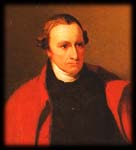 "Orator of
Liberty". His compelling speeches kindled the fires of the Revolution and fueled the
effort to secure freedom.
"Orator of
Liberty". His compelling speeches kindled the fires of the Revolution and fueled the
effort to secure freedom.
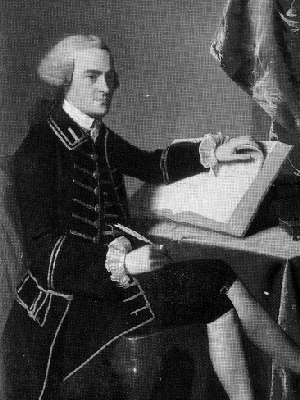 the more particular notice
of those distinguished men, who signed their names to that instrument, and thus identified
themselves with the glory of this American republic.
the more particular notice
of those distinguished men, who signed their names to that instrument, and thus identified
themselves with the glory of this American republic. 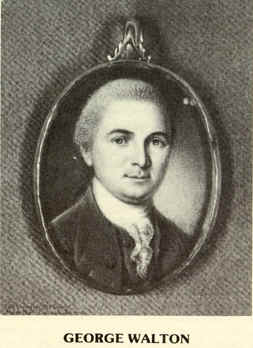 conclude these biographical notices, was born in the county of Frederick, Virginia, about
the year 1740. He was early apprenticed to a carpenter, who being a man of selfish and
contracted views, not only kept him closely at labor during the day, but refused him the
privilege of a candle, by which to read at night.
conclude these biographical notices, was born in the county of Frederick, Virginia, about
the year 1740. He was early apprenticed to a carpenter, who being a man of selfish and
contracted views, not only kept him closely at labor during the day, but refused him the
privilege of a candle, by which to read at night. 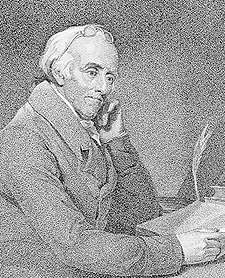 His ancestors emigrated front
England to Pennsylvania, about the year 1683.
His ancestors emigrated front
England to Pennsylvania, about the year 1683.  and graduated in 1760. He was
admitted to the bar in 1764 and went to Wilmington, N. C. in 1764. In 1767 he married Anne
Clark. In 1773 he was elected to the Assembly. He was elected to the Continental Congress
and remained a member of that body until 1777, serving on many important committees. He
was absent when independence was voted but he returned in time to sign the Declaration. On
Apr.29, 1777, Hooper resigned from Congress and retired to "Finian," his home
near Wilmington. He was eager to restore his fortune, ruined by his public service. The
impending capture of Wilmington forced him to flee, and he left his family in Wilmington
in preference to exposing them to danger from the British. His family was finally restored
to him, but much of his property was destroyed and he had become dangerously ill with
malaria. In 1782 he moved to Hillsboro and two years later he was again in the House of
Commons. After several years of painful decline, he died in Hillsboro.
and graduated in 1760. He was
admitted to the bar in 1764 and went to Wilmington, N. C. in 1764. In 1767 he married Anne
Clark. In 1773 he was elected to the Assembly. He was elected to the Continental Congress
and remained a member of that body until 1777, serving on many important committees. He
was absent when independence was voted but he returned in time to sign the Declaration. On
Apr.29, 1777, Hooper resigned from Congress and retired to "Finian," his home
near Wilmington. He was eager to restore his fortune, ruined by his public service. The
impending capture of Wilmington forced him to flee, and he left his family in Wilmington
in preference to exposing them to danger from the British. His family was finally restored
to him, but much of his property was destroyed and he had become dangerously ill with
malaria. In 1782 he moved to Hillsboro and two years later he was again in the House of
Commons. After several years of painful decline, he died in Hillsboro. 
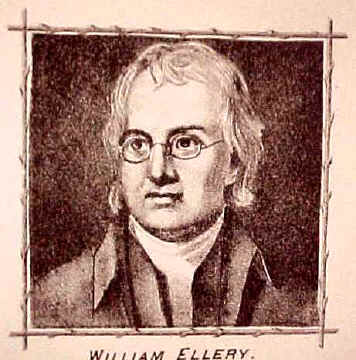 originally from Bristol, in
England, whence they emigrated to America during the latter part of the seventeenth
century, and took up their residence at Newport, in Rhode Island.
originally from Bristol, in
England, whence they emigrated to America during the latter part of the seventeenth
century, and took up their residence at Newport, in Rhode Island. 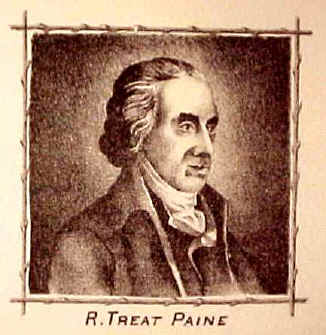 for some years the settled
pastor of a church in Weymouth, in the vicinity of Boston. His health failing him,
however, he removed with his family to the latter place; where he entered into mercantile
pursuits. His mother was the grand-daughter of Governor Treat of Connecticut.
for some years the settled
pastor of a church in Weymouth, in the vicinity of Boston. His health failing him,
however, he removed with his family to the latter place; where he entered into mercantile
pursuits. His mother was the grand-daughter of Governor Treat of Connecticut. 
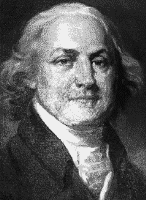 VA. He attended the College of
William and Mary, and in early 1776 he joined the 3d Virginia Regiment. Mercer became Gen.
Charles Lee's aide-decamp in 1778, but after General Lee's court-martial in October 1779,
Mercer resigned his commission. He spent the next year studying law at the College of
William and Mary and then rejoined the army, where he served briefly under Lafayette.
VA. He attended the College of
William and Mary, and in early 1776 he joined the 3d Virginia Regiment. Mercer became Gen.
Charles Lee's aide-decamp in 1778, but after General Lee's court-martial in October 1779,
Mercer resigned his commission. He spent the next year studying law at the College of
William and Mary and then rejoined the army, where he served briefly under Lafayette.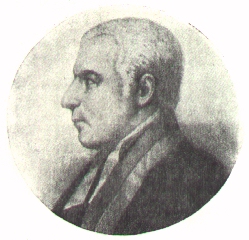 emigrated to America, disembarking at New Castle, DE. While the father
traveled about the country, apparently selling tinware, the family lived in New London,
other places in Connecticut, and in Trenton, NJ. In 1750 he settled in Princeton, NJ.
There, he became a merchant and manufacturer of tin goods. His prosperity enabled William
to attend local private schools and the College of New Jersey (later Princeton). He took a
B.A. in 1763 and an M.A. 3 years later.
emigrated to America, disembarking at New Castle, DE. While the father
traveled about the country, apparently selling tinware, the family lived in New London,
other places in Connecticut, and in Trenton, NJ. In 1750 he settled in Princeton, NJ.
There, he became a merchant and manufacturer of tin goods. His prosperity enabled William
to attend local private schools and the College of New Jersey (later Princeton). He took a
B.A. in 1763 and an M.A. 3 years later.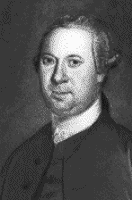 Charles County, Md. Little is known
about his childhood or education, but as an adult he came into possession of a large
estate near Annapolis, called Stepney, where he lived most of his life. He never married.
The web of his far-reaching friendships included such illustrious personages as George
Washington.
Charles County, Md. Little is known
about his childhood or education, but as an adult he came into possession of a large
estate near Annapolis, called Stepney, where he lived most of his life. He never married.
The web of his far-reaching friendships included such illustrious personages as George
Washington.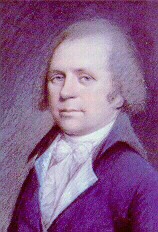 emigrated to Philadelphia in 1771. The following year, the rest of his
family came to the colonies, and his brother and father established an import business at
Baltimore. During that year, James continued schooling at Newark Academy in Delaware and
then studied medicine for 2 years under the well-known Dr. Benjamin Rush in Philadelphia.
emigrated to Philadelphia in 1771. The following year, the rest of his
family came to the colonies, and his brother and father established an import business at
Baltimore. During that year, James continued schooling at Newark Academy in Delaware and
then studied medicine for 2 years under the well-known Dr. Benjamin Rush in Philadelphia. local and state politics. The youth obtained a good education, graduating
from the College of New Jersey (later Princeton) in 1776. He immediately entered the
Continental Army and saw extensive action. Achieving the rank of captain by the age of 19
and serving under his father, Gen. Elias Dayton, and the Marquis de Lafayette, he was a
prisoner of the British for a time and participated in the Battle of Yorktown, VA.
local and state politics. The youth obtained a good education, graduating
from the College of New Jersey (later Princeton) in 1776. He immediately entered the
Continental Army and saw extensive action. Achieving the rank of captain by the age of 19
and serving under his father, Gen. Elias Dayton, and the Marquis de Lafayette, he was a
prisoner of the British for a time and participated in the Battle of Yorktown, VA.
 farmer-merchant. At age 12, after receiving an elementary education at local schools, he
matriculated at Dummer Academy in South Byfield, MA, and in 1777 graduated from Harvard.
He served briefly as a general's aide during the War for Independence. Choosing a legal
career, he read for the law at Newburyport, MA, and entered practice there in 1780 .
farmer-merchant. At age 12, after receiving an elementary education at local schools, he
matriculated at Dummer Academy in South Byfield, MA, and in 1777 graduated from Harvard.
He served briefly as a general's aide during the War for Independence. Choosing a legal
career, he read for the law at Newburyport, MA, and entered practice there in 1780 .
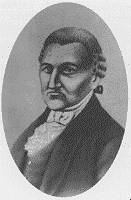 around 1680. Signer Brearly was
born in 1745 at Spring Grove near Trenton, was reared in the area, and attended but did
not graduate from the nearby College of New Jersey (later Princeton). He chose law as a
career and originally practiced at Allentown, NJ. About 1767 he married Elizabeth Mullen.
around 1680. Signer Brearly was
born in 1745 at Spring Grove near Trenton, was reared in the area, and attended but did
not graduate from the nearby College of New Jersey (later Princeton). He chose law as a
career and originally practiced at Allentown, NJ. About 1767 he married Elizabeth Mullen. MD. He was the second son of Samuel
Dickinson, the prosperous farmer, and his second wife, Mary (Cadwalader) Dickinson. In
1740 the family moved to Kent County near Dover, DE., where private tutors educated the
youth. In 1750 he began to study law with John Moland in Philadelphia. In 1753 Dickinson
went to England to continue his studies at London's Middle Temple. Four years later, he
returned to Philadelphia and became a prominent lawyer there. In 1770 he married Mary
Norris, daughter of a wealthy merchant. The couple had at least one daughter.
MD. He was the second son of Samuel
Dickinson, the prosperous farmer, and his second wife, Mary (Cadwalader) Dickinson. In
1740 the family moved to Kent County near Dover, DE., where private tutors educated the
youth. In 1750 he began to study law with John Moland in Philadelphia. In 1753 Dickinson
went to England to continue his studies at London's Middle Temple. Four years later, he
returned to Philadelphia and became a prominent lawyer there. In 1770 he married Mary
Norris, daughter of a wealthy merchant. The couple had at least one daughter.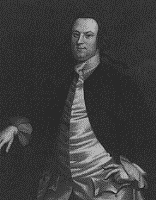 of Carrollton, signer of the
Declaration of Independence. Daniel's older brother was John Carroll, the first Roman
Catholic bishop in the United States.
of Carrollton, signer of the
Declaration of Independence. Daniel's older brother was John Carroll, the first Roman
Catholic bishop in the United States.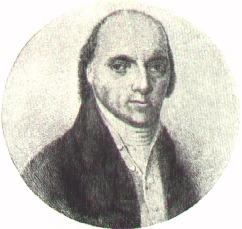 James Blair, founder and first
president of the College of William and Mary. Signer Blair graduated from that institution
and studied law at London's Middle Temple. Thereafter, he practiced at Williamsburg. In
the years 1766-70 he sat in the Virginia House of Burgesses as the representative of
William and Mary. From 1770 to 1775 he held the position of clerk of the colony's council.
James Blair, founder and first
president of the College of William and Mary. Signer Blair graduated from that institution
and studied law at London's Middle Temple. Thereafter, he practiced at Williamsburg. In
the years 1766-70 he sat in the Virginia House of Burgesses as the representative of
William and Mary. From 1770 to 1775 he held the position of clerk of the colony's council.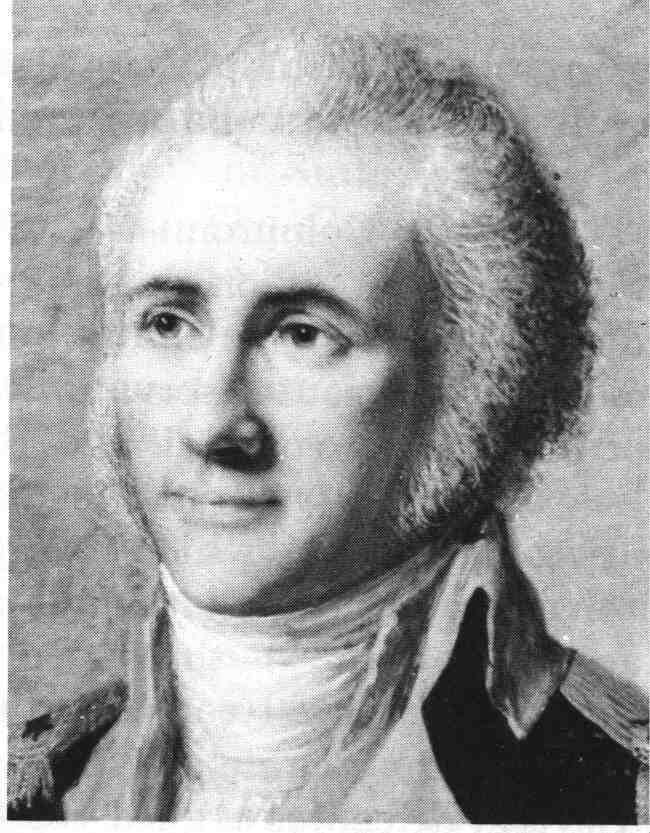 1763
Archibald Davie brought his son William to Waxhaw, SC, where the boy's maternal uncle,
William Richardson, a Presbyterian clergyman, adopted him. Davie attended Queen's Museum
College in Charlotte, North Carolina, and graduated from the College of New Jersey (later
Princeton) in 1776.
1763
Archibald Davie brought his son William to Waxhaw, SC, where the boy's maternal uncle,
William Richardson, a Presbyterian clergyman, adopted him. Davie attended Queen's Museum
College in Charlotte, North Carolina, and graduated from the College of New Jersey (later
Princeton) in 1776. distinguished family that originally settled in Jamestown, VA. He
usually referred to himself as Gunning Bedford, Jr., to avoid confusion with his cousin
and contemporary Delaware statesman and soldier, Col. Gunning Bedford.
distinguished family that originally settled in Jamestown, VA. He
usually referred to himself as Gunning Bedford, Jr., to avoid confusion with his cousin
and contemporary Delaware statesman and soldier, Col. Gunning Bedford.