Abandoned & Little-Known Airfields:
Florida: Northern Orlando area
© 2002, © 2016 by Paul Freeman. Revised 8/28/16.
This site covers airfields in all 50 states: Click here for the site's main menu.
____________________________________________________
Please consider a financial contribution to support the continued growth & operation of this site.
Cannon Mills Airport (revised 5/30/13) - Flying Seminole Ranch (revised 2/27/16) - Howey Airport (revised 8/28/16)
Mt. Plymouth Airport (revised 3/22/14) - Ryan Municipal (revised 5/24/11)
Showalter Airpark (revised 7/14/13) - Silver Springs Airpark (revised 7/11/15) - Taylor Field (revised 5/24/11) - Zellwin Farms Airport / Potters Field (added 5/22/11)
____________________________________________________
Silver Springs Airpark, Silver Springs, FL
29.22, -82.07 (North of Orlando, FL)
A 1949 aerial view (from the U of FL Digital Collections) depicted Silver Springs Airpark as having 2 unpaved runways,
with 2 small buildings southwest of the runway intersection.
This small general aviation airport was not yet listed among active airfields in the 1945 AAF Airfield Directory (courtesy of Scott Murdock).
David Tooker recalled, “My dad & a friend (who didn't last too long, so he mustn't have been much of one) Ken Richardson, bought the property in 1946 for $60k.
My dad bought him out in 1948. They built the filling station & airport at about the same time, from 1947-48.
My dad had a PT-19 that he stunted for a while, then let rot on the taxi strip
(the north/south one - a few guys actually took off on it, but were not supposed to, it was only about 1,600').
I remember one guy in a taildragger took off going south, made it over SS Boulevard & caught his gear in the power lines, flipped & made a great hung-in-the-trees retrieval.
I stepped out of the house we were living in at the time to watch the fire truck get them down with ladders.
He probably would have made the takeoff OK, but had 4 people in the plane, and was over-grossed.
I was about 4 at the time [1949 or 1950], but remember it well... some things stick in your mind.
I have a picture of the Silver Springs SkyWay Station, which was either ESSO or Mobile at the time.
Pictured in front with Al Boice's Stinson.”
The earliest depiction of the field which has been located was a 1949 aerial view (from the U of FL Digital Collections),
which depicted Silver Springs Airpark as having 2 unpaved runways,
with 2 small buildings southwest of the runway intersection.

An undated (circa late 1940s?) photo of 2 taildraggers & a Beech Bonanza at the Skyway Station at the south end of Silver Springs Air Park (courtesy of Alex Nelon).
Alex Nelon noted, “The Hudson convertible was owned by the Air Park owner, Nat Tooker,
and was, in addition to being a pretty zippy car for its day, the favored spot for their cat to give birth to the family's kittens.”
Alex Nelon recalled, “Silver Springs Airpark... was owned at one time by my best friend’s father & had 2 runways, north/south & east/west, both turf.
The operators were John & Pat Henderson.
John had been a civilian instructor during WWII & continued to instruct at Silver Springs.
Their Chesapeake Bay Retriever, Press, used to catch lady-finger firecrackers & let them blow up in his mouth,
sending smoke & spit all over the place to the delight of the airport bums.
Light a newspaper & Press would bite it until the fire was out – it was a story in the Orlando Sentinel a few times: “Fire Eating Dog” or some such.
It was a real human-being airport, populated with some of the most interesting characters:
Johnny Weissmuller ('Tarzan'), Ricou Browning (The Creature in the underwater scenes from the movie 'Creature of the Black Lagoon'),
Chicago radio personality Tommy Bartlett, and old war buddies of the owner, Nat Tooker.”
Gay Kite recalled, “Silver Springs Airpark.. I grew up at the airport.
My father, John Henderson, was the flight instructor & FBO along with my mother from the mid-1950s.”
AirForrest recalled, “Lloyd Bridges used to fly into & out of the Silver Springs [Airpark] while filming 'Sea Hunt' [1958-61] there.”

A 1960 photo (courtesy of Alex Nelon) of a group in front of a taildragger at Silver Springs Airpark.

A 1964 aerial view (from the U of FL Digital Collections) depicted Silver Springs Airpark as having a single unpaved east/west runway,
A building had been added at some point between 1949-64,
and 2 light single-engine aircraft were visible on the southeast side of the runway.
Steve Sierens recalled, “On highway 40 near Silver Springs was a paved east/west strip that was on the site of 'Six Gun Territory”; a tourist attraction.
I used to fly in there in a Piper J-3 Cub; you could walk to the attraction.”

The 1968 Flight Guide (courtesy of Robert Levittan) depicted Silver Springs as having a 3,000' paved Runway 9/27,
with taxiway leading to 2 small buildings on the southeast side.

The only aeronautical chart depiction which has been located of Silver Springs Airpark was on a 1972 FL Aeronautical Chart (courtesy of Patrick).
It depicted Silver Springs as having a 3,000' paved east/west runway.
Alex Nelon recalled, “John Henderson... continued to instruct at Silver Springs until the mid to late-1970s when the airport was sold.”
Gay Kite recalled, “Silver Springs Airpark.. My father, John Henderson, was the flight instructor & FBO along with my mother until 1978-79.
After that airport closed, he was instructing at Jim Taylor Field.”
A 1995 USGS aerial photo showed mobile homes around the former airport site,
but the western end of the runway remained clear.

Although surrounded by trailers, a 1/1/08 aerial view showed the western half of the Silver Springs runway remained clear.
Alex Nelon reported in 2008, “The airpark is now covered with mobile homes
and only the concrete block office remains, a shed for maintenance equipment.”

The latest photo which has been located of the site of Silver Springs Airpark was a 11/21/11 aerial view looking northeast by Rocky Driggers.
The outline of the runway remains recognizable.
The site of Silver Springs Airport is located west of the intersection of Northeast 29th Street & Silver Springs Airport Road, appropriately enough.
____________________________________________________
Zellwin Farms Airport / Potters Field, Zellwood, FL
28.73, -81.64 (Northwest of Orlando, FL)

The 2/6/95 USGS aerial photo looking southwest showed Zellwin Farms Airport to have a single paved runway, ramp, and 2 hangars.
This small airport may have been built at some point between 1979-80,
as it was not yet depicted on a 1969 aerial photo, nor on the 1970 or 1979 USGS topo maps.
The earliest depiction of the field which has been located was a 1980 aerial photo.
It depicted Zellwin Farms Airport as having a single paved runway, ramp, and 2 hangars.
No airfield was depicted at this location on the 1985 FL Aeronautical Chart (courtesy of Alex Hauzer).
The earliest depiction of the field which is available is a 2/5/95 USGS aerial photo.
It depicted Zellwin Farms Airport as having a single paved runway, ramp, and 2 hangars.
According to Matthew Clapp, “Zellwin Farms Airport... was a crop dusting airport that was closed when the St. Johns water district purchased the farmland.
This was an attempt to mitigate the pollution that was ending up in Lake Apopka.”
A 1/4/04 aerial view depicted Zellwin Farms Airport to remain completely intact.
A 5/28/05 aerial view showed that the northern hangar had been removed at some point in the previous year.

A circa 2005-2010 photo looking south at Zellwin Farms Airport,showing the paved runway, ramp, and hangar, all looking abandoned yet intact.

A circa 2005-2010 aerial view looking south at Zellwin Farms Airport,showing the paved runway, ramp, and hangar,
with some earthmoving in progress at the northern end of the runway.
Tony Air reported in 2007, “It's pretty rural out there, and the abandoned airport is still there. Fenced off though.
It has a paved north/south runway with an apron on the northwest side of the airport, and what I think is a hangar.
The runway looked small in width, a little bigger than lane on a street.
We went to White Field, a public grass airport right around that abandoned airport. We asked around & these folks explained most of it.
They told me it was a private agricultural airstrip used by one man, Potters.
That man sold the airport to the state & the state fenced it off for some reason.
It [is] listed it as Zellwin Farms on Google Earth. But then the people told me it was Potters Field.”

The last photo which has been located of Zellwin Farms Airport was a 5/2/10 aerial view looking southwest,
showing the paved runway, ramp, and hangar as remaining intact.
Zellwin Farms Airport was depicted as an abandoned airfield on the 2011 Jacksonville Sectional Chart.
Zellwin Farms Airport is located southwest of the intersection of Jones Avenue & Jewel Foliage Road.
____________________________________________________
Howey Airport, Howey in the Hills, FL
28.7, -81.77 (Northwest of Orlando, FL)

A 2/1/47 aerial view of Howey Airport (from the U of FL Digital Collections).
The earliest depiction of the field which has been located
was a 2/1/47 aerial view of Howey Airport (from the U of FL Digital Collections).
It depicted Howey as having 2 runways, with a single hangar on the north side.
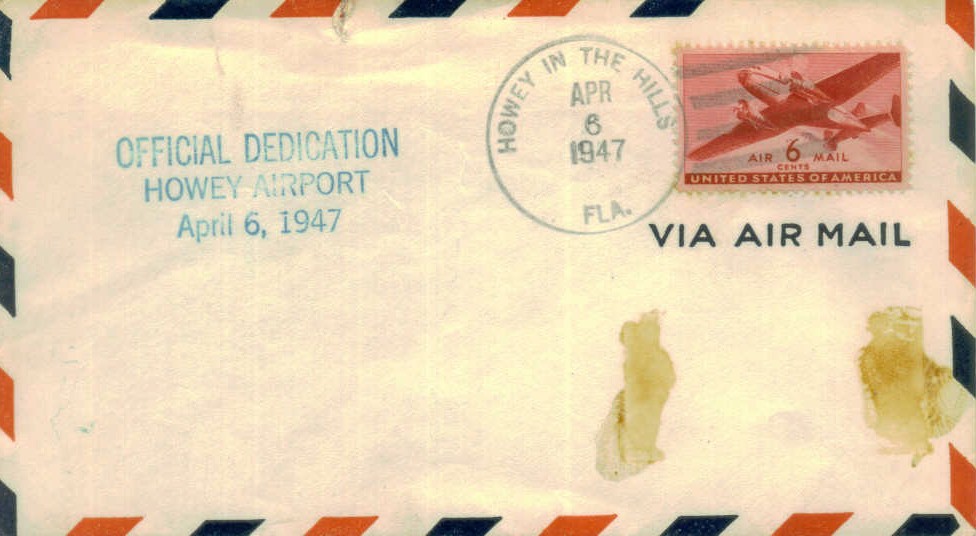
A postmark commemorated the 4/6/47 Dedication of Howey Airport.

The earliest aeronautical chart depiction of the field which has been located
was on the February 1949 Orlando Sectional Chart (courtesy of Chris Kennedy),
which described "Howey" as having a 2,000' unpaved runway.

A January 11, 1958 USDA aerial photo of Howey Airport (via the FL Department of Transportation, courtesy of Brian Rehwinkel)
showed the field as having 2 unpaved runways, with a ramp & a single hangar at the northeast corner.
The Aerodromes table on the 1964 Orlando Sectional Chart (according to Chris Kennedy)
described the field as having 2 runways, with the longest being a 2,000' turf strip,
but the remarks said "Northwest/Southeast runway permanently closed."

The last aeronautical chart depiction which is available of Howey Airport
was on the November 1965 Orlando Sectional Chart (courtesy of Ron Kunse),
which depicted Howey as having a 2,000' unpaved runway.
The Aerodromes table on the 1966 Orlando Sectional Chart (according to Chris Kennedy)
described the field as having a single 1,850' bare runway.

The 1969 USGS topo map depicted the "Howey Landing Strip" as having a single northeast/southwest unpaved runway,
with a single hangar on the northeast corner of the field.
The former crosswind runway was no longer depicted.
Howey was listed in the "Low Use" section of the 1971 Flight Guide (according to Chris Kennedy),
as was described as having a single 1,800' unpaved Runway 4/22.

A 2/10/74 aerial view of Howey Airport (from the U of FL Digital Collections)
depicted the field as having a single grass northwest/southeast runway, with the hangar at the north end.
There was no longer any sign of the former crosswind runway,
the land having been returned to cultivation.
It was depicted as "Howey Airport" on the 1978 & 1979 USGS topo maps.
Howey was listed as a private field in the 1980 AOPA Airports USA directory (according to Chris Kennedy).
Howey Airport was evidently abandoned (for reasons unknown) at some point between 1980-82,
as it was no longer listed at all in the 1982 AOPA Airports USA directory (according to Chris Kennedy).
It was depicted as "Howey Landing Strip" on the 1985 USGS topo map.
Howey Airport was no longer depicted at all on the 1998 World Aeronautical Chart.
The 1999 USGS aerial photo showed that the airfield consisted of a single 2,400' runway, oriented northeast/southwest.
The single hangar sat at the northeast end of the runway.

A circa 2001 aerial photo of the site of Howey Airfield showed the outline of the former northeast/southwest runway, along with the single hangar.
There was no trace remaining of the former crosswind runway.


Two 2003 views by Robert Murphy of the remaining hangar at Howey Airport.
Robert Murphy "stumbled across" this former airfield in 2003.
"I was actually looking for abandoned buildings to photograph when I came across what I thought was an old warehouse,
but upon later inspection, it is an old hangar.
The sign scars on the side of the building say something like 'GREEN AIRWAYS',
'HOWEY-IN-THE-HILLS' (that's the name of the town, believe it or not).
It didn't cross my mind that this was an old airstrip,
but I believe the area that looks to be the former runway was all low brush."
Douglas Wilson reported in 2005 that a recent visit showed the Howey Airport property to be for sale.
“According to my latest information, the hangar has been bulldozed.”

Indeed a 2008 aerial view by Bob, looking northeast, shows that the runway & hangar of the Howey In The Hills Airport have been completely removed -
another bit of local aviation history wiped away by “development”.
Howey Airport is located south of the intersection of Route 19 & South Florida Avenue.
____________________________________________________
Mt. Plymouth Airport, Mt. Plymouth, FL
28.79 North / 81.53 West (Northwest of Orlando, FL)

A series of undated photos showing aircraft parked next to the Mt. Plymouth Hotel.
According to the website of the Florida Central Academy, the 150-room Mount Plymouth Hotel was opened in 1926.
The hotel was built at a cost of $350,000, and was the centerpiece of a golfing resort.

An unnamed auxiliary airfield was depicted approximately at Mt. Plymouth on the 1935 Orlando Sectional Chart.
At some point, an airfield was established directly adjacent to the hotel building,
and it was used by hotel guests to fly in & out of the resort.
The date of construction of the airfield has not been determined.
The earliest depiction of the airfield which has been located
appears to be the 1935 Orlando Sectional Chart,
which depicted an unnamed auxiliary airfield in approximately the location of Mt. Plymouth.
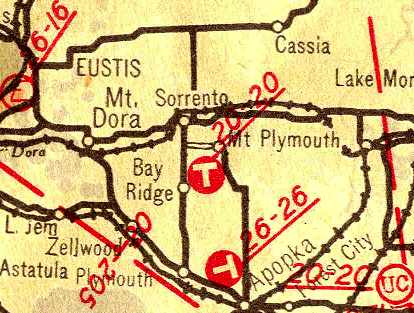
The November 1936 "Official Airway Map of FL" (courtesy of Chris Kennedy)
depicted an airfield just to the southwest of Mt Plymouth.
This location is somewhat different from that depicted on the 1935 chart, but was presumably the same field.

A circa 1930s aerial view of the Mt. Plymouth Hotel, showing the airfield extending toward the right.

A circa 1930s view of 2 unidentified biplanes & a monoplane in front of the Mt. Plymouth Hotel.

An aerial view of the Mt. Plymouth Airport,
from the Airport Directory Company's 1937 Airports Directory (courtesy of Bob Rambo).
The directory described Mt. Plymouth as an auxiliary airfield,
having two 2,000' runways, oriented north/south & east/west in a T-shape.
The aerial photo in the directory depicted the Mt. Plymouth directly adjacent to the runways.
It has not been determined how much longer the Mt. Plymouth Hotel (or its airfield) continued to operate.

A 1941 USDA aerial photo of the Mt Plymouth Airport (courtesy of the FL DOT via Brian Rehwinkel).
Although the north/south & northwest/southeast runways were still clear,
there was no indication that the field was still in use as an airport.
The Mt. Plymouth Airport was evidently closed at some point between 1937-42,
as it was no longer depicted at all on the January 1942 Orlando Sectional Chart (according to Chris Kennedy),
nor listed in the 4/1/44 US Army/Navy Directory of Airfields (courtesy of Ken Mercer).
A 1947 aerial photo showed the north/south & northwest/southeast runways were still clear,
but there was no indication that the field was still in use as an airport.
Starting in 1959, the former Mt. Plymouth Hotel was reused as the location of the Florida Central Academy.
In its heyday, it was considered one of the finest college preparatory boarding schools in the United States.
A 1969 aerial photo showed the north/south & northwest/southeast runways were still clear.
In 1983 the Mt. Plymouth property became the custody of the U.S. Bankruptcy Court,
which ordered the Florida Central Academy school closed & all business transactions halted pending the settling of claims.
Four days later county health officials condemned the building as unfit for human habitation.
The building quickly fell prey to vandals.
Plumbing was ripped out, walls bashed in, windows broken & graffiti painted on the walls.
Then in 1986, two 3-story wings of the former hotel were destroyed in a fire set by 2 teenagers.
One year later, in 1987, fire destroyed the remaining South Wing, in yet another episode of arson.

As seen in the 1999 USGS aerial photo,
the former north/south runway has been covered with a housing development.
It is believed that the clearing running northwest/southeast (just above the center of the photo)
is the remaining outline of one of the former runways.
The site of the hotel is at the west end of that runway (at the northwest corner of the photo).
A later aerial photo shows that the additional portions of the former airfield have been covered by housing as well.
The site of the Mt. Plymouth Airport is located southeast of the intersection of Westchester Avenue & Timuquana Avenue.
Thanks to Charles "Sandy" Jordan for pointing out the location of this airfield.
____________________________________________________
Ryan Municipal Airport, Apopka, FL
28.69 North / 81.51 West (Northwest of Orlando, FL)

Ryan Field, as depicted on the November 1936 "Official Airway Map of FL" (courtesy of Chris Kennedy).
The date of construction of the Ryan Municipal Airport has not been determined.
The earliest depiction of the field which has been located
was on the November 1936 "Official Airway Map of FL" (courtesy of Chris Kennedy).
It depicted the field as having 2 runways in the shape of a "T".
According to the Apopka Historical Trail web site (courtesy of Brian Rehwinkel),
Helen McBride leased the Ryan Municipal Airport starting in 1942 to teach military pilots to fly in her four airplanes.
McBride had received her pilot's license in the mid-1930s,
and was a former cross-country air racer.
The January 1942 Orlando Sectional Chart (courtesy of Chris Kennedy).
depicted Ryan as an auxiliary airfield.
The earliest directory listing of Ryan Field which has been located
was in the 4/1/44 US Army/Navy Directory of Airfields (courtesy of Ken Mercer).
It described Ryan as having a 2,800' unpaved runway.

The 1945 Orlando Sectional Chart (courtesy of John Voss)
depicted Ryan as a commercial or municipal airport.

A 2/21/47 aerial photo of Ryan Field (from the FL DOT, courtesy of Brian Rehwinkel)
depicted Ryan Field as having 2 runways, oriented north/south & east/west.
It did not seem to depict any buildings at the airport, though.

The runways of Ryan Field were depicted on an August 1950 FL Department of Transportation street map (courtesy of Brian Rehwinkel),
but the airport was not labeled.
According to the Apopka Historical Trail web site (courtesy of Brian Rehwinkel),
Helen McBride's lease at Ryan Municipal Airport ended in 1952.
A portion of the airport on the northwest corner of Park Avenue & Summit Drive
was sold in 1954 to the Orange County School Board,
and the Dream Lake Elementary School opened the following year.
By the time of the August 1954 Orlando Sectional Chart (according to Chris Kennedy),
Ryan Field was no longer depicted at all.

The last photo which has been located of Ryan Municipal Airport was a 3/1/54 aerial view (from the U of FL Digital Collections).
It depicted the field as remaining intact, but evidently abandoned.
A 1969 aerial photo showed that houses had covered the site of the former airport at some point between 1954-69.

As seen in the 1999 USGS aerial photo, the site of the former Ryan Field has been densely redeveloped,
with not a trace appearing to remain of the former airport.
____________________________________________________
Showalter Airpark, Winter Park, FL
28.6, -81.32 (Northeast of Orlando, FL)

A circa 1940s artist's conception of the planned Showalter Airpark (from the Winter Park Public Library, courtesy of Dallam Oliver-Lee).
A 4/10/40 USDA aerial photo (courtesy of Dallam Oliver-Lee)
did not yet depict any airfield on what would eventually become the site of Showalter Airpark.
As described on the current Showalter Flying Service web site,
Howard & "Sandy" Showalter & "Buck" Rogers migrated to Florida in late 1945 after completing their military service,
acquired 100 acres of ground in Winter Park, and built Showalter Airpark.
The Airpark was intended to be the mecca for the private pilot
with a country club atmosphere to make flying attractive to everyone.
With the advent of the G. I. Bill, flight training became a large part of the operation
and the fleet was increased to 3 J-3 Cubs, a Luscomb Silvaire, a Taylorcraft and a Fairchild-24.

The earliest photo which has been located of Showalter Airpark
was a 1946 aerial view showing a hangar with attached office, and 4 single-engine planes (from the Winter Park Public Library, courtesy of Dallam Oliver-Lee).

A 3/17/47 aerial photo (from the FL DOT, courtesy of Brian Rehwinkel)
depicted Showalter Airpark as having 2 grass runways, oriented east/west & northeast/southwest,
and 2 hangars west of the runway intersection.
No aircraft were visible on the field.

An undated view of Showalter Airport.

Howard Showalter, Ford Rogers Jr., and Sandy Showalter.

A photo & advertisement for a June 1948 Airshow at Showalter Airpark (from the Winter Park Public Library, courtesy of Dallam Oliver-Lee).

The 1949 Orlando Sectional Chart (courtesy of Chris Kennedy)
described Showalter Airport as having a 2,500' unpaved runway.
The Showalter company was expanded to include a flight school at Sanford
and one at Herndon (then the Orlando Municipal Airport).
The original Showalter Airpark was becoming a smaller part of the company's business,
as the growing number of corporate pilots needed an airport with better facilities,
navigation systems & capacity to handle the larger aircraft.
Therefore, when the new terminal was built on Orlando Municipal Airport in 1951,
the Showalter Corporation was the successful bidder to initiate the first Fixed Base Operation on the Municipal Airport.
A 3/17/52 USGS aerial photo (courtesy of Dallam Oliver-Lee)
depicted 2 light aircraft parked north of Showalter's hangars.
A 3/1/54 USDA aerial photo (courtesy of Dallam Oliver-Lee) did not depict any aircraft at Showalter.

By the time of the 1957 Orlando Sectional Chart (courtesy of Chris Kennedy),
Showalter Airport was still depicted as an active airfield, but it was also labeled "Emerg only".

The last photo which has been located of Showalter Airpark was a 12/1357 aerial view (courtesy of Dallam Oliver-Lee).
It depicted one single-engine aircraft parked on the north side of the hangars.
According to Bob Showalter, "We had moved our main business to the downtown Orlando Airport by 1959."

An early 1960s FL Department of Transportation street map (courtesy of Brian Rehwinkel)
depicted Showalter Airport as having two 2,500' runways, oriented east/west & northeast/southwest.
By the time of the 1962 AOPA Airport Directory, Showalter Airport was obviously on its way out,
as the directory said that the field was unattended, and for "Emergency use only."
It was described as having a single 2,500' turf Runway 9/27.
According to Bob Showalter, "The last plane landed at Showalter Airpark, with me on board with my Dad, in 1963.
We sold the property to a condominium developer."
By the time of the 1966 Orlando Sectional Chart (courtesy of Chris Kennedy),
Showalter Airpark was no longer depicted at all.
A 1969 aerial photo showed that houses had covered the site of the former airport.

A 1/22/13 aerial photo (courtesy of Dallam Oliver-Lee) showed the Showalter Airport property has been densely redeveloped,
and not a trace remains of the former airfield.
The site of Showalter Airpark is located south of the intersection of Aloma Avenue & Balfour Drive.
Showalter Flying Service continues in business today at the Orlando Executive Airport.
____________________________________________________
Cannon Mills Airport, Orlando, FL
28.54 North / 81.3 West (East of Orlando Executive Airport, FL)

Cannon Mills Airport, as depicted on the January 1942 Orlando Sectional Chart (courtesy of Chris Kennedy).
Not much is known about this small former airport.
Cannon Mills Airport was located just east of Orlando Municipal Airport (now Orlando Executive Airport).
The date of construction of Cannon Mills Airport has not been determined.
It was evidently built at some point between 1938-41,
as it was not yet depicted on a 1935 aeronautical chart (courtesy of Dallam Oliver-Lee)
nor listed among active airfields in the Airport Directory Company's 1938 Airports Directory (according to Chris Kennedy).
The earliest reference to the field which has been located
was in the Airport Directory Company's 1941 Airports Directory (courtesy of Chris Kennedy).
It described Cannon Mills as a commercial airport,
consisting of 2 sod runways (3,000' east/west & 2,600' north/south) & a hangar.
The earliest depiction of Cannon Mills which has been located
was on the January 1942 Orlando Sectional Chart (courtesy of Chris Kennedy).
The 4/1/44 US Army/Navy Directory of Airfields (courtesy of Ken Mercer)
described Cannon Mills Airport as having a 4,100' unpaved runway.

The earliest photo which has been located of Cannon Mills Airport was a 2/23/47 USDA aerial photo (courtesy of Dallam Oliver-Lee).
It depicted a total of 4 unpaved runways, along with about a half-dozen planes parked around a few small buildings at the southwest corner of the field.

The last aeronautical chart depiction which has been located of Cannon Mills Airport
was on the 1949 Orlando Sectional Chart (courtesy of Chris Kennedy)
described Cannon Mills as having a 4,100' unpaved runway.

The last photo which has been located showing Cannon Mills Airport still intact was a 12/1/49 USGS aerial photo (courtesy of Dallam Oliver-Lee).
The airport may have already been closed by this point, as the ramp was empty – devoid of planes compared to the 1947 photo.
Cannon Mills was definitely closed by 1952,
as a 3/17/52 USGS aerial photo (courtesy of Dallam Oliver-Lee) showed that new residential streets had been built over the southwestern portion of the airfield.
A 3/1/54 USGS aerial photo (courtesy of Dallam Oliver-Lee) showed housing covering the site,
erasing any trace of Cannon Mills Airport.
Cannon Mills Airport was no longer depicted by the time of the 1956 aeronautical chart (courtesy of Dallam Oliver-Lee).

Even though the field was apparently already closed,
Cannon Mills Airport continued to be depicted
on a FL Department of Transportation street map thought to be from the early 1960s (courtesy of Brian Rehwinkel).
It depicted Cannon Mills Airport as having 3 runways,
with the longest being a 3,300' east/west strip.

A 1/3/12 aerial photo showed the property of Cannon Mills Airport has been densely redeveloped as the Azelea Park neighborhood,
and not a trace appears to remain of the former airfield.
The site of Cannon Mills Airport is located northeast of the intersection of East/West Expressway & Route 436.
____________________________________________________
29.18 North / 82.15 West (Northwest of Orlando, FL)

Taylor Field, as depicted on the 1935 Orlando Sectional Chart.
The date of construction of Ocala's Taylor Field has not been determined.
The earliest reference to the field which has been located
was in The Airport Directory Company's 1933 Airports Directory (courtesy of Chris Kennedy).
It described Taylor Field as a municipal airport, consisting of 170 acres.
The landing area was said to be a triangular sandy loam field, measuring 4,400' northeast/southwest by 2,100' northwest/southeast.
The earliest depiction of the field which has been located
was on the 1935 Orlando Sectional Chart,
which depicted "Taylor" as a commercial or municipal airport.

The earliest photo which has been located of Taylor Field was an undated aerial view looking east
from The Airport Directory Company's 1937 Airports Directory (courtesy of Bob Rambo).
The directory depicted Taylor Field as having 2 paved runways, with the longest being the 3,900' northeast/southwest strip.
A paved taxiway led to a paved ramp on the north side of the field.

A 2/26/40 aerial view of Taylor Field (from the U of FL Digital Collections)
depicted the field as having 2 paved runways, with a paved ramp leading to a hangar on the north side.
According to the FL Department of State, the Greenville Aviation School opened in November 1941
as a primary flight training facility, located at Ocala's Taylor Field.
The airport was named for the original donor of the property, James Taylor.
The school's owner, Frank Hanley, had moved this facility from Greenville, MS,
while retaining the name of that location for his Florida school.
West Point Cadets made up the first class to arrive at the school in November 1941.
Using the Stearman-designed Kaydet PT-17 trainer,
over 5,000 cadets received primary flight training at this location.
With a monthly payroll of $50,000,
the Greenville School made a significant economic contribution to the Ocala Community.
Taylor Field was depicted as a municipal/commercial field on the January 1942 Orlando Sectional Chart (courtesy of Chris Kennedy),
although with the comment “Restricted to Air Corps Training.”

The 1944 US Army/Navy Directory of Airfields (courtesy of Ken Mercer)
described "Taylor, Army" as having a 4,000' hard-surface runway.
It was described as a Civilian Pilot Training field,
with "extensive training 15 mile radius."
The Greenville Aviation School at Taylor Field closed in September 1944.

Taylor Field, as depicted on the 1945 Orlando Sectional Chart (courtesy of John Voss).
Taylor Field continued to operate as a civilian airport after WW2.

A 3/9/49 USDA aerial photo of Taylor Field,
from the Digital Library Center / University of Florida George A. Smathers Libraries (courtesy of Brian Rehwinkel).
At some point between 1940-49 a 3rd paved runway had been added,
and the number of hangars along the northwest side of the field had increased to three.
The airfield did not seem to be very active, as not a single plane was visible anywhere on the field.
A group of dorms/classrooms previously used by the Greenville Aviation School
were still standing on the northeast corner of the field.

As depicted on a 1956 FL Department of Transportation street map (courtesy of Brian Rehwinkel),
Taylor Field had 3 runways.

The last photo which has been located showing Taylor Field while it was still open was a 2/2/57 aerial view (from the U of FL Digital Collections).
The airfield configuration was basically the same as seen in 1949.
Only 2 light aircraft were visible on the field.

The 1960 Jeppesen Airway Manual (courtesy of Chris Kennedy)
depicted Taylor Field was having 3 paved runways, with the longest being the 4,006' Runway 3/21.
A series of hangars was located along a taxiway on the northwest side of the field.
Taylor Field was described by the 1962 AOPA Airport Directory as having a single 5,000' asphalt Runway 18/36.
Airline service was provided by Eastern Airlines.
Taylor Field was closed in 1962, when it was replaced by a new & larger airport west of the town.
The Taylor Field property was eventually reused as an industrial park.
A 1964 aerial view of Taylor Field (from the U of FL Digital Collections)
showed the field to remain completely intact, with 3 paved runways & 4 hangars,
but no aircraft were visible on the field.
By the time of the 1966 Orlando Sectional Chart (courtesy of Chris Kennedy),
Taylor Field was no longer depicted at all.

The last photo which has been located of Taylor Field was a 3/6/72 aerial view (from the U of FL Digital Collections).
It showed that industrial buildings had covered the eastern end of the runways,
but the former hangars remained standing on the northwest side.

A 1999 USGS aerial photo showed that the former hangars had been removed at some point between 1972-99.
Brian Rehwinkel reported in 2003, "I visited the site about 2 weeks ago
and there is very little evidence of the former airfield.
It has been completely transformed into an industrial park.
I did photograph a small portion of the remains of one of the former runways."
The site of Taylor Field is located south of the intersection of State Road 200 & Martin Luther King Avenue.
____________________________________________________
Flying Seminole Ranch Airport, Chuluotta, FL
28.65, -81.15 (Northeast of Orlando, FL)

Flying Seminole Airfield, as depicted on the April 1966 Orlando Sectional Chart (courtesy of Chris Kennedy).
The date of construction of this former general aviation airport is unknown.
It was apparently built at some point between 1964-66,
as it was not yet depicted on a 1957 aerial photo, nor on the April 1964 Orlando Sectional Chart (according to Chris Kennedy).
The earliest depiction of the airfield which has been located
was on the April 1966 Orlando Sectional Chart (courtesy of Chris Kennedy).
The Aerodromes table in the chart described "Flying Seminole Ranch Space University"
as having a single 4,050' turf runway.
Clark True recalled that "I used to fly there often in 1966-67.
At that time it was a 4,000' turf runway & had a small building for the FBO
and a restaurant that put out a great breakfast for about $3, thus the reason for visiting often.
Usually about 5 plane loads from Cocoa & Rockledge would descend upon them
for breakfast on Sunday mornings before air touring the state for the rest of the day."

The earliest photo which has been located of Flying Seminole Ranch was a 1972 aerial view (from the U of FL Digital Collections).
It depicted the field as consisting of a single northwest/southeast grass runway.
A 1980 aerial photo showed the field to consist of a grass southeast/northwest runway.

An undated aerial view looking southeast along the Flying Seminole runway (courtesy of Jonathan Taylor).

The 1980 USGS topo map depicted the “Flying Seminole Ranch Airport” as having a single unpaved southeast/northwest runway,
with a single building (a hangar?) on the southwest side of the field.
Flying Seminole Ranch Airport was listed in the 1982 AOPA Airport Directory (courtesy of Ed Drury),
which described the field as having a single 4,000' turf Runway 11/29,
and listed the operator as Flying Seminole.

The last aeronautical chart depiction which has been located of Flying Seminole Airfield
was on the 1985 FL Aeronautical Chart (courtesy of Alex Hauzer).
It depicted Flying Seminole Ranch Airfield as a 3,700' unpaved runway which conducted glider operations.
Jim Ash reported, "I have log book entries up to 1987 from when I flew gliders there.
They were towing a SGS2-33A, a SGS1-26E, and a Grob 103 with a Cessna L-19.
There was a small office structure mid-field, on the south side of the runway, right next to the road, but no hangars.
A developer bought it (rumor) and built a paved runway next to the grass runway on the north side (fact),
before finding out the western end of the airport under the normal approach was environmentally sensitive wetlands (fact).
The project was abandoned, but not before the glider operation moved to Clermont, FL.
They operate now as Seminole Lake Gliderport.
The couple that own the operation are named Knut & Ingrid Kjenslie."
It was no longer depicted at all (even as an abandoned airfield) on the 1998 aeronautical charts.

A 1995 USGS aerial view looking northwest showed Flying Seminole Ranch Airfield's original grass runway,
along with its abortive paved runway to the north of the original runway.
A 1999 aerial photo showed the site of Flying Seminole Ranch Airfield to remain unchanged.

A 2002 aerial view looking northwest showed that the west side of the site of Flying Seminole Ranch Airfield had been covered by construction,
but the majority of the paved & unpaved runways remained intact.
Steve Stern provided an update to the status of the site of the Flying Seminole Ranch in 2004:
"It is now all housing. Urban sprawl from Orlando. The road that runs by there (419) is now 4-laned."

A 2015 aerial view looking northwest showed no trace remaining at the site of Flying Seminole Ranch Airfield,
erasing another vestige of FL aviation history.
The site of the Flying Seminole Ranch Airport is located
north of the intersection of Chuluotta Road & Twin Rivers Boulevard.
Thanks to John Foskett for pointing out this airfield.
____________________________________________________
Since this site was first put on the web in 1999, its popularity has grown tremendously.
That has caused it to often exceed bandwidth limitations
set by the company which I pay to host it on the web.
If the total quantity of material on this site is to continue to grow,
it will require ever-increasing funding to pay its expenses.
Therefore, I request financial contributions from site visitors,
to help defray the increasing costs of the site
and ensure that it continues to be available & to grow.
What would you pay for a good aviation magazine, or a good aviation book?
Please consider a donation of an equivalent amount, at the least.
This site is not supported by commercial advertising –
it is purely supported by donations.
If you enjoy the site, and would like to make a financial contribution,
you
may use a credit card via
 ,
using one of 2 methods:
,
using one of 2 methods:
To make a one-time donation of an amount of your choice:
Or you can sign up for a $10 monthly subscription to help support the site on an ongoing basis:
Or if you prefer to contact me directly concerning a contribution (for a mailing address to send a check),
please contact me at: paulandterryfreeman@gmail.com
If you enjoy this web site, please support it with a financial contribution.
please contact me at: paulandterryfreeman@gmail.com
If you enjoy this web site, please support it with a financial contribution.
____________________________________________________
This site covers airfields in all 50 states.