Abandoned & Little-Known Airfields:oks
Indiana: Western Indianapolis area
© 2002, © 2016 by Paul Freeman. Revised 12/9/16.
This site covers airfields in all 50 states: Click here for the site's main menu.
____________________________________________________
Please consider a financial contribution to support the continued growth & operation of this site.
Brownsburg Airport (revised 1/17/16) - Capital Airways Airport / Capitol Airways Airdrome (revised 10/5/16) - Hoosier Airport (revised 1/17/16)
Shank Airport (revised 5/8/14) - Speedway Airport (revised 12/9/16) - Stout Field / Stout AAF (revised 1/17/16)
____________________________________________________
Capital Airways Airport / Capitol Airways Airdrome, Indianapolis, IN
39.818, -86.231 (Northwest of Downtown Indianapolis, IN)
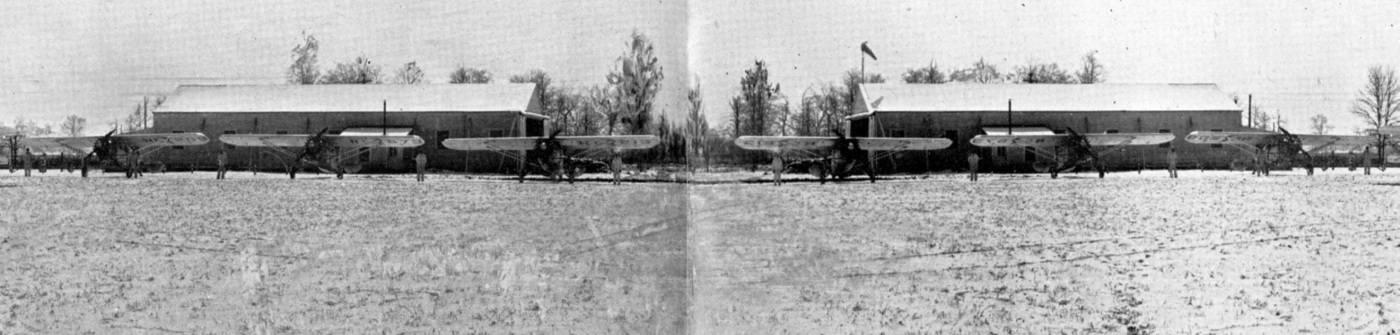
An undated photo from a circa 1928 advertisement for Capitol Airways Inc, showing “Winter activities at Capitol Airways Airdrome” (courtesy of Tom Heitzman).
This small airport was located less than a mile north of the Indianapolis Motor Speedway.
The date of establishment of Capitol Airways Airdrome has not been determined.
The earliest photo which has been located of this airfield was an undated photo from a circa 1928 advertisement for Capitol Airways Inc (courtesy of Tom Heitzman),
captioned “Winter activities at Capitol Airways Airdrome”.
It depicted a total of 13 monoplanes & biplanes in front of 2 hangars.
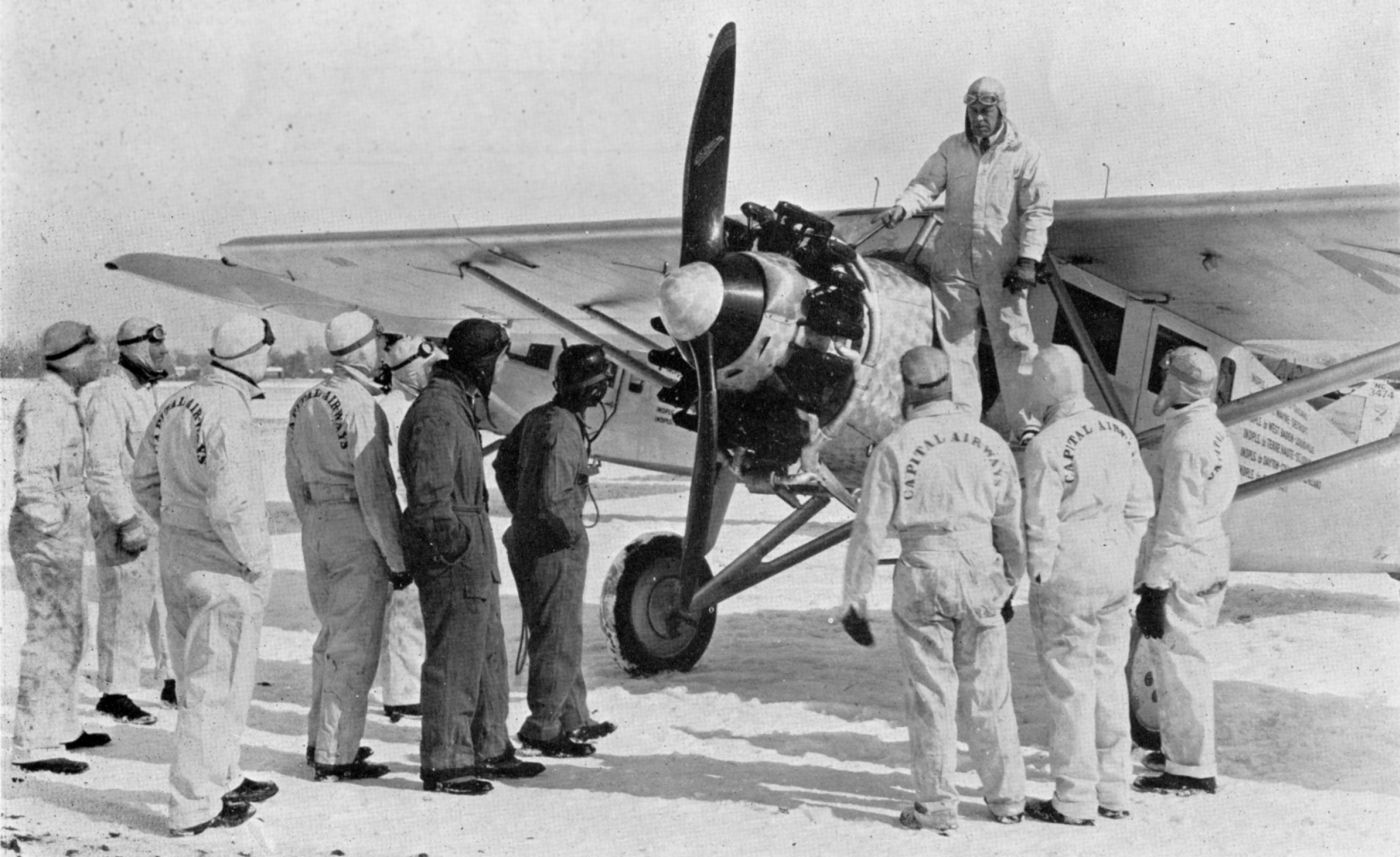
An undated photo from a circa 1928 advertisement for Capitol Airways Inc, showing “Instructing students on Wright Whirlwind engine” (courtesy of Tom Heitzman).

A circa 1928 advertisement for Capitol Airways Inc (courtesy of Tom Heitzman).
According to the book “The Encyclopedia of Indianapolis”, “The second airline to serve the city was Capitol Airways,
which on 10/22/28 began a passenger & express service from Capitol Airport.
By the spring of 1929 however all services were temporarily discontinued, and permanently dropped in the fall for financial reasons.”
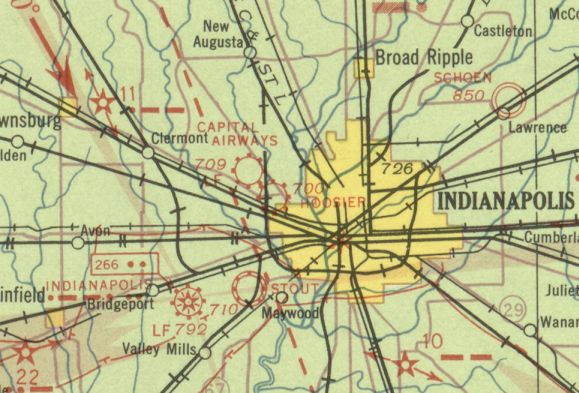
The earliest aeronautical chart depiction which has been located of Capitol Airways Airfield was on the November 1933 Cincinnati Sectional Chart.
It labeled the field as “Capital [sic] Airways”.
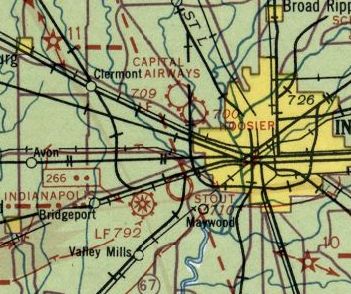
The last aeronautical chart depiction which has been located of Capitol Airways Airfield was on the 1934 Cincinnati Sectional Chart.
It labeled the field as “Capital [sic] Airways”.

The last depiction which has been located of Capitol Field was on a 1938 street map (courtesy of Kevin Walsh).
Capitol Airways Airport was evidently abandoned (for reasons unknown) at some point between 1934-41,
as it was no longer depicted on the April 1941 Cincinnati Sectional Chart.
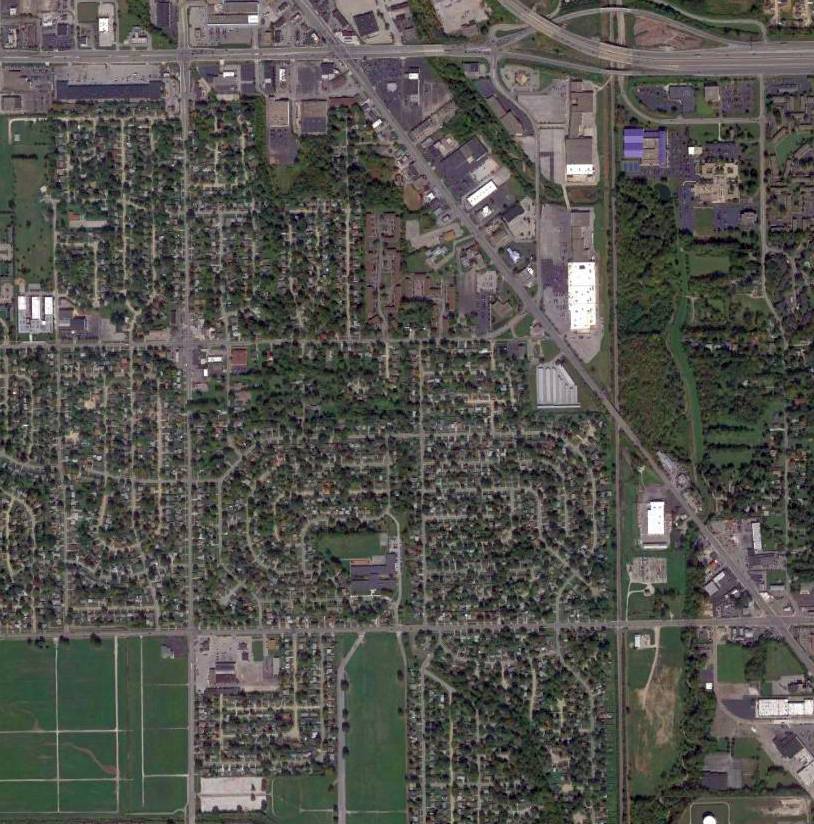
A 2014 aerial view showed no trace remaining of Capitol Airways Airport.
The site of Capitol Airways Airport is located south of the intersection of Lafayette Road & West 38th Street.
Thanks to Tom Heitzman for pointing out this airfield.
____________________________________________________
Brownsburg Airport, Brownsburg, IN
39.825, -86.394 (West of Indianapolis, IN)

Brownsburg Airport, as depicted on the June 1950 Cincinnati Sectional Chart.
Brownsburg Airport was apparently built at some point between 1945-50,
as it was not yet listed among active airfields in the 1945 AAF Airfield Directory (courtesy of Scott Murdock).
The earliest depiction of Brownsburg Airport which has been located was on the June 1950 Cincinnati Sectional Chart.
It depicted Brownsburg as having a 2,600' unpaved runway.
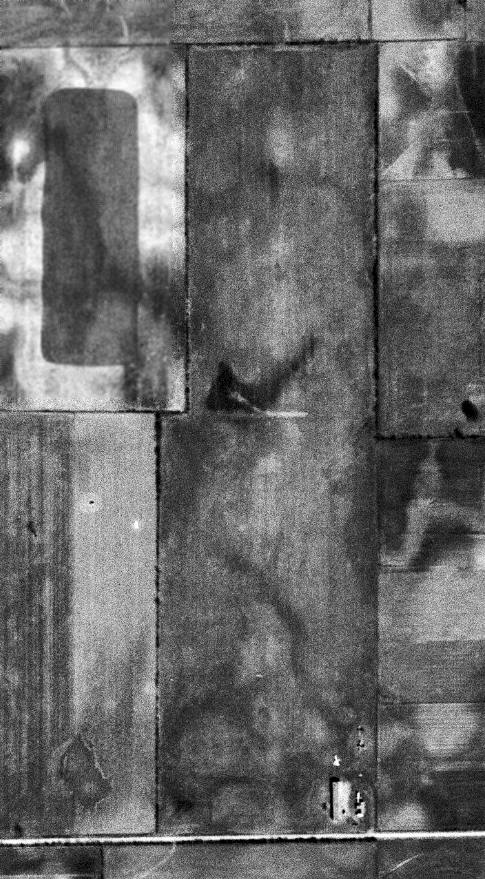
The earliest photo which has been located of Brownsburg Airfield was a 11/1/52 USGS aerial view.
It depicted Brownsburg as having a single north/south grass runway, with 3 light planes & a few small buildings on the southeast side.
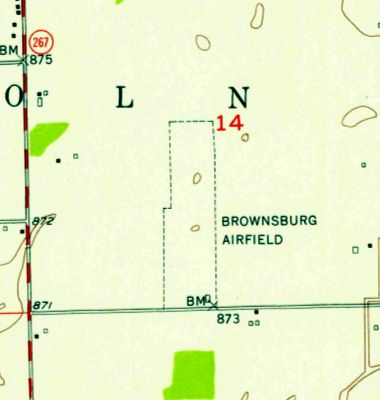
The earliest topo map depiction of Brownsburg Airport which has been located was on the 1953 USGS topo map.
It depicted “Brownsburg Airfield” as a north/south rectangular outline with 1 small building in the southeast corner.
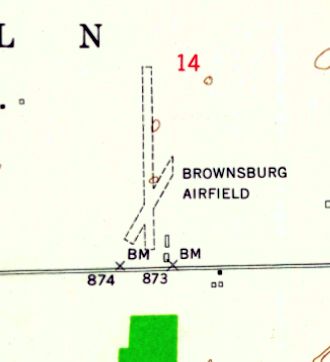
The 1959 USGS topo map depicted Brownsburg Airfield as having 2 unpaved runways, with 2 small buildings on the southeast side.

A 10/23/69 USGS aerial photo depicted Brownsburg Airport at perhaps the zenith of its popularity,
with a total of 24 single-engine aircraft visible on the field.

The last aeronautical chart depiction which has been located of Brownsburg Airport was on the December 1971 Sectional Chart (courtesy of Charles Germaine).
It depicted Brownsburg as having a 2,600' unpaved runway.
Phil Brooks observed, “I visited & had the privilege of meeting legendary operator 'Shorty' Graves. He was someone special.”
Charles Germaine recalled, “I made one landing & takeoff from Brownsburg during my time flying;
the FBO at Eagle Creek really didn’t like their rental planes going in & out of grass strips.
The runway was ruff & rutted.
I got my license in 1987 & it was still open but it closed soon after, sometime in the late 1980s.”
A 1998 aerial photo showed the site was covered with houses, with no trace remaining of Brownsburg Airport.
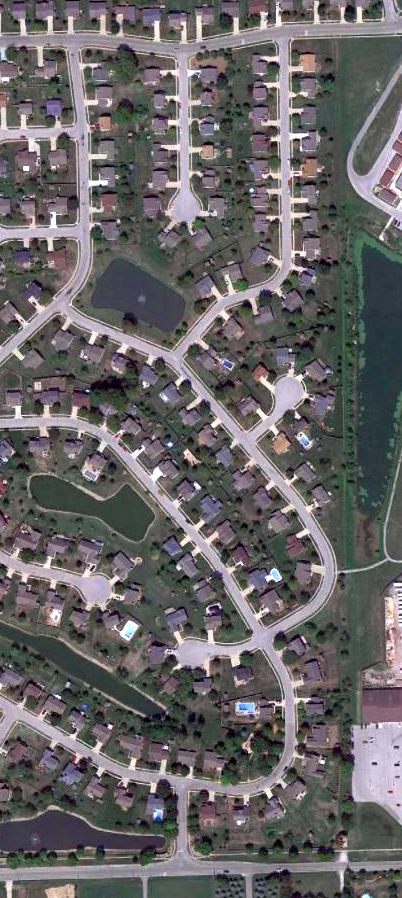
An 8/29/12 aerial photo showed the site of Brownsburg Airport was covered with houses, with no trace remaining of the little airport.
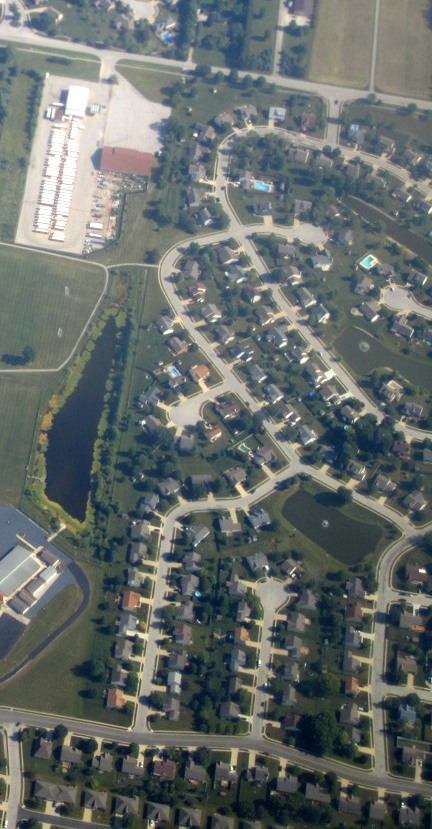
A 7/13/14 aerial view by Phil Brooks looking south at the site of Brownsburg Airport.
The site of Brownsburg Airport is located north of the intersection of Devin Drive & Airport Road, appropriately enough.
Phil Brooks observed, “I live in Brownsburg, and people relatively new to the area assume that Airport Road refers to Speedway Airport, rather than Brownsburg!”
Thanks to Charles Germaine for pointing out this airfield.
____________________________________________________
Hoosier Airport, Indianapolis, IN
39.8, -86.215 (Northwest of Downtown Indianapolis, IN)
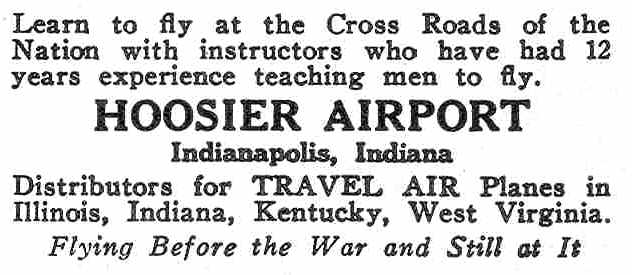
An advertisement for Hoosier Airport from the 8/18/28 issue of Aviation Magazine (courtesy of Chris Kennedy).
This small airport was located less than a mile east of the Indianapolis Motor Speedway.
Hoosier Airport was established in 1927 by Harold Brooks & Bob Shank (who would later establish nearby Shank Airport).
It was the first privately owned airfield in Marion County (according to the 7/18/76 issue of the Indianapolis Star).
According to a 2/6/48 Indianapolis News article (courtesy of Chuck Stuart),
Hoosier Airport was established by Bob Shank in 1928.
According to Mark DeVecchio, “I believe Richard Taylor & Captain Fowler owned the Hoosier Airport from possibly the mid/late-1920s until about 1940.”

The earliest photo which has been located of Hosier Airport was a circa 1928-30 aerial view looking east,
showing a hangar along the north side of a grass field, on which were visible 3 aircraft.
The earliest directory reference to the field which has been located
was in The Airport Directory Company's 1933 Airports Directory (courtesy of Chris Kennedy).
It described Hoosier as a commercial airport consisting of a 3,000' x 1,320' rectangular sod field.
The field was said to have hangars, one of which had "Hoosier" painted on the roof.
The earliest aeronautical chart depiction which has been located of Hoosier Airport was on the November 1933 Cincinnati Sectional Chart.

A 1941 aerial view from the IN Historical Aerial Archive (courtesy of Chris Kennedy)
depicted an airplane taking off or landing (just left of the center of the photo) at Hoosier Airport,
as well as airplanes parked near the hangar at the north end.
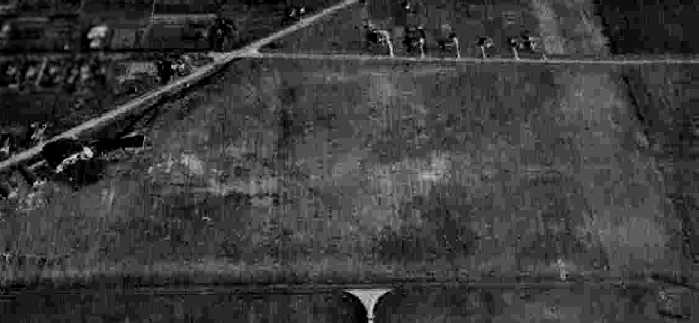
A 11/17/43 aerial view looking east from the 1945 AAF Airfield Directory (courtesy of Scott Murdock)
depicted Hoosier Airport as an irregularly-shaped grass area with a hangar along the north side.
It was still depicted as "Hoosier" Airport on the May 1944 Cincinnati Sectional Chart (courtesy of Chris Kennedy).
The 1945 AAF Airfield Directory (courtesy of Scott Murdock) described Hoosier Airport
as an 81 acre rectangular property containing an all-way sod field measuring 2,640' north/south by 1,320' east/west.
The field was said to have a total of 7 hangars, the largest being a 124' x 86' cinder block structure.
Hoosier Airport was described as being owned & operated by private interests.
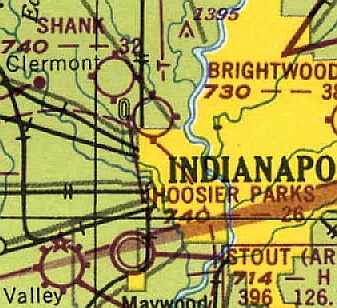
The field was evidently renamed "Hoosier Parks" at some point within the next 4 years,
as that is how it was depicted on the September 1948 Cincinnati Sectional Chart (courtesy of Chris Kennedy).
Richard Slagle reported, “I have lived near the old Hoosier Airport most of my life.
In about 1948 I took great delight in the Hoosier Airport as it was used for the landing site for the Goodyear Blimp
which came for the Indy 500 race & it was easy to access as a kid.
in those days you could walk right up to it... the field wasn't busy & people would come & look at the blimp.”
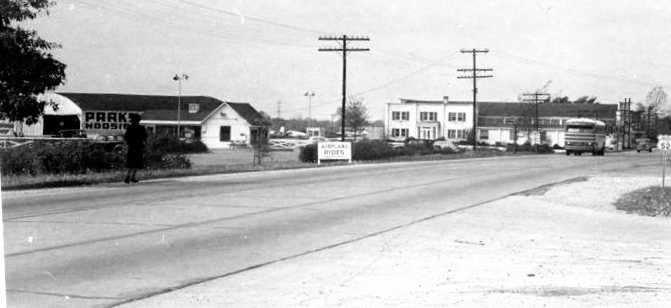
A circa 1940s photo by B.L Weddle (courtesy of Chuck Stuart) looking at the Parks Hoosier hangar.
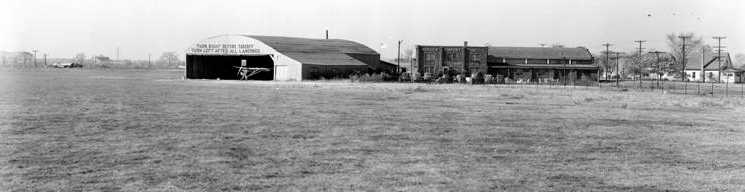
A circa 1940s photo by Robert Young (courtesy of Chuck Stuart) of a Hoosier Airport hangar.

A circa 1940s aerial view (courtesy of Chuck Stuart) depicted Hoosier Airport as having a hangar & a few smaller buildings along the north side.
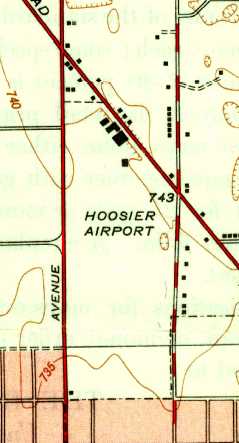
The 1948 USGS topo map depicted Hoosier Airport as an open area with several buildings along the north side.
According to a 2/6/48 Indianapolis News article (courtesy of Chuck Stuart),
“The 82 acre field, oldest privately operated airport in Indianapolis, has been subleased by Charlie Stuart & John Ramp,
Indianapolis automobile dealers.
The Parks name will be dropped, so that the field will again be called Hoosier Airport.
The new occupants will take over February 15, and a part of their sizable automobile sales operations
will be transferred to the office & hangar which has served as an airport repair shop.
Both Mr. Ramp & Mr. Stuart are aviation enthusiasts.
Mr. Stuart & Mr. Ramp will maintain the hangar storage & gasoline & oil phases of the airport business.
Other airport activities, the flying school, sales agencies, and repair shop will be leased to private operators.”
Hoosier Airport was evidently closed (for reasons unknown) at some point between 1948-54,
as Dave Slosson recalled, “I grew up in this area, from 1954.
Hoosier was gone before I knew about it, becoming Eagledale shopping center & housing area.”
A 1956 aerial photo showed the airfield area of the site of the Hoosier Airport had been densely redeveloped with housing,
but several hangars appeared to remain intact along the northern part of the property.
Hoosier Airport was no longer depicted at all on the 1961 Cincinnati Sectional Chart (courtesy of Chris Kennedy).
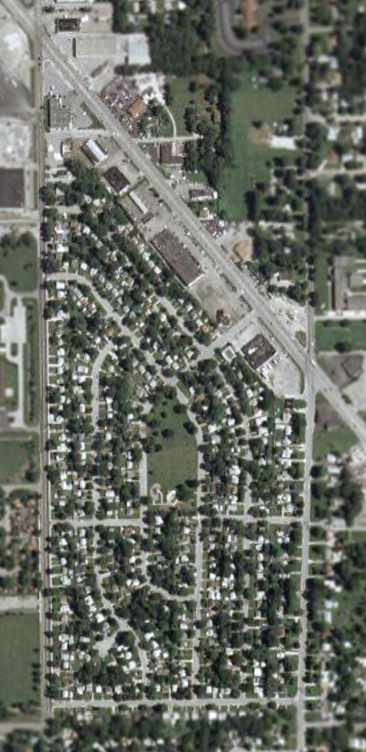
As seen in a circa 2001-2005 USGS aerial photo,
and not a trace appears to remain of the former airport.

A circa 2006 aerial view looking south at a building (west of the intersection of Lafayette & Groff)
which was the former Hoosier hangar, according to Richard Slagle.
Richard reported that the former hangar “later became Walt's Super market and a addition was added to the north of the building,
also gone is the large concave arched roof of the hangar,
the small metal sheds were there for many years after the airport closed, but everything is gone now.”
The site of Hoosier Airport is located west of the intersection of Lafayette Road & Kessler Boulevard.
____________________________________________________
Shank Airport, Indianapolis, IN
39.83, -86.25 (Northwest of Downtown Indianapolis, IN)
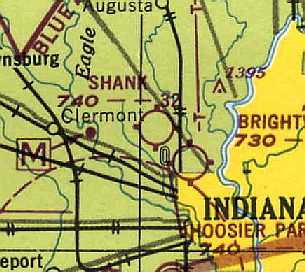
Shank Airport as depicted on the September 1948 Cincinnati Sectional Chart (courtesy of Chris Kennedy).
No airfield was yet depicted at this location on a 1941 aerial photo.
Robert Shank was a pioneer air mail pilot & a flight instructor during both World Wars,
who was also one of the founders of nearby Hoosier Airport.
In 1944, he founded the Bob Shank Airport,
less than 2 miles northwest of the Indianapolis Motor Speedway.
Bob Shank Airport was described as "Now under construction" in an advertisement in the 1945 Haire Publishing Airport Directory (courtesy of Chris Kennedy).
Bob Shank Airport was not yet listed among active airfields in the 1945 AAF Airfield Directory (courtesy of Scott Murdock),
nor depicted on the October 1946 Cincinnati Sectional Chart.
Robert Shank was awarded the Haire Publishing Company Trophy for the most outstanding airport development in 1946.
The earliest depiction of Shank Airport which has been located
was on the September 1948 Cincinnati Sectional Chart (courtesy of Chris Kennedy).
It depicted Shank as having a 3,200' unpaved runway.
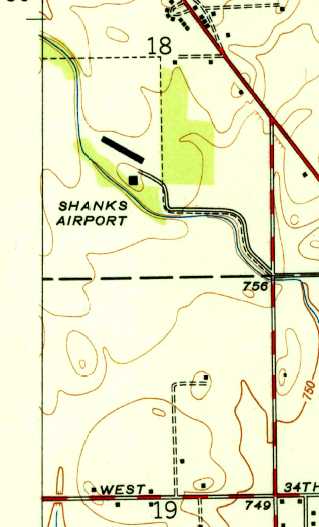
The 1948 USGS topo map depicted “Shanks Airport” as having 2 buildings on the northeast side of an open airfield area.
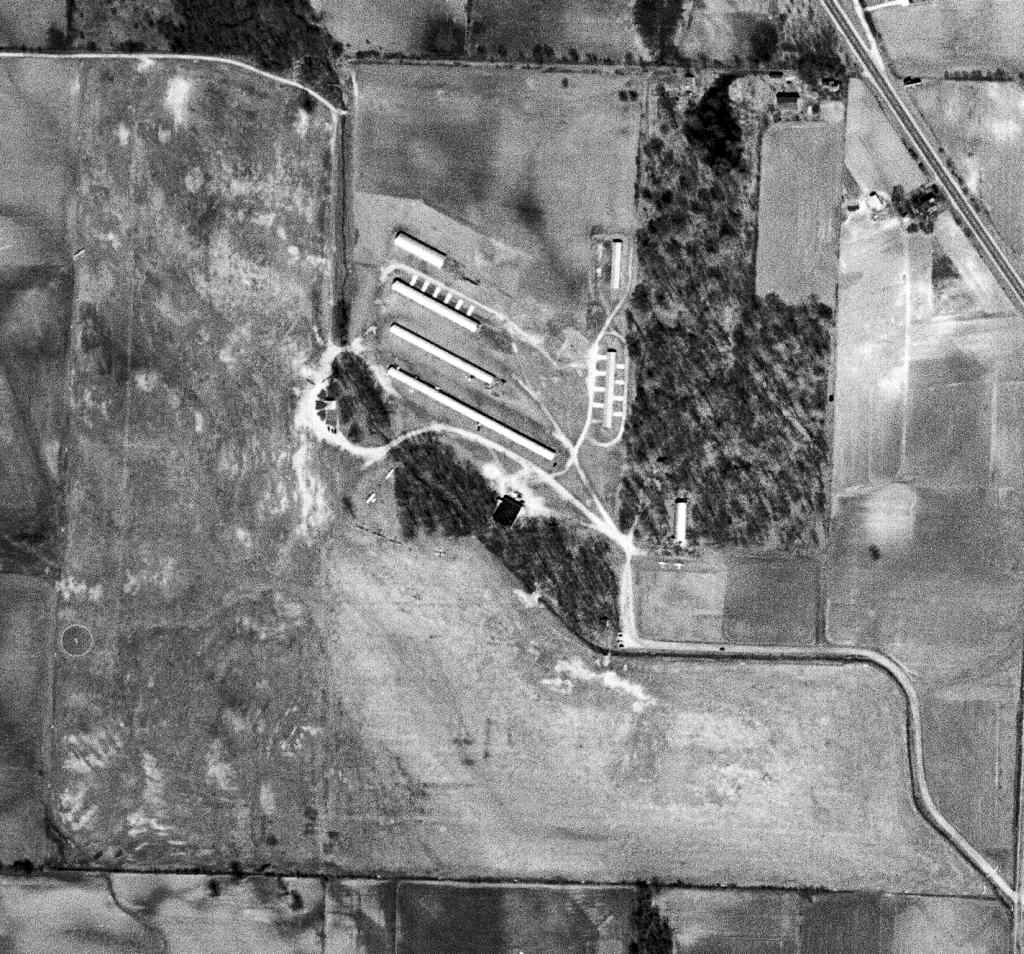
The earliest photo which has been located of Shank Airport was an 11/1/52 USGS aerial view.
It depicted Shank as having a large grass airfield area, with runways oriented north/south & east/west.
Six long narrow hangars were depicted on the northeast side of the airfield,
and at least 10 single-engine aircraft were visible.

A 1956 aerial view (from the IN University Electronic Atlas of Central IN Historical Aerial Archive, courtesy of Chris Kennedy)
depicted Shank as having a large grass airfield area, with runways oriented north/south & east/west.
Six long narrow hangars were depicted on the northeast side of the airfield.
Robert Shank continued to operate the airport until his retirement in 1957.
The 1961 Cincinnati Sectional Chart (courtesy of Chris Kennedy)
still depicted Shank as having a 3,200' unpaved runway.
Dave Slosson recalled, “Shank was fun to watch, and I remember Cubs landing on an east/west short sod strip parallel to 38th Street in the mid-1960s,
years before they added the northeast/southwest paved strip.
My dad was a WWII Navy pilot, so we paid attention to such things.”
John Teipen recalled of Bob Shank Airport, “Where I first took some flying lessons during the Summer of 1966.
My first lessons were in a J3 Cub ($12.50 per hour CFI included)
and at that time I remember 'Shank Field' as being a grass strip.
My logbook was kept at the airport & I have often wondered what became of that logbook.”
The runway at Shank was evidently paved at some point between 1966-68,
as the 1968 Cincinnati Sectional Chart (courtesy of Chris Kennedy)
depicted Shank as having a single 3,200' paved runway, oriented northeast/southwest.
Phill Brooks recalled, “Shank is close to my heart because I took my first small plane ride there, I believe in the summer of 1968 (when I was 6 years old).
The pilot was my neighbor Harry Eakin. He flew a Navion.”
Randy Wade recalled, "I started flying at Shank Airport in 1970-71.
Ned Bottoms & Charlie Lamb were 2 old gentlemen that ran the airport at that time."
Bob Leyner recalled, “Shank Field... My mother took instruction in a Franklin engine powered Cub.
My first flight instruction was in the Cub under her ‘block time’ at Bottoms & Lamb in the Cub for $10/hour.
My brother & I both got our certificates. Bottoms & Lamb operated from a trailer.”
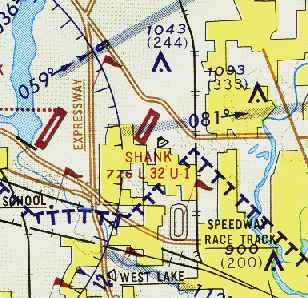
The May 1971 St. Louis Local Aeronautical Chart (courtesy of Robert Brown)
still depicted Shank as having a 3,200' paved northeast/southwest runway.
The last aeronautical chart depiction which has been located of Shank Airport was on the December 1971 Sectional Chart (courtesy of Charles Germaine).
It depicted Shank as having a 3,200' northeast/southwest paved runway.
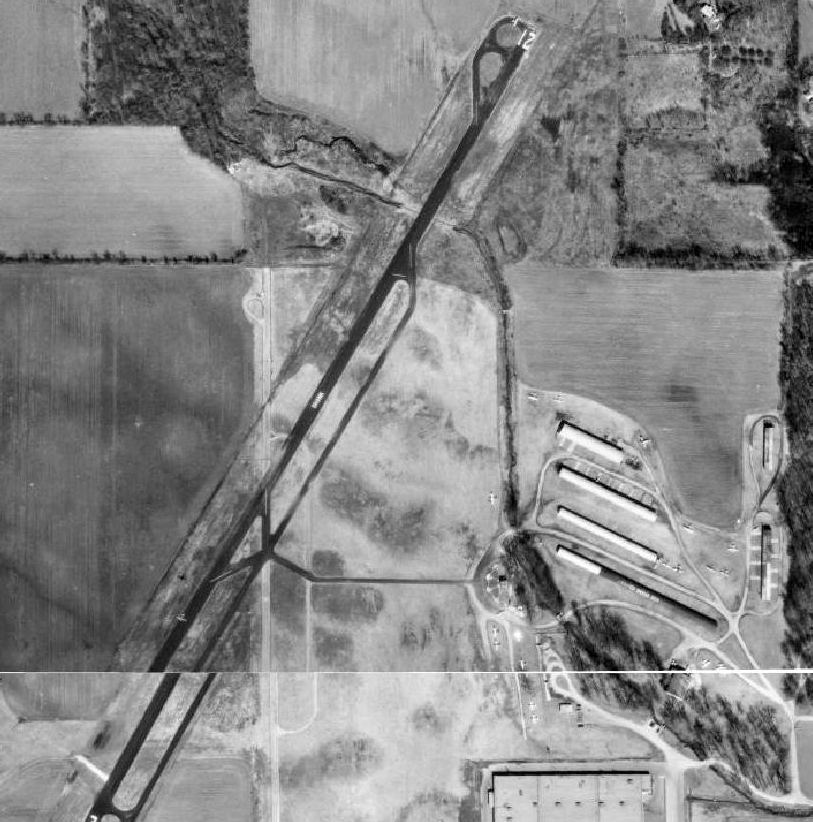
The last photo which has been located of Shank Airport was a 1972 aerial view
(from http://maps.indy.gov/MapIndy/, courtesy of Matthew Payne).
It depicted Shank as having a paved Runway 3/21, with one aircraft entering the runway,
and another dozen parked around the hangars.
Phill Brooks recalled, “Around 1973 I recall a Ford Trimotor giving rides out of Shank.
My mother expressly forbid my purchasing a ride, dang it!”
The 1974 USGS topo map still depicted Shank Airport,
but that doesn't necessarily prove the field was still open at that point.
According to the City of Indianapolis web site,
"Shank Airport at 38th & Moller Road survived until the 1970s - a victim to the building boom in Pike Township."
Phill Brooks recalled, “My first job was in summer, 1978, bussing tables at the Laughner's Cafeteria at the southeast corner of the field.
I don't recall it being open, or at least active, at that time.”
A 1978 aerial photo (from http://maps.indy.gov/MapIndy/, courtesy of Matthew Payne) showed that the end had come for Shank Airport,
with roads having been built across the northern, central, and southern portions of the runway.
Shank Airport was no longer listed in the 1982 AOPA Airport Directory (courtesy of Ed Drury).
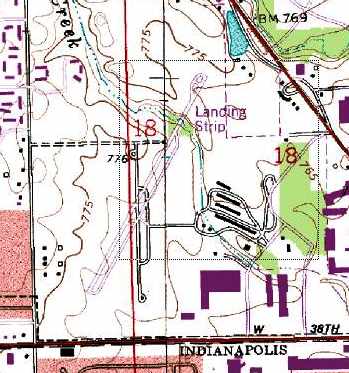
The 1984 USGS topo map still depicted the airfield layout of Shank Airport, even though it was already closed at that point.
It depicted 2 paved runways, oriented north/south & northeast/southwest.
Several long narrow hangars were depicted to the east of the runway.
The field was labeled simply "Landing Strip".
The 1998 USGS aerial photo showed that the site of the Shank Airport had been thoroughly covered by redevelopment,
with large buildings & parking lots obliterating any trace of the former airport.
A new road, West Pike Plaza Road, had also been built through the center of the airport site.
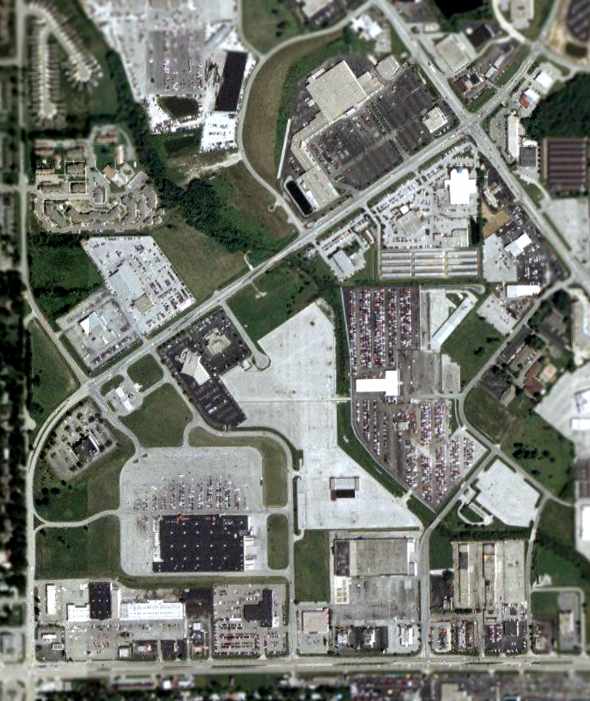
As seen in a circa 2001-2005 USGS aerial photo,
not a trace remains of the Shank Airport.
The site of Shank Airport is located southwest of the intersection of West Pike Plaza Road & Lafayette Road.
____________________________________________________
Speedway Airport (3SY), Indianapolis, IN
39.8, -86.36 (West of Downtown Indianapolis, IN)

A 1958 aerial view of Speedway Airport,
from the IN University Electronic Atlas of Central IN Historical Aerial Archive (courtesy of Chris Kennedy).
Speedway Airport was apparently built at some point between 1954-58,
as it was not yet depicted at all on the 1953 USGS topo map nor on the June 1954 Cincinnati Sectional Chart (according to Chris Kennedy).
The earliest depiction of Speedway Airport which has been located
was on a 1958 aerial photo from the IN University Electronic Atlas of Central IN Historical Aerial Archive (courtesy of Chris Kennedy).
It depicted the field as having 2 grass runways, oriented east/west & northeast/southwest.
Two hangars were located on the north & west sides of the field,
and there was a total of 6 light aircraft visible on the field.

The 1959 USGS topo map depicted Speedway Airport as having 2 unpaved runways, with small buildings on the west & north sides.

The earliest aeronautical chart depiction which has been located of Speedway Airport
was on the 1961 Cincinnati Sectional Chart (courtesy of Chris Kennedy).
It depicted Speedway as having a 2,700' unpaved runway.
Joe Chadwick recalled, “Speedway Airport... I flew my 1941 Ercoupe from there in the early 1960s.
The main Runway was 9/27, grass; [Runway] 6-24 was shorter & narrow. We just called it 'The Diagonal'.
The field was operated by Bert Gerts & his 2 teenage sons. Bert worked elsewhere during the day.
The airport was wide open & on the honor system.
If you needed gas, 80/86 only, you pulled up to the pump, went inside,
turned it on, pumped it, turned it off and put money or IOU in the cigar box.
Tie-down was $12 a month.”
Charles Miles recalled, “Speedway Airport... I was a flight instructor & manager of the airport from April 1963 to September 1963.
The airport was recently owned by William McGinty & I flew with William & his son John many times in 1963.
We had a Piper PA-22 (N8894C), a Cessna 172A (N7497T), and in July 1963 I flew a 1946 J3 from Shank's Airport to Speedway.
I have many hours instructing in that J3 (N6200H) at Speedway Airport.
We had only the grass runway. When I first came to the airport the new lounge & office was built on the east side of the main hangar.”
Richard Pearsall recalled, "I was there many years ago before it was paved.
It was the race day. It was a real zoo. Everyone wanted to get landed & get to the track… I never saw anything like it."
Donna McCallum recalled, “Speedway Airport... I lived there from 1967-78 as my father was the FBO - George Stubbs.
The runway was paved by the time we moved there in 1967.”
The 1968 Cincinnati Sectional Chart (courtesy of Chris Kennedy)
depicted Speedway as having a 2,800' paved runway.
A 1970 aerial photo from the IN University Electronic Atlas of Central IN Historical Aerial Archive (courtesy of Chris Kennedy)
depicted Speedway as having a paved northeast/southwest runway
as well as a grass east/west runway.
The single row of T-hangars along the north side of the field had been expanded to 3 longer rows of T-hangars.

A 1971 airport directory (courtesy of Chris Kennedy)
depicted Speedway Airport as having 3 long rows of hangars along the northwest side of the runway.
The December 1971 Sectional Chart (courtesy of Charles Germaine) depicted Speedway as having a 2,900' northeast/southwest paved runway.
Dave Slosson recalled, “In the summer of 1976 I flew into Speedway airport in a helicopter,
doing auto-rotations after maintenance with the Indianapolis Police Department's Hughes 269.
The mechanic I worked for had a Taylorcraft in the hangar at the far end, in the open area of the T's.
One of the female observers was taking flying lessons from Officer Jim Stanley, who later took over the FBO, in a Piper Colt at Speedway.
My father was also on the board of the Indianapolis Airport Authority from 1972-82.
I remember discussions about Speedway being in a poor spot as far as future plans for Indianapolis International,
not because the pattern was in the way, but because any approaches to either end of the main runway would conflict with the flow at IND.
It was just too close. It was also real close to the site of the Indianapolis VORTAC, as the sectionals show.”

An aerial view by Roger Rozelle looking northeast after having departed from Speedway's Runway 6
from the 1979 AOPA Airports USA directory (courtesy of Jonathan Westerling).
Over two-dozen light aircraft were visible on the field.
The 1982 AOPA Airport Directory (courtesy of Ed Drury)
described Speedway as having a 2,820' asphalt Runway 6/24 & a 2,345' turf Runway 9/27.
The operator was listed as Stanley Aviation Service.
A 1987 airport directory (courtesy of Chris Kennedy)
listed the operator as Speedway Aviation.
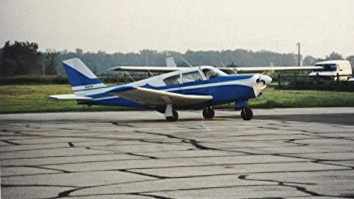
An August 1990 photo by Bob Fitzpatrick of the Comanche in which he flew into Speedway.
In Bob's words, “While I only flew out of there once, I often flew over it.
It was an airport that really didn't have to die, and I am sorry to see it gone.”

The 1992 USGS topo map depicted Speedway Airport
as having one paved runway & one unpaved runway,
along with 3 hangars on the northwest side of the field.
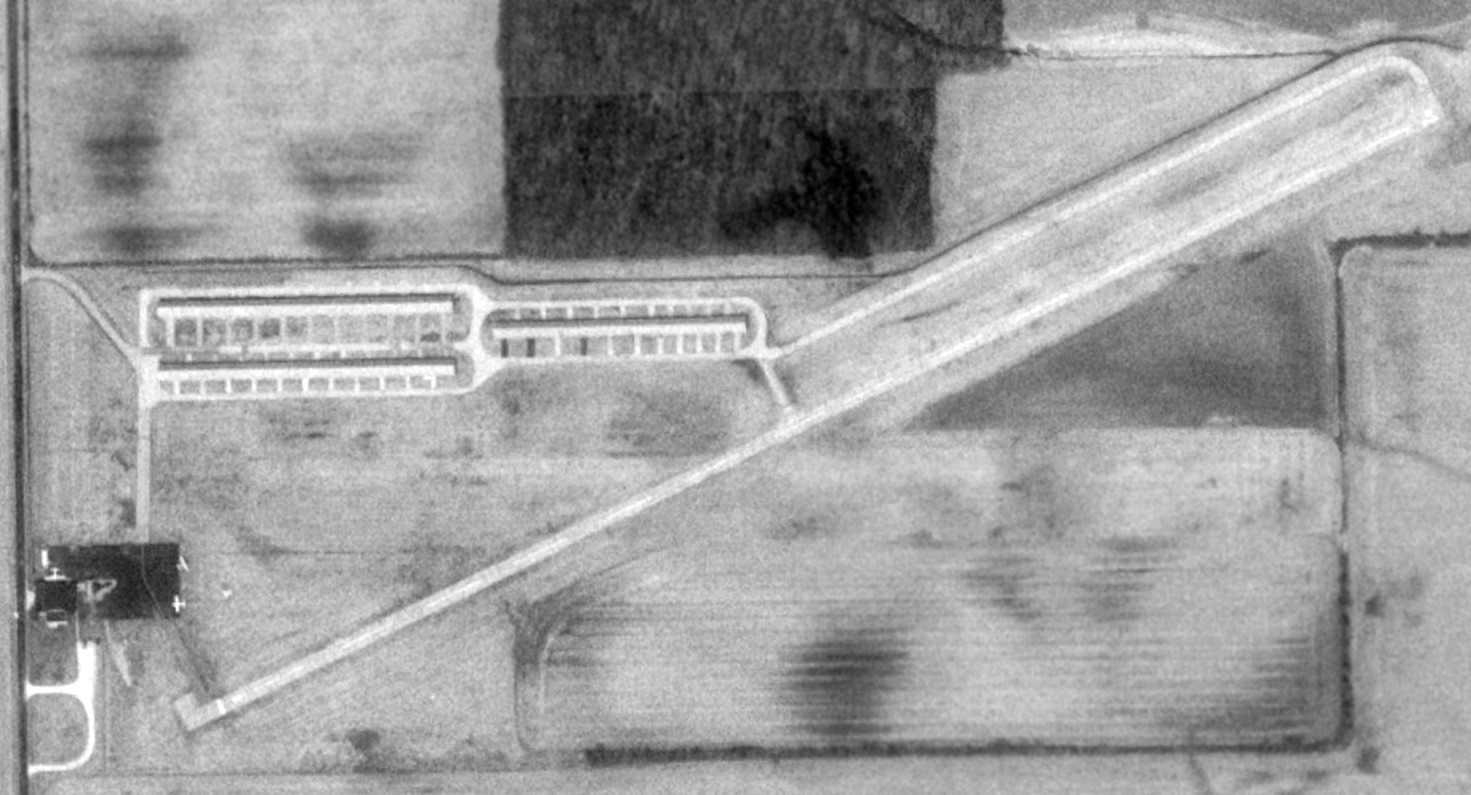
A 1993 USGS aerial photo depicted Speedway Airport as having a paved runway,
3 long hangars on the northwest side, and 3 light single-engine planes parked near a small hangar on the southwest side.
According to Indianapolis resident Phil Brooks, the northern-most of the 3 hangars (depicted in the 1993 photo)
was removed by "a tornado [which] blew through in the early 1990s, destroying several aircraft contained within.
A United mechanic had JUST moved his 2 or 3 aircraft in from San Francisco before the tornado hit."
According to Nick Newcomb, “I visited the library, and found some information about this airport.
The tornado went through on 4/27/94. The tornado destroyed '22 vintage airplanes & their hangars.'
They decided not to rebuild the hangar because there were already plans for a new airport.
The airport lasted in service longer than expected, it was supposed to be closed in the early 1990s, but lasted a few more years.”

A 1998 USGS aerial view showed that Speedway Airport was not doing very well, as not a single plane was visible on the field.
It appeared as if it was already closed, yet it was still open.
Also note that the northern-most of the 3 hangars was missing, having been leveled a few years before by the tornado.

The last aeronautical chart depiction which has been located of Speedway Airport was on the 2000 Sectional Chart (courtesy of Ruth Wells).
It depicted Speedway as having a 2,800' paved runway.

A 2000 photo of the office at Speedway Airport.
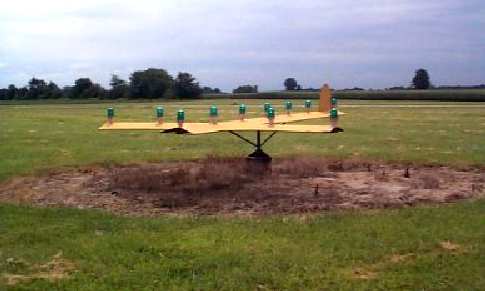
A 2000 photo of the wind indicator at Speedway Airport.
Speedway was still listed as an active airfield in the 2000 AOPA Airport Directory
with a 2,820' asphalt Runway 6/24 & a 2,185' turf Runway 9/27.
The operator was listed as B & J Aviation.
In its latter days, Speedway Airport was owned by the Indianapolis Airport Authority.

A circa 2000-2001 aerial photo showed Speedway Airport
to be nearly empty, with only 2 planes visible on the ramp.
According to Indianapolis resident Phil Brooks, "Speedway Airport was closed on New Year's Eve, 2001."
It was replaced by the new Hendricks County Airport (2R2),
which opened in 2001 on Indianapolis' west side.
Dennis Fabbrini reported in 2003, "While on approach from the west today into Indianapolis,
I noticed an X'ed off strip just northwest of Indianapolis International.
After checking a map, I determined it to be Speedway Airport.
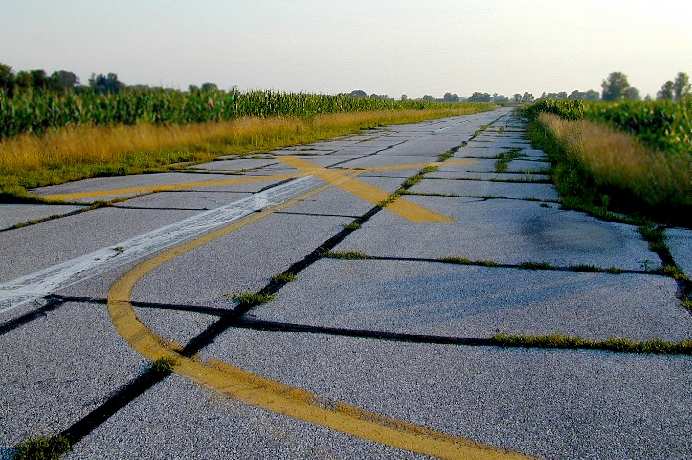
A 2003 photo by Dennis Fabbrini of Speedway Airport's abandoned Runway 3.
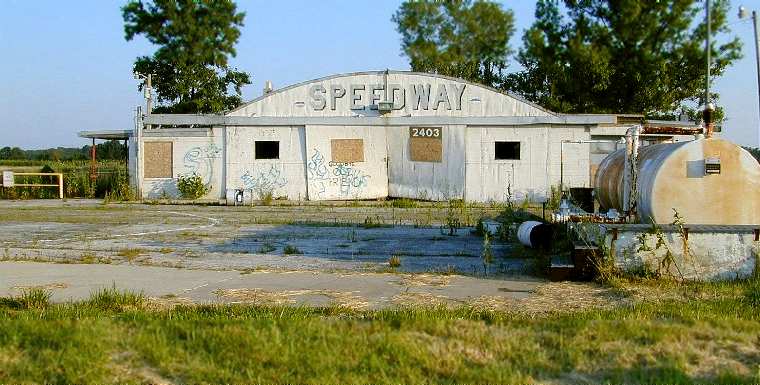
A 2003 photo by Dennis Fabbrini of Speedway Airport's abandoned main hangar.
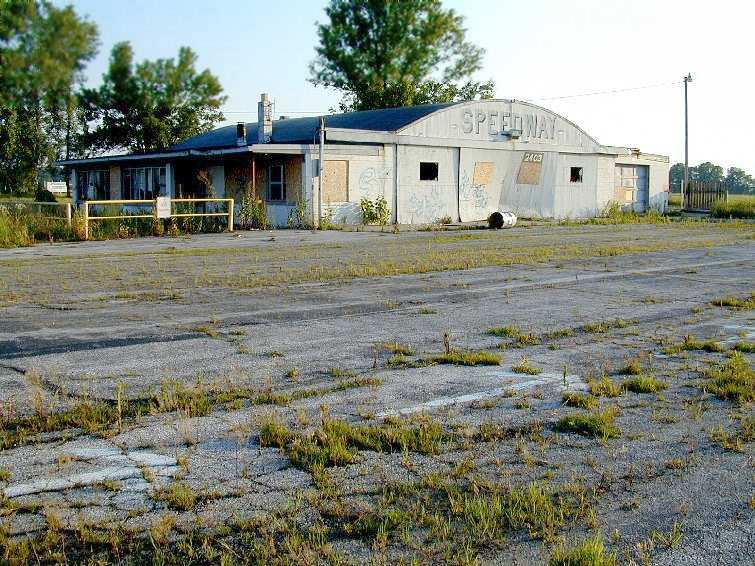
A 2003 photo by Dennis Fabbrini of Speedway Airport's abandoned main hangar & office.
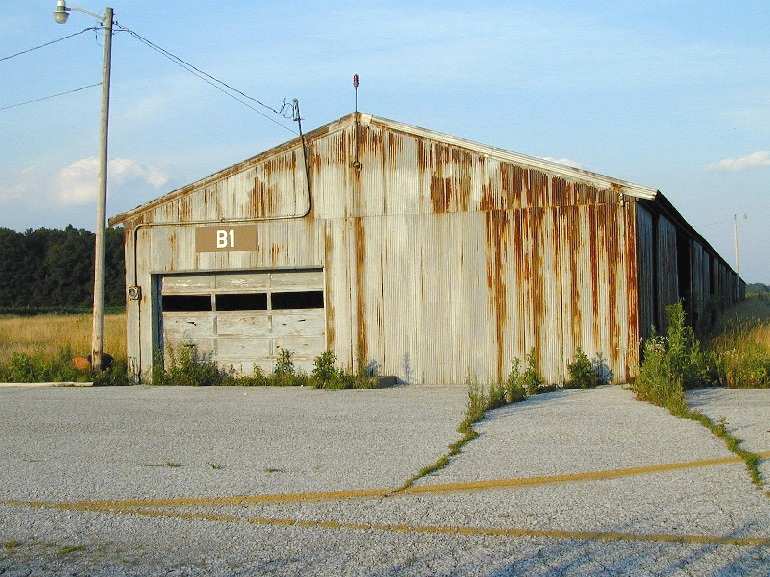
A 2003 photo by Dennis Fabbrini of Speedway Airport's abandoned B1 hangar.

A 2003 photo by Dennis Fabbrini of other abandoned hangars at the former Speedway Airport.
Dennis Fabbrini continued, "The closure must have been recent,
because the pavement is in pretty good shape.
Relatively fresh graffiti on the main hanger says 'goodbye old friend.'
Two long hangars sit on the north side of the field,
with abundant tie-down area nearby.
The runway is oriented northeast/southwest.
New housing developments surround the field,
and fresh fence posts around the perimeter of the property indicate new chain link is on the way."

Phil Brooks visited the site of Speedway Airport on 10/4/04, to find "Nothing left - very sad."
This photo is of the "site of the main hangar, looking Southeast."

A 2004 photo by Phil Brooks, "looking East-Northeast, along what used to be the grass Runway 9/27,
also showing the former hangar area on the left."

A sad sight – a circa 2006 aerial view looking east at the site of Speedway Airport,
showing all of the hangars to have been removed,
but the runway & taxiway pavement still intact.
Jonathan Katz reported in 2008, “The site is still owned by the Indianapolis Airport Authority.
It's 'For Sale' but there is no buyer.
They want $4M or so for all the property & were trying to sell it to the village of Avon, which is the incorporated town in the area.
I'd love to redevelop it as an airpark (it's in an area of booming home development & good schools) but I don't have the cash & the economy is the pits.
There was some talk about the land over the past year or two in the Indianapolis Star.
One of the reasons for the airport closure was listed as 'it interfered with traffic for IND.'
I find that hard to believe given that pattern traffic at 3SY would be below any approach or take-off from Indianapolis' Runway 14/32.”
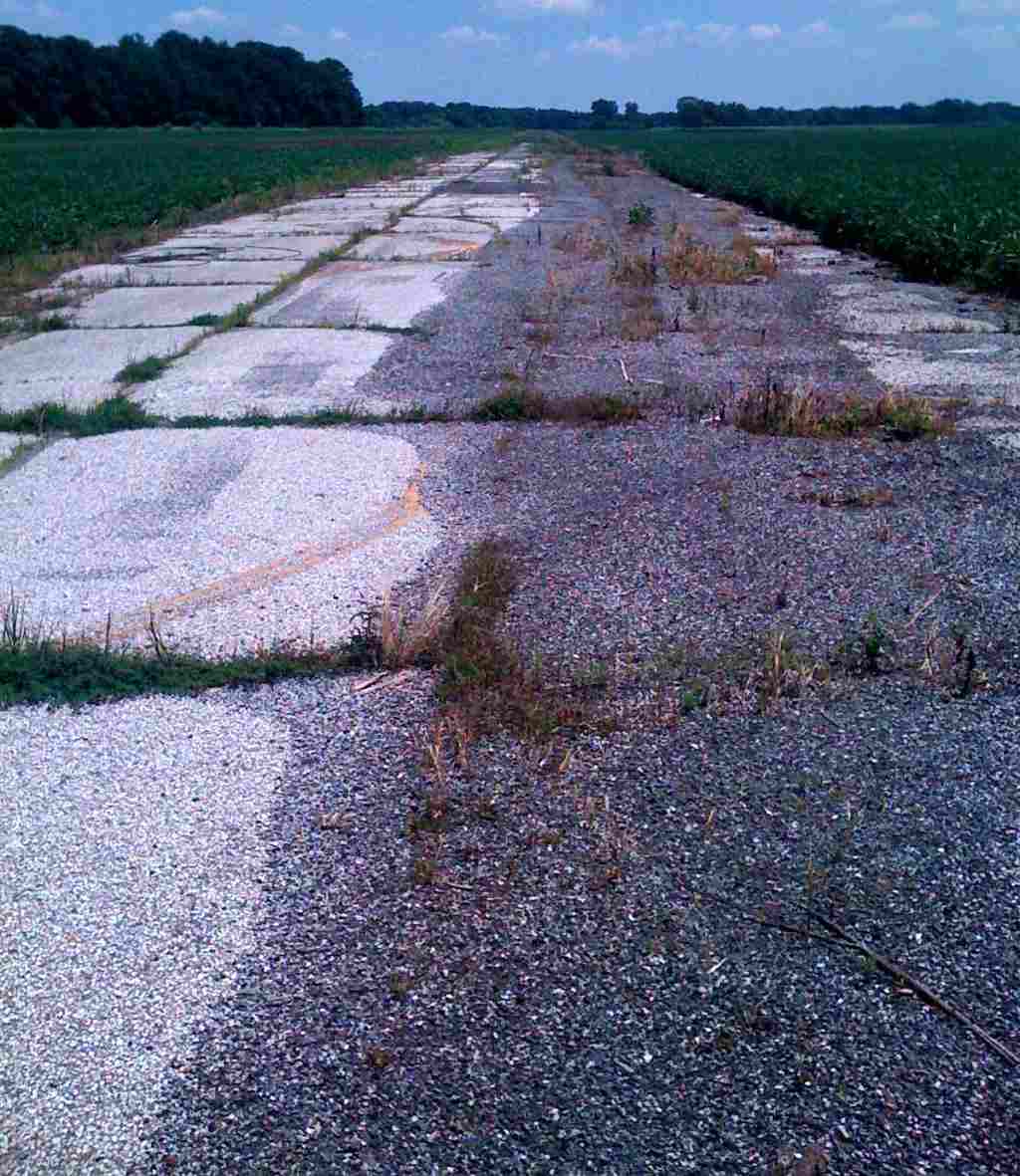
A 2010 photo by Jonathan Katz looking along the remains of the Speedway paved runway.
Jonathan reported, “The Indianapolis Airport Authority is still trying to sell the land that made up the Speedway Airport.
They're still farming the greenspace & letting the tarmac decay.”

A 10/11/10 aerial view by Phil Brooks looking northwest at the abandoned Speedway Airport.
Phil Brooks noted in 2010 an unusual aspect of the Indianapolis Airport Authority's advertisement for selling the Speedway Airport land:
“Either they've forgotten why the airport was closed, or are engaging in revisionist history. This is the first time I'd heard the tornado excuse!”
Tom Townsend reported on 3/5/11, “I visited the Speedway airfield & it is the same as listed [above].
It is surrounded by new housing developments & probably will go under the bulldozer soon.”
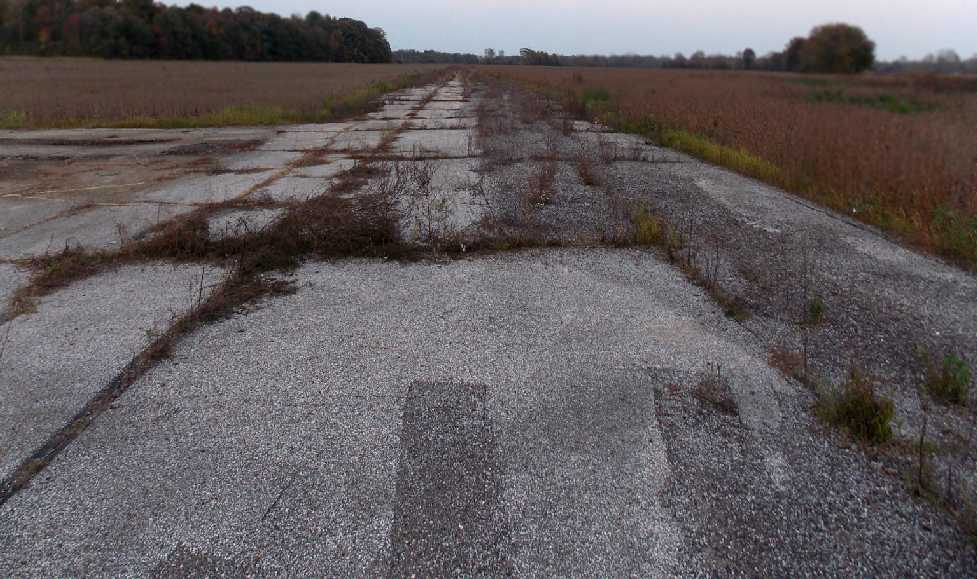
A 10/4/12 photo by Nick Newcomb looking northeast along Runway 6, with the main taxiway to the left.

A 2013 photo by Dave Smith of a Speedway Airport sign.
Dave Smith recalled, “When they were tearing it down I noticed a 'Speedway Aiport' sign sitting on top of a trash pile,
so I took it, hung it in my garage & nicely framed it. It's a cool conversation piece now.”
Phill Brooks reported in 2014, “The area is STILL undeveloped. What a waste of a nice airport.
Just to the southeast is the Outer Marker for IND Runway 14, but it's been years since that runway was used on a regular basis for landings, so there wasn't really a conflict.
Interestingly, the 'cutout' in the Class C airspace to accommodate a left downwind to Runway 21 at Speedway still exists on the latest St. Louis Sectional,
despite the airport being gone for 12 years!”

A 2015 aerial view shows the site of Speedway Airport to remain mostly intact, without redevelopment.
What a shame that this nice little airport had to be closed, with the property to remain completely unused 14 years later.
The site of Speedway Airport is located northeast of the intersection of West 21st Street & Griswold Road South.
Thanks to Dennis Fabbrini for pointing out this airfield.
____________________________________________________
Stout Field / Stout Army Airfield, Indianapolis, IN
39.74, -86.23 (East of Indianapolis International Airport, IN)
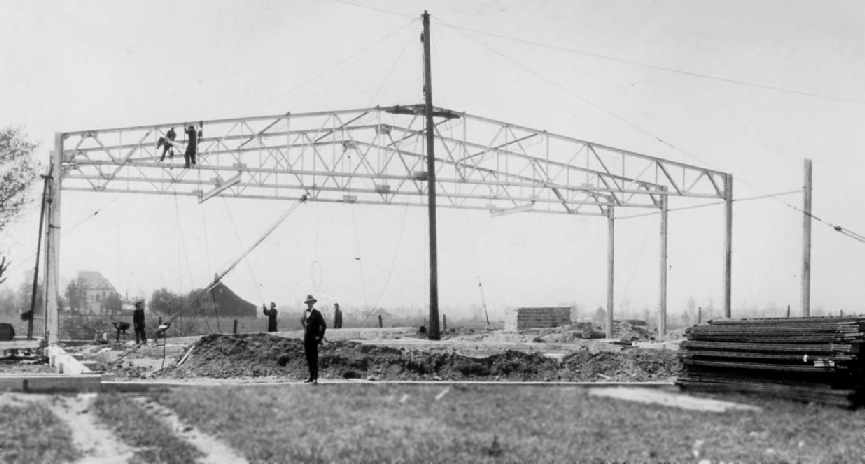
A photo captioned “1st hangar at Staut [sic] Field 1927” (courtesy of Becky Strosnider).
This former airfield is located only 2 miles east of the present-day Indianapolis International Airport.
Stout Field was built in the 1920s by the city of Indianapolis
as a municipal airport & a home for the Indiana National Guard.
According to the City of Indianapolis web site,
it was also initially known as the Mars Hill Airport,
and it was the first airport to provide Indianapolis with passenger & mail service.
The earliest depiction of Stout Field which has been located
was a photo captioned “1st hangar at Staut [sic] Field 1927” (courtesy of Becky Strosnider).
It depicted the construction of the frame of a hangar.
In 1928, with expansion possibilities at Stout already limited,
the city realized it needed a larger airport,
and it purchased 1,000 acres 2 miles west to build what would eventually become Indianapolis International Airport.
Stout Field was then turned over to the state to be used primarily by the National Guard & as a secondary commercial airport.

The earliest photo which has been located of aircraft at Stout Field was a circa 1928-30 photo of 2 unidentified biplanes in front of a hangar.
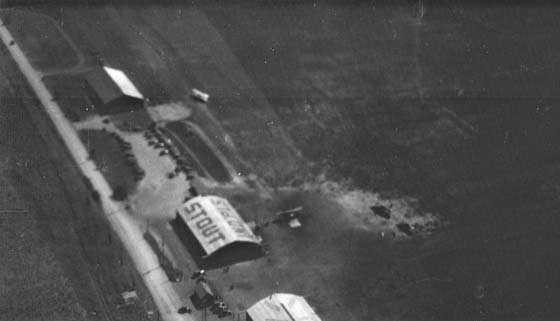
A circa 1928-30 aerial view looking southwest at Stout Field showed several hangars (one of which was painted “Stout” on its roof)
along the east side of a grass field, with 4 aircraft visible on the field.
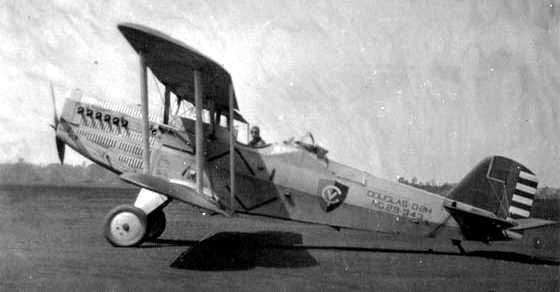
A circa 1929 photo of a Douglas O-2H biplane at Stout Field.
The earliest aeronautical chart depiction which has been located of Stout Field was on the November 1933 Cincinnati Sectional Chart.

A 1937 aerial photo (from http://maps.indy.gov/MapIndy/) depicted Stout Field as a square grass field
with an “NG” (National Guard) marking in the center & several checkerboard-roofed hangars along the east side.
The Airport Directory Company's 1937 Airports Directory (courtesy of Bob Rambo)
described Stout Field as being operated by the National Guard, and consisting of a 2,800' square sod field.
A 1938 street map of Stout Field (courtesy of Kevin Walsh).

A 1941 aerial view of Stout Field
from the IN University Electronic Atlas of Central IN Historical Aerial Archive (courtesy of Chris Kennedy)
depicted Stout's 4 runways in the process of being paved, and 4 hangars along the east side.
In early 1942 the Army Air Forces leased the nearly empty airport from the state
& converted it into a training field & headquarters for the newly created I Troop Carrier Command.
It operated C-47, C53 & C-46 transports.

A WW2-era photo of 2 Curtiss C-46 Commando transports in front of Stout's control tower.
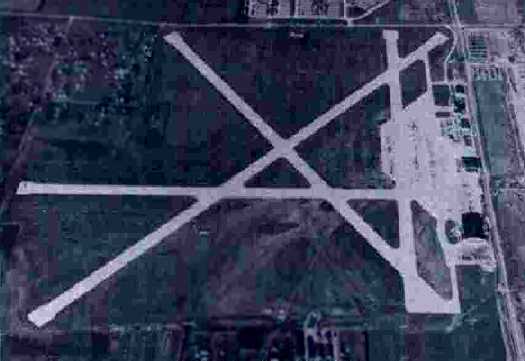
A 11/17/43 aerial view looking north from the 1945 AAF Airfield Directory (courtesy of Scott Murdock)
showed that Stout Field had gained paved runways, a large paved ramp, and another hangar between 1941-43.
In 1944 Stout acquired a glider pick-up school as well.

A WW2-era matchbook cover for Stout Field, showing a C-47 towing a glider.
The airfield at Stout Field was significantly expanded during WW2,
as the 1944 US Army/Navy Directory of Airfields (courtesy of Ken Mercer)
described the field as having a 4,500' hard-surface runway.
Ralph Miller recalled, “Stout Field... In the summer of 1944, I attended a 2-week camp there for Civil Air Patrol Cadets. I was 16.
They were training Waco CG-4A glider pilots & snatching them with C-47s.
Ground school was very good, well organized & thorough.
Most glider snatching was on the grass beside Runway 4.
The high point for the Cadets was a ride in a glider snatched by a C-47.
There was a roar as the tow plane passed overhead just above us.
Then the jerk as he caught the tow line loop between 2 upright poles.
The nose dipped as we gained speed sliding on the skids & then rolling on the wheels.
We climbed rapidly, but it was quiet. We could see the C-47 ahead of us.
He banked left for a 180 degree turn to parallel the runway. Then another to fly overhead the landing point.
The glider pilot cut us loose there & started a 360 left to glide back to land near the starting point.
The landing was smooth & he lifted the tail to lower the nose to drag the skids to stop. A great flight!”
Ralph continued, “One day as we rode a bus from the classrooms at the south end of the field to the quarters area at the north end for lunch,
we passed by a very large 4-engine very shiny new bomber parked on the ramp.
We were instructed to forget we had seen it.
It was the first I knew of the B-29s. It was gone when we passed by again.”
According to the book "Forgotten Fields of America, Volume III" by Lou Thole,
during WW2 Stout Field was comprised of a total of 357 acres,
and had approximately 150 buildings.
The 1945 AAF Airfield Directory (courtesy of Scott Murdock) described Stout Field
as a 357 acre irregularly-shaped property containing 3 concrete runways, the largest being the 4,495' northeast/southwest strip.
The field was said to have 2 hangars, the largest being a 247' x 209' concrete & steel structure.
Stout Field was described as being owned by the State of IN & operated by the Army Air Forces.
After the war, the I Troop Carrier Command headquarters was transferred to Greenville, SC,
and Stout stood vacant for a while.
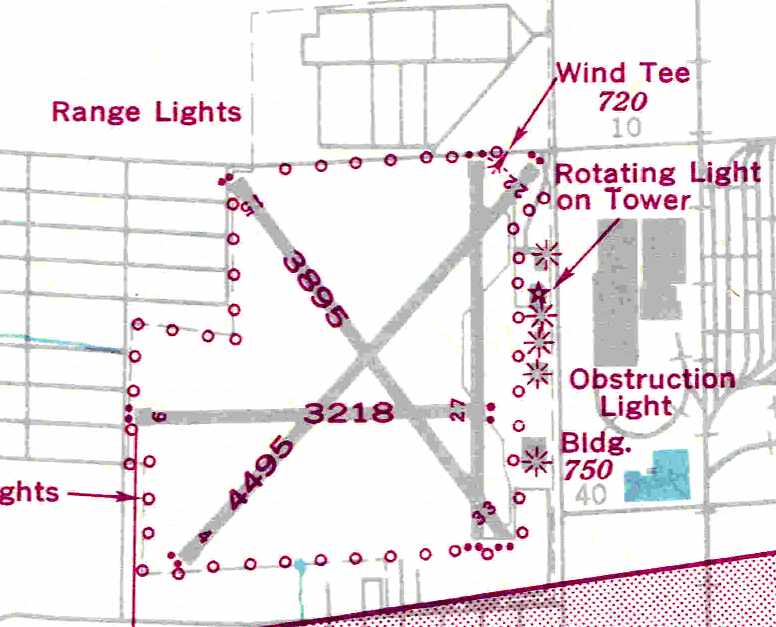
A 1946 USAAF KS-NY Pilot's Handbook (courtesy of Chris Kennedy)
depicted Stout as having 3 paved runways, with the longest being the 4,495' Runway 4/22.
In 1947 the field was returned to the state & again became the home of the Indiana National Guard.

A circa 1947 photo of several Indiana National Guard P-51 Mustang at Stout Field.
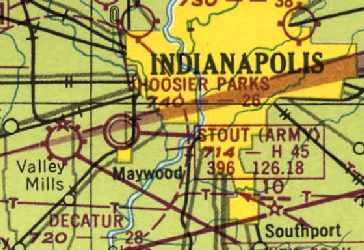
"Stout (Army)" was described as having a 4,500' paved runway on the 1948 Cincinnati Sectional Chart (courtesy of Chris Kennedy).
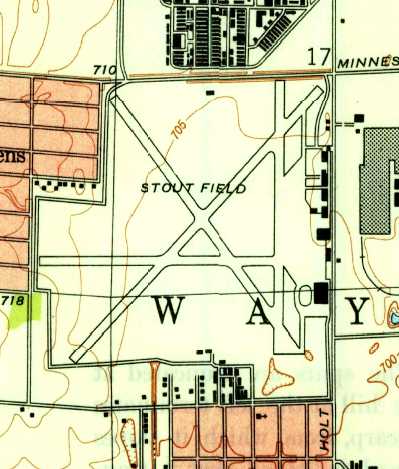
The 1948 USGS topo map depicted Stout Field as having 4 paved runways, and a ramp & buildings along the east side.
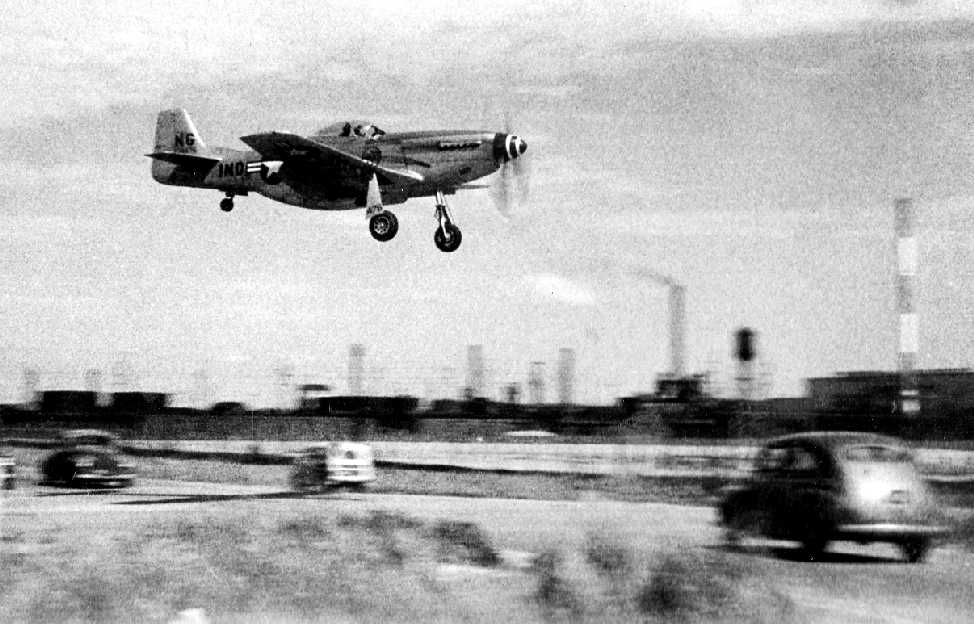
A circa 1940s photo by Harry Cole of a National Guard “P-51 Mustang about 20-30' above Minnesota Street, gear down heading to a landing” at Stout Field.
Harry recalled, “I grew up in Indy about 3 miles from Stout Field.
I remember riding in my dad's car & the aircraft flying so low my brother and I thought it was going to land on us.
I know these photos are of Stout Field because of the buildings of what I knew was Bridgeport Brass in the background.”
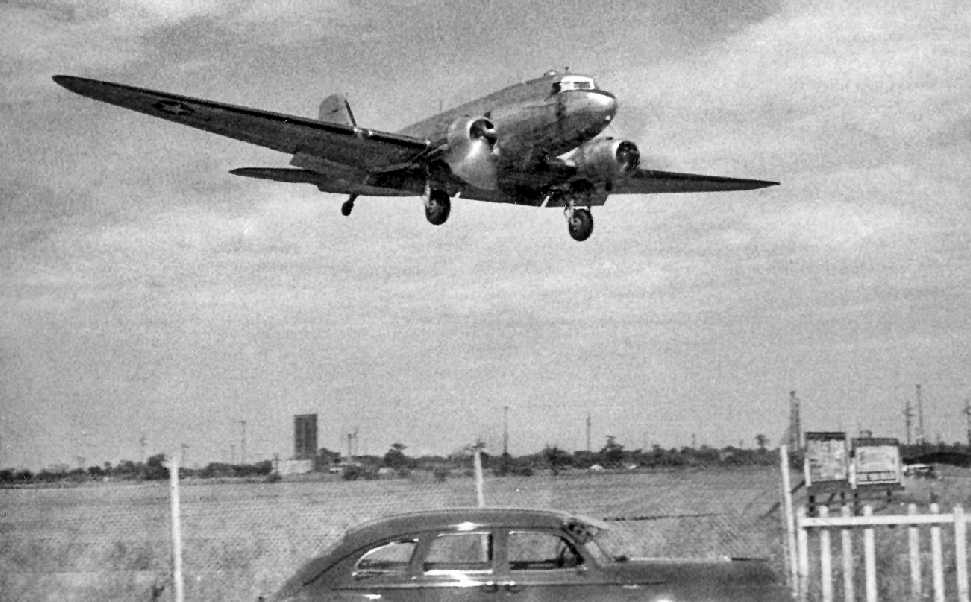
A circa 1940s photo by Harry Cole “of a C-47 on final approach with gear down about 20-30' above the ground & north of Minnesota Street”, landing at Stout Field.
Stout Field was described as having a 4,500' paved runway on a 1953 Flight Chart (courtesy of Scott O'Donnell).
Jim Slater recalled, “I've lived in Indianapolis since late 1955,
and as luck would have it, I lived about 1 & ½ blocks west of Runway 9.
Living in between 2 airports in the 1950s was exciting sometimes.
There was always something going over the house... day & night!
I remember, on weekend, 'adults' would bring their model airplanes to the west end of Runway 9 & fly them.
They were using 60 foot wires to do this, so as a youngster, it was fun to watch.
Sometime in about 1956, they used part of Stout Field for sports car racing.
Now and then, an old National Guard Otter would come out, do an engine check & then taxi back to a hangar.
The Indiana State Police had some very beautiful aircraft parked at Stout... V-tailed Bonanzas.
These aircraft had a wonderful turquoise & white color scheme.
These would takeoff & land now & then, but not on Runway 9,
(too many houses at the west end of the runway).”

In the 1956 aerial photo of Stout AAF
from the Electronic Atlas of Central IN (courtesy of Chris Kennedy),
the airfield looked for all intents abandoned, as not a single aircraft was visible on the entire field.
But all 4 runways remained intact.
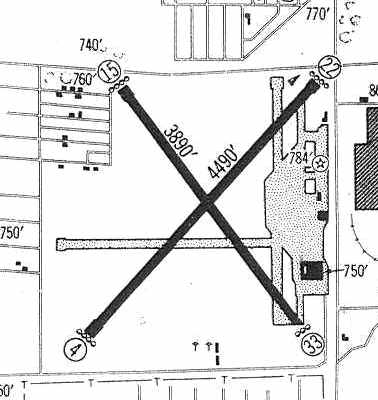
Stout was still depicted in the 1960 Jeppesen Airway Manual (courtesy of Chris Kennedy),
but the field was described as being "available to IN National Guard, State Police, and Highway Department aircraft only."
The field was depicted as having only 2 active runways (4,490' Runway 4/22 & 3,890' Runway 15/33).
The north/south & east/west runways were still depicted, but they had apparently been closed.
Stout AAF was closed at some point between 1960-61,
as it was labeled "Stout (NG) (Closed)" on the 1961 Cincinnati Sectional Chart (courtesy of Chris Kennedy).
Jim Slater recalled, “By 1961, buildings were popping up on some of the runways.
After that, it stopped looking like an old airport.
It took on the appearance of an industrial park combined with a parking lot for National Guard trucks.”
Stout Field appeared to remain largely intact in a 1962 aerial photo,
but several buildings had been constructed over Runway 15.
Stout Field was depicted as an abandoned airfield on the May 1971 St. Louis Sectional Chart (courtesy of Robert Brown).
Jim Slater recalled, “By the mid-1970s, there were 2 F-80s mounted on pylons at the southeast & northeast end of the field.”
By 1977, portions of the land not used by the National Guard were sold off to become an industrial park.

The 1986 USGS topo map still depicted several remaining runways at “Stout Field (Abandoned)”.
According to Jim Slater, “There were plans to make an outdoor museum so a collection of different aircraft started coming together,
but something changed by the mid 1980s & most of it was gone.
In the mid-1990s, there was still 1 aircraft parked at the field.
It was a static display the public hardly noticed it. An old F-101 Voodoo was all that was left.
Needless to say, I took my young daughter to Stout Field 1 day,
got permission from the National Guard to walk out to the F-101 & I took her picture standing next to it.
She was more interested in the birds that were flying in & out of the air intakes.”

A 1994 photo by Lou Thole (author of the book "Forgotten Fields of America") of former hangars at Stout Field.
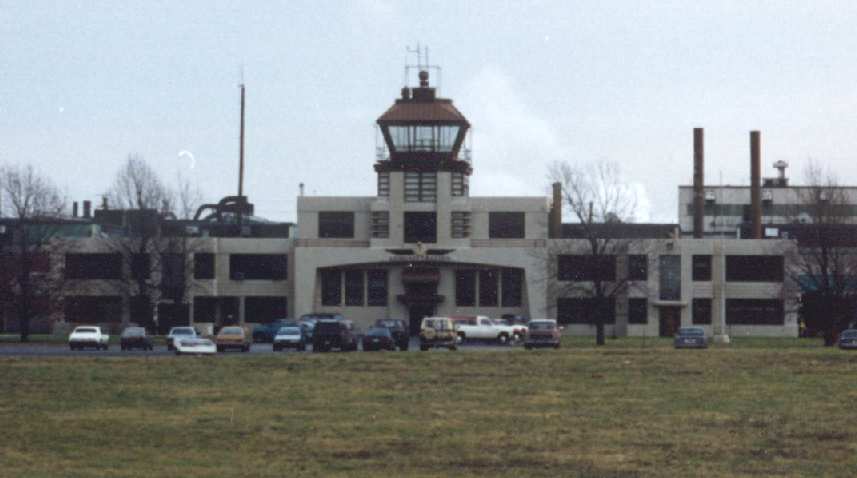
A 1994 photo by Lou Thole (author of the book "Forgotten Fields of America")
of Stout Field's former headquarters building (with control tower on top).
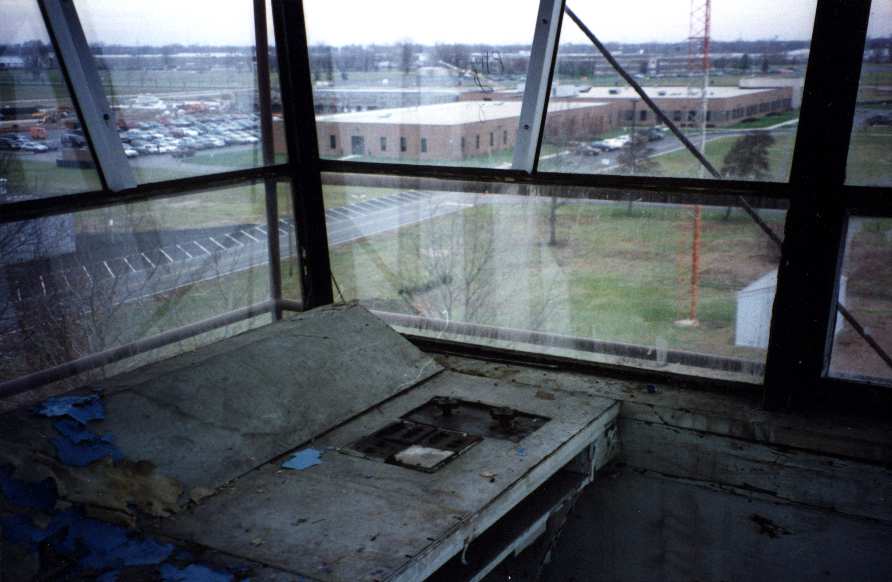
A 1994 photo by Lou Thole showing the view from inside Stout Field's former control tower.
As of the 1998 USGS aerial photo,
warehouses had been built over significant portions of the runways,
and other portions of the runways were used for vehicle parking.
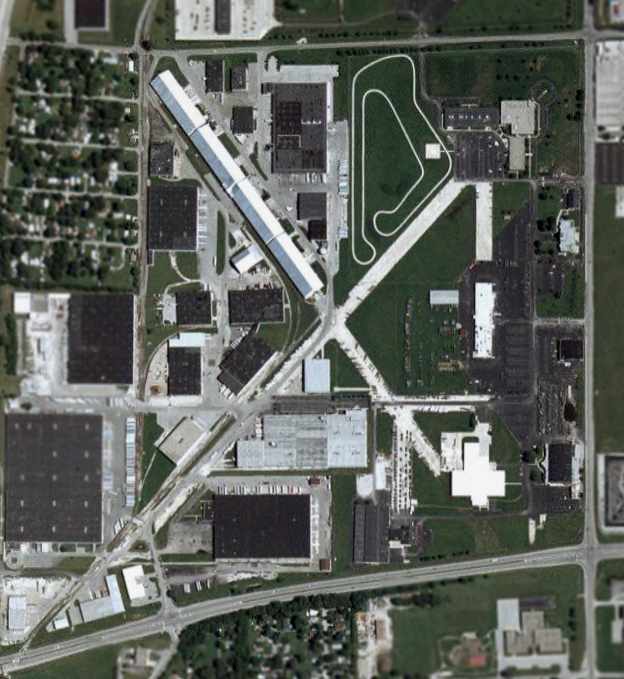
As of the circa 2001-2005 USGS aerial photo,
the remains of 4 paved runways still existed,
along with a control tower & numerous hangars.
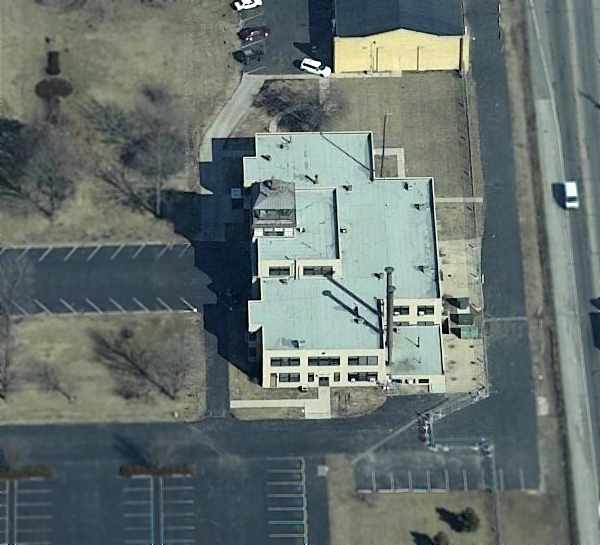
A circa 2005 aerial photo looking north at Stout's remaining control tower building.
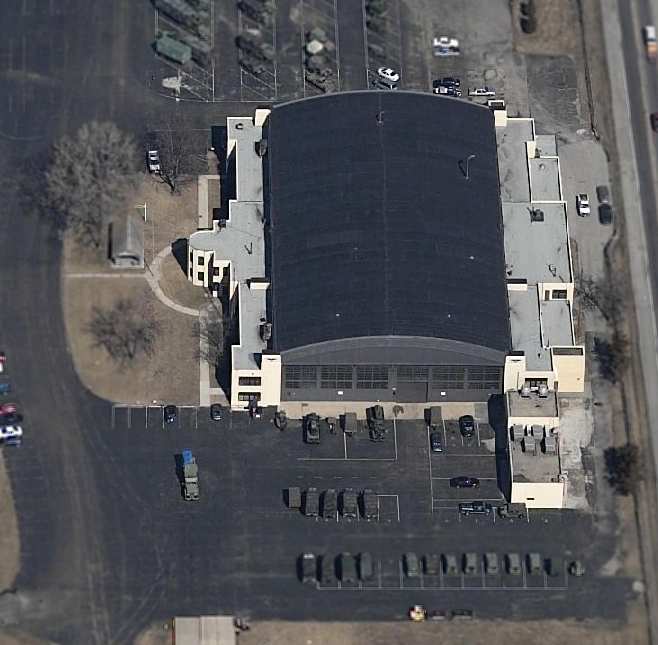
A circa 2005 aerial photo looking north at 1 of 2 remaining hangars at Stout Field, on the southeast corner of the base.
Jim Slater reported that by 2005, the static display F-101 formerly at Stout Field “was long gone.”
Jim Slater reported in 2006, “The old control tower & a couple of the old hangars are still at Stout Field.
Old, crumbling runways can still be found, along with yellow painted lines, but you have to look for them.
They're all reminders of how this airport, at 1 time, was an active place, pointing to the future.
Funny how when we sometimes look so hard for the future, we forget & bury our past.”

A 2008 photo by Dick Merrill of Stout's control tower.
Dick reported, “The guard said I couldn't get on the field to take photos of the old terminal.”

A 2008 photo by Dick Merrill of a former hangar at Stout Field.
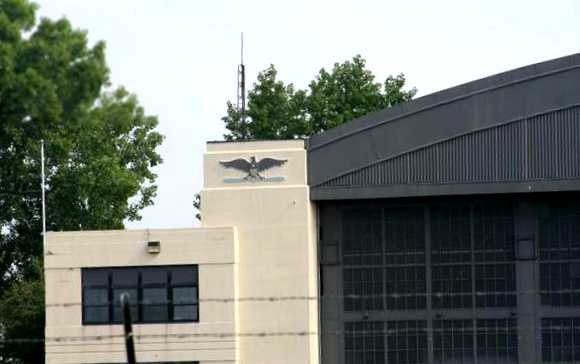
A 2008 photo by Dick Merrill of a military emblem on a former hangar at Stout Field.
Brian Harrier of Tippmann Properties reported in 2008, “The history of Stout Field is not completely forgotten.
I manage many of the industrial buildings in the park.
We still refer to the buildings that were built on Runway 15 as the 'Runway Buildings'.
Grass does not easily grow on the north end, possibly where the runway lights used to be.
We also use some of the original brick drainage system that dates back well before 1961.”
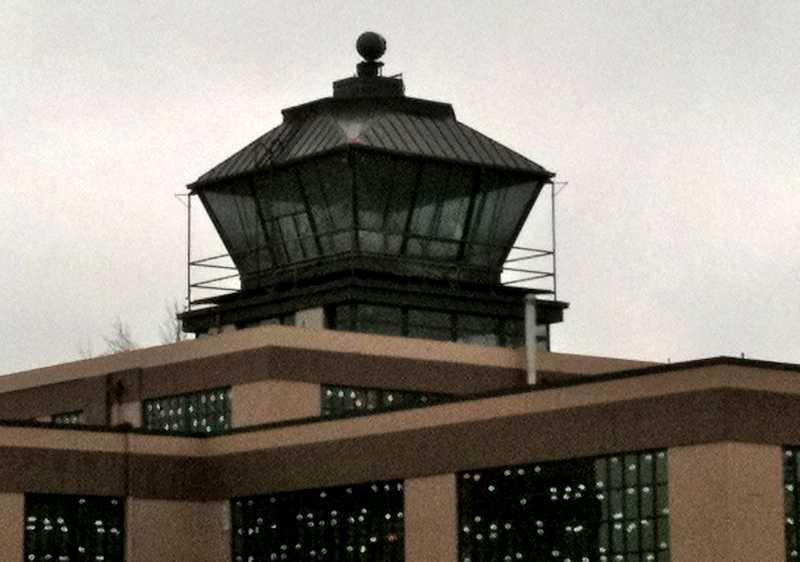
A 3/5/11 photo of the Stout control tower by Tom Townsend.
Tom reported, “I could not get through the gate,
but the guard said that the Indiana Historical Society is rehabbing the tower & visits can be arranged by calling them in advance.”
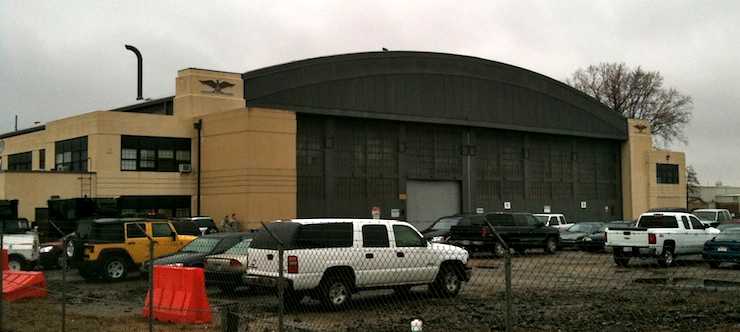
A 3/5/11 photo of a Stout hangar by Tom Townsend.
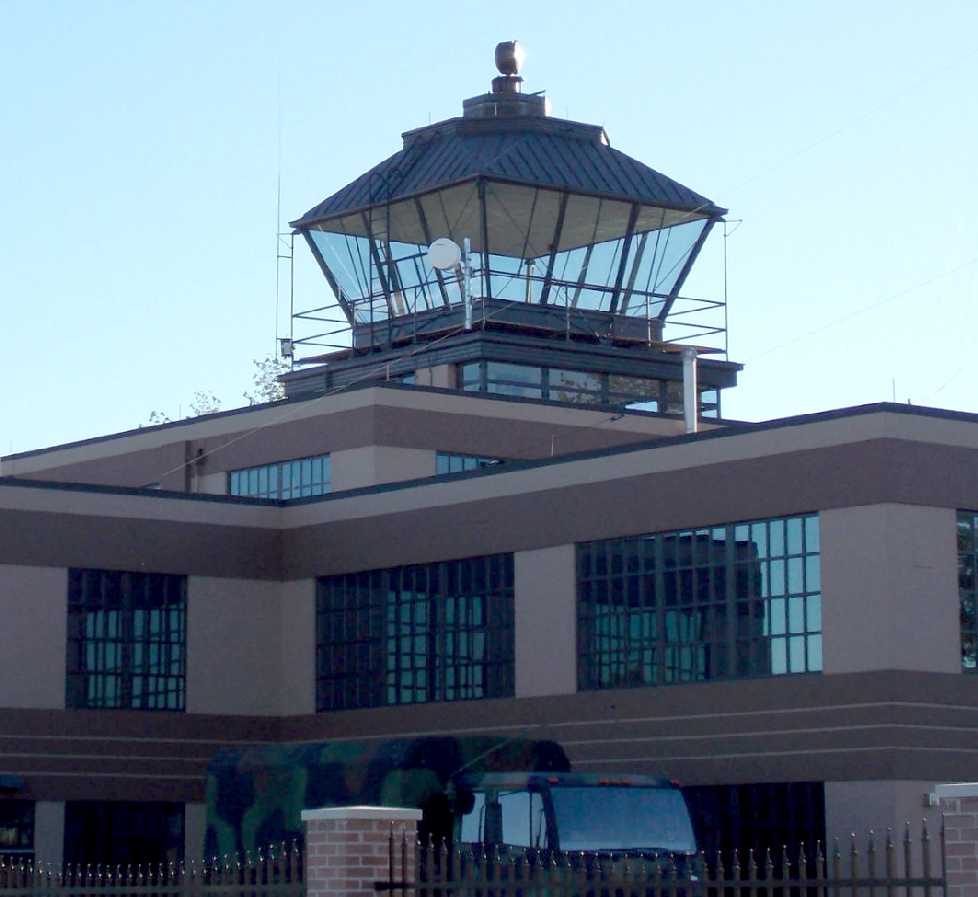
A 9/22/12 photo of the Stout control tower by Nick Newcomb.

A 9/22/12 photo by Nick Newcomb of Stout's “original runway pavement, you can get a good idea of the condition from this picture.
There is a road that runs right through the center of the field, and the National Guard is stationed there now. Barbed wire fences surround much of the field.
Parts of the former runways are now degraded, and covered with gravel from the runways, but there are some patches of runway that are visible.
The concrete itself seems to be in pretty good condition in some places.”
H. Bennis reported in 2013, “The tower building has been renovated & is used for National Guard office space.
The hangar immediately south was used to refurbish the bronze top from the monument on the circle last year.
It is now office space for the Employer Support of the Guard & Reserve.
The hanger (Building 9) on the southeast corner was headquarters for the Indiana Guard Reserve & a National Guard military police company.
Both have moved to Tyndall Armory downtown & the hangar is being extensively refurbished.
Last year it was used for the American Legion convention & a job fair.
The National Guard Joint Forces Headquarters is also undergoing some major additions.
The 38th Infantry Division vehicle maintenance depot has doubled in size on the southwest corner.”
____________________________________________________
Since this site was first put on the web in 1999, its popularity has grown tremendously.
That has caused it to often exceed bandwidth limitations
set by the company which I pay to host it on the web.
If the total quantity of material on this site is to continue to grow,
it will require ever-increasing funding to pay its expenses.
Therefore, I request financial contributions from site visitors,
to help defray the increasing costs of the site
and ensure that it continues to be available & to grow.
What would you pay for a good aviation magazine, or a good aviation book?
Please consider a donation of an equivalent amount, at the least.
This site is not supported by commercial advertising –
it is purely supported by donations.
If you enjoy the site, and would like to make a financial contribution,
you
may use a credit card via
 ,
using one of 2 methods:
,
using one of 2 methods:
To make a one-time donation of an amount of your choice:
Or you can sign up for a $10 monthly subscription to help support the site on an ongoing basis:
Or if you prefer to contact me directly concerning a contribution (for a mailing address to send a check),
please contact me at: paulandterryfreeman@gmail.com
If you enjoy this web site, please support it with a financial contribution.
please contact me at: paulandterryfreeman@gmail.com
If you enjoy this web site, please support it with a financial contribution.
____________________________________________________
This site covers airfields in all 50 states.