
April 24
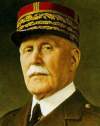
1857 Birth: Henri Philippe Petain: into a farming family from northern France. He joined the French army in 1876.
After a number of World War One commands, in 1916, Petain was ordered to stop the massive German attack on the city of Verdun. He reorganised the front lines and transport systems and was able to inspire his troops, turning a near-hopeless situation into a successful defence. He became a popular hero and replaced General Robert Nivelle as commander-in-chief of the French army. Petain then successfully re-established discipline after a series of mutinies by explaining his intentions to the soldiers personally and improving their living conditions. In November 1918, he was made a marshal of France.
In 1934, Petain was appointed minister of war, and then secretary of state in the following year. In 1939, he was appointed French ambassador to Spain. In May 1940, with France under attack from Germany, Petain was appointed vice premier. In June he asked for an armistice, upon which he was appointed 'chief of state', enjoying almost absolute powers. The armistice gave the Germans control over the north and west of France, including Paris, but left the remainder as a separate regime under Petain, with its capital at Vichy. Officially neutral, in practice the regime collaborated closely with Germany, and brought in its own anti-Semitic legislation.
In December 1940, Petain dismissed his vice-premier, Pierre Laval, for his policy of close Franco-German collaboration. But Laval's successors were unacceptable to the Germans and Laval was restored. In November 1942, in response to allied landings in North Africa, the Germans invaded the unoccupied zone of France. Vichy France remained nominally in existence, but Petain became nothing more than a figurehead. In the summer of 1944, after the allied landings in France, Petain was taken to Germany. He returned to France after liberation, was brought to trial and condemned to death. This was immediately commuted to solitary confinement for life by General Charles De Gaulle. Petain was imprisoned on the Ile d'Yeu off the Atlantic coast, where he died on 23 July 1951.
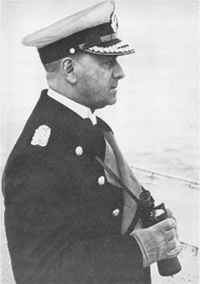
1876 Birth: Erich Raeder: German naval commander. Raeder attained the high rank of Grand Admiral in 1939, becoming the first person to hold that rank in wartime since Alfred von Tirpitz. Raeder led the Kriegsmarine (War Navy) for the first half of World War II but was eventually demoted and replaced by Karl Doenitz in 1942. He was sentenced to life in prison during the Nuremberg Trials, but was later released and wrote his autobiography.
1882 Birth: Hugh Dowding: considered one of the masterminds behind the victory in the Battle of Britain: one of the most prominent battles in World War Two. Dowding is seen as one of the more important military commanders of the war.
Dowding was born in Scotland in April 1882 and educated at Winchester College and the Royal Military Academy at Woolwich. Dowding served in Ceylon, Gibraltar, Honk Kong and then for six years in India. When he returned to Britain from this tour of duty, Dowding took up flying and received his flying license in 1913. Following this, he joined the newly created Royal Flying Corps and fought in World War One where he commanded 16 Squadron. During this war, he clashed with the head of the Royal Flying Corps - General Hugh Trenchard - over the issue of rest for pilots exhausted by constant flying sorties. As a result, Dowding was sent back to Britain. He was promoted to brigadier-general, but took no more active part in the war itself.
After the war, Dowding joined the newly established Royal Air Force becoming a vice-marshal in 1929. In 1933, he was promoted to air marshal and in 1934, Dowding was knighted.
It was in the 1930's that Dowding made his real mark. He was a believer in research and development and pushed hard for this aspect of the RAF to be adequately funded. He knew that the days of the bi-plane were numbered and pushed for a fast fighter. This led to a competition that ended with the construction of the legendary Supermarine Spitfire. By 1937/38, Dowding became convinced that a war with Nazi Germany was a real possibility and the Nazis had done little to disguise the growth of the Luftwaffe. In April 1937, the Luftwaffe had demonstrated its ability to destroy an undefended city with the bombing of Guernica in Spain. For this very reason, Dowding believed that Britain had to be in a position to defend itself from German bombers: hence his part in pushing for the development and manufacture of both the Spitfire and Hurricane. Dowding also pushed for the development of the radar, to give the British an adequate warning of an enemy attack.
In 1938, Dowding believed that Britain was not able to adequately protect itself against the Luftwaffe. For this reason, he advised Neville Chamberlain to pursue a policy of appeasement at Munich. Whereas Chamberlain has been criticised for 'giving in' to Hitler and not making a firm enough stand against him, Dowding believed that he needed more time to develop Fighter Command to enable Britain to defend itself.
In 1940, Dowding played his part in providing what fighter cover he could give to the men being evacuated at Dunkirk. However, both he and Winston Churchill believed that any full use of what resources Dowding had would be reckless, especially for what many considered to be a lost cause. In this, Dowding proved to be correct.
Dowding's resources as head of Fighter Command were about to be given a massive test - one which they could not fail. In the Battle of Britain, the men of Fighter Command were pushed to the limit. As in World War One, Dowding clashed with other senior officers in the RAF over tactics. Men like Air Vice Marshal Douglas and Air Vice Marshal Leigh-Mallory wanted the pilots of Fighter Command to engage the Luftwaffe before they crossed the English coastline. Dowding rejected this approach as he believed that any British/Allied pilot that parachuted out over the English Channel was more liable to be drowned. Any combat over the mainland that led to a pilot parachuting out, meant that the pilot had a greater chance of survival. Dowding knew that Fighter Command was not short of fighter planes. But it was short of experienced pilots and he resolved that Fighter Command could not lose any more. Hence why he engaged the Luftwaffe on 'home' soil.
The victory in the Battle of Britain ended any hope of Hitler launching "Operation Sealion". In recent years, some historians have re-assessed the importance of the battle, claiming that Hitler's heart was not in an invasion of Britain and that he was fully focused on the an attack on Russia. However, no-one in Britain would have known this in August/September 1940 and no chance could be taken that the barges on the French and Belgium northern coastline were there only as a threat.
Dowding has been given the credit for the victory in September 1940 - along with the "few". For this he was awarded the Knight Grand Cross. However, his career did not end in the glory many feel it should have done. Air Chief Marshal Portal, the chief of air staff, did not agree that Dowding had used the right tactics and in November 1941, the man who had masterminded the victory that was the Battle of Britain, was forced to retire from the position as head of Fighter Command. Age was not an issue as Dowding was only 59. Dowding was replaced as head of Fighter Command by one of his chief critics: Air Vice Marshal Douglas.
Dowding was given 'special duties' to do in America involving aircraft production. However, he retired from the Royal Air Force in July 1942 and was awarded a baronetcy in 1943.
Dowding died on February 15th, 1970.
1891 Death: Helmuth Karl Bernhard Graf von Moltke (1848-1916):

AKA: Moltke the Elder, famous for important military victories against Austria in 1866 and during the Franco-Prussian War of 1870-71.
1906 Birth: William Joyce-- in New York City:
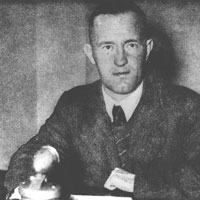
His mother was English and his father was a naturalized Irishman. He lived for a time in Ireland as a child and in 1922 he emigrated to England with his family. He attended the University of London, where he graduated with a first class honours degree.
In 1923 Joyce joined the British Fascisti (BF) . . . . Members of the British Fascists had been horrified by the Russian Revolution. However, they had gained inspiration from what Benito Mussolini had done it Italy. The BF were unpopular in some areas and Joyce often acted as a steward at public meetings. On 22nd October 1924 Joyce was on duty at a meeting at Lambeth. He became involved in a fight and received a razor cut from the corner of his mouth to behind his right ear . . . .
Like other members of the British Fascisti, Joyce had a deep hatred of Jews and Communists. He claimed that his facial wound had been caused by a "Jewish Communist". He also blamed his failure to complete his MA on a Jewish woman tutor. In early 1933 Joyce joined the British Union of Fascists (BUF) led by Oswald Mosley. The BUF argued for a programme of economic revival based on government spending and protectionism. By 1934 Mosley was expressing strong anti-Semitic views and provocative marches through Jewish districts in London lead to riots . . . .
Oswald Mosley appointed Joyce as the party full-time Propaganda Director. Joyce, along with Mosley and Mick Clarke, were the organisation's three main public speakers. On 7th June, the BUF held a large rally at Olympia. About 500 anti-fascists managed to get inside the hall. When they began heckling Mosley they were attacked by 1,000 black-shirted stewards. Several of the protesters were badly beaten by the fascists. There was a public outcry about this violence . . . . Over the next few months membership went into decline.
Under the influence of Joyce the BUP became increasingly anti-Semitic. The verbal attacks on the Jewish community led to violence at meetings and demonstrations. In November 1936 a serious riot took place when left-wing organisations successfully stopped Mosley marching through the Jewish areas of London.
The activities of the BUF was checked by the the passing of the 1936 Public Order Act. This gave the Home Secretary the power to ban marches in the London area and police chief constables could apply to him for bans elsewhere. This legislation also made it an offence to wear political uniforms and to use threatening and abusive words.
The BUP anti-Semitic policy was popular in certain inner-city areas and in 1937 Joyce came close to defeating the Labour Party candidate in the London County Council election in Shoreditch. Joyce argued that the BUP should take a more extreme position on racial issues. Mosley disagreed and began to feel that Joyce posed a threat to his leadership. He therefore decided to sack Joyce as Propaganda Director. In an attempt to save money another 142 staff members also lost their jobs.
Joyce now decided to leave the organization and with the help of John Becket and A. K. Chesterton he founded the National Socialist League. In a pamplet, National Socialism Now, Joyce began to express views similar to those of Adolf Hitler. He wrote: "International Finance is controlled by great Jewish moneylenders and Communism is being propagated by Jewish agitators who are at one fundamentally with the powerful capitalists of their race in desiring an international world order, which would, of course, give universal sovereignty to the only international race in existence."
When Adolf Hitler ordered the invasion of Czechoslovakia, Joyce became convinced that war with Germany was inevitable. Unwilling to fight against Hitler's forces, Joyce began to consider leaving the country. This view was reinforced when he was warned by Maxwell Knight of MI5 that the British government was considering the possibility of interning fascist leaders.
On 26th August, 1939, Joyce left for Nazi Germany. Soon after arriving in Berlin he found work with the German Radio Corporation as an English language broadcaster. Joyce joined the 'German Calling' programme. On 14th September, 1939, a report in the Daily Express described the broadcaster as speaking the "English of the haw-haw, damit-get-out-of-my-way variety." It was not long before Joyce became known as Lord Haw-Haw.
Joyce continued to broadcast throughout the Second World War. In 1940 the Daily Mirror organized the Anti Haw Haw League of Loyal Britons and members pledged not to listen to these broadcasts. Other British subjects who took part in these broadcasts included John Amery, Railton Freeman, Norman Baillie-Stewart, Kenneth Lander and William Griffiths. [Note: Norman Birkett, advocate par excellence, was given his own broadcasting slot on the BBC, to combat Joyce and the British traitors.‑‑Ed.]
Joyce was captured by the British Army at Flensburg on 28th May 1945. Three days later . . . . Joyce made a full confession; but, at first, the Director of Prosecutions doubted whether he could be tried for treason as he had been born in the United States. However, his broadcasts during the war had made him a hate figure in Britain and the Attorney General, David Maxwell-Fyfe, decided to charge him with high treason.
Joyce's trial for high treason began at the Old Bailey on 17th September, 1945. In court it was stated that although he was United States citizen he had held a British passport during the early stages of the war. It was therefore argued in court by Hartley Shawcross that Joyce had committed treason by broadcasting for Germany between September 1939 and July 1940, when he officially became a German citizen.
William Joyce was found guilty of treason and was executed on 3rd January 1946.
[That Joyce was indicted and executed for high treason sticks in the throats of many lawyers, who hold the view that holding a passport is not evidence of a duty of allegiance in the UK‑‑Ed.]
1915 World War I: Various:
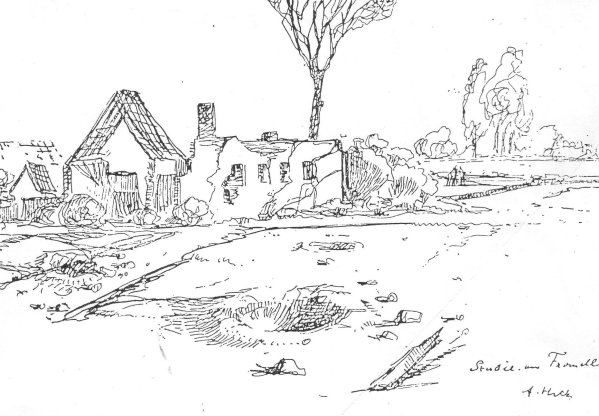
List Regiment: Gefreiter Adolf Hitler's 16 Reserve Infantry Regiment [List Regiment] occupy a position, at Fromelles (pictured above in a drawing by Hitler), which is on a level field with water channels, willow trees and willow stalks, in the distance towards the enemy lines lie an insignificant wood with barbed wire entanglements. Under the direction of their defense-minded commander, Lieutenant General Gustav Scanzoni von Lichtenfels, the regiment works ceaselessly day and night in the subsequent weeks, to further fortify their position at Fromelles. [For further details, Click here.]
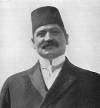
In April of 1915 tens of thousands of Armenian men were rounded up and shot [by the Turks]. Hundreds of thousands of women, old men and children were deported south across the mountains to Cilicia and Syria. On April 15 the Armenians appealed to the German Ambassador in Constantinople for formal German protection. This was rejected by Berlin on the grounds that it would offend the Turkish Government. By April 19 more than 50,000 Armenians had been murdered in the Van province.
Within nine months, more than 600,000 Armenians were massacred. Of the deported during that same period, more than 400,000 perished of the brutalities and privations of the southward march into Mesopotamia. By September more than a million Armenians were the victims of what later became known as the Armenian Genocide! A further 200,000 were forcibly converted to Islam to give Armenia a new Turkish sense of identity and strip the Armenian people of their past as the first Christian state in the world.
1916 World War I: Various:
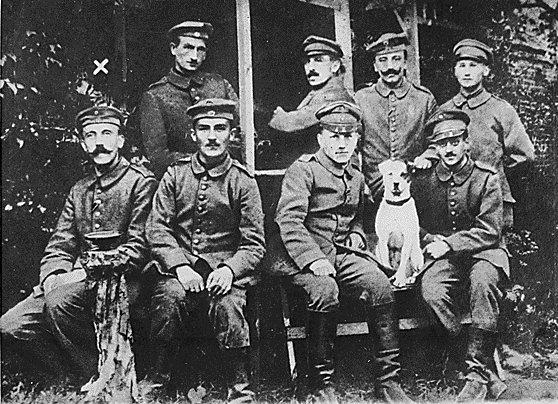
List Regiment: Gefreiter Adolf Hitler endures trench warfare in Flanders (Artois) with 3 Company, 16 Reserve Infantry Regiment [List Regiment]. [For further details, Click here.]
Ireland: The Easter Rising begins in Dublin:
Around noon on Easter Monday of 1916, some 1,600 Irish nationalists—members of the Irish Volunteers—launch the so-called Easter Rising in Dublin, seizing a number of official buildings and calling on all Irish patriots to resist the bonds of British control.
Since the outbreak of World War I, the leading Irish nationalist, Sir Roger Casement, had pressed the German government to see the potential benefit of an Irish rebellion against British rule. Consequently, on April 2, the German merchant ship Aud was sent to the Atlantic coast of Ireland, loaded with some 20,000 rifles and 1 million rounds of ammunition bound for the hands of the Easter rebels. Before the Aud reached its destination, however, a British ship intercepted it, and the crew members of the Aud scuttled the ship with all its cargo. When Casement himself traveled from Germany to Tralee Bay, also on the Atlantic coast, three weeks later, he was put ashore by the Germans on an inflatable raft. He was subsequently arrested, tried and executed for treason by the British authorities. [Casement's case was somewhat akin to that of William Joyce (see 1906, above). However, Casement's defense was far flimsier. It was claimed that he was hanged on a comma, but the truth is that he was hanged on the lack of a comma.‑‑Ed.]
Meanwhile, plans for the Easter Rising had gone ahead without Casement or German help. Due to last-minute uncertainty, however, one of its leaders canceled the orders for mobilization on the Saturday before the planned uprising—because of this only 1,600 of an expected 5,000 participants gathered at Liberty Hall on April 24 to march towards the center of Dublin. There, they seized the post office, several court buildings, St. Stephen's Green and several other locations. From the steps of the post office, the rebels declared Ireland an independent republic, stating that We declare the right of the people of Ireland to the ownership of Ireland, and to the unfettered control of Irish destinies, to be sovereign and indefeasible.
Despite the rebels' hopes, the public did not rise to support them, and they were quickly crushed by the police and government forces sent against them, among them some newly recruited troops bound for service in World War I. Sixty-four rebels were killed during the struggle, along with 134 troops and policeman, and at least 200 civilians were injured in the crossfire. Fifteen of the uprising's leaders were eventually executed; a sixteenth, Eamon de Valera, was saved from a death sentence because he was an American citizen.
Even in its failure, the Easter Rising and the continued volatility of the so-called Irish question demonstrated the thwarted desires for self-determination that still bubbled beneath the surface in Great Britain, as in many countries in Europe, even as the larger matter of international warfare superseded them for the moment.
1917 World War I: List Regiment: Gefreiter Adolf Hitler's 16 Reserve Infantry Regiment, 3 Company, fortify trenches near Arras. [For further details, Click here.]
1918 World War I: Various:
Zeebrugge Raid: Official Report by Admiral Alfred von Tirpitz:
During the night of April 22-23 an enterprise of the British naval forces against our Flanders bases, conceived on a large scale and planned regardless of sacrifice, was frustrated. After a violent bombardment from the sea, small cruisers, escorted by numerous destroyers and motorboats, under cover of a thick veil of artificial fog, pushed forward near Ostend and Zeebrugge to quite near the coast, with the intention of destroying the locks and harbour works there. According to the statements of prisoners, a detachment of four Companies of the Royal Marines was to occupy the Mole of Zeebrugge by a coup de main, in order to destroy all the structures, guns, and war material on it and the vessels lying in the harbour. Only about forty of them got on the Mole. These fell into our hands, some alive, some dead. On the narrow high wall of the Mole both parties fought with the utmost fierceness. Of the English naval forces which participated in the attack the small cruisers Virginia [sic], Intrepid, Sirius and two others of similar construction, whose names are unknown, were sunk close off the coast. Moreover, three torpedo-boat destroyers and a considerable number of torpedo motor-boats were sunk by our artillery fire. Only a few men of the crews could be saved by us. Beyond damage caused to the Mole by a torpedo [sic] hit, our harbour-works and coast batteries are quite undamaged. Of our naval forces only one torpedo-boat suffered damage of the lightest character. Our casualties are small.
List Regiment: Gefreiter Adolf Hitler's 16th RIR constructs fortified works in difficult defensive positions on an active front with German assault regiments near Fountaine (Montdidier). [For further details, Click here.]
1921 The Tyrol region of central Europe votes for union with Germany:
FRENCH TRY TO STOP TYROL PLEBISCITE; 1922 Palestine: Confirming the agreed text of the San Remo Conference, the Council of the League of Nations decides to assign the Mandate for Palestine to Britain. The Mandatory shall be responsible for placing the country under such political, administrative and economic conditions as will secure the establishment of the Jewish national home, as laid down in the preamble, and the development of self-governing institutions, and also for safeguarding the civil and religious rights of all the inhabitants of Palestine, irrespective of race and religion. [For further details, Click here.]
1926 Weimar: The Treaty of German-Soviet Friendship and Neutrality extends the Rapallo Treaty of 1922.
1932 Weimar: In German elections, the Nazis make gains in Bavaria, Wurttemberg and Hamburg; and increase their seats in the Prussian Diet from 6 to 162.
1933 Various:
Vatican and Reich: Baron von Ritter, the Bavarian ambassador at the Vatican reports to Berlin that Monsignor Kaas and the Papal Secretary of State are in constant touch with each other. "There can be no doubt that Cardinal Pacelli (the future Pope Pius XII) approves of a policy of sincere cooperation by the Catholics within the framework of the Christian Weltanschauung (world view) in order to benefit and lead the National Socialist Movement." (THP)
Witnesses: Nazi Germany begins its persecution of Jehovah's Witnesses by shutting down the Watch Tower Society office in Magdeburg. [For further information, click here.]
1935 Various:
Antisemitism: USA: The American Union for Social Justice, Father Coughlin's organization, holds its first meeting in Detroit.
Holocaust: A Nazi decree orders that publishers and newspaper editors must prove their "Aryan" descent to 1800, or lose their jobs. (THP)
1936 Antisemitism: Czechoslovakia April 24-27: Anti-Jewish demonstrations break out after screenings of the film The Golem.
1938 Sudeten Crisis: A Sudeten German Congress at Karlsbad demands full autonomy for Sudeten Germans. There were many reasons why the Czech government did not agree with the stance of the Sudeten Germans: if the area was handed over to the Germans, would it lead to other nationalities in Czechoslovakia wanting independence? Also, the Sudetenland contained many valuable resources such as lignite, coal and the area was just about the [country's] most vital defensive zone as the Sudetenland contained many border fortifications with Germany. The Sudeten Germans People's Party received both verbal and financial support from Hitler. Hitler had constantly talked about putting all Germans into one Reich and that no true German would have to live outside of Germany.
In 1938, Hitler ordered his generals to start to make plans for the invasion of Czechoslovakia. He also ordered Henlein and his followers to start to create trouble in the Sudetenland, therefore proving to the outside world that the Czech government was incapable of maintaining order in its own state. Hitler planned to use this chaos to put his army into the Sudetenland to restore law and order. Hitler's plan was risky not least because the Czech army was strong and professional. The terrain from Germany to the Sudetenland was very steep and it was very likely that the Wehrmacht's use of Blitzkrieg would have been of no value.
1940 World War II: Operation Demon: Evacuation of British forces in Greece begins:
British forces, along with Australian, New Zealand, and Polish troops, begin to withdraw from Greece in light of the Greek army's surrender to the Axis invaders. A total of 50,732 men are evacuated quickly over a six-day period, leaving behind weapons, trucks, and aircraft.
1942 Various:
Holocaust: Germany:
650 Jews are deported from Nuremberg to Izbica and Belzec.
Jews are no longer allowed to use public transportation at all. (THP)
Volkishness: Adolf Hitler, perhaps in a search of new territory to conquer, orders Dr. Heinz Fisher to conduct "Hollow Earth" experiments on the Baltic Island of Ruegen.
1943 Holocaust: Warsaw ghetto: From the SS and Police Fuehrer in the District of Warsaw to the Higher SS and Police Fuehrer East:
Apparently the Jews still in the Ghetto were deceived by the fact that the operation did not start until 1000 hours into believing that the action really had been terminated yesterday. The search action, therefore, had especially satisfactory results today. This success is furthermore due to the fact that the noncommissioned officers and men have meanwhile become accustomed to the cunning fighting, methods and tricks used by the Jews and bandits and that they have acquired great skill in tracking down the dug-outs which are found in such great number. The raiding parties having returned, we set about to clean a certain block of buildings. [For further details, Click here.]
1945 Various:
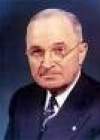
Truman briefed on Manhattan Project: President Harry Truman learns the full details of the Manhattan Project, in which scientists are attempting to create the first atomic bomb, on this day in 1945. The information thrust upon Truman a momentous decision: whether or not to use the world's first weapon of mass destruction.
America's secret development of the atomic bomb began in 1939 with then-President Franklin Roosevelt's support. The project was so secret that FDR did not even inform his fourth-term vice president, Truman, that it existed. (In fact, when Truman's 1943 senatorial investigations into war-production expenditures led him to ask questions about a suspicious plant in Minneapolis, which was secretly connected with the Manhattan Project, Truman received a stern phone call from FDR's secretary of war, Harry Stimson, warning him not to inquire further.)
When President Roosevelt died on April 14, 1945, Truman was immediately sworn in and, soon after, was informed by Stimson of a new and terrible weapon being developed by physicists in New Mexico. In his diary that night, Truman noted that he had been informed that the U.S. was perfecting an explosive great enough to destroy the whole world.
On April 24, Stimson and the army general in charge of the project, Leslie Groves, brought Truman a file full of reports and details on the Manhattan Project. They told Truman that although the U.S. was the only country with the resources to develop the bomb—eliminating fears that Germany was close to developing the weapon—the Russians could possibly have atomic weapons within four years. They discussed if, and with which allies, they should share the information and how the new weapon would affect U.S. foreign-policy decisions. Truman authorized the continuation of the project and agreed to form an interim committee that would advise the president on using the weapon.
Although the war in Europe ended in May 1945, Stimson advised Truman that the bomb might be useful in intimidating Soviet leader Joseph Stalin into curtailing post-war communist expansion into Eastern Europe. Truman agreed and said that if the weapon proved feasible I'll certainly have a hammer on those [Russians]. Meanwhile the war with Japan dragged on and it looked to many as if the Japanese would never surrender. On July 16, the team of scientists at the Alamogordo, New Mexico, research station successfully exploded the first atomic bomb. Truman gave Stimson the handwritten order to release when ready but not sooner than August 2 on July 31, 1945.
The first bomb was exploded over Hiroshima on August 6, 1945, and a second was dropped on Nagasaki on August 8. The Japanese quickly surrendered. Although other nations have developed atomic weapons and nuclear technology since 1945, Truman remains the only world leader to have ever used an atomic bomb against an enemy.
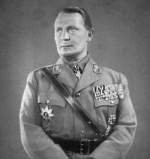
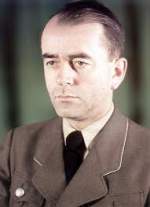
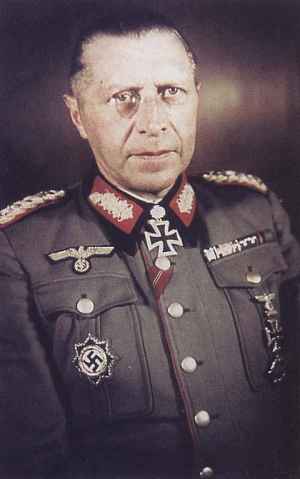
World War II: Churchill to Truman: I thank you for your answer to my telegram. I agree with the preamble, but later paragraphs simply allow the Russians to order us back to the occupational zones at any point they might decide, and not necessarily with regard to the position of the fronts as a whole. It is your troops who would suffer most by this, being pushed back about a hundred and twenty miles in the center and yielding up to the unchecked Russian advance an enormous territory. And this while all questions of our spheres in Vienna or arrangements for triple occupation of Berlin remain unsettled. Churchill to Stalin: I have seen the message about Poland which the President handed to M. Molotov for transmission to you, and I have consulted the War Cabinet on account of its special importance. It is now my duty to inform you that we are all agreed in associating ourselves with the President in the aforesaid message. I earnestly hope that means will be found to compose these serious difficulties, which if they continue will darken the hour of victory. Hermann Goering is officially removed from all his military and Party offices by Hitler. [See: The Last Days of the Third Reich.] Berlin: Soviet artillery fire makes the first direct hits on the Chancellery buildings and grounds directly above the Fuehrerbunker. [See: Why Did Hitler Insist on No Surrender?] Albert Speer talks with Hitler for the last time in the Fuehrerbunker: He supposedly confesses to his Fuehrer that he has been countermanding his orders for scorched earth. However, the only account we have to support this contention is Speer's own. There is some reason to believe that at least a portion of the story is no more than wishful thinking on Speer's part. However, the meeting certainly is contentious as Guderian will later relate that Hitler, after this meeting, declares: 'I refuse to see anyone alone anymore . . . . [Speer] always has something unpleasant to say to me. I can't bear that.' (Shirer, Sereny) General der Artillerie Helmuth Weidling—commander of the 56th Panzer Corps—arrives at the Fuehrerbunker. Communications with Weidling had been cut off since the 20th, and he had been sentenced to death on the 22nd as a deserter. He has traveled to Berlin to plead his innocence to his Fuehrer, who, impressed by the effort, soon gives him a new post. (Kershaw) Albert Speer and Walter Frentz (above) take their final leave of the Fuehrerbunker. Speer meets with Himmler, and fills him in on the events in Berlin and of Goering's fall. Himmler maintains that Goering's fall is temporary: Goering is going to be the successor now. We've long had an understanding that I would be his Premier. Even without Hitler, I can make him Head-of-State . . . . You know what he's like—naturally, I'll be the one to make the decisions. I've already been in touch with various persons I mean to take into my Cabinet. Keitel is coming to see me shortly . . . . Europe cannot manage without me in the future, either. It will go on needing me as Minister of Police. After I've spent an hour with Eisenhower, he'll appreciate that fact. They'll soon realize that they're dependant on me—or they'll have a hopeless chaos on their hands. From Triumph and Tragedy by Winston Churchill: In the early hours of April 25 a telegram arrived in London from Sir Victor Mallet, British Minister to Sweden. He reported that at 11 PM on April 24 he and his American colleague, Mr. Herschel Johnson, had been asked to call on the Swedish Minister for Foreign Affairs, Mr. Boheman. The purpose of the interview was to meet Count Bernadotte (above), who had an urgent mission. Bernadotte told him that Himmler was on the Eastern Front, and had asked to meet him urgently in Northern Germany. Bernadotte suggested Luebeck, and they had met the previous evening. Himmler, though tired and admitting Germany was finished, was still calm and coherent. He said that Hitler is so desperately ill that he might be dead already, and in any case would be so within the next few days. Himmler stated that while the Fuehrer was still active he would not have been able to do what he now proposed, but as Hitler was finished he could act with full authority. 1946 Nuremberg Tribunal: On day 113, Hans Frick's counsel, Dr Otto Pannenbecker, calls Hans Bernd Gisevius to the stand: Gisevius: It was the Prussian Minister of the Interior Goering who considered this Secret State Police as his special preserve. During those months nothing happened in this office which was not known or ordered by Goering personally. I want to stress this, because in the course of years the public formed a different idea of Goering because he noticeably retired from his official functions. At that time, it was not yet the Goering who finally suffocated in his Karinhall. It was the Goering who looked after everything personally and had not yet begun to busy himself with the building of Karinhall or to don all sorts of uniforms and decorations. It was Goering still in civilian clothes, who was the real chief of an office, who inspired it, and who attached importance to being the 'iron' Goering. [For the full testimony, Click here.] 1946 Nuremberg Tribunal: Schacht's delighted reaction to Gisevius's first day of testimony: "Now all the rotten business is coming to light. It was so stupid of the prosecution to indict me. My witness is their best witness." (Tusa) [See: Are There Any Lasting Effects From the Nuremberg Trials?] 1947 Death: Hans Biebow: The Nazi Administrator in Lodz:
Hans Biebow was born in Bremen, Germany in 1902, the son of Julius Biebow an insurance company director. After graduating from secondary school he entered his father's company, the district branch of the Stuttgart Insurance Company, as an apprentice. Biebow then joined the cereal and foodstuff bank in Bremen as a trainee from there he went into the cereal business and stayed in this trade until he was twenty-two. He then went into the coffee trade, after a short period of training with a business friend of his father's, he opened his own business with very little capital, building over the course of eighteen years into one of the largest companies in Germany, employing approximately 250 workers and office personnel.
When the Lodz ghetto was established in the spring of 1940, Biebow was put in charge of its food and economic office which in October 1940 was re-designated the ghetto administration (Ghettoverwaltung). The office had a staff of 250 German officials, thanks to his personal ties with Reinhard Heydrich, chief of the Sicherheitsdienst (SD) and with Arthur Greiser, governor of the Warthegau, Biebow enjoyed wide powers in administering the Lodz ghetto. By exploiting the manpower in the ghetto factories that he established and by robbing the Jews of their property, Biebow was able to extract great profits. He personally made sure that the ghetto was hermetically sealed and that the inhabitants would starve.
He set up special warehouses in the town of Pabiance, where the personal possessions and clothing of the victims of the Chelmno death camp were stored, sorted and sent to the Reich for use by the German population. Biebow was among the officials who helped organise the transports to the Chelmno death camp from Lodz and the surrounding towns and villages within the Warthegau. Deportations to the Chelmno death camp began on 16 January 1942 and lasted, with short intervals, until 15 May 1942. During this period 55,000 people were deported from Lodz Ghetto and murdered in Chelmno.
Biebow was determined to retain control of the Lodz ghetto and in order to maintain the flow of profits from the ghetto factories he ensured the ghetto's continued existence even after the mass deportations during 1942, until the summer of 1944. However, once it was decided that the ghetto would be liquidated, Biebow played an active role in organising transports to both Chelmno death camp, which had been re-established and Auschwitz-Birkenau, from June to August 1944, and in the final liquidation of the Lodz ghetto.
He excelled in deception tactics, convincing the Jews that the transports from the ghetto would take them to work camps attached to German factories, he also completely deceived Chaim Rumkowski, the Judenrat chairman, in the following manner: "We also learned something of Rumkowski unexpected departure. Biebow included in that transport Rumkowski's brother Jozef and his wife, who, for some time was referred to as 'Princess Helena' or the 'Princess of Kent.' The Chairman went to the Ghetto Administration, asking that they do not deport his immediate family. Biebow refused, but he added, "if you wish, you can accompany them." Rumkowski accepted this half- facetious offer.
Biebow drove him to the station himself, assigned him a separate car on the train and placed only twelve of Rumkowski's closest people with him. He said goodbye to him, most sincerely. As soon as he turned around, however, the Schupo standing guard—probably on Biebow's instructions—began assigning the deportees just arriving at the station to that very car. And so there were finally over eighty people in Rumkowski's car."
Biebow remained in Lodz until January 1945 where he supervised the removal to Germany of possessions left behind by the ghetto's inhabitants.
After the war, Biebow was tried by a Polish court in Lodz, he was sentenced to death and executed [on this day].
1947 Spandau Prison: From Spandau: The Secret Diaries, by Albert Speer: Talked with Hess. He keeps to his cell while the rest of us go walking. Like Hitler when things started going badly, he has built up an escapist world. And once again, as we did with Hitler, we respect his conduct, if only because he has a life sentence before him. Sometimes I have the impression that being a prisoner was always his destined role. Ascetic in appearance, his eyes sometimes wild in their deep, dark sockets; as a prisoner he can again be the total eccentric he was when he moved so strangely in the sphere of power. Now at last he can play the martyr and the buffoon, thus fulfilling the two sides of his personality. (Speer II) 1953 Winston Churchill: The British leader, who guided Great Britain and the Allies through the crisis of World War II, is knighted by Queen Elizabeth II:
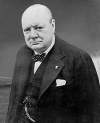
Born at Blenheim Palace in 1874, Churchill joined the British Fourth Hussars upon his father's death in 1895. During the next five years, he enjoyed an illustrious military career, serving in India, the Sudan, and South Africa, and distinguishing himself several times in battle. In 1899, he resigned his commission to concentrate on his literary and political career and in 1900 was elected to Parliament as a Conservative MP from Oldham. In 1904, he joined the Liberals, serving in a number of important posts before being appointed Britain's First Lord of the Admiralty in 1911, where he worked to bring the British navy to a readiness for the war he foresaw.
In 1915, in the second year of World War I, Churchill was held responsible for the disastrous Dardanelles and Gallipoli campaigns, and he was excluded from the war coalition government. He resigned and volunteered to command an infantry battalion in France. However, in 1917, he returned to politics as a cabinet member in the Liberal government of Lloyd George. From 1919 to 1921, he was secretary of state for war and in 1924 returned to the Conservative Party, where two years later he played a leading role in the defeat of the General Strike of 1926. Out of office from 1929 to 1939, Churchill issued unheeded warnings of the threat of Nazi and Japanese aggression.
After the outbreak of World War II in Europe, Churchill was called back to his post as First Lord of the Admiralty and eight months later replaced the ineffectual Neville Chamberlain as prime minister of a new coalition government. In the first year of his administration, Britain stood alone against Nazi Germany, but Churchill promised his country and the world that the British people would "never surrender." He rallied the British people to a resolute resistance and expertly orchestrated Franklin D. Roosevelt and Joseph Stalin into an alliance that eventually crushed the Axis.
In July 1945, 10 weeks after Germany's defeat, his Conservative government suffered an electoral loss against Clement Attlee's Labour Party, and Churchill resigned as prime minister. He became leader of the opposition and in 1951 was again elected prime minister. Two years later, he was awarded the Nobel Prize in literature for his six-volume historical study of World War II and for his political speeches; Queen Elizabeth II also knighted him. In 1955, he retired as prime minister but remained in Parliament until 1964, the year before his death. (History.com)
1955 Cold War: The Bandung Conference concludes:
The Afro-Asian Conference‑-popularly known as the Bandung Conference because it was held in Bandung, Indonesia‑-comes to a close on this day. During the conference, representatives from 29 "non-aligned" nations in Africa, Asia, and the Middle East met to condemn colonialism, decry racism, and express their reservations about the growing Cold War between the United States and the Soviet Union. [For further details, Click here]
1960 Death: Max von Laue:German physicist:
[Von Laue] won the Nobel Prize in 1914, for his work measuring the wavelength of x-rays by their diffraction through the atoms of a crystal. His studies showed that x-rays are a form of electromagnetic radiation similar to light, and that crystals have a molecular structure that regularly repeats its arrangement. He studied or worked under David Hilbert, Arnold Sommerfeld, Albert Einstein, and Max Planck, and made significant contributions to the scientific understanding of how applied magnetic fields affect superconductivity.
As the Nazis came to power in Germany, von Laue openly criticized the governmental stance against "Jewish physics" (i.e., Einstein), and remained in contact with otherwise-isolated Jewish colleagues. During World War II he refused to work on the Nazi program to develop nuclear weapons, and instead wrote a respected book on the history of physics. Still, as one of the leading physicists in Germany, he was among the scientists taken into custody after the war, and was imprisoned for almost a year at Farm Hill in England. During his incarceration he wrote a paper on the absorption of X-rays.
He was an early and enthusiastic adapter of the automobile, and had a reputation for driving at fast speeds. He was seriously injured in a collision with a motorcycle in Berlin on 7 April 1960 in which the cyclist was killed, and von Laue died of his injuries about two weeks later.
1961 Wunderwaffen: Vice President Johnson (center), in response to JFK's query concerning possible space missions, convenes a meeting with NASA administrator, James Webb (right); science advisor, Jerome Wiesner; and representatives from the Army, Navy, and NASA. Von Braun (left) spoke for NASA. Jerome Wiesner would later write: Johnson went around the room saying, "We've got a terribly important decision to make: Shall we put a man on the moon?" Everybody said Yes, and he said, "Thank you" and reported to the president that the panel said we should put a man on the moon. 1963 Spandau Prison: From Spandau: The Secret Diaries, by Albert Speer: Today at breakfast Schirach and Hess refuse to eat their eggs because the shells are cracked. They demand replacements, which are amazingly enough provided. In response to my question as to what all the fuss is about, Hess informs me: "Water on the inside of eggs is unhygienic. Think of all the people who may have handled the egg. Then all that penetrates through the crack into the egg, enters the stomach when consumed, and naturally has devastating effects. Now do you understand?" I nod, at once grateful and intimidated. At noon Long whispers to me behind his hand that the rejected eggs are served in chopped egg salad—which Schirach and Hess devour with pleasure. (Speer II) 1964 Death: Gerhard Domagk: German chemist and pathologist:
[Domagk] researched infections caused by bacteria, and found that an industrial dye, prontosil rubrum, had antibacterial action that proved an effective treatment for staphylococci and haemolytic streptococci. While staph infections are generally minor maladies today, in Domagk's time the only effective treatment usually involved amputation of limbs. It was also the first sulfa drug, the group of sulfur-based antibiotics that interfere with bacterial metabolism. Sulfa drugs are still used today.
For his discovery of prontosil's therapeutic effect, Dr Domagk was named a Nobel Prize winner in 1939, but he was ordered by Nazi authorities to decline the honor. His mother was driven from their family home, and starved to death in a refugee camp.
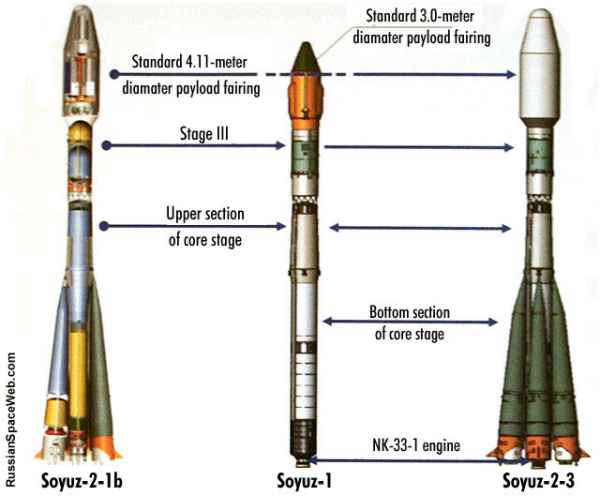
1967 Wunderwaffen: After orbiting the earth for a day in Soyuz-1, Cosmonaut Colonel Vladimir Komarov dies during his final descent, when his parachute lines tangle, causing his capsule to crash. 1991 Medal of Honor (Posthumous): Corporal Freddie Stowers:
President George Bush: So, it's a lovely day here, and we welcome each and every one of you to the White House. We want to honor a true hero, a man who makes us proud of our heritage as Americans, a man who, in life and death, helped keep America free. I speak of Corporal Freddie Stowers, to whom posthumously we present our highest military award for valor: the Medal of Honor. It's an award for bravery and conscience, the compendium we call character.
Today, Corporal Freddie Stowers becomes the first black soldier honored with the Medal of Honor from World War I. He sought and helped achieve the triumph of right over wrong. He showed, as this year has proved again, that an inspired human heart can surmount bayonets and barbed wire.
Seventy-three years ago, the Corporal first was recommended for a Medal of Honor, but his award was not acted upon. In 1987, then-Congressman Joe DioGuardi and my friend the late Mickey Leland, known to many here, from Houston, discovered the Stowers case while conducting other research. And the Army took up the case. And last November, the Secretaries of the Army and Defense recommended that Corporal Stowers receive the Medal of Honor. I heard his story, accepted their recommendation enthusiastically.
It's been said that the ultimate measure of a man is not where he stands in moments of comfort and convenience but where he stands at times of challenge. On September 28th, 1918, Corporal Freddie Stowers stood poised on the edge of such a challenge and summoned his mettle and his courage . . . .
On that September day, Corporal Stowers was alone, far from family and home. He had to be scared; his friends died at his side. But he vanquished his fear and fought not for glory but for a cause larger than himself: the cause of liberty.
Today, as we pay tribute to this great soldier, our thoughts continue to be with the men and women of all our wars who valiantly carried the banner of freedom into battle. They, too, know America would not be the land of the free, if it were not also the home of the brave . . . .
Medal of Honor Citation:
Corporal Stowers, a native of Anderson County, South Carolina, distinguished himself by exceptional heroism on 28 September 1918, while serving as a squad leader in Company C, 371st Infantry Regiment, 93rd Infantry Division. His company was the lead company during the attack on Hill 188, Champagne Marne Sector, France, during World War I. A few minutes after the attack began, the enemy ceased firing and began climbing up onto the parapets of the trenches, holding up their arms as if wishing to surrender. The enemy's actions caused the American forces to cease fire and to come out into the open. As the company started forward and when within about 100 meters of the trench line, the enemy jumped back into their trenches and greeted Corporal Stowers' company with interlocking bands of machine gun fire and mortar fire causing well over fifty percent casualties. Faced with incredible enemy resistance, Corporal Stowers took charge, setting such a courageous example of personal bravery and leadership that he inspired his men to follow him in the attack. With extraordinary heroism and complete disregard of personal danger under devastating fire, he crawled forward leading his squad toward an enemy machine gun nest, which was causing heavy casualties to his company. After fierce fighting, the machine gun position was destroyed and the enemy soldiers were killed. Displaying great courage and intrepidity, Corporal Stowers continued to press the attack against a determined enemy. While crawling forward and urging his men to continue the attack on a second trench line, he was gravely wounded by machine gun fire. Although, Corporal Stowers was mortally wounded, he pressed forward, urging on the members of his squad, until he died. Inspired by the heroism and display of bravery of Corporal Stowers, his company continued the attack against incredible odds, contributing to the capture of Hill 188 and causing heavy enemy casualties. Corporal Stowers' conspicuous gallantry, extraordinary heroism and supreme devotion to his men were well above and beyond the call of duty, follow the finest traditions of military service and reflect the utmost credit on him and the United States Army.
Edited by Levi Bookin (Copy editor) Click to join 3rdReichStudies Disclaimer: This site includes diverse and controversial materials--such as excerpts from the writings of racists and anti-Semites--so that its readers can learn the nature and extent of hate and anti-Semitic discourse. It is our sincere belief that only the informed citizen can prevail over the ignorance of Racialist "thought." Far from approving these writings, this site condemns racism in all of its forms and manifestations.
Vote on Annexation to Germany, Set for April 24, Strongly Opposed by Paris.
RAISES FRONTIER QUESTION
Common German-Italian Line Objected To, as Well as Union of Teutonic People in One State.
PARIS, April 10.—An important Political question has been raised by the German-prepared plebiscite to be held in Austrian Tyrol on April 24, when the residents will be asked to vote on the proposition of annexation to Germany. (The New York Times)



He then asked if the Swedish Government would arrange for him to meet General Eisenhower and capitulate on the whole Western Front. Bernadotte said there was no need for this as he could simply order his troops to surrender, and in any case he would not forward the request unless Norway and Denmark were included in the capitulation. If this were done there might be some point to a meeting, because special arrangements might be necessary as to how and to whom the Germans there were to lay down their arms. Himmler thereupon said he was prepared to order the German forces in Denmark and Norway to surrender to either British, American, or Swedish troops. When asked what he proposed to do if the Western Allies refused his offer, Himmler replied that he would take command of the Eastern Front and die in battle. Himmler said he hoped that the Western Allies rather than the Russians would be the first to enter Mecklenberg, in order to save the civilian population. Count Bernadotte ended by saying that General Schellenberg was now in Flensburg, near the Danish border, eagerly waiting for news, and could make sure than any message would reach Himmler immediately.
Both Ministers remarked that Himmler's refusal to surrender on the Eastern Front looked like a last attempt to make trouble between the Western Allies and Russia. Obviously the Nazis would have to surrender to all the Allies simultaneously. The Swedish Minister admitted this might be so, but pointed out that if the troops on the whole of the Western Front and in Norway and Denmark laid down their arms it would be a great help for all the Allies, including Russia, and would lead to an early and total capitulation. In any case, he thought that Bernadotte's information should be passed to the British and American Governments. As far as his own government were concerned, we were completely at liberty to tell the Soviets, as the Swedes would in no way be, or thought to be, promoting discord between the Allies. The only reason that the Swedish Government could not inform the Soviets direct was that Himmler had stipulated that his information was exclusively for the Western Powers. 

levi.bookin@gmail.com









Fair Use Notice: This site may contain copyrighted material the use of which has not always been specifically authorized by the copyright owner. We are making such material available in our efforts to advance understanding of historical, political, human rights, economic, democracy, scientific, environmental, and social justice issues, etc. We believe this constitutes a "fair use" of any such copyrighted material as provided for in section 107 of the US Copyright Law. In accordance with Title 17 U.S.C. Section 107, the material on this site is distributed without profit to those who have expressed a prior interest in receiving the included information for research and educational purposes. If you wish to use copyrighted material from this site for purposes of your own that go beyond 'fair use', you must obtain permission from the copyright owner.
Please Note: The list-owner and the moderator of 3rdReichStudies are not responsible for, and do not necessarily approve of, the random ads placed on our pages by our web server. They are the unfortunate price one pays for a 'free' website.



