of Europe
 Bratislava,
but there are other large cities as Kosice, Presov, Banska Bystrica, Nitra,
Zilina, Trnava and
Trencin.
Bratislava,
but there are other large cities as Kosice, Presov, Banska Bystrica, Nitra,
Zilina, Trnava and
Trencin.
History
First settlement
in this region was already from prehistoric times, what proved found human
skull from Ganovce. Later in the Iron age the culture. In this time there
were made the first coins. In 5th century AD came first Slavs
to this territory during the large Slavic migration westward. First national
organisation, which worked as a defence union for Western Slavic tribes
known as the "Empire of Samo". This was established in 632 AD to protect
the tribes against the threats of Avars. In 863 came missionaries St. Constantine
and St. Metod to the Great Moravia. They founded the first basic of Slavic
alphabet. In 11th century, Slovakia became part of Hungarian
Kingdom and it remained almost for 1000 years. The first university Academia
Istropolitana was founded in Bratislava in 1465. It was first university
at present territory of Slovakia. During the Turkish expansion into central
Europe, after the battle near Mohac in 1526 Ottoman Empire occupied most
of the Hungarian kingdom. Because of this Bratislava became the capital
and the coronation city for Hungarian kings. In 1735 was founded the first
mining college in Europe in town Banska Stiavnica. The first codification
of Slovak language by Ludovit Stur in 1843. In 1863 was established Matica
Slovenska which was abolished in 1875 by Hungarian authorities. October
1918 is known for establishing of Czechoslovak Republic. From 1948 has
changed regime to communist and was abolished only in the Velvet Revolution
in 1989. The National Council of Slovak Republic adopted constitution of
Slovak Republic. 9th of September 1992. Slovak Republic has
originated after peaceful dissolution of Czechoslovak federation 1st
January 1993.
Rivers and Lakes
Main river in Slovakia
is Danube, which comes from Austria and continues to Hungary. Many other
Slovak rivers fall into Danube. The longest river is Vah, but Hron, Ipel,
Morava, and Poprad have also to be mentioned. There are not very many lakes
in Slovakia except some mountain lakes as Strbske pleso, Zelene pleso barriers
as Zemplinska Sirava, Liptovska Mara, Oravska priehrada, Krpelany.
Relief
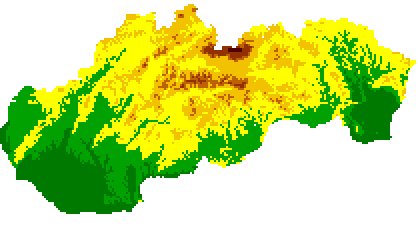
Slovakia has very
miscellaneous relief. There are mountains there Vysoke Tatry /High Tatras
and Nizke Tatry/Low Tatras, which are part of Carpathian ridge. There is
the highest peak of this ridge in Vysoke
Tatry called Gerlachovsky stit (Gerlach peak) about 2655 metres high.
Than there are lower mountains in Slovakia like Mala Fatra, Velka Fatra
a Slovenske Rudohorie. These mountains are mostly situated in the worth,
east Slovakia. The largest lowland is Podunajska nizina /Danube lowland/and
Zapadoslovenka nizina /Westslovak lowland/. The lowest point above the
sea level is 94 metres above the sea level and it is near Hungarian border
on the river of Bodrog.
People
In Slovakia lives
about 5 365 300 people. Most of this population are Slovaks about 85,7
%, than Hungarians 10,6 %, Gypsies 1,4 %, Czechs 1 % and other. Main religion
is Roman Catholic about 60,4 %, Atheists 9,7 %, Protestants 8,4 %, Greek
Catholic 3,4 %, Orthodox 0,7 % and other about 17,5 % of all population.
Economy
Currency in Slovakia
is Slovak crown, which international code is SKK. Each crown is equal to
100 hellers. There are banknote of 5000, 1000, 500, 200, 100, 50, 20 and
coins 10, 5, 2, 1 and hellers 50, 20, 10.Slovak Central bank is Narodna
Banka Slovenska. Most of large towns have grown because of industry. Main
industries are engineering, metallurgy, chemical, textile and food industry.
Most of raw materials as iron ore, oil, coal, manganese ore, chrome ore,
bauxite and so on.
Politics
Since March last
year 1998, there is no President in Slovak Republic. Prime minister Meciar
took over his duties after the end of President's electoral term. Meciar
was prime minister till the end of September. In September there were parliamentary
elections. SDK /Slovak Democratic Coalition/, SMK /Party of Hungarian Coalition/,
SOP /Party of Civil Understanding/ and SDL /Slovak Democratic Left/ won
the election and they formed coalition of these four parties. Prime minister
is Mikulas Dzurinda. Slovakia is one of countries, which tries to join
NATO and European Union. Hopefully we will join EU by year 2004.
Sports
National sport
of Slovakia is either ice hockey or football /soccer/. Other popular sports
are basketball, volleyball and tennis. Nowadays is fitness becoming very
popular, mostly among young people. Some famous players, who could be seen
playing tennis around the world, are Dominik Hrbaty, Karin Habsudova or
Korda. There are also some good ice-hockey players in NHL. The only gold
medal, that Slovakia won in Winter Olympic Games in Atlanta 1996 was for
Martikan for Kayaking. Slovakia is also one of competitors for the Winter
Olympic Games in 2006. It would be in Vysoke Tatry /High Tatras/. We will
see if we get this opportunity or now later on.
Representative
Symbols
National emblem
consists of an early Gothic shield with a silver double cross erected on
the central and highest of three blue hills. National flag has three horizontal
stripes, white blue and red. The state emblem of Slovak Republic appears
in the upper left of the flag. National
Anthem is composed of the first two stanzas of the hymn "Nad Tatrou
sa blyska" /Thunder above the Tatra Mountains/. National seal has the national
emblem of Slovak Republic surrounded by the inscription Slovenska republika.