  What's New! Detailed Sitemap All images © by Roberto Piperno, owner of the domain. Write to romapip@quipo.it. Text edited by Rosamie Moore. Page added in December 2006. |
  Antiparis (Andiparos) Antiparis (Andiparos)
Key dates: 1207 Marco Sanudo a Venetian adventurer conquered Nasso and the nearby islands including Antiparis 1566 The last Duke of Nasso, Jacopo IV Crispo was cashiered by the Sultan 1645-69 During the War of Candia the Venetians often controlled the Cycladic islands including Paris and Antiparis Antiparis (opposed to Paris) is located opposite the southern part of Paris: there is only a very narrow passage between the two islands.
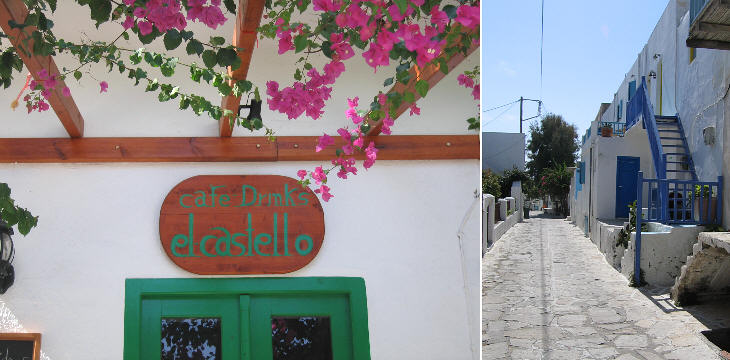
Many tourists try to escape the crowded beaches of Paris by taking the ferry which links the two islands: when they land on Antiparis they hardly notice the difference because Kastro the main town of Antiparis looks as crowded and cosmopolitan as those in Paris. Kastro means castle but apparently there is no castle in sight although a cafè at the end of the main street is named in a mixture of Spanish and Italian El (Span.) Castello (Ital.). An inscription in the pavement (you can see it in the image used as background for this page) is another indication of the existence of the castle together with a long series of adjacent buildings.
After a relatively long walk one reaches a low passage which gives access to a square where a large 1645 church is located. This part of the castle is called Xopyrgo (outside the tower) and is an addition to the original fortified village (because the castle turns out to be a fortified village similar to that of Argentiera).
The older part of the castle was built in the XVth century when Antiparos was ruled by Giovanni Loredan and his wife Maria Sommaripa: they both belonged to important Venetian families. They most likely resettled their farmers and servants living on the island in one location which offered some protection, if not from the attack of a proper army, at least from the raids of pirates. This type of countryside village was typical of central and northern Italy where it was called cascina: S. Maria di Galeria near Rome was built following a similar pattern.
A keep at the centre of the village was most likely the residence of the lords of Antiparos: it was damaged by being used as a base for building a water tank.
All the houses were built on three levels according to a similar pattern: the lower level was most likely used for stables and sheltering farming equipment.
Introductory page on the Venetian Fortresses Pages of this section: On the Ionian Islands: Corfù (Kerkyra) Paxo (Paxi) Santa Maura (Lefkadas) Cefalonia (Kephallonia) Asso (Assos) Itaca (Ithaki) Zante (Zachintos) Cerigo (Kythera) On the mainland: Butrinto (Butrint) Parga Preveza and Azio (Aktion) Vonizza (Vonitsa) Lepanto (Nafpaktos) Atene (Athens) On Morea: Castel di Morea (Rio), Castel di Rumelia (Antirio) and Patrasso (Patra) Castel Tornese (Hlemoutsi) and Glarenza Navarino (Pilo) and Calamata Modon (Methoni) Corone (Koroni) Braccio di Maina, Zarnata, Passavà and Chielefà Mistrà Corinto (Korinthos) Argo (Argos) Napoli di Romania (Nafplio) Malvasia (Monemvassia) On the Aegean Sea: Negroponte (Chalki) Castelrosso (Karistos) Oreo Lemno (Limnos) Schiatto (Skiathos) Scopello (Skopelos) Alonisso Schiro (Skyros) Andro (Andros) Tino (Tinos) Micono (Mykonos) Siro (Syros) Egina (Aegina) Spezzia (Spetse) Paris (Paros) Antiparis (Andiparos) Nasso (Naxos) Serifo (Serifos) Sifno (Syphnos) Milo (Milos) Argentiera (Kimolos) Santorino (Thira) Folegandro (Folegandros) Stampalia (Astipalea) Candia (Kriti) You may refresh your knowledge of the history of Venice in the Levant by reading an abstract from the History of Venice by Thomas Salmon, published in 1754. The Italian text is accompanied by an English summary. Clickable Map of the Ionian and Aegean Seas with links to the Venetian fortresses and to other locations (opens in a separate window) |