What's New!
Detailed Sitemap All images © by Roberto Piperno, owner of the domain. Write to romapip@quipo.it. Text edited by Rosamie Moore.
|
Atene (Athens)
Foreword: the Dukes of Athens
I do not know if today's students do it, but I used, as soon as I had the books for the new school year, to rush through
them to see the images they had. I still remember being quite puzzled by the (B&W) image below which I found in my history
book covering the period from the fall of the Roman Empire to 1492.
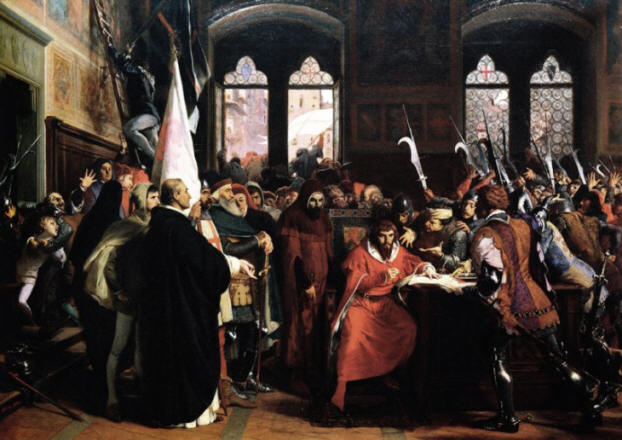
The Duke of Athens is forced out of Florence
I could not understand what a Duke of Athens had to do with the Republic of Florence. Dante made reference to a Duke of Athens (Inferno XII):
| "Forse | - |
| tu credi che qui sia'l duca d'Atene | "You think this is the Duke of Athens here,
|
| che su nel mondo la morte ti porse? | The man who rid the world of you. |
and Shakespeare set the first act of A Midsummer-Night's Dream in the palace of the Duke of Athens. But they both made
reference to Theseus, the slayer of the Minotaur and the mythological founder of Athens.
The Duke of Athens shown in this XIXth century painting
is Gautier de Brienne, a vassal of Robert I, the Angevin King of Naples. In 1342 the richest Florentine families offered him the lordship of Florence, but his rule
was so despotic that in 1343 he was ousted from power. He was a descendant of Jean de Brienne, Latin Emperor of Constantinople (1231-37).
But let us see some
key dates:
1204 At the fall of the Byzantine Empire, Athens becomes part of the Duchy of Athens under a Burgundian family. In the next 250 years the French are replaced
by Catalan, Sicilian, Navarrese and Florentine rulers
1456 The Turks seize Athens
1467 The Venetians conquer Athens for a very short period
1687 The Venetian commander Francesco Morosini seizes Athens
1699 The peace of Carlowitz assigns Athens to the Turks
The 1687 siege of Athens
The Acropolis seen from the Monument to Philopappus in an early XIXth century print
The Venetians approached Athens from the south and positioned their artillery on the hill of the Muses also called
hill of Philopappus after a monument to the consul Caius Julius Philopappus. From the hill the Venetians
could see the Acropolis, which had the appearance of a fortress with the notable exception of the Temple to Athene, the Parthenon.
The early XIXth century print shown above is very likely a faithful representation of the scene in 1687. In the late XVIIth century most of the small population of
Athens (3,000 inhabitants) lived at the foot of the Acropolis northern side.
The Acropolis seen from the Monument to Philopappus
At first sight today's view does not seem very different, but then one notices the changes in the Acropolis.
An early XIXth century view of the Acropolis
The Acropolis was from the very beginning a fortress and the view above shows that in the XIXth century it had merlons and
artillery sites. A tower strengthened its defence. The Acropolis could only be accessed from the west through the Propylaea, the imposing
entrance built in the Vth century B.C.. Its two wings were turned into fortified palaces which were used by the Dukes of Athens and
by the Turkish governors.
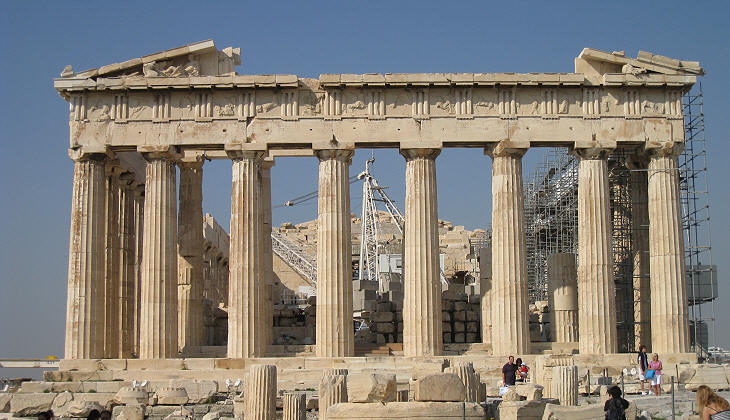
The Acropolis today
In the XIXth century the Acropolis was the object of a vast campaign of archaeological excavations. Their aim was to
bring back the Acropolis to the Vth century B.C. All additions of the Byzantine, Frankish and Turkish periods were regarded
as not being of any interest and were destroyed. Maybe today this aim would be achieved in a more sophisticated
way (the image used as a background for this page is a Turkish relief I noticed in the rubble of the Acropolis).
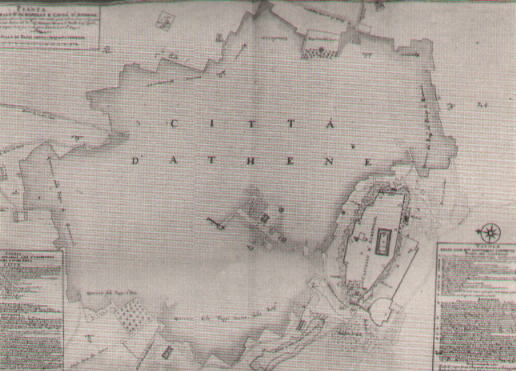
1687 Map of Athens
In the short period of Venetian occupation after 1687 a topographer drew a map of Athens where the Acropolis
is called Castello d'Acropoli and which shows that the theatre of Herodes Atticus was included in the fortification of the Acropolis.
We can also see that there were very few buildings on the Acropolis.
The Venetian conquest of Athens would be a very minor event in world history if it had not caused
great damage to the Parthenon. Francesco Morosini, the Venetian Commander was given the title of Peloponnesiacus by the Senate
for his swift victories in the Morea War (1684-87), a type of recognition the Romans had given to very few commanders (Britannicus, Germanicus, etc..).
Certainly Morosini passed away in 1694 in the belief he would be remembered as a great commander. As a matter of fact today's
encyclopaedias devote a line to his military records and a paragraph to the fact that the Venetian artillery hit the Parthenon causing
the collapse of its central part (maybe a today's hero, tomorrow will be remembered for the damage he indirectly caused to an important
museum).
The damage caused to the Parthenon
The Venetians had little interest in targeting the Parthenon, because they were aiming at damaging the fortifications at the
entrance of the Acropolis. Most likely they knew that the Turks were using a part of the ancient temple as a powder-magazine.
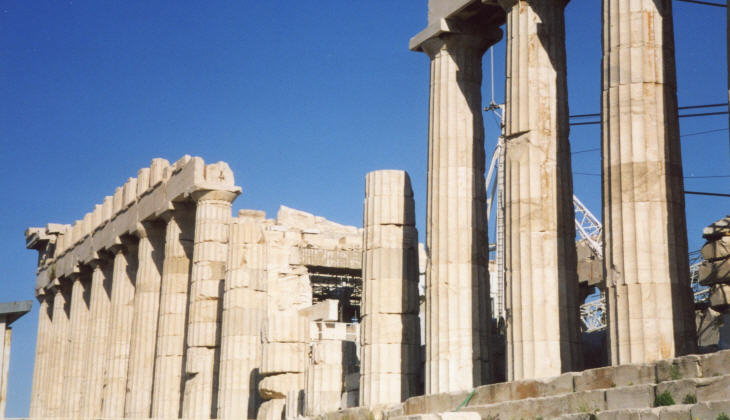
At the time the cannons threw metal or stone balls, which were not able to cause any major damage to the solid columns of the Parthenon.
The columns of the façade show the impact of these balls (their right side - towards the hill of Philopappus - is more damaged than the left side).
But when a ball hit the powder-magazine the explosion was so large that the central part of the temple collapsed.
We'll never do it again!
When I was taking some of the pictures you see in this page I noticed three tourists who were speaking Turkish and after a brief explanation we
arranged to take this picture, where on behalf of our Italian and Turkish ancestors, we formally acknowledge our wrongdoings and apologize
for them.
Sitting at a cafè at Piraeus and the lion which Morosini brought to Venice
Many tourists sit everyday at a Piraeus cafè near the departure of the ferries for the Cycladic Islands. Its menu brings back
other memories of Francesco Morosini. At the time Piraeus was called Porto Leone after the statue of a lion at the
entrance to the harbour. Morosini tried to take some of the statues which decorated the Parthenon, but a first attempt
to bring down a statue ended with a technical disaster, so he gave up and contented himself with the statue of the lion,
which was put at the entrance of Arsenale in Venice.
Modern Athens
The Bazaar Mosque and the portal of a Koranic school
In the second half of the XVIIIth century Athens had a period of development and was embellished by the Turks. Certainly when in 1833 Athens became the capital of the Kingdom
of Greece, it had a pretty oriental appearance with a bazaar, hammams, Koranic schools and mosques. After a long period of neglect,
the few remaining buildings of that period are gaining increasing attention. The Greek Kingdom was initially limited
to Peloponnese, Acarnania, Boeotia, Attica and the Cycladic islands: its "obvious" capital was Nafplion (Napoli di Romania) which had
had this role during the Venetian Kingdom of Morea (1699-1714). The majority of the Greeks still lived in the Ottoman Empire and there were
far more Greeks in Istanbul, Izmir or Alexandria than in any other town of the infant kingdom. The choice of Athens as capital
aimed at emphasizing the links between modern and ancient Greece: a view supported by the Great Powers protecting
the new kingdom, less by the Greeks themselves who believed themselves to be the heirs of Justinian and the Byzantine Empire, rather than of Pericles
and the Greek Democracy.
The National Library and the Academy
This explains why the expansion of Athens was so much based on Neoclassic buildings. The first king came from Bavaria and many
buildings were designed by German architects. It was (like most of XIXth century architecture) a sort of Neoclassicism à la carte in
the sense that the architects assembled in various ways elements of different styles. The image above shows buildings where Neoclassic elements prevailed, but in Athens there
are also a few buildings with a distinct Renaissance appearance (image below).
The Palace of the Duchess of Piacenza and Ilion Megaron, the house of Schliemann
Excerpts from Memorie Istoriografiche del
Regno della Morea
Riacquistato dall'armi
della Sereniss. Repubblica
di Venezia printed in Venice in 1692 and related to this page:
Porto Lione
Porto Lione cosi detto da un leone di Marmo di piedi dieci d'altezza, posto sù le rive
del di lui fondo, chiamato dalli Greci moderni Porto Draco: da Cicerone, e Strabone Piraus Portus,
detto anche Athenarus Portus è situato alle sponde Settentrionali del Golfo d'Engia.
L'ingresso di questo Porto è assai streto, perchè sopra vi ponno passare due Galere assieme; il di dentro
però è di bonissimo fondo, eccettuata una picciola parte, che forma quasi un seno, che pare fosse destinato
per Darsena per alloggiare Galere: e capacissimo di quantità di Navigli, e Pli: lib.7 cap. 37, scrive, che conteneva
mille Vascelli, e Strabone 400 e il Portolano del Mediterraneo in folio lo mette capace di 500, dandoli
dieci braccia di fondo. Spon però accreditato Auttore dice, che li nostri Navigli, essendo maggiori di quelli
degl'Antichi, non sarebbero ricevuti di quaranta, ò cinquanta al più.
Il maggiore comercio, che in questo Porto si fa, è il carico di Valonia, e lana di Capra.
Avanti, che Temistocle fosse Principe degl'Ateniesi non era questo il ricetto delle loro Navi, ma il porto
Falero, percioche quivi, il mare era pochissimo lontano dalla Città d'Atene, e però quest'era la stanza
delle Navi loro; e di quì dicono essersi partito Menesteo per andare a Troia colle Navi, e prima di lui
Teseo, quando andò per pagare la pena a Minoe della morte d'Androgeo; mà poiche Temistocle
fù Prencipe, parendogli ch'il Pireo fosse più comodo à Naviganti, e c'havesse tre Porti, in vece di quell'uno
del Falero edificò questo per ricetto delle Navi loro, e l'unì con muraglie lunghe trè miglia
continuate alla Città d'Atene, che si chiamavano Macrateichi, distrutte da Sylla, de quali tutta via
appariscono parte delle sue vestiggie. Al maggior porto del Pireo altre volte si vedeva il Sepolcro
di Temistocle; il luogo dedicato à Pallade, e à Giove; una loggia lunga dove si faceva la Piazza di coloro
ch'abitavano vicino al Mare, con molt'altre antichità, come si può leggere in Pausania.
Atene
Atene, chè Città antichissima della Grecia con titolo d'Archiepiscopale, e metropoli dell'Attica,
giace non lungi dalle spiaggie del Golfo d'Engia, parte del Mar Ionio, edificata dal Rè Cecrope,
che Cecropia la disse, e accresciuta in perfezione dal Rè Teseo, che l'aggrandì, obligando tutti
gl'Abitanti della Campagna à popolarla; Cecropia precisamente chiamasi la sua Cittadella,
alla quale dopo fu dato anch'il nome d'Acropolis: Questa è eretta sopra vivo sasso, ovunque
inacessibile, detratrone dalla parte d'Occidente, per dove envi l'ingresso: Da levante, e
mezzo giorno le muraglie formano la facciata d'un quadro; l'altre due accomodandosi alla
base formatagli dal medemo sasso, non riescono del tutto regolari, il circuito consiste in mille,
e duecento passi, al basso della Collina si scuoprono i vestigij d'alta muraglia, che girando
un tempo le radici della medema, tanto più rendeano difficultoso l'accesso. Li Soldati della
Guarniggione sono semplici paghe morte, che colle loro famiglie vivono anco in grembo
alla pace, gelosi di guerra, causa degl'insulti, a quali sogliono soggiacere, frequentemente inferitigli
da Corsari. E fraposta detta Cittadella quasi in egual distanza a due eminenze, una a Sud Ovest
detta Museum, chè della medema altezza della Cittadella in distanza d'un tiro di falconetto;
l'altra è il monte Achesmus impratticabile per il trasporto del cannone a fine di battere la Città, e
Cittadella; oltre che sopra di questa non evvi altra pianura; ch'una punta, sù la qual'è fabricata
la capella d'Agios Giorgios, ov'altre volte era statua di Giove, al Settentrione della Cittadella è posta
la Città, da quale in si fatta maniera vien coperta dalla parte del Mare, ch'a Naviganti sembra non esservi
altre Case, che quelle della Cittadella; perrciò molti, quali non hanno havuto curiosità di sbarcare
in terra, si sono persuasi esser tutta la grandezza d'Atene ristretta nel Castello; la situatione
della Città è molto vantaggiosa alla salute degl'Abitanti, perch'essendo il Clima caldo, segue
di grand'utile l'esser egli esposta alla Tramontana.
S'osservano con tuttociò nella medema gran numero di bell'antichità, trà quali vengono
considerate il Tempio della Vittoria d'Architettura Ionica, di presente fatto dà Turchi magazino per polvere.
L'Arsenale di Licurgo d'ordine Dorico, nel qual hoggidì, com'in deposito, vengono
custodite l'armi.
Il Tempio di Minerva pure d'ordine Dorico, ridotto quest'hoggi Moschea al culto di Meemet.
La Lanterna di Demostene, che serve d'hospizio a Padri Capucini.
La Torre ottogona de Veneti designata da Andronico Cireste riportata nell'Architettura di Vetruvio.
Il Tempio di Teseo.
I Fondamenti dell'Areopago, ecc.
E popolata da otto in nove milla habitanti, de quali tre parti sono Greci, gl'altri Turchi, c'hanno
quattro Moschee nella Città, una nel Castello. Quivi non sono tolerati gl'Hebrei, non essendo
gl'Ateniesi meno di loro accorti; onde corre il il proverbio. Dio ci guardi dagl'Hebrei di Salonichi,
dalli Greci d'Atene, e da Turchi di Negroponte.
Differiscono questi Greci nell'vestire da Turchi, mentre non portano, che vesti strette di color negro.
La Città è presentemente divisa in otto Quartieri, chiamati Platamota, che sono.
Placa.
Sotiras tu Cotaki:
Mono calustis.
Roumbi.
Boreas Platoma:
Psiri Platoma.
Gerlada.
Agioi Colymbti, o Olijmpoi.
Nella sua Campagna anticamente si numeravano 174 Villaggi, che si potevano uguagliare
per grandezza alla Città; hoggi il maggiore dell'habitato è ridotto nella pianura di Mesoia, ò Mesogia,
nella quale si contano li seguenti luoghi.
Mitropis.
Keratià.
Misochorì.
Chourades.
Elàda.
Marcopulo,
Cursala.
Phyglia, altre volte Philea.
Carelà.
Alodèki.
Cocla.
Balambafi.
Bourà.
Arvato.
Agoupi, quali quasi sono del tutto rovinati, e li chiamano col nome di Zeugalatia.
Pikervi.
Bafi.
Lecambasi.
Lambrianò.
Lambricà nella strada d'Atene à C. Celone Paleo Lambrica sono le rovine dell'antica Lampra.
Elimbò.
Egnaphyrghi.
Spitià.
Vràona.
Negl'altri Teritorij d'Atene.
Caramamet alli piedi del Monte Hymetto.
Maroùsi appresso Penteli deserto.
Calandri nella strada di Penteli.
Gisissià nella strada di Marathon altre volte Cephyssia.
Basicoumaria dietro Penteli.
Stamati, nella strada di Marathon rovinata à Negroponte.
Varnàda.
Limicò.
Calamò.
Marcopulo.
Appreso d'Atene per mezzo degl'olivieri.
Sepollià, ò Sopollia.
Mainidi.
Cacouànes.
Patischa.
Ambelòkipous nella strada di Penteli.
Callirhoe.
Madre del sapere, scola di Marte universal Accademia delle virtù fù questa Città,
che però divenuti rivali i Natij Regij nell'ambizione di comparire quivi all'eternità
caratterizati nel nome, leggevasi sopra sontuoso Palaggio in un lato. Questa è Atene,
qual'era Città di Teseo; nell'altro, quest'è la Città d'Adriano, non quella di Teseo.
Passò assieme cogl'anni al comando di varij Prencipi, perche moltiplici gl'accidenti, cosi la costrinsero.
Silla dopo haverla con lungo assedio tentata, si fece Padrone, all'hor che ritrovavasi
all'ubbidienza d'Aristonico Epicureo Filosofo Tiranno, fù trionfo di Baiazet II, indi ottenutala Renier
Acciaioli alla Republica Veneta la diede; ritornò non ostante de medemi Acciaioli, quali signoreggiano
l'Attica, e la Beotia.
Nel 1455, assediata da Meemet II fù dal detto presa per diffetto de soccorsi, da qual tempo
già mai dall'Impero Ottomano si disgionse.
|

Introductory page on the Venetian Fortresses
Clickable map: hover on the dots
On the Ionian Islands:
Corfù (Kerkyra)
Paxo (Paxi)
Santa Maura (Lefkadas)
Cefalonia (Kephallonia)
Asso (Assos)
Itaca (Ithaki)
Zante (Zachintos)
Cerigo (Kythera)
On the mainland:
Butrinto (Butrint)
Parga
Preveza and Azio (Aktion)
Vonizza (Vonitsa)
Lepanto (Nafpaktos)
Atene (Athens)
On Morea:
Castel di Morea (Rio), Castel di Rumelia (Antirio) and Patrasso (Patra)
Castel Tornese (Hlemoutsi) and Glarenza
Navarino (Pilo) and Calamata
Modon (Methoni)
Corone (Koroni)
Braccio di Maina, Zarnata, Passavà and Chielefà
Mistrà
Corinto (Korinthos)
Argo (Argos)
Napoli di Romania (Nafplio)
Malvasia (Monemvassia)
On the Aegean Sea:
Negroponte (Chalki)
Castelrosso (Karistos)
Oreo
Lemno (Limnos)
Schiatto (Skiathos)
Scopello (Skopelos)
Alonisso
Schiro (Skyros)
Andro (Andros)
Tino (Tinos)
Micono (Mykonos)
Siro (Syros)
Egina (Aegina)
Spezzia (Spetse)
Paris (Paros)
Antiparis (Andiparos)
Nasso (Naxos)
Serifo (Serifos)
Sifno (Syphnos)
Milo (Milos)
Argentiera (Kimolos)
Santorino (Thira)
Folegandro (Folegandros)
Stampalia (Astipalea)
Candia (Kriti)
Genoese Bases:
Metelino (Mytilini)
Metimno (Molyvos)
Cunda (Alibey)
Fochies (Foca)
Candarli
Cismes (Cesme)
Scio (Chios)
Fortresses of the Knights of Rhodes:
Lero (Leros)
Calimno (Kalimnos)
Coo (Kos)
Castel S. Pietro (Bodrum)
Symi
Nissiros
Rhodes (Rodos)
Lindos
Castelrosso (Kastelorizo)
Other fortresses
Ottoman fortresses:
Imbro (Gokceada)
Tenedo (Bozcaada)
Seddulbahir
Kale Sultanieh (Canakkale)
Cilitbahir
Other locations shown in the map:
Patmos
Dodoni (Dodona)
Nikopolis
Hadrian's Athens
Pergamum
Roman Smyrna
Sardis (Sart)
Ephesus
Afrodisia
Delphi
Ioanina
Kos
Priene Miletus Didyma Iasos
Euromos
Milas
You may refresh your knowledge of the history of Venice in the Levant by reading an abstract from
the History of Venice by Thomas Salmon, published in 1754. The Italian text is accompanied by an English summary.
|