  What's New! Detailed Sitemap All images © by Roberto Piperno, owner of the domain. Write to romapip@quipo.it. Text edited by Rosamie Moore. Page added in August 2006. |
  Cunda (Alibey)/Aivali Cunda (Alibey)/Aivali(coats of arms at a gate of the Metelino fortress) The Genoese lords of Metelino had a foothold on the Asian continent where they controlled the islet of Cunda (Alibey) which is located very near the mainland (today a bridge allows cars to reach the island).
Cunda had an almost entirely Greek population until 1923 when its inhabitants had to leave and were replaced with Turks who in turn had left their homes in Crete. The appearance of the town is without doubt very Greek.
A short stroll through the streets of Cunda shows that its many churches are in ruins after so many years of abandonment.
At the top of the town there are some round towers which at least in more recent times were used as windmills: it is possible that they had a military purpose in an earlier period.
The islet of Cunda protects a very calm bay: on the mainland there is a relatively large town (Aivali/Ayvalik) which greatly developed in the second half of the XIXth century.
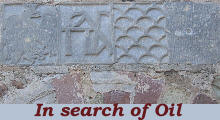
Cunda is still known for its olive groves and olive oil, although its main resource nowadays comes from tourism and from its many summer residents.
At Ayvalik they sell a T-shirt showing in the background a minaret and a bell tower and in the foreground the sentence: Ayvalik, crossroad of civilizations. It is a welcome sign that while in some other parts of the world enmity and hate seem to prevail, here (and also in Mytilini), the view of so many abandoned buildings where ordinary people lived ordinary lives has eventually brought a change in the minds and hearts of the new generations.
The image used as a background for this page shows a detail of an Ottoman building. Other pages of this section: Metimno (Molyvos) Metelino Samothrace Thassos Clickable Map of the Ionian and Aegean Seas with links to other locations covered in this website (opens in a separate window)    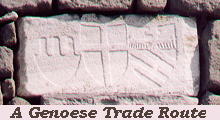 |


