  What's New! Detailed Sitemap All images © by Roberto Piperno, owner of the domain. Write to romapip@quipo.it. Text edited by Rosamie Moore. Page revised in October 2010. | S. Andrea al Quirinale (Book 7) (Day 2) (Map B2) (Rione Monti)
In this page:
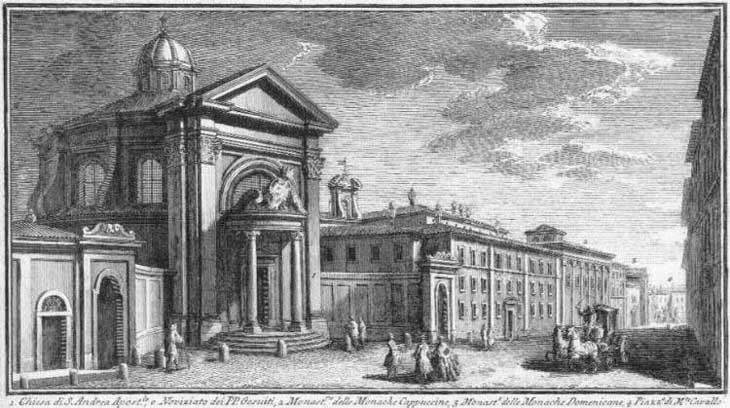
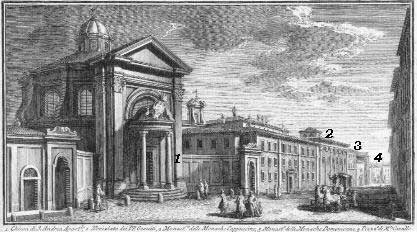
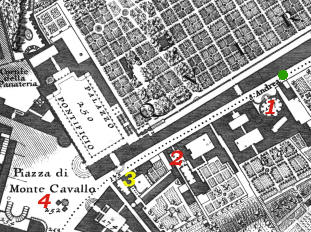
In 1756, at the time of this etching by Giuseppe Vasi, Strada Pia, the street opened by Pope Pius IV to link Piazza di Monte Cavallo (Quirinale) with Porta Pia, could also have been called pia strada (pious street) because its eastern side was occupied by a series of monasteries and nunneries; the church of S. Andrea belonged to a Jesuit friary, but it is commonly named S. Andrea al Quirinale with reference to its location. The view is taken from the green dot in the 1748 map below. In the description below the plate Vasi made reference to: 1) S. Andrea al Quirinale; 2) Monastero delle Monache (nuns) Cappuccine; 3) Monastero delle Monache Dominicane; 4) Piazza di Monte Cavallo. 4) is shown in another page. The dotted line in the small map delineates the border between Rione Trevi (upper part) and Rione Monti (lower part).
Today
After the 1870 annexation of Rome to the Italian Kingdom, Palazzo del Quirinale became the residence of the royal court. The presence of so many religious buildings was in contrast with the very lay policies and legislation which characterized the first fifty years (1861-1911) of the new kingdom. In 1888, on the occasion of a visit to Rome by German Emperor Wilhelm II, it was decided to redesign the surroundings of Palazzo del Quirinale and two nunneries were replaced by a public garden; S. Andrea was spared because of its artistic value, but the adjoining monastery was confiscated and turned into a building which houses public offices. Another change relates to the obelisk placed by Pope Pius VI in 1786 between the two gigantic statues of Piazza del Quirinale. S. Andrea al Quirinale
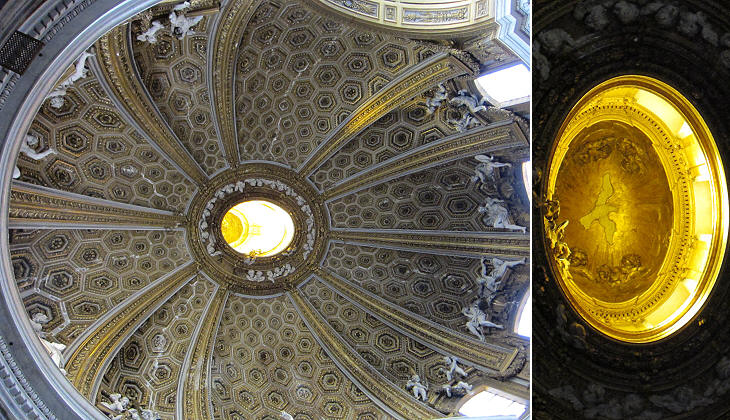
In 1566 a small medieval church dedicated to St. Andrew was donated to the Jesuits who also acquired some adjoining properties; they built a new church which incorporated the old one, but in 1653 they decided to replace it with a larger building; Pope Innocent X, however, denied the authorization, on the grounds that it was not appropriate for the Jesuits to have an imposing church near the palace of the Pope; in 1658, Prince Camillo Pamphilj, nephew of Pope Innocent, convinced Pope Alexander VII to grant the authorization, which was obtained, but with two provisos: a) that the new church should be built at a certain distance from Strada Pia and that it should be screened from it by a wall; b) that the Jesuits should seek the advice of Gian Lorenzo Bernini, the pope's preferred architect.
The construction of the church was completed in 1661, but it did not have a proper façade; after the death of Pope Alexander VII, the obligation to hide the church behind a wall was forgotten and in 1670 Bernini designed the façade, the construction of which was financed by the Pamphilj; their coat of arms was included by Filippo Juvarra in his selection of papal coats of arms (the image used as background for this page is based on a preliminary sketch by Juvarra).
In 1634 Gian Lorenzo Bernini designed a small elliptical church inside Palazzo di Propaganda Fide, but a few years later it was pulled down to make room for a church designed by Francesco Borromini; it is possible that Bernini built on that early project to develop the design of S. Andrea al Quirinale; a church by Borromini (S. Carlo alle Quattro Fontane) is also located along Strada Pia, so it is easy to compare the styles of the two architects. Bernini masterminded the activity of a skilled group of assistants (Mattia de' Rossi, Antonio Raggi, Stefano Castelli and many others), but he did not want to be paid for his personal involvement.
For centuries the ancient Roman monuments were regarded as a never-ending source of marbles and other stones which could be used for the decoration of
churches and palaces, but in the second half of the XVIIth century this source started to dry up; Bernini did not want to use ancient columns of different size and colour for the decoration of S. Andrea, so he used a stone from a quarry near the village of Cottanello in the Apennines, which he first employed in the decoration of S. Pietro.
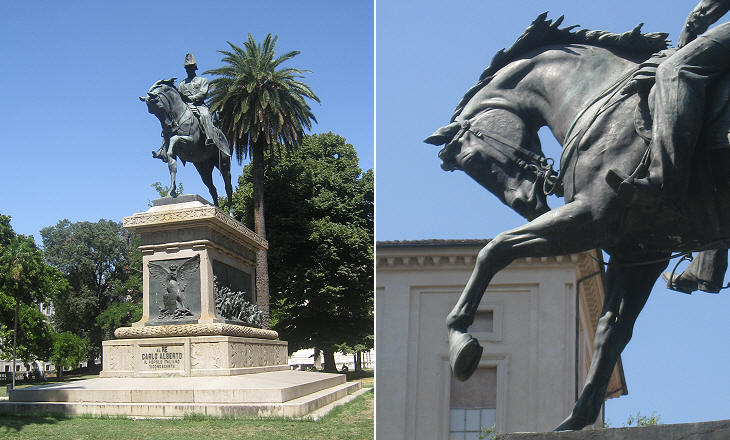
"Italian Hamlet" is a famous appellation by the Italian poet Giosuè Carducci for Charles Albert, King of Sardinia; the king, although supporting constitutional reforms and the cause for Italian Unity had often shown an uncertain conduct, which eventually alienated him from the sympathy of many patriots. He redeemed himself during the First Italian War of Independence in 1848-49; perhaps because he was still regarded as a controversial figure, the monument to him was placed in the new gardens near Palazzo del Quirinale, a rather minor location. Excerpts from Giuseppe Vasi 1761 Itinerary related to this page:
Next plate in Book 7: S. Carlo ai Catinari Next step in Day 2 itinerary: Chiesa e Monastero di S. Susanna Next step in your tour of Rione Monti: Chiesa e Monastero di S. Carlo alle Quattro Fontane |