NOTES ON STRAIT-JACKETS
by Jim Stewart
Jim Stewart is one of the world's foremost authorities on straitjackets
and escapology. He is the founder of Fetters, both in London and
the USA. In 1982 he wrote these "Notes on Strait-Jackets" and distributed
them to Fetter's customers. A few years ago he included the notes
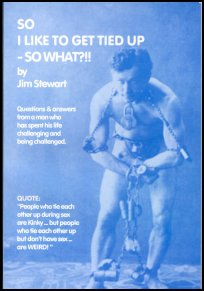
in a short book he wrote entitled, "So I Like to Get Tied Up - So What?!!"
The "Notes on Strait-Jackets" are reproduced here with permission of the
author. (Thanks Jim!)
The image of a strait-jacket.
In the real world there's a general consciousness that such things
exist although most people have never seen one except briefly in a movie
or used by a street performer Escapologist. Most Escape Artists consider
a strait-jacket to be a sure-fire crowd puller. Since HARRY HOUDINI first
introduced the stunt (or at least so he claimed) it has proved to be popular
with a lot of people in a lot of places ... I think, for a lot of different
psychological reasons. It certainly seems to be more than morbid fascination.
A 'Regulation' or Officially Approved strait-jacket: The very existence
of such a barbaric device should, surely, make most people cringe. Suggestion
that such a piece of equipment might have been used in real-life situations
should make the whole idea repugnant? So why do crowds regularly gather
to see someone strapped into such a threatening and challenging situation?
I won't attempt to analyze the reasons - the fact is indisputable: vast
numbers of people enjoy seeing such a happening. Just what percentage of
the crowd speculates on what it might be like to have it done to them /
do it to somebody else / have a shot at escaping .... who knows? The fact
remains that being 'interested' in strait-jackets isn't all that unusual.
What is a strait-jacket?:
Traditionally it is a reasonably tough fabric garment designed to
prevent violent mentally disturbed patients and prisoners from causing
harm to themselves and other people (before the days of sedatives). Strait-jackets
or strait waist-coats can be anything from a simple smock with closed sleeve
ends and tie tapes, to deliberately intimidating constructions of sail-cloth,
leather straps and metal hardware. The term 'Regulation' usually suggests
that it is an approved pattern, as used in a particular Institution or
by a particular prison authority. In hospitals where a patient may continually
remove all his/her clothes the garment was often little more than a night-gown
which the wearer could not remove.
In Britain 'The Home Office', the authority which has responsibility
for most Police and Prison equipment, has at various times in the past
approved specifications for pieces of restraining clothing (although all
information on the garments is 'strictly classified'). Inevitably, the
existence of such equipment has led to it being used as punishment as well
as a last resort. In places where such an item would find very little actual
use, to have some form of restrainer hanging around serves as a useful
threat, to keep would-be troublesome patients in line.
Historical records:
Official records are almost non-existent. Restraint devices and
early prison equipment were usually made locally to specifications of people
responsible for running the establishment. Hence personal preferences dictated
the design and frequency of use of such equipment. There is evidence that
many jackets in hospitals and prisons were purposely designed to look threatening;
extra bands of canvas and leather to suggest additional strength and durability.
In reality such thick and bulky strait-jackets may not have been as efficient
as a well constructed garment made from lighter pliable rip-proof canvas.
Not only more comfortable, light-weight jackets can be infinitely more
confining it correctly cut and sewn - and efficiently applied.
Psychological impact:
Seeing someone restrained by, strapping someone into, or being strapped
into ... is what we are dealing with in these notes. Whether as a challenge
or punishment, here is a situation in which energy and aggression can be
worked off harmlessly. Although strait-jackets are now seldom used 'officially'
in most European medical/ detention institutions - it is still recognized
in some circles that the hugging tightness of a well-applied strait-jacket
has a calming effect on some patients once they have exhausted all attempts
to free themselves. In less, threatening situations, to escape from a strait-jacket
can be an exhilarating experience for an escaper and anyone watching. Many
spectators when watching an Escape Artist probably feel the urge to help
strap the would-be escaper. What number of them would, secretly, like to
have a go at struggling free?
Escaping from.......:
In the short space available only the basics can be indicated. JOHN
NOVAK wrote a small book for Escape Artists which covered alternatives.
Called STRAIT- JACKET ESCAPES it is still in print. Techniques for escaping
from a strait-jacket must necessarily vary with the design and manner in
which it is applied. This is the main consideration. HOUDINI never allowed
anyone a second chance to strap him into a jacket. To successfully escape
the main aim should be to surreptitiously gain 'slack' while the garment
is being strapped on. Every inch counts, particularly in the tightness
of the arm straps.
Factors affecting escape:
(A) Whether straps or tie tapes are used.
(B) If canvas is supple enough to use fingers through it.
(C) If it is possible to work the arms upwards or downwards.
(D) If arm-holes are wide enough to work arms out of sleeve by twisting
jacket around the body
Quick release.......
1 . Slack is gained mainly by expanding chest and faking tightness by bracing
elbows against sides as jacket is strapped on. Extra space can also be
stolen by gripping a handful of fabric under the arms out of sight.
2. When ready to escape relax all muscles, hunch shoulders forward
to bring all available slack to back, pushing arms deeper into sleeves.
This leaves all available slack in-back allowing buckle of arm-strap to
be worked systematically upwards until arms can be pulled free over head
- or downwards to bring arms under seat. This, of course, can only be achieved
in jackets which have no side loops through which arms have been passed.
It will be noticed that virtually no Escape Artist uses an S/J with side
loops. On TV if the Hero escapes from a jacket, arms are not through the
loops.
3. To complete an escape once arms have been un- crossed, fingers
through canvas can usually work at straps or ties, or by shifting the jacket
around the body, teeth can often reach buckles
4. HOUDINI often made his jacket escapes out of view, inside
a 'cabinet'. Who knows what clips, hooks, razor blade and other useful
gimmicks were concealed within what was, essentially, a conjuror's magic
cabinet.
Escape from any jacket is very much a matter of practice. To improve
chances of escape by methods 1/2/3, when jacket is applied the right arm
should be crossed over the left (unless you're left-handed), placing right
hand on left bicep (that is, if you are allowed to 'get away with it')
otherwise under left elbow. It is best to avoid allowing arms to be 'folded'.
When trying to work both arms upwards and over the head, brace the elbow
against a wall or door-handle. Or kneel down on one knee, using the other
as a Pushing Post. The same effect can be accomplished by lying face down
on the floor and rolling alternately from one elbow to the other, forcing
the elbows closer together to increase slack in mitt straps. The easiest
way to escape from a strait-jacket is to be sure that it is only ever strapped
on by someone who has never done it before.
To prevent escape:
Having studied and experimented with ways to escape from a strait-jacket
it becomes more easy to devise ways to make escape more difficult. Jackets
used by Escape Artists usually have longish wide sleeves, loose neck-bands
and no strap between the legs. (Crotch strap) and certainly no side loops.
A jacket with short, tight sleeves, snug under the armpits presents a much
more exacting challenge. A close high collar also adds to the general 'cling',
and straps connecting sleeves should be short with holes right up to the
end .... and be very strong. The strain in all directions on a well applied
jacket can be intense, seams should be double sewn.
Additional defenses against escape:
A crotch strap to prevent the body of the jacket being dragged over the
head. In addition to side loops, arm straps anchored through one of the
back straps to stop arm strap buckle moving either up or downwards. Sleeve-ends
around hands being made of heavy material or leather to prevent tampering
with buckles through sleeves will defeat many would-be Escape Artists.
A small strap added around each wrist before the arms are crossed makes
'slipping' the jacket virtually impossible. Extra reinforcement of seams,
elbows and neck will stop any attempts to wear a way out of an otherwise
escape-proof jacket - but most important of all is to eliminate 'slack'.
Getting the jacket on in a challenge situation:
Even with a willing victim, applying a jacket single-handed needs practice.
A particular awareness of the various tricks for gaining slack is essential.
One way to eliminate stolen slack is, after threading the arm-strap as
far as possible, to then stand to one side and brace your body against
that of the victim, use the free hand to clamp prisoners elbows together.
The back-strap can then be wrenched tighter at the same moment elbows are
pulled closer together.
Two people applying a jacket:
Slack can be eliminated much more easily with additional vigilance.
Also as one pulls the arm-strap tight behind, the other can press the victims
elbows together at the front. It is amazing how much further arms will
reach across the chest with a little persuasion. Two people can also manage
to 'fold' a victims arms even against quite violent opposition.
Unwilling victim being forced into a strait-jacket:
This is a complicated and potentially dangerous undertaking. As
a test of ingenuity and stamina it can be fun. In a one-to- one situation
it is virtually impossible unless the pair are very unequally matched.
With two against one, if a routine has been worked out in advance, it is
possible to subdue a victim even if he is prepared to put up a healthy
struggle. In any event it's certainly fun to try.
Finally, extra defenses against a would-be Escapee:
Escape from any form of body restrainer is seriously hampered if
feet are strapped together. A strong leather strap or Pinion Strap set
threaded between elbows at the back defeats most would-be Escape Artists.
Lacing the hapless (helpless) bundle to a bed or short ladder (which must
be safely anchored or laid on floor). Imagination, ingenuity and the element
of surprise count for much in the field of escapes and the sort of challenges
we have been discussing.
This article is included in the book, "So I Like to Get Tied Up -
So What?!!", available from
Fetters.
It is a nice book. Buy it!
Jim Stewart would like
to hear from you. Send him an email!
NOTES ON STRAIT-JACKETS
- Jim Stewart is one of the world's foremost authorities on straitjackets
and escapology. He is the founder of Fetters, both in London and
the USA. In 1982 he wrote these "Notes on Strait-Jackets" and distributed
them to Fetter's customers. A few years ago he included the notes
in a short book he wrote entitled, "So I Like to Get Tied Up - So What?!!"
The "Notes on Strait-Jackets" are reproduced here with permission of the
author. (Thanks Jim!)
The image of a strait-jacket.
In the real world there's a general consciousness that such things
exist although most people have never seen one except briefly in a movie
or used by a street performer Escapologist. Most Escape Artists consider
a strait-jacket to be a sure-fire crowd puller. Since HARRY HOUDINI first
introduced the stunt (or at least so he claimed) it has proved to be popular
with a lot of people in a lot of places ... I think, for a lot of different
psychological reasons. It certainly seems to be more than morbid fascination.
A 'Regulation' or Officially Approved strait-jacket: The very existence
of such a barbaric device should, surely, make most people cringe. Suggestion
that such a piece of equipment might have been used in real-life situations
should make the whole idea repugnant? So why do crowds regularly gather
to see someone strapped into such a threatening and challenging situation?
I won't attempt to analyze the reasons - the fact is indisputable: vast
numbers of people enjoy seeing such a happening. Just what percentage of
the crowd speculates on what it might be like to have it done to them /
do it to somebody else / have a shot at escaping .... who knows? The fact
remains that being 'interested' in strait-jackets isn't all that unusual.
What is a strait-jacket?:
Traditionally it is a reasonably tough fabric garment designed to
prevent violent mentally disturbed patients and prisoners from causing
harm to themselves and other people (before the days of sedatives). Strait-jackets
or strait waist-coats can be anything from a simple smock with closed sleeve
ends and tie tapes, to deliberately intimidating constructions of sail-cloth,
leather straps and metal hardware. The term 'Regulation' usually suggests
that it is an approved pattern, as used in a particular Institution or
by a particular prison authority. In hospitals where a patient may continually
remove all his/her clothes the garment was often little more than a night-gown
which the wearer could not remove.
In Britain 'The Home Office', the authority which has responsibility
for most Police and Prison equipment, has at various times in the past
approved specifications for pieces of restraining clothing (although all
information on the garments is 'strictly classified'). Inevitably, the
existence of such equipment has led to it being used as punishment as well
as a last resort. In places where such an item would find very little actual
use, to have some form of restrainer hanging around serves as a useful
threat, to keep would-be troublesome patients in line.
Historical records:
Official records are almost non-existent. Restraint devices and
early prison equipment were usually made locally to specifications of people
responsible for running the establishment. Hence personal preferences dictated
the design and frequency of use of such equipment. There is evidence that
many jackets in hospitals and prisons were purposely designed to look threatening;
extra bands of canvas and leather to suggest additional strength and durability.
In reality such thick and bulky strait-jackets may not have been as efficient
as a well constructed garment made from lighter pliable rip-proof canvas.
Not only more comfortable, light-weight jackets can be infinitely more
confining it correctly cut and sewn - and efficiently applied.
Psychological impact:
Seeing someone restrained by, strapping someone into, or being strapped
into ... is what we are dealing with in these notes. Whether as a challenge
or punishment, here is a situation in which energy and aggression can be
worked off harmlessly. Although strait-jackets are now seldom used 'officially'
in most European medical/ detention institutions - it is still recognized
in some circles that the hugging tightness of a well-applied strait-jacket
has a calming effect on some patients once they have exhausted all attempts
to free themselves. In less, threatening situations, to escape from a strait-jacket
can be an exhilarating experience for an escaper and anyone watching. Many
spectators when watching an Escape Artist probably feel the urge to help
strap the would-be escaper. What number of them would, secretly, like to
have a go at struggling free?
Escaping from.......:
In the short space available only the basics can be indicated. JOHN
NOVAK wrote a small book for Escape Artists which covered alternatives.
Called STRAIT- JACKET ESCAPES it is still in print. Techniques for escaping
from a strait-jacket must necessarily vary with the design and manner in
which it is applied. This is the main consideration. HOUDINI never allowed
anyone a second chance to strap him into a jacket. To successfully escape
the main aim should be to surreptitiously gain 'slack' while the garment
is being strapped on. Every inch counts, particularly in the tightness
of the arm straps.
Factors affecting escape:
(A) Whether straps or tie tapes are used.(B) If canvas is supple enough to use fingers through it.
(C) If it is possible to work the arms upwards or downwards.
(D) If arm-holes are wide enough to work arms out of sleeve by twisting jacket around the body
Quick release.......
1 . Slack is gained mainly by expanding chest and faking tightness by bracing elbows against sides as jacket is strapped on. Extra space can also be stolen by gripping a handful of fabric under the arms out of sight.2. When ready to escape relax all muscles, hunch shoulders forward to bring all available slack to back, pushing arms deeper into sleeves. This leaves all available slack in-back allowing buckle of arm-strap to be worked systematically upwards until arms can be pulled free over head - or downwards to bring arms under seat. This, of course, can only be achieved in jackets which have no side loops through which arms have been passed. It will be noticed that virtually no Escape Artist uses an S/J with side loops. On TV if the Hero escapes from a jacket, arms are not through the loops.
3. To complete an escape once arms have been un- crossed, fingers through canvas can usually work at straps or ties, or by shifting the jacket around the body, teeth can often reach buckles
4. HOUDINI often made his jacket escapes out of view, inside a 'cabinet'. Who knows what clips, hooks, razor blade and other useful gimmicks were concealed within what was, essentially, a conjuror's magic cabinet.
Escape from any jacket is very much a matter of practice. To improve chances of escape by methods 1/2/3, when jacket is applied the right arm should be crossed over the left (unless you're left-handed), placing right hand on left bicep (that is, if you are allowed to 'get away with it') otherwise under left elbow. It is best to avoid allowing arms to be 'folded'. When trying to work both arms upwards and over the head, brace the elbow against a wall or door-handle. Or kneel down on one knee, using the other as a Pushing Post. The same effect can be accomplished by lying face down on the floor and rolling alternately from one elbow to the other, forcing the elbows closer together to increase slack in mitt straps. The easiest way to escape from a strait-jacket is to be sure that it is only ever strapped on by someone who has never done it before.
To prevent escape:
Having studied and experimented with ways to escape from a strait-jacket it becomes more easy to devise ways to make escape more difficult. Jackets used by Escape Artists usually have longish wide sleeves, loose neck-bands and no strap between the legs. (Crotch strap) and certainly no side loops. A jacket with short, tight sleeves, snug under the armpits presents a much more exacting challenge. A close high collar also adds to the general 'cling', and straps connecting sleeves should be short with holes right up to the end .... and be very strong. The strain in all directions on a well applied jacket can be intense, seams should be double sewn.Additional defenses against escape:
A crotch strap to prevent the body of the jacket being dragged over the head. In addition to side loops, arm straps anchored through one of the back straps to stop arm strap buckle moving either up or downwards. Sleeve-ends around hands being made of heavy material or leather to prevent tampering with buckles through sleeves will defeat many would-be Escape Artists. A small strap added around each wrist before the arms are crossed makes 'slipping' the jacket virtually impossible. Extra reinforcement of seams, elbows and neck will stop any attempts to wear a way out of an otherwise escape-proof jacket - but most important of all is to eliminate 'slack'.Getting the jacket on in a challenge situation:
Even with a willing victim, applying a jacket single-handed needs practice. A particular awareness of the various tricks for gaining slack is essential. One way to eliminate stolen slack is, after threading the arm-strap as far as possible, to then stand to one side and brace your body against that of the victim, use the free hand to clamp prisoners elbows together. The back-strap can then be wrenched tighter at the same moment elbows are pulled closer together.Two people applying a jacket:
Slack can be eliminated much more easily with additional vigilance.
Also as one pulls the arm-strap tight behind, the other can press the victims
elbows together at the front. It is amazing how much further arms will
reach across the chest with a little persuasion. Two people can also manage
to 'fold' a victims arms even against quite violent opposition.
Unwilling victim being forced into a strait-jacket:
This is a complicated and potentially dangerous undertaking. As
a test of ingenuity and stamina it can be fun. In a one-to- one situation
it is virtually impossible unless the pair are very unequally matched.
With two against one, if a routine has been worked out in advance, it is
possible to subdue a victim even if he is prepared to put up a healthy
struggle. In any event it's certainly fun to try.
Finally, extra defenses against a would-be Escapee:
Escape from any form of body restrainer is seriously hampered if
feet are strapped together. A strong leather strap or Pinion Strap set
threaded between elbows at the back defeats most would-be Escape Artists.
Lacing the hapless (helpless) bundle to a bed or short ladder (which must
be safely anchored or laid on floor). Imagination, ingenuity and the element
of surprise count for much in the field of escapes and the sort of challenges
we have been discussing.
This article is included in the book, "So I Like to Get Tied Up -
So What?!!", available from
Fetters.
It is a nice book. Buy it!
Jim Stewart would like
to hear from you. Send him an email!