
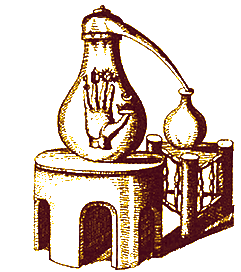

LESSONS IN THE UNFOLDMENT OF THE
PHILOSOPHER'S STONE
by
Delmar DeForest Bryant
 CHAPTER I
"Behold I lay in Zion for the foundation, a stone, a tried stone, a precious corner stone, a sure foundation. He that believeth shall not make haste."
---Isaiah: 28.16

No greater mystery was ever involved in human consciousness than that which is implied in the term "Philosophers' Stone." Although the greatest of mysteries, and one that seemingly defies analysis and baffles investigation, yet for that very reason if for no other, it fascinates and holds the minds of all who come in touch with the subject and credit the possibility of its attainment or discovery.
Setting out in search for this wondrous Stone is very much like undertaking a journey to the end of the rainbow for that fabled pot of gold. To attempt the solution of the mystery subjects one to the fate of those who tried to answer the Riddle of the Sphinx; yet from all the available hints and suggestions afforded us through the writings of numerous mystics it is apparent that the thing has been known and understood by many, and that it is simple of explication, once one has the key to it, as the famous Riddle.
The Sages all assure us that the Thing called Philosophers' Stone is a thing "seen by all but recognized by few." They say that it is a common element, or rather the Quintessence of all elements, Fire, Air, Earth, Water, and that virtually it is contained in all things, but more in some than in others. Again, they say that its simplicity is so great that if openly declared it would be utterly incredible.
Pythagoras, in his Fourth Table, says: "How wonderful is the agreement of the Sages in the midst of difference! They all say that they have prepared the Stone out of the substance which by the vulgar is looked upon as the vilest thing on earth. Indeed, if we were to tell the vulgar herd the ordinary name of our substance, they would look upon our assertion as a daring falsehood. But if they were acquainted with its virtue they would not despise that which is, in reality, the most precious thing in the world. God has concealed this mystery from the wicked and the scornful, in order that they may not use it for evil purposes." Such statements as these only add to the baffling nature of the mystery itself, since they carry complete confirmation of its reality, but throw little or no light upon its nature or means for its discovery. They serve to whet the zeal of those aspirants to the attainment of this wonderful Stone, but do not greatly aid them in finding it.
People in general, may be divided into two classes, viz., those who never heard of such a thing as the Philosophers' Stone, and they are the mass, and, those who have heard it mentioned, but who regard it as some medieval fake or fairy-tale. Just a rare few there are who take the subject seriously and believe in the existence of the Stone, and the possibility of its production. But of those who believe, we have two distinct classes. 1st; those who construe it as metaphysical, and 2nd, those who hold to the purely physical conception.
The former class, and they include probably the mass of our thinkers and writers, interpret the Philosopher's Stone of Hermetic Science to be some peculiar and abnormal psychic development of the individual, by and through which he acquires unusual powers, not only in the extension of the ordinary sense-faculties, but also in the acquisition of magical ability in dealing with the elements themselves.
The latter class, only a few of whom exist on this planet at the present time, read the writings of the Sages more literally, and see the Stone for what it purports to be, viz., a menstruum or means for prolonging life, as well as for the conversion of the baser metals into Silver and Gold.
The metaphysical alchemist regards all occult descriptions of minerals and metals, of salts and solutions, of principles and processes, as simply so many figurative expressions for certain mental and spiritual states and conditions, while the physical alchemist sees nothing whatever in these vague, symbolic statements with which the books of the sages teem, beyond allusion to a certain hidden, or lost, art of chemistry.
The writer was attracted to this subject in very early youth by finding a piece of old parchment on which was written what purported to be a recipe for making the Alkahest, or menstruum, by which lead was said to be converted into gold. This incident, and some peculiar circumstances in connection with it, was the means of leading the mind to give serious thought and investigation to the subject of medieval alchemy and later to Egyptian Hermeticism, which in the end was the means of necessitating a search through all literatures extant.
This search for reliable data on the subject extended over many years. One quite unfamiliar with the subject could have no idea of what a mass of testimony there is to be found bearing on the subject, nor did the writer follow the plan of certain omnivorous collectors with whom he has been brought in contact, who appear to think all they have to do is to collect books on the subject and read them over. An incident is recalled of meeting such a bibliomaniac at one time in New York City. This person was what we call 'daffy' on the subject of occultism, under which term he classed everything relating to alchemy, theosophy, astrology and mysticism in general. He had gotten together at enormous expense a most wonderful library, but it was soon evident in conversation with him that he had not the slightest illuminating with respect to the subject-matter of his vast library. Such reading had not increased the sum-total of his wisdom. Many similar cases are to be found.
In our earlier experience we followed an entirely different plan.
The imagination is the very Hammer of Thor, with which he cleaves the skies, and forges thunderbolts to do his bidding. Most people seem almost wholly devoid of it, which explains why they are crawling about upon a planet of dirt like so many flies or ants. Unless by some process Imagination be unfolded, it is impossible to acquire any sane or reasonable idea of the Philosophers' Stone. If we suggest conditions and processes that seem to be outside the pale of unusual experience, or unsanctioned by orthodox philosophy, it is purely for the purpose of arousing this greatest of all faculties of the human mind, Imagination. Freedom, travel diversity, Love--these are some of the conditions necessary to the unfoldment of imagination, and the Philosophers' Stone.
After collecting the testimonies of a large number of alchemical writers, a careful comparison of them was made, and one of the first things noted was the fact that, although these writers lived a different epochs, and wrote in different languages, yet a most striking similarity was observable in their styles of writing, and more especially in the symbols which they employed. From this the whole conclusion became irresistible that they all were discoursing of the very same thing, and something assuredly which they all understood in common.
This thing is called by a great variety of names in the books of the Sages, but all are said to signify One Thing, viz., The "Philosophers' Stone". And what, in brief, are the qualities and virtues attributed to the Stone? It is said to be a substance intellectually discoverable, and producible, but only by a secret process, known to a few advanced sages in the history of the world. Of course, it is impossible to know how many of such have existed, but very few are recorded. The Stone has the inherent, or developed, power of bringing everything with which it comes in contact into a state of harmony and perfection. It changes all the baser metals into gold, and restores man to perfect health.
Since neither the metaphysical nor the physical school of investigators along this line has apparently ever accomplished any miracle of this sort, or been able to discover any such wonderful "Stone" in their experience, it is not difficult to draw the conclusion that something has been at fault with their process, indicating a fundamental error in their interpretation of the meaning of the mystery itself.
So, without guide or compass, without so much as a friendly hint from a living soul, we set out to find the lost trail in a veritable jungle, the traces of which were apparently hopelessly obliterated. To follow other commentators seemed of little avail. One of the earliest of these, and about the only one printed in this country until our own works on the subject appeared, was a book by E. A. Hitchcock, entitled "Alchemy and the Alchemists," published about 1850.
The writer belongs apparently to the metaphysical school, for he assumes the "Conscience" as the thing glyphed by the Philosophers' Stone. In his work, which is cleverly written, he draws some very interesting parallels and deductions, which might prove convincing to the average reader; for the mass of humanity are mentally so constituted, that when they have assumed a hypothesis as a pivotal point around which they can argue, they appear satisfied, as if they had really come to the root of the matter. Just as humanity is satisfied with the hypothesis of a creator, or ruling deity, called God. It is the master hypothesis, undefined and unproved, and yet accepted as final by the mind of man. So in its solution of this Master Principle of nature, called by Hermes the "Philosophers' Stone," the orthodox mind may be quite satisfied to consider it as the "Conscience," believing as it does that the conscience is the most essential thing possessed by man.
But it takes only a very little logical reasoning to disprove the validity of this correspondence between the "Philosophers' Stone" and conscience. Can conscience produce gold from lead? Can the conscience heal a disease? And even if we take gold to mean Character, what really has conscience to do with the latter? No one can rationally regard Conscience as a panacea for human ills. It rather is the indirect CAUSE of all ills, inasmuch as it is the phase of mind that recognizes evil--that fears and broods over evil--and consequently is back of all evil and adverse realization in human experience.
If Hitchcock had made Consciousness, instead of conscience, synonymous with the "Stone," he would, from a purely metaphysical standpoint, have come nearer defining it. But even then the question remains, Consciousness of what? For consciousness to BE consciousness must be conscious of some THING--not necessarily a physical thing--it may be metaphysical, as Love, the consciousness of feeling, or Life, the consciousness of being. But whether concrete or abstract, it really amounts to the same thing.
We believe we have very clearly shown in previous lessons how that the abstract and the concrete are but different phases of one and the same thing. Nor can the mind be said to be master of a thing, until it understands how to convert it into one state or the other at will--that is, to make the metaphysical physical, or the reverse. And this essentially is alchemy, or transmutation.
This peculiar feature is to be observed in common with all the sages, namely, that while none of them ever attempt to reveal the art openly in so many plain words, and while they all apparently retire from the world as soon as ever they come into the supreme knowledge of the Stone, and never thereafter are seen to mingle with people in a general way, yet they all appear to have one common, deep, altruistic desire to write in such a manner concerning this great mystery as to lead those interested to investigate the subject for themselves, thus aiding them in their investigations.
A great deal is said in these writings about the worthiness of the student to come into possession of this knowledge, and that worthiness is made contingent upon his ability to discover, an ability which is evidenced by a rare disposition and character, and distinguished by indifference to worldly attainment, to honor and wealth and selfish gratification, and by great and unusual zeal in the acquirement of true wisdom and knowledge. With all this, the aspirant must be anchored by faith, which inspires belief in unlimited human attainment. He must know, through the unfoldment of rationality, that anything conceivable is possible of acquirement. And when the understanding of his UNITY with ALL-POWER becomes a matter of conscious knowledge, then he perceives clearly that this assumption of personal power rests upon a solid foundation.
It will be our aim in the forthcoming lessons to lead the mind of a student by a definite process of reasoning through a comparison of the statements of the Sages to a clear perception of what is intended to be conveyed by the term, "Philosophers" Stone;" whether one ever comes into actual conscious possession of such a boon is quite another matter. It is essential at the very outset that one lay aside egotism and personal bias long enough to grasp some idea of what it would mean to be in possession of such a masterly gift as the "Philosophers' Stone." Most people will get the idea that it is something that should be discovered, as Edison has discovered practical electric illumination, and then dealt out to them at so much per kilowatt, or ounce, as the case may be. In illustration of the very limited notion that even students of this noble Art sometimes have, we cite the instance of a learned man who once sent a dollar to us for a "piece" of the "Philosophers' Stone," as if we had it in boxes or barrels! He had read that if you had a small piece you could multiply it, and economy suggested to him the investment of a dollar only in the "raw product," whereupon he believed he could multiply it at will, something as the chemist does a bacterial culture.
We may say at the very outset that nothing is of greater value in this quest than common-sense and reason. The Powers that have possession of this knowledge, who may be said to be the discarnate adepts of the Chaldean and Atlantean periods, will see to it that it never falls into hands that could by any possibility misuse it, and the aspirant to this knowledge, once he takes the path, will be put to EVERY POSSIBLE TEST, before the true and full awakening comes.
Progress is made and assured through sincere motives and the awakening of the psychic faculty. All superior, magical knowledge is, as you may say, stored in a vast reservoir, and within reach of every individual if he will but use the proper tools to open and gain connection with this inexhaustible supply of wisdom. Our earlier suggestions in this course of lessons are all pertinent and germane to the desired attainment. No sage will ever write openly of this subject. You, yourself, would not if you became a sage. The very nature of the subject is such that a knowledge of it insures its protection. No person would foolishly reveal that which will stop his progress in life and handicap his progress, if he knows it. No sane man, if he discovers a mine, will run and tell every one about it. Jesus says that a man discovering a precious pearl will go and buy the FIELD.
Here, more than elsewhere, silence, secrecy, and indirection are demanded on the part of the neophyte. Of what avail to shout such things from the house top? Of what avail to cast pearls before swine? The unawakened mass are as the swine, content to wallow, and it is this mass that stands ready to "turn and rend you." Be wise as serpents and harmless as doves. "Render unto Caesar the things that are Caesar's and unto God the things that are God's." To the latter belong this wisdom concerning the "Philosophers' Stone." By this wisdom Jesus was enabled to catch the fish that produced the gold to pay his taxes to Caesar, so that the knowledge of God takes care of the faithful in any situation. "Consider the lily," and do not bother about clothing and food for tomorrow, because He has power to produce these things at a moment's notice. Moreover, one possessing his power could say, "If a man smite thee on one cheek, turn the other," for the striking arm would drop from paralysis. And why could he NOT afford to give away both cloak and coat?
From the very earliest times of which we have any record, there are evidences that there have been those who possessed the knowledge of this wonderful Stone. Isaiah, Zechariah, and all the prophets speak of it. And before that time, Moses makes mention of it in his wonderful "Song." Even Abraham knew it. No doubt he learned it from Melchizedek, Prince of Peace, who came out to meet him. In Genesis 15.8 to 17, we have an occult account of divination which shows Abraham to have been an alchemist. The tale of the "molten calf" in the wilderness also reveals the fact that Moses was a very good alchemist, indeed, for to grind up a "golden calf," so that the Israelites could drink it, was a feat that only a good alchemist could perform.
There are those, like Jacob Boehme, who have been able to divine that Christ himself is but a figure of the Stone. (Christ is from the Greek for NShICh--358--NChSh, the serpent who tempted Eve. The Stone is therefore "The Anointed One," but this One is the same that brings about the Fall.) Indeed, he is called that throughout the Bible. But the true knowledge of the Stone will raise the mind above the contemplation of Christ as an isolated figure in history, and will reveal Christ as the dominant principle of life in the whole world, particularly in man himself, and in all that immediately relates to humanity and its needs.
Thus, while the principle of Christ, or the Stone, is metaphysical like TRUTH itself, yet it unfolds itself in myriad ways to the consciousness of man, and brings to life and its terrestrial experiences every joy. It is primarily the principle of abundance and supply. On the first planes it relates to the transmutation of the chemical into the vegetable, and higher up of the vegetable into the animal. It is, from start to finish, a molding of the abundance of life by Spirit, into desired and desirable forms. Its processes are absolutely magical, though many of them are so common and apparent that they cease to be considered wonderful.
There are two classes of such processes, those that have become established in any certain era of the world's progress, and these stand revealed in the seemingly fixed and varying forms of nature. However, we see that every form and its fixity are but illusions, for these are ever disappearing and reappearing, yet they manifest themselves apart from human consciousness and control. Then there are those processes which the mind of man may invent or devise, which give him certain definite powers over those natural forces that ordinarily are quite beyond his control.
It is manifestly the study and attainment of these processes that leads to adeptship. We wish to draw a wide line of demarcation between conjuring of spirits and the unfoldment of true Hermetic Wisdom. Thaumaturgy has no more to do with alchemy than has astrology. In fact, less, for the symbols of astrology were originally derived from alchemy, (no proof of this statement is offered, however) and there exists a subtle connection between the two sciences. The reason the stars govern men's lives is not to be found in the planets, but rather in certain alchemic correspondences in man himself.
The "Philosophers' Stone" may be looked upon as a fact or reality, though at the present time, for certain reasons, its knowledge is withheld from the mass of mankind. The time is at hand when this knowledge is to be restored at first to a faithful few, who will thus have power to rehabilitate and restore the fallen race. It will mean the abolition of poverty and disease. To those who are able to sense the glory of the New Jerusalem, descending as a Bride adorned, this unfoldment is possible and will come, if they are earnest and faithful to the end.
CHAPTER II
"For behold the Stone that I have laid before Joshua; upon one stone shall be seven eyes; behold I will engrave the graving thereof, saith the Lord of Hosts, and I will remove the iniquity of that land in one day."
---Zechariah, 3.9
One of our greatest Hermetic philosophers has written a tract called "The Sophic Hydrolith," which means, "The Water-Stone of the Wise." This writer tells how that "from the beginning of the world God-enlightened men and experienced philosophers diligently studied nature and fervently longed to discover if it contained anything that would preserve the earthly body from disease and death, and maintain it in perpetual health and vigor." At last, he declares, it was discovered, and was used by the patriarchs to restore their bodily vigor and prolong their lives, whereby they procured "length of days and boundless wealth."
Those who discovered it, he says, "always made it a point of conscience and honor to keep it secret. But that the secret might not be lost, but rather preserved to posterity, they expounded it most faithfully in their writings; nevertheless, they so clothed and concealed the truth in allegorical language, that even now only a few are able to understand their instruction and turn it to practical account."
"Lest any one," says our author, "should doubt the existence of this secret Art, or look upon it as a mere figment, I will enumerate some of the true Sages, (besides those names in Holy Scripture) who really knew this Art. They are, Hermes Trismegistus, Pythagoras, Alexander the Great, Rhasis, Acholaus, Rupecissa, Mary the Prophetess, Dionysius, Zachaire, Haly, Morienus, Calid, Constantius, Serapion, Albertus Magnus, Estrod, Arnold Villanova, Geber, Raymond Lully, Roger Bacon, Allan, Thomas Aquinas, Marcellus Palingenius, Bernard of Trevisa, Frater Basil Valentine, Paracelsus and many others."
This writer (Boehme) gives some very clear hints regarding this "most precious object, the "Philosopher's Stone," the most ancient, secret, natural, incomprehensible, heavenly, blessed, beatified and triune Universal Stone of the Sages." The reason for naming it a stone, he states, or likening it to a stone, was this: First, because its original matter IS really a kind of a stone, which being hard and solid like a stone, may be pounded, reduced to power, and resolved into its three elements (which nature herself has joined together), and then again may be re-combined into a solid stone of the fusibility of wax, by the skilled hand of the artist, adjusting the law of Nature.
The above paragraph contains some very valuable suggestions to one who will meditate thereon. A pertinent question may be asked right here: How is it possible to construe such statements as these as figurative or metaphysical? Surely, if they are designed to tell anything at all, it must be some plain fact in relation to some natural object. The original matter of the "Philosopher's Stone," it is stated by Boehme, is a "kind of-stone." Now, what can be possibly meant by this statement? It means that we must locate that particular "stone." The importance of starting with the exact knowledge of the First Matter of the Stone is largely dwelt upon by all writers, and naturally, because without this, progress is impossible.
It is said that the "matter of the Stone is found in One Thing, out of which alone our Stone is prepared, without any foreign ad-mixture." Naturally, the student or searcher for this mystery should look first for the said "One Thing," and never cease until he is SURE that he has it. It appears to be called by a thousand names, not so much to hide it, evidently, as to reveal it, if only the student will consider that each "name" given it implies some specific quality, condition, or appearance of the substance itself, whereby it may the more easily be recognized. It is never called by its actual name, that is, its common name; therefore, when the Sages say that it is "salt," "sulphur," "lead," "orpiment," or any other thing, know that they are not to be taken literally in what they say. Every alchemical writer says this, yet, despite the admonition, many will go right ahead on the assumption that it is this or that or the other thing mentioned in the books, particularly "sulphur" and "mercury," as these two substances are perhaps mentioned most frequently.
These names, let it be understood, are to be taken in their basic signification: SULPHUR (sol-pyr) is fundamentally SUN-FIRE, while Mer-cury (Mar-kurios) is "Lord of the Waters." The terms really signify occultly the inner principles of Fire and Water, having as little reference to actual fire and water as they do to mineral sulphur and mercury.
Another thing that gives rise to many puzzling, and seemingly contradictory, statements of the Sages, is the fact that the matter itself is described at so many different stages of the Stone's confection. At one time it will be likened to "gum and white water," and again it will be termed the "water of life." Not the water of the clouds, or of any common spring, but "a thick, permanent, salt, and dry water which does not wet the hand--a SLIMY WATER which springs from the fatness of the earth."
And by "earth" they do not mean the common ground on which we walk, but the "earth of the Sages,: which is a very part of the confection itself. In Genesis we read how that the "Spirit of God moved upon the face of the waters." And we note in nature how that all life springs primarily from the waters; and when it becomes "slimy," as in a stagnant pool, there we see abundant manifestation of infusorial and insect life-forms, springing spontaneously from the water as their natural matrix. The confection of the Stone appears to follow much the same law as that exhibited in ordinary water when subjected to the sun's ray, so that it is possible to draw a strong parallel between the Water of the sea, and the Water of the sages.
They tell us that this Water is found potentially everywhere, in everything, but in all its perfection and fullness in only one thing, seen by all but known by few. This author gives the following enigma: "It is in everything, so that everything contributes to the formation of this Stone. It is conceived below the earth, quickened in heaven, dies in time, obtains eternal glory." There is evidently but one thing that answers to this description.
There is a reason why all Sages are drawn naturally to the solitudes of the forest and elsewhere, for there Nature most surely reveals herself, though to the illumined the same voice may be heard everywhere. Every blade of grass, every shrub, every tree--all vegetation in fact--contributes to the formation of the Stone in Nature. All these are, as the Sages say of the Stone itself, "conceived below the earth, quickened above the earth--all die to obtain glory." Observe that the "glory" comes through death, indicating that their bodies must preserve their essence in a more glorified form.
How well we know this to be true, since, if you take common clay and subject it to intense electrical heat, beautiful rubies may be formed, showing that everything follows the spiritual law of transmutation by heat. But we are seeking, not rubies, but gold, which has quite another base, though equally simple and apparent, when the vision is opened to perceive it. And nothing in the world will so open the vision and unfold the spiritual nature of man as the search for this One Thing.
This Thing that nature produces ready-made for the alchemist, is described by our author as a "kind of stone." It is upon this that the alchemist must work. He further says, "Above all things, you must let it be your first object to solve this substance of first entity (that is to say, the original stone), which the Sages call the "highest material good." Moreover, he says, "It must be purged of its watery and earthy nature, for at first it appears an earthy, heavy, thick, slimy, and misty body, and all that is thick, nebulous, opaque and dark in it must be removed." By this process, we get the heart and inner soul contained in it, separate and reduce it to a precious essence.
How, then, is this done? Our Sage answers: "With our Pontic and Catholic Water, which in its refulgent course irrigates and fertilizes the whole earth (of the Sages), and is sweet, beautiful, clear, limpid, and brighter than gold, silver, carbuncles, and diamonds."
The essence extracted from the original Stone is what the Sages call this "crude Mercury," and that which develops this, through a long chemical process, is "our Pontic and Catholic Water," above -- mentioned. This water is often called "Sulphur," because it contains a hidden, generating Fire, for which reason it is called also the "Fire of the Sages."
Of this Fire we shall have occasion to speak more in detail in future lessons. That it is no ordinary fire, is evidenced by the saying of one of the Sages that "Chemists burn with fire, while alchemists burn with water." Therefore we are to infer that this is a kind of "fiery water." It must, indeed, be that to effect the wonderful changes described as taking place in our Matter.
It is customary to speak of the Mercurial substance of the Stone as the "wife," and of the other substance, the transmutive agent, as the "husband." These, they say, are shut up together in a sealed prison, and after losing their bodies, their spirits float above, being afterwards reunited in one body again, which is the true exalted hermaphrodite, the Powder of Projection, the perfected "Philosophers' Stone."
All this symbolism is greatly simplified, and the mind is led to a nearer apprehension of the subject-matter of the Sages, if one has the true key to their writings, and this is to be discovered through meditation on the sexual terminology, remembering that no human relationship is referred to. This idea has misled many people, and put them wide of the mark in this investigation. (Note D. D. B's subtle choice of language here, and in other references to sex, and popular notions of it - P.F.C.) There is, however, another science relating to sexology, which bears a very remarkable analogy to that of the science of the Stone. To this some allusion has been made in the Course on "Vitality," and more will be said along the same line in future writings. If people would read the writings or the Philosophers thoughtfully, and with due regard to their inner meaning, they would never get so confused.
It is, of course, absurd to suppose that two human beings could be shut up in a glass case without food, losing their bodies and later-regaining them in a more glorified form, yet we read of this very thing taking place, in the books of the Sages.
Something akin to this MAY actually happen in the Regeneration, but not by any such process, which is cited in the philosophical books merely to awaken a perception of the true method of confection. This philosophical confection of the Stone is a work of the laboratory, in a sense purely manual and mechanical, so far as the part which man plays in the work. With all that, it is something vastly above making brass tacks or compounding medicines. It demands a pure heart and a keen intellect, with unfolded reason and unbounded faith and reliance on spiritual guidance.
The two bodies referred to as Sulphur and Mercury, are the male and female principles of the Mixt, they are also called "Sun and Moon," or "Sol and Luna." D'Espagnet says: "Now that (abandoning all blinds) we may write candidly and truly, we hold that this entire work is perfected by TWO BODIES ONLY; to wit, Sol and Luna rightly prepared, for this is the mere generation which is by nature, with the help of art, wherein the union of male and female doth take place, and from thence an offspring far more noble than the parents is brought forth."
The whole process of the confection of the Stone is summed up by our author in the following words: "At first the earthly Body of the Sun is totally dissolved and decomposed and robbed of all strength (the Body, which was at first of a muddy impurity, changing to a coal-black color, called by the Sages the 'Raven's Head,' within the space of forty days) and is thus despoiled of its soul.
"The Soul is borne upward, and the Body being severed from the Soul, lies for some time as if dead at the bottom of the still, like ashes. But, if the Fire is increased and well tempered, the Soul gradually descends again in drops, and saturates and moistens the body, and so prevents it from being completely burned and consumed. Then, again, it ascends and descends, the process being repeated seven times. The temperature you must keep at the same point from point from beginning to end. Haste slowly--for it is of the greatest importance that the influence of the Fire should be brought to bear gently and gradually. In the meantime, you will observe various chemical changes (e.g., of color) in the distilling vessel, to which you must pay careful attention. For if they appear in due order, it is a sign that your undertaking will be brought to a prosperous issue." It is evident from the above, and from many other statements of the Sages, that the "Fire" alluded to must be in the Matter itself, being brought into operation through a species of chemism--somewhat akin in principle to the combustion of coal in the grate, which we know to be accomplished by the rushing together of two elements, oxygen and carbon. Now, the very same elements are in our chemical substances, though they are in a liquid form. There is nothing improbable about burning water, when we reflect that it may readily be decomposed into its two component gases, oxygen and hydrogen, each of which burns with an intense flame.
In this magic confection of the Stone, it is the cold,watery element that keeps the substances from burning themselves up. The Fire burning slowly in the midst of the waters of time dries them up, and causes the opposite natures to unite with each other in close and inseparable union, thus producing a Unique Thing in the world, viz., the "Philosophers' Stone." Now, if this were altogether a spiritual matter, as many try to imagine, how is it that it can be described as a "saffron-colored powder, very subtle, and almost impalpable, of a very pleasant odor," etc.? This only shows, as we have taught in earlier lessons, that the abstract becomes concrete, the metaphysical physical, the invisible visible, and so on. The two appearances are but conscious phases of the one eternal fact of being. Through the mastery of the Stone, man learns that he IS MASTER OF ALL ELEMENTS, and that he may manipulate them at will to his own advantage.
It is evident that the Stone assumes every known (and some unknown) form, i.e., it is first solid, then liquid, then gaseous, and finally a powdery essence, or quintessence, of all the elements, unlike anything known to chemistry at the present time. Chemistry itself is a science that has arisen in modern times from the experiments of those who in its early history were seeking to discover the Art of the Stone, and who were misled by the confusing and ambiguous statements of the early alchemists, the real Sons of the Doctrine. The science and art of chemistry to-day is devoted to the destruction and disintegration of forms, and is almost wholly an attempt to separate them into elementary principles which in themselves are but more or less arbitrary postulations of the chemists themselves. The science and art of alchemy, on the other hand, is devoted to the combining of natural principles into an actual creation. It is virtually a reproduction of the process employed in sprouting a seed or hatching an egg and bringing the same to maturity.
Our author, who was evidently a devout man (it was politic to be devout in those days when the Black Marie smiled to embrace all unbelievers), and he appeared to recognize the Divine Man, the Human God, Jesus Christ, as the type and symbol of this heavenly Stone, for he says, was he not declared to be "the Stone which the builders rejected, the same that has become the head of the corner?" And he draws an interesting parallel between the forty days required for the chemical digestion of the Stone, and the "Forty Days" frequently used in connection with scriptural events, as, the Forty Days' rain of the Deluge, the Forty Years of wandering in the desert, Elijah's Forty Days' flight from Ahab, the Forty Days' fast of Jesus in the Mount, the Forty Hours spent by him in the tomb, and his appearance to the disciples Forty Days after the resurrection. These, and many similar events seem most significant. Boehme says that if people will not believe God and his Holy Word, they might at least be enlightened by a study of our Chemical Art and the Union of Two Waters. This chemical compound in which the two essences have combined, is subjected to the action of Fire and is decomposed, dissolved and well digested; and in this process, before its consummation, it exhibits various chemical, chromatic changes, which afford a KEY to the entire work.
The confection of the Stone is spoken of by the Sages as "Our Magistery," and this it is which they seem to delight in describing under the most fantastic figures, and in such a variety of ways that they seem to have created an almost hopeless labyrinth of confusion, in which, if the learner allow himself to become entangled, he will hardly be able to find his way through or out. The number SEVEN appears to figure prominently in all alchemical descriptions. There are seven stages, seven colors, seven metals, and seven planets. Beginning with Saturn, or lead, the work proceeds to Jupiter, or tin, thence to Mars, or iron, to Venus, or copper, to Mercury, or quicksilver, and finally to the Moon, or silver, and the Sun, or gold.
It is not, however, to be understood as if the mineral lead itself actually transmuted into tin, and thence into copper, etc., but rather the SUBSTANCE ITSELF--the substance of the embryonic Stone--undergoes a series of changes or appearances, called planes ("planets" are "little planes" but only in D. D. B.'s etymology). A "planet" is a "wanderer" reaching perfection in what is called the Sun, or gold, which is not gold, however, but a power of high magic potency, that may be projected on molten Mercury, and cause the whole mass to change quickly INTO real silver or gold, as desired.
The very same powder, taken in homeopathic doses, has power to purify the blood, raising its vitality, or vital quality, thus banishing from the system every known form of disease. Paracelsus declares that the virtue of the Stone as a universal medicine lies in its power absolutely to purify the blood. Modern physicians themselves agree that perfect blood means perfect health, disease being always caused by some impurity or obstruction in the blood itself. Moreover, it is unquestionably true that if the blood of an adult be changed to that of the youth, then youth itself is regained. "The blood is the life thereof," hence the ancient law against the shedding of blood.
Joshua is figured in the Biblical description as the type of the Stone. The ancient prophets, or alchemists, took this method of expounding this natural wonder, personifying it as has been done often by later writers. Joshua is Hebrew for Jesus, and in fact, if you understand it, Jesus is but another and later personification of the very same idea, as all medieval Hermetists and alchemists recognized.
Joshua is figured in the legend also as "a brand plucked out of the fire," which when rightly understood, is very literal indeed. He was "clothed in filthy garments, and stood before the angel." This also is quite true. The "angel" is Mercury, the clear, limpid water that washes and redeems Joshua. The angel, Mercury, utters this command: "Take away the filthy garments from him." And to Joshua he says: "Behold I will cause thine iniquity to pass from thee, and I will clothe thee with a CHANGE OF RAIMENT." "Then they set a fair mitre upon his head, and clothed him with garments. Thus saith the Lord, Hear now O Joshua, the high priest, behold I will bring forth my servant, THE BRANCH," and this branch is the "Stone with seven eyes," that has power to remove iniquity (disease) in one day. In that day, saith the Lord of hosts, "shall ye call every man his neighbor under the vine and fig tree." THAT DAY is verily at hand, though it SEEMS to be very far off, when we contemplate the millions that are engaged in slaughtering each other. But these are the "terra damnata," the refuse at the bottom of the still, utterly without the spirit of love and truth, the spirit of constructive altruism, and must first be "cast into outer darkness, where there is weeping and wailing and gnashing of teeth."
Those who take the sword will perish with the sword, the Scripture says, and how true it is! But the Lord of Hosts is about to inaugurate another kind of warfare, which will terminate in that wonderful, "peace on earth, good will to men" era. All that the Master said 2000 years ago is being literally fulfilled to-day. The end of ignorance and superstition is in sight. Wisdom will soon reign triumphant on earth. Through business policies is developing the perception that the honest, the good, and the true alone redound to personal advantage and interest.
CHAPTER III
"Every man's work shall be made manifest: for the day shall declare it because it shall be revealed by FIRE; and the Fire shall try every man's work, of what sort it is."
--- 1st Cor. 3:13
The greatest natural mystery in the whole world is Fire. For ages in the early history of the race the means of its production was unknown. No animal has the slightest idea of fire, and experiences only terror at the sight of it, until accustomed to it. The Greeks have a legend that Prometheus stole it from heaven, and for the theft was chained to a rock, in which situation a Vulture continually lacerated his side, opening the wound as soon as ever it was healed. This, like most of the early legends of ancient mythology, is purely alchemical in its origin, and was devised by the Sons of the Doctrine to keep the sacred wisdom intact, handing it down traditionally. Prometheus is that Divine Element which the modern chemist calls "Oxygen," which is known to be the cause of fire. The "heaven" that this "god" steals the fire from is the "Water" known to Sages as their "Sulphur." It is termed "Heaven" because in the so-called "Mixt," where Sol and Luna unite in the confection of the Stone, Luna is ever drawing down the Solar influences from above, exactly as earth draws sunlight to itself.
Sol shines above in its resplendent, humid atmosphere, transmitting its warm rays to the cold earth beneath, which in this case is represented by the thick, slimy, opaque, mercurial Body, known to alchemists as "Luna." The result of this is the awakening of a species of chemism, quite analogous to the electric ray of the sun itself, piercing the atmosphere and thus reviving the cold, moist earth, so that it brings forth all the things which go to beautify and diversify the landscape.
This action alchemically in the Vase of Art has the effect of turning all that was black into a deep, crimson red, and this is expressed in the legend as a "Vulture, plucking at the vitals of Prometheus and causing the blood to gush forth." We have said that without Imagination no progress is possible in this sublime Art, and this we wish again to emphasize. Every tale of ancient lore, all the allegories of scripture, etc., may be interpreted as having a direct bearing on the confection of this Wondrous Stone of the Wise, if one is sufficiently illumined to unveil their inner meaning. This demands true psychic unfoldment of a high order.
The great mystery that pervades all that we see in nature is the lifeforce itself. Scientists have discovered that the smallest particles of matter manifest all the qualities of life, such as organization, growth and reproduction, but these phenomena are exhibited only under certain condition which may best be expressed by the term "polarization." When the positive and negative electric polarities are brought into play, then matter manifest the qualities of life, otherwise not. And this, indeed is the secret underlying the confection of the Wonder Stone. The matter of which it is composed would lie dead and inert for ages, and indeed does so lie, until subjected by the right polarity, by which the inherent, magnetic CREATIVE life-forces are aroused and set in operation. It appears plain from all experiments that matter is one thing and spirit is another, and that life is the combination of the two. And from the Natural Philosopher's viewpoint this is most true. The eternally appearing "Father-Mother-Son" (N.B.: Ehben, the Stone is ABN, which conceals AB, Father, BN, Son, and AIMA, Mother, because AIMA = 52 = BN) is manifested as Spirit - Matter - Life, and the greatest of all phenomenal exhibitions of this principle is found in the confection of the Stone, as we shall see.
Man at last learned to make fire by friction. Even this day, fire is produced by the natives of Australia and some of the islands by whirling one stick rapidly against another. (See Jung for descriptions of the peculiar ceremonies connected with fire-production) Our forefathers not very long ago had no better means of producing fire than the "flint, steel and tinder." The friction match is one of the modern discoveries. And still we have no more idea of what fire really IS, than the most ignorant savage.
Some of the early Hermetists class fire as an element, while other writers more advanced, like Vaughan, declare it to be rather a spiritual principle acting THROUGH the triple element, "air-water-earth." Tyndall, the well-known scientist, declares it to be simply a "mode of motion." The correlation of heat, light, electricity, gravitation and magnetism is truly a great discovery. It proves all forms of Force to be identical. To illustrate: The waterfall which is produced by the action of gravitation is readily convertible into electricity, and that in turn into heat, light and magnetism.
Heat or fire, then, is seen to be but an expression or state of the one eternal principle, which we call motion or life. It is a sensible attribute of the Divine Being. Little wonder the ancients worshipped fire, and its apparent source, the Sun. Every religion has its origin in such worship, and all the gods and goddesses and other figurative beings held sacred by various religious devotees are but personifications of the aspects of the one great life force, the most ordinary expression of which is Fire. And the whole world virtually worships this same principle to-day when it calls into service the forces of heat, light and electricity. Is there one living who does not continually BLESS these forces? Is there one who does not recognize life as being absolutely dependent on them? Are they not still our chief deities, in whose presence we may be said to "live, move, and have our being?" And if you insist that these are merely "material and mechanical," and there is something higher, as love, emotion, feeling, thought, intelligence, etc., we must reply that all these various phenomena are reducible to the fundamental principle of MOTION, manifested throughout the universe as electricity, heat, light and magnetism, etc. They are, in truth, the very attributes of God.
There is nothing the Sages have tried so hard to conceal as their "Fire"). It would seem from all descriptions of it to be unlike any fire that we have any knowledge of in daily life. And yet it is said to be simply the "Meat of Generation," the very same that hatches the egg or causes the seed to burst and sprout. Medales says, "The Fire of the sages may be extracted from all natural things, and is called the Quintessence. It is of earth, water, air, and fire." This is rather vague. Nundinus says: "The Fire which includes all our chemical processes is three-fold: the fiery element of the air, of water, and of the earth. This is ALL our magistery requires." Here we get a much closer view of the matter. We see that if we have the Philosophers' Fire, we really have ALL that is necessary. Let us search on. Bondinus, another sage, says: "Our Stone is Fire, and has been generated in Fire, without, however, being consumed by Fire." This gets more and more interesting. What is it that could be made by Fire, and yet not be destroyed by Fire? This is the fabled "Salamander," which is said to "live in the fire, which imparts to it a glorious hue."
Rosinus says: "Two things are hidden in two things, and indicate our Stone." Listen closely to what he further says. "In earth is Fire and air in Water, yet there are only TWO outward things, viz., Earth and Water." According to the statement of this Sage, just two things enter into the composition of the Stone, viz. Earth, containing the Fire, and Water, containing the Air. These are what is known as Sulphur and Mercury. Neither the Earth nor the Water of the Sages exhibits anything like fire, or even heat, outwardly to the senses, until they are brought together in intimate contact in a vacuum or vase, excluding the outer air. Then the air in the water begins to stir up the heat in the earth. From start to finish it appears as a conflict between heat and cold, in which the heat finally triumphs, yet it is to the tempering effect of cold that we owe a perfect digestion and maturation of the Stone.
This natural phenomenon has been variously figured by the sages of all ages, who seem to have vied with each other in inventing "fairy tales" to illustrate it. It is alluded to as a fight between a red dragon and a white eagle, or again it is the lion and the unicorn, again the wolf and the dog. All this becomes as real and intelligible as setting a hen on eggs, once we perceive the real substance involved in the Art of the Sages. Aros says, "Our Medicine consists of two things, and one essence. There is one Mercury and a fixed and volatile substance composed of body and spirit, cold and moist, warm and dry."
The "one essence" is the invisible SOMETHING that creates itself out of the two things. It is in reality the life-force that creates all things. Matter seems to be its origin and base, but in reality Matter is simply its sensible vehicle, its servant in the production of forms. The "fixed body" is cold and moist, while the "volatile body," or rather spirit, is warm and dry. Now, let us set to work in earnest to see if we cannot reason this thing out, for surely if others have done it, we can do it. D'Espagnet says in "Hermetic Arcanum": "The more acute students, by their constant reading of grave and credible authors, and by the radiant sunlight, have attained unto a knowledge of Sulphur, but are at a standstill at the entrance of their search for the Philosophers' Mercury; for writers have twisted it with so many windings and meanderings, involving it with so many equivocal names, that it may sooner be met with by the force of the seeker's intuition, than be found by reason or toil."
Perhaps the greatest "blind" in regard to this Mercury of the Philosophers lies in the fact that they are accustomed to apply the term "Mercury" to so many phases of the Work. In the first place it is the name applied to the crude substance, partially refined, on which they begin their operations. It is then called "quicksilver: from its resemblance, especially after its conjunction with the Sulphur of the Sages, for it gathers into drops at the bottom of the still, and becomes like quicksilver, shining and opaque. Here, as in all operations, we note that it is the appearance of substances that is responsible for their many fanciful names.
The most useful thing in our art, save one, Mercury, would be of no use to us in its crude state. It has to undergo further refinement by a process quite unknown to chemistry, has to be "tried in the Fire of the Sages" that the work of each may be manifest, according to the text. At each different stage of sublimation it is still called "Mercury," and after the final union with Sulphur in the form of the Stone, it is called the "Perfect Mercury," the "hermaphrodite," since it is a union of the male and female principles, the positive and negative, in fixed and inseparable union, THIS it is that "God hath so joined together that no man CAN put asunder." (Rebis )
This Hermaphrodite, the union of Hermes and Aphrodite, wisdom and love, embodies all principles in one. But there is a great difference between the crude Mercury of the first confection and the finished Mercury of the final stage as there is between a piece of black coal and a diamond, though it is well known that one is derived from the other, exactly as in our Art the Perfected Stone is derived from crude Mercury. Spiritually, too, we conceive of Mercury somewhat as the ancients did, as the "cup bearer or messenger of the gods" --the invisible principle working incessantly between the substances of the Mixt, causing sublimation, solution and congelation, on which the progress and success of the whole work depend.
The author of the "Glory of the World" says: "Take Fire, or the quicklime of the Sages, which is the vital fire of all trees, and therein doth God himself burn by divine love." This statement seems to be the plainest of all. The Fire is declared to be the "vital fire of all trees," thus indicating its origin, and it then only remains for us to learn the principle and method of its extraction.
In this fire, they say, purify Mercury, and mortify it for the purposes of our Art. The Mercury which lies "hidden in this water," or Fire, is therein FIXED OF ITSELF. Now we are getting towards the Light! We are plainly told that the Fire IS a kind of Water (remember, alchemists "burn with Water"), and in this very Fire-Water, Mercury itself becomes decomposed, clarified, coagulated and fixed with indelible, living DIVINE FIRE, of that kind which God has placed in the Sun itself.
This Fire goes by many names, which appear sometimes very fanciful, yet for the most part the names have a bearing on the form and features of the Substance of our Art, aiding the thoughtful student in its discovery. "Fire placed in the Stone," says d'Espagnet, "is Nature's Prince, Sol's sons and Vicar, moving and digesting matter and perfecting all things therein. Nature useth fire, so also doth Art after its example, as an Instrument and Mallet in cutting out its works. Fire is Master and Perfector, wherefore the knowledge of Fire is most necessary for a Philosopher."
Now, a great deal is said in the books of the Sages about "Coction," or cooking. We all know that to cook we have to have fire, and yet we are constantly warned not to use the ordinary fire of cook-stoves in our Art. This appears to have been a great stone of stumbling to many would-be alchemists. They attempted to use the fire of coals, or some sort of stove or furnace, working thus upon all sorts of minerals and metals, which is all in direct contravention of all the rules laid down by the Sages.
Such workers as these are called in derision by true alchemists, "bellows-alchemists," and we admonish all who wish to obtain this Pearl of Greatest Price to steer clear of such foolish operations. Although some of the greatest adepts will openly advise you to employ Fire in the operation, yet this admonition has a double meaning. For example, Basil Valentine, in the Postscript to his famous "Twelve Keys," seemingly mystifies the whole matter by saying: "When you have thus obtained the material, the regimen of FIRE is the only thing on which you need bestow much attention. THIS IS THE SUM AND GOAL OF OUR SEARCH. For our fire is a common fire,"---and now see how subtly he throws dust into the eyes of the unwary---" and our furnace is a common furnace. And though some of my predecessors have left it in writing that our fire is not a common fire, I may tell you that it was only one of their devices for hiding the mysteries of our Art."
By this apparently frank statement, Valentine has probably been the means of throwing thousands off the right scent. He goes on to say: "The fire of a spirit lamp is useless for our purpose, nor is there any profit in 'horse-dung,' nor in the other kinds of heat in the providing of which so much expense is incurred. Neither do we want many kinds of furnaces. Only our three-fold furnace affords facilities for properly regulating the heat of the fire. Our furnace is cheap, our fire is cheap, and our material is cheap. He who has the material will ALSO find a furnace in which to prepare it, just as he who has flour will not be at a loss for an oven in which it may be baked." The simile here is not quite accurate, for the oven is NOT the flour, while the material DOES constitute the furnace of the Philosophers. This is the very thing Valentine is trying to convey to you, at the same time that he is deceiving the millions who are not quick-witted enough to pick him up. In the statement he has actually named the subject of the art, but has done it so adroitly that hardly any one will be able to discover it.
Ethelius says: "When the moist and the dry have been separated, the dry lies at the bottom and is called 'our Stone.' It is as black as a raven. It must be subjected to the COCTION OF OUR WATER." This shows plainly enough that the heat of Fire is in the WATER ITSELF, does it not. He says: "It must be separated from it until it loses its blackness and becomes white as dazzling marble. Then is THIS the Mystic Stone, which by coction has been transmuted into fixed Mercury, and this with the blessing of God."
This same writer says that this coction requires that "sulphur be added to sulphur for their mutual preservation." He means that though after separation of spirit and body (which takes place slowly, but early in the work, by the action of Fire), there seems to be two substances, but in reality it is only one substance. It is what the sages call "Rebis," or "two-thing." The Body which is below is called "sulphur," and the spirit liquified above is also called "sulphur," when the spirit enters the body, which it does gradually by long coction, one sulphur is added to the other, and they are bound together, as it were, in a"lesgue of eternal unity" together as it were in a "league of eternal amity."
One of these sulphurs appears white (that is, transparent), and it is that which is derived from the initial black sulphur. It is the "Swan" coming from the "Crow's Head." The other sulphur is red, and lies beneath, being the embryo of our "Ruby Stone," consituting the so-called Body. This gradual amalgamation of the "two sulphurs" or waters is spoken of as restoring the Spirit to its body, and when this is fully accomplished, we have the true Stone of Art, the "Pearl of Great Price." In the wonderful tract, entitled "Lambspring", by Delphinis, we read the following:
"For there is only ONE substance
In which all the rest is hidden.
Therefore keep a good heart;
Coction, time and patience are what you need.
"The Sages will tell you that two fishes are in our sea
Without any flesh or bones. Cook them in their own
water.
Moreover, the Sages say
That the two fishes are only one, not two;
They are two, and nevertheless they are one.
"Cook the sulphur with the sulphur
And hold your tongue about it.
Conceal your knowledge to your own advantage
And you shall be free from poverty.
Only let your discovery remain a close secret."
The above appears to be a VERY plain statement indeed, and one that practice assuredly will verify. For the Sages do not lie. The "two sulphurs" become one by coction. Time and patience are the main things required for results. Unless there were a most remarkable affinity between the two substance, they surely would never behave as they do, and ultimately unite in the wondrous Stone. When once one comes to understand it, they will appear as brother and sister, both being derived from the same stock, though one is some ages older than the other. Solomon, who is "black and comely," alludes to this when he says in the Songs, "My sister and my spouse."
This Ancient One is spoken of as Saturn or Time. The myth of Saturn (the Chronus of the Greeks) swallowing his children one after another is but another tale of the confection of the Stone. According to this legend, as he was about to swallow little Jupiter, his wife Rhea handed him a Stone instead to lunch on, and Jupiter was spirited away, and brought to maturity by two nymphs. These nymphs are the "two doves of Diana" often alluded to in alchemic literature. They represent the spiritual, working principle of the two sulphurs respectively, working incessantly back and forth, "feeding" as one may say, the growing Stone, which is represented by Jupiter, god of wealth and good fortune. The word Jupiter itself is from Ju, Iu (Eu) meaning "good," while Piter or petros means "stone," hence the word Jupiter means simply "the GOOD STONE." (False etymology, but true doctrine. P. F. C.)
See how wonderfully this all works out in Hermetic Philosophy. In the confection of the Stone, Saturn stands for the cold, moist principle, inhering in the Mercurial Water, whereas Jupiter is the warm, dry principle or the Sulphur. Throughout the work, we see first one of these principles triumphing, then the other, exactly as in human life; for after all, man himself is but a more unfolded example of the Stone. He is the Macrocosm of which the Stone is the Microcosm, and the parallelism between the two is marvellous. That is why the Stone has so great an affinity for man and becomes the panacea for all his ills. Those who desire to unfold this treasure must voluntarily fulfill all conditions to the mastery thereof.
CHAPTER IV
"The Stone which the builders rejected is become the headstone of the corner. This is the Lord's doing; it is marvelous in our eyes:.
---Psalms 118: 22,23
According to the legend, a certain Stone, more valuable than all the rest, was thrown out by the workmen amid the rubbish of the Temple. King Solomon, knowing its value, ordered diligent search to be made for the same, and it was finally discovered among the refuse, cut into shape, and made to form the Key-Stone of the ROYAL ARCH.
Now this legend could never have persisted as it has through all these many ages unless it betokened something more important than the mere historical fact as cited in the story; and the strange thing about it is that such a tale should ever have been written, after passing traditionally from generation to generation, no one apparently understanding what it meant, and yet surviving and maintaining its interest. Something like the tale of "Santa Claus," which seems, by the way, to be another version of the very same idea, once it is analyzed.
All through the Bible allusions are made to this rejected "Stone." Moses in his Song alludes to it. Job speaks of it. Also David, Solomon, Isaiah and Zechariah. It is also mentioned by the apostles in the New Testament, who in some vague, mysterious way, connect the Stone with Christ and his appearing.
Even the Mohammedans preserve a record of the tradition in Heliogablus (the Sun-Moon), a Black Stone which hangs suspended in the mosque at Mecca. The tradition is that this Stone fell from heaven in the desert of Arabia, and was found by Mohammed, who brought it to Mecca, where it has since remained, an object of awe and reverence.
We ourselves spent many years, wandering in many places, to find out the meaning of this strange legend, feeling that it must be a key to deeper mysteries, and at last we unearthed it in conversation with the spirit of a very old and learned Arab, who informed us that the Black Stone was originally formed of the interior essence of the leaves of the palm, with other leaves and grasses, which is why it was called by the singular name, "Heliogabalus," or "Sun-Moon stone," these things growing and thriving under influence of the heavenly luminaries.
How it became reduced to the form of a Black Stone was a very great mystery, which could be solved only by the two sole inhabitants of the desert, the camel and its rider. First the camel ate the vegetation, which in its series of stomachs passed through a peculiar chemical transformation or reduction, into the form of a stone. The virtue of this stone was revealed to Mohammed in a dream, wherein the Angel of the Lord descended, and, taking a piece of this Stone, burned it upon live coals until it became outwardly black, but interiorly resplendently white. Whereupon Mohammed rejoiced exceedingly, realizing that he held within his possession the Pearl of Greatest Price. Afterwards this discovery became the chief source of wealth to the Mohammedans, so that really it is little wonder that they still revere Heliogabalus, and look to it as a source of miraculous endowment, refusing to disturb the gold of the mines, which is believed to belong to Mohammed, and will be claimed by him on his return to earth.
The significance of this Stone is as utterly lost to the modern Muslim as to the modern Christian, both of whom have buried the true doctrine of the Stone in the rubbish of religious personalizations, itself a form of the grossest idolatry, although the devotees of either sect pride themselves upon being the only "true worshippers." What is the difference between worshipping a wooden or a stone image, or a live man, or again the imaginary figure of an anthropomorphic God? Christians and Mohammedans are both idolaters of the commonest type, not a whit beyond the pagans they so violently condemn.
The original revelation concerning both Christ and Mohammed relates solely to this wonderful STONE, and to nothing else whatever. But both have become so confounded by religious vagaries that none of the adherents to either religion have at present any conception of the real meaning of the Stone, and still less of the nature of its figures, Christ and Mohammed. (D.D.B., therefore, has read the mind of every Christian and of every Mohammedan. One wishes, sometimes, that occult philosophers would learn how to write what they mean. In this instance I presume he means to say that few adherents of either religion seem to have any true idea of Christ or Mohammed as being symbols of the Stone -P.F.C..) They imagine all allusion to this Stone in their scriptures is merely symbolic of the permanence and enduring nature of their idol, or prophet. But we see more deeply than this, perceiving the Stone to be that great natural mystery, the true unfoldment of which means the perfecting and redemption of humanity.
Because under certain conditions the Stone appears as a form of matter, our "spiritually" obsessed and metaphysically bewildered brethren object to its taking its rightful place as the very Lord of the World. But let them stop to consider that man himself, the very masterpiece of creation, appears in visible, material form, and in a perishable vehicle, while the Stone, when once perfected, is imperishable and immortal, having as you may say a body worthy of human emulation. It is worthy to be called "Lord," being an expression of omnipotence and omniscience.
This Stone is revealed in nature in a myriad forms and guises, which effectually conceal its real nature. If you look at the tallest tree that grows, or the tiniest blade of grass springing from beneath your feet, there you behold it, and yet you do not actually see it. It is the Lily to which the Master called attention, and truly, whoever shall behold this Lily, understanding the mystery of its growth, will no longer have need to labor for "the meat which perisheth."
Above all things, at the outset of this study and investigation, it is necessary that you should thoroughly divest the mind of all racial skepticism in relation to the existence of this Stone, otherwise not so much as the first inkling of its nature will ever enter the mind. Its unfoldment comes only through faith and belief. It is impossible that you should actually, sensibly, perceive and KNOW this thing, until you have literally crystallized it out from the thin air. You must believe in its existence as you do in that of your own soul, which you have never seen, before it will begin to make itself manifest or give any clue as to its nature and characteristics.
The very best basis for this belief is the scripture intelligently interpreted. Where did Solomon get the gold with which to adorn the Temple? It is estimated that there were millions of dollars' worth of gold used in the various altars, images and vessels of the Temple. This gold came from Tarshish (blackness). ThRhISH = 1210. Also name of angel of Geburah of Briah. It is the name of a precious stone, derived from TRSH = 900, to be strong, firm, hard. Josephus identifies this stone with chrysolite, the modern topaz; in the Auth. Ver. it is rendered as beryl; others think it is amber. The last is probably the real derivation, since it agrees with other alchemical symbolism. Note, however, that blackness is not the true Hebrew meaning.) And was designated by the term "Ophir." (AVPIR=297, also ABIR=291, and AVPR=287.) And they came to Ophir, and fetched from thence gold, four hundred and twenty talents, and brought it to King Solomon." (I Kings 9.28) Job speaks, too, of this gold of Ophir: "Then shalt thou lay up gold as dust, and the gold of Ophir as the stones of the brook." (Job 22.24).
(APIR=291=ARTZ, Earth. AVPR which is AVR with the letter of Mars, P, added, is 287=ZOIR, Zoar, the city into which Lot escaped at the destruction of Sodom and Gomorrah. ZOAR means "Little," and the passage in Gen. 19 which refers to Lot's escape from the destruction of Sodom and Gomorrah specifically mentions Fire and Brimstone, while Lot's wife is turned into a pillar of SALT. Sodom=SDM=S added to DM, "blood"=104=DTZI, 'fish-hook," and SDM means "burning, or conflagration." Gomorrah=OMRH=315, the number of GBISh, 'petrified, frozen; ice, crystal," of ITxIRH, Yetzirah, "formation." Gomorrah means "submersion, or woodland" and is probably from the root OMR, to sprout. Compare NVN, to sprout. Thus Sodom represents FIRE and GOMORRAH represents WATER. They are two of five cities in the vale of Siddim=ShDIM=354, a metathesis of the digits of 345. This word means plain, and it is the present site of the Dead Sea. The other three cities in this plain were ADMH, Admah "fruit-ground"=50; Zeboiim, TxBIIM," place of hyenas," and Bela, or Zoar.)
The alleged site of this gold as being in the "Black Land" gives us an important clue, identifying it with the black stone of the Mohammedans. It was mystic gold, nevertheless it was "good," solid gold, and did not float away, like some spirit materialization. In Ezekiel there is said to be a secret key given in a sort of cryptogram--Notariqon the Hebrews called it--being in the initial letters at the heads of various chapters and verses, telling just where this gold is buried, buried at the time the Jews were taken into captivity in Babylon.
This place is in an ancient aqueduct that formerly supplied a precinct of Jerusalem with water. The water, it is said, was turned aside in order to enable the priests to enter and secrete the golden vessels of the Temple, this place is believed to be known to this day by a rare few, and when the present war is ended an attempt may be made to induce the government of Turkey to allow an excavation to find these treasures, which will be restored to the Jews, who are about to reinvest Jerusalem and rebuild the Temple. The rediscovery of the Great Art comes about, it seems, about at the same time as the rediscovery of these ancient golden vessels.
It is not commonly known, but considerable of the gold of the world's commerce was manufactured by certain alchemists of the Middle Ages, and much more of this is buried in certain places throughout Europe and Asia. But still, the world in general is less interested in this fact than in the tales of buried wealth of Captain Kidd. And really what should interest us most is the restoration of the Art, rather than its product.
One might think, why call such emphatic attention to this matter? Might not the curiosity of chemists be aroused to the extent of setting to work to resurrect the Art? Of this there is little danger. For if every chemist in the world should set to work on the problem tomorrow, and should follow the general lines of chemical research and reasoning, not one in a thousand years would ever discover it. For, while it is called a chemical art, it has nothing in common with ordinary chemistry. An old woman occupied in setting hens is far more likely to discover it then any learned chemist of the modern school.
A very true and pertinent saying that the Gnostic writers put into the mouth of Jesus is this: "The only sign that shall be given is that of Jonas the prophet, as Jonas was three days and nights in the whale's belly, so shall the Son of Man be three days and nights in the heart of the earth." This "sign" relates to the dark state of the matter involved in the confection of the Stone. The Sages say that the sign of successful accomplishment or their work lies in Blackness at the start. It is when their "sun" appears to set, or becomes "eclipsed" in their "earth," the result being a state of blackness, or corruption of the matter, for a period of three days. The Sages then refer to the Body as the Black Soil in which there is concealed a fixed salt, which, like seed, will soon spring up and bear excellent fruit. Others call it the Black Raven which has in its maw the White Dove. Again they describe it as the union of man and woman, or body and spirit, by means of which the Child is conceived in the Water, and the whiteness extracted from the black Body. Thus under a variety of figures the thing is apparently concealed; and yet, if you know to what the Sages actually refer, these figures become luminous, revealing in themselves the entire rationale and process of the thing.
It is said that the Sages never lie. What they do is simply to withhold the actual name of the substance employed in their Art, but otherwise they give us virtually the entire process, so that it becomes, as they say, "like woman's work and child's play," once it is understood. Nor can we blame them at all for this reticence in disclosing the whole art. Does any one discover a vein of gold, and then run and publish the fact, telling of the richness and location of his find? Hardly. He goes to work and stakes out his claim, and sets to work as quietly as possible. Nevertheless, if he be generous-hearted, he may throw his intimate friends a few hints, so that they may get in and stake out similar claims adjacent to his own. He will be satisfied with a small mine, if its wealth be inexhaustible, as is the mine of the philosophers.
All the seemingly exaggerated descriptions of the composition and confection of the Stone, are, as you may say, fairy tales invented by the Sages, or suggested by their imagination, as they watch the changes which the matter undergoes in its process of unfoldment. We are told by those who have witnessed this phenomenon that it is a sight to inspire the most wonderful metaphors, which serve the double purpose of expressing the nature and qualities of the Stone, and of concealing it from the comprehension of the vulgar herd, who would be certain to misuse and abuse it, if they possessed any definite knowledge of it.
In a book called the "Turba Philosophorum", Zimon, one of the assembly, says: "Know that the secret of the work consists in male and female, i.e., an active and a passive principle. In lead is found the male, in orpiment the female." Now, reading a statement like this, the literalist would doubtless think that it is mean to combine "lead and orpiment;" but if this be done, there is no result whatever, and such a one might then throw down the books, and rail against the sages as prevaricators and frauds. But the wise investigator knows from the start that the one thing most carefully concealed in all the writings of the sages is the substance of the Art, for if that were known, the whole art would soon become common property, and gold would get to be as common as cobble-stones, and of no more value, so what would be the object in making the knowledge common? (I suspect that D. D. B. is availing himself of the alchemical usage which permits writing with a double meaning.)
By "lead" our sage simply means Blackness, which is a temporary condition of the Matter at a certain stage, as so many writers plainly affirm. By "orpiment" is meant the yellow water, or "fire," which brings the Whiteness out of the Blackness, thus creating the base of the Silver.
The same writer goes on to say: "The male rejoices when the female is brought to it, and the female receives from the male a tingeing seed, and is colored thereby." Nothing truer or more to the point could possibly be said, for the "female" surely IS colored by this Fire, assuming thereafter a brilliant red, or burnt-wine color. Before the end of the work, all colors, many more than are contained in the spectrum, appear.
Richard, an English sage, says: "The Stone is One, the Medicine is One, which, however, according to the philosophers is called Rebis, being composed of two things, viz., a body and spirit (Red and White.)" But over this many foolish persons have gone astray. Bernard, Count of Trevisan, puts it straight when he says: "Our work is performed by means of one root, and two crude, mercurial substances, drawn and extracted from a mineral, pure and clear, being conjoined by the heat of friendship, as this matter requires, and carefully cooked, until the two things become one."
A certain German philosopher who wrote anonymously says that though he studied the art for 17 or 18 years, yet he had, after all, to wait for God's own time, and accept it as a free gift. "No one," he says, "need doubt the truth or certainty of this art. It is as true and certain, and as surely ordained by God in nature, as it is that the sun shines at noontide, and the moon shows her soft splendor at night."
Knowing this, believing it to be true, who would not be willing to search for a life-time, if need be, to find so wonderful a treasure? And yet the mass of doubting Thomases will reject it, betaking themselves to laborious and fruitless occupations, grinding out their little lives in misery and want, when they might, with proper devotion to this Art, revel in munificence, promised by Christ to all true disciples of the doctrine.
The planets are used by the sages, like the various colors, and also the metals, to express certain conditions in their substance, which they universally declare to be One Thing, assuming many forms and states. Thus the substance in its original Black Stage is called "Saturn," and as Saturn is the same as Chronos, ot Time, they often give us the symbol of Father Time, wearing a wooden leg, all of which is significant.
What are we to make of this symbol? Simply this. The tincture of Saturn is both mineral and vegetable, and the Fire created and sustained by their juxtaposition causes the blackness of the matter, which very much resembles lead in color, and being so cold and apparently lifeless is called Saturn. At this stage it is so unpromising that an ignorant man would be constrained to dump it into the alley, not realizing that he would be throwing away something of priceless value, as the builders threw the Stone into the rubbish of the Temple.
By another famous writer, this Matter at the dark stage is called "Antimony, the chariot of the King." (See Tarot VII). It is so called because of the brilliancy of the blackness assumed after solution. The Sage rejoices when he sees the blackness, for he knows what it portends. Paracelsus say that an ignorant man often picks up and throws away a stone of more value than a cow. This is literally true, so that this very saying of the great alchemist becomes a Key to the Art itself.
Aphicius says, "The Philosopher's gold may be bought at a low price". Morienus says, "All that is bought at a high price is false. With little gold we buy much." From all these hints it is evident that poverty will prove no handicap to the true sage in working out the problem. All he needs is a few pennies to purchase the material, and after that, time and patience. He would even be justified in picking up enough of the substance of the Stone in the streets, as the Arabs did on the desert, provided he could get it in no other way. The end justifies the means.
Once he is in possession of the ore of the Stone, and has convenient the Fire of the Sages, he will not find the process of confection at all difficult. As Arnold plainly says: "The object of the Sages is to dissolve the Stone into its Mercury, or elementary matter." He might have added "It is then their object to congeal it, into a more refined form of matter, which is the perfected Sulphur of the Sages."
Geber says: "Our stone is one, one medicine, to which we add nothing, from which we take nothing away, only removing that which is superfluous." And this, as we understand it, is accomplished by the action and reaction of the substances themselves, called by different writers by various names, as cohobation, solution, congelation, albu- faction, trituration, grinding, etc. They will tell you to do all these things to the matter, and yet they tell you the work is accomplished without the laying on of hands. The truth is, the matter takes care of itself, and goes through these various phenomena or performances spontaneously. "The mills of the gods grind slow, but they grind exceedingly fine."
Here we see exhibited in a most marvelously fascinating manner the action, counteraction, or interaction, of the four elements, whereby they are reduced to their original essence. The atoms are so dessicated that they relinquish their individual hold or attraction upon their several Ions, and these becoming free, unite in due proportions to make the perfect metal, or substance, known as the Stone, something that never is or can be produced in external nature in any tangible form, though of course the principle and potency of the Stone are at work everywhere, affecting all the visible formations in nature.
But a man might grind the world up fine, and run every grain through the finest sieve, and he would still be unable to discover a grain of the Philosophers' Stone. It is like looking for the soul of man in the body. The soul can become apparent only through the perfecting of the body, or vehicle of expression. So the Stone has to be made, created of the elements themselves, and this may be accomplished in an easy, natural manner, if man will but open his eyes to perceive the nature of the Body to be operated on, and at the same time reflect on the Spirit that performs the operation.
Nor will the veil be likely to remain long over his eyes, if he will but seek out a sedulous companion, go into retirement, and devote himself to the work. The WORD has gone forth, and will be heard and apprehended where the tympana are sufficiently sensitized to hear. Not long since we received the following from a long-time student, who had been studying nights and working at a forge by day, for his daily bread: "Eureka! At Last! I am about to disappear. You will not hear from me again, till I lay the finished product at your feet."
We have of late received other gratifying evidences that the seed we have sown in the past has not all fallen by the wayside. One by one they are springing up. This is the age for the reincarnating of the Atlanteans, who are here to form a new race. And the restoration of this sublime Art goes hand in hand with, and in fact forms the foundation of, the New World structure. Let those who are touched by the fire of sincerity and the zeal of truth not despair nor refrain from their search into this myster, which when unfolded, qualifies them as administrators of the New Time.
CHAPTER V
"To him that overcometh will I give to east of the hidden Manna, and will give him him a White Stone, and in the Stone a new name written; which no man knoweth saving he that recieveth it".
--- Rev. 2.17
In one of the earlier lessons we have a metaphysical interpretation of this text, but we desire to say that, like all similar texts, it is capable of several different interpretations; and, since the Apocalypse bears unmistakable evidence of having been written by a Gnostic, we feel justified in viewing this particular text hermetically.
The mysticism of Egypt, known as Hermeticism, was transported to Greece in the early centuries, where it was known as "Gnosticism"--that which knows. The central figure or personification of this Gnosis in Egypt was exoterically Horus, esoterically, Iesu, which came by way of Chaldea or Babylon, into Judaism as "Jesus," the complete Hermetic IDEA finding expression in "Jesus the Christ," who we may say is the carnalized, metamorphosed hermaphrodite, HERMES, the Mercury of the Greeks and Romans, or to bring it down to Rosicrucian times, the PHILOSOPHERS' STONE. All are ONE THING under different names.
It will become evident, once this great mystery is clearly defined and unfolded in consciousness, that there has existed a deeper reason for the spread of idolatry among all primitive peoples than simply ignorance or superstition. There is a spirit in Stone as in Wood which strives to speak to humanity in various ways, and this Spirit is shown to be the Master Principle of the world, then it will be clearly seen how that idolatry, the worship of stone and wooden images, comes naturally in the line of evolutionary unfoldment. It will also be seen that there is no impiety or sacrilege whatever in alluding to Jesus Christ as a "Stone," even as did the prophets and apostles, and later, alchemists. He, or IT, surely is the Principle by which Ions into Atoms and the Atoms into Molecules, and these into aggregations called a "Stone." But more specifically do we apply the symbol to a certain Stone, unlike any other in the world, and this is the "White Stone" referred to by the Gnostic writer of Revelations, "St. John" as he is known, but in reality, Apollonius of Tyana.
"To him that overcometh"--overcometh what? First of all, doubt and ignorance in relation to the existence and nature of this Stone, which places him in position to overcome all natural obstacles to its full attainment and complete mastery.
And this "hidden manna," what is this? Manna is said to be a corruption of Hebrew, "man-hu," meaning "What is it?" It is described as "a small, round thing, like hoar frost, "that disappeared with the riding of the sun. There is a great deal of mysticism associated with the Mosaic account of manna-how it fell to feed the wandering Israelites. We may find as we go more deeply into the scriptures that this whole tale is nothing more than a poetical version of some early Oriental rhapsodist relative to this very mystery of the Stone. St. John, or the author of the Apocalypse, seems to hint at this.
Now let us see what light the alchemists throw on the White Stone. Pythagoras says, "Our Stone is a Stone and not a Stone. It has neither the appearance nor the properties of a Stone, and yet it is Stone. Many have called it after the place where it is found, others after its color." By this we take it that its ore must be a species of stone, but that in its development it becomes something that in no way resembles a stone. But this is nothing so very strange or unusual. Any stone can be melted and assume a liquid state, or under extreme heat gaseous state, in which states it in no wise resembles a stone. Even trees and animals, including man, are stones sublimed.
As to its color, we have very specific data concerning it: The order of colors it assumes is black, white, red. Blackness seems to be a characteristic of the ore, and is only a temporary condition apparently. The Stone under proper treatment goes from black to white, and this is termed the work of Luna, or Silver. Great patience and skill are required to reach this stage. The whole work is accomplished by "our Water," which dissolves the Body over and over, each time becoming thicker. Hermes used to say when he saw the water grow gradually thicker and harder, he rejoiced, for thereby he knew he should find what he sought.
It is the action of this Water that coagulates the water, which then becomes white, flaky earth, described by one writer as the "brilliant coruscations of the Moon." This it is that corresponds to Manna, for it is the heavenly food which the ravens, or blackbirds, bring to Elijah at the Brook, and which falls for the Israelites in the (dark) wilderness. In all these symbols we are shown that blackness is a necessary precedent to the white stage of the Matter. D'Espagnet says: "In making the Crow white, extract the elements, and distil them according to the order prescribed, until they be fixed in their Earth, and end in snow-like, and most subtle dust, which being finished, thou shalt enjoy thy first desire, the White Work"--said to be finished in the sign of Cancer, under rule of the Moon.
He that has proceeded thus far may be said to have "overcome" all obstacles, and the Stone, having imbibed the "heavenly manna", becomes a brilliant white, so that this in itself is equivalent to "receiving a new Name," a name that might be Master, Priest, or King, for there is no earthly title that such a one would not be qualified to assume--qualified far and beyond all those pretenders to power who do assume such titles.
While this is not by any means the end of the Work, yet it betokens that the end will be successful. The great sage, Alze, gives us some very clear and satisfactory directions. He says: "By one operation and way, by one substance, and by one mixing, the whole work is accomplished, while its purity also is one; and it is perfected in two stages, each consisting of a dissolution and a coction, with the repetition of these.
"It must be your first object," he says, "to elicit the whiteness of the substance by means of gentle and continual coction or heat. I know that the sages describe this simple process under a great number or misleading names. But this puzzling variety of nomenclature is only intended to veil the fact that nothing is required but simply coction. This process of coction, however, you must patiently keep up, until the King is crowned and you receive your great reward."
Avicenna, another great Sage, says that "natural heat operating in humid bodies first causes blackness, and finally causes whiteness, as may be seen in calyx." "Coction," says Alze, "causes the substance to become first black, then white, then red, all by the separation of waters. The waters being divided, cook the matter and the vapor until coagulation takes place, and there is made a White Stone."
The whole process of the Stone is shown very comprehensively, though mystically, in the Fifteenth Figure of the Book of Thoth (The Tarot), which is that of the Devil, or Saturn. The two pigmy figures chained to the block at his feet represent the two active forces engaged in the work of coction or transmutation. Saturn has the right hand raised, the left pointing downwards. Inscribed on each respectively are the words Solve, dissolve, and Coagula, coagulate. This is the chief sign of the operative work, dissolution and coagulation.
The solution of the problem is rendered less difficult by the fact that only two substances in the world when combined will behave in this manner. A great many sages contend that there is a third substance added to the mixt, which they term "Salt," but let not this either deceive or confuse you at the outset of your work. You will be shown the proper time, place, and manner of adding this "Salt." Besides, you have much to learn concerning the nature and kind of salt used, before you attempt to add it to so precious a confection.
D'Espagnet assures us that the entire work is perfected by Two Bodies, namely, Sol and Luna. "Let none, therefore," he says, "be deceived by adding a third to two; for love admitteth not a third, and wedlock is terminated in the number Two; love further extended is not matrimony." This is a good example of the striking sexual symbolism employed by the alchemists, which seems to have had the effect of misleading many narrow-minded people, who have seen in it only some subtle reference to the human sex-relationship.
"The means, or demonstrative signs, are colors, successively and orderly affecting the Matter. The first is black, which is called the Crow's Head, because of its extreme blackness, whose twilight (crepusculum) showeth the beginning of the action of the fire of nature and solution, and the blackest midnight showeth the perfection of liquefaction and confusion of the elements. Then the grain putrefies and is corrupted that it may be the more apt for generation. The white color succeedeth the black, wherein is given the perfection of the first degree, and of the White Sulphur. This is called the blessed Stone; this Earth is white and foliated, wherein, the Philosophers do sow their gold."
The above is the clearest and most straightforward description of the process ever set down, and no aspirant to this knowledge should rest content until he has witnessed these demonstrative signs or colors appearing in the Work, before his very eyes. As for the time it takes for this phenomenon to transpire, none of the Sages have written definitely. One says three days, another forty days, another six months, another eighteen. Some say that it is the work of years, which is probably more correct. From our own experience, we think it impossible to state the time with accuracy, as this will depend upon the skill of the operator, as well as on the proportions and purity of the matter worked upon, and on other conditions that each will have to test out as he proceeds. It would take ten ordinary life-times to make all the possible experiments leading to the confection of the Stone, therefore it is well to use reason, and ask for heavenly guidance in the matter.
At one time we made fully a thousand experiments before catching a single gleam of sunlight, which was at last afforded by seeing our Spring turn a melon color in the bottom of which was discovered a most beautiful ruby. We believe that almost any one who sets to work in dead earnest will be led to discover the Alpha of the Art, and when this is done, he will find a Master standing ready to save him more weary years of uncertain wandering, showing him the Omega IN the Alpha. As Jesus expressed it, "The last shall be first, and the first shall be last," meaning that they are both one and the same. So we may say all steps are contained in the first step, and THIS consists simply in the discovery of the true matter.
As an example of what earnest research will accomplish, we know of one student who started out without a penny in his purse, and who wandered over hill and dale in search of this One Thing. At last he discovered it in abundance, and in a very short time had unearthed nearly a million dollars worth of it, and this, too, without at the time realizing its true value, which was greatly beyond what he actually received for it. After he had sold the ore commercially, though the money received made him independent for life, yet so great was his grief and disappointment in having thus foolishly parted with his treasure at so low a price, that he could never forgive himself for his stupidity.
Again, we know another person who is eking out a miserable existence trying to farm a poor piece of land, and he will probably die in ignorance that only a few feet below the surface of his farm there lies inexhaustible wealth. Now and then there is a man more observing of nature than the rest, who utilizes his observation to advantage.
A few years ago a most unpromising-looking man, dressed as a tramp, went into a certain district of Ohio, and negotiated for what was considered by all in that part of the country as the very poorest piece of land in the country. It was, in fact, nothing but stone, with very little soil above the rock. Even grass would grow in only a few places. He bought the farm cheap enough, and instead of attempting to farm it, began digging and quarrying the rock. In a short time it developed that he had discovered and possessed the largest ledge of pure grindstone rock in the country. This was "Old Man Baldwin," who became wealthy from his grindstone industry, and who built a university named for him. This was at one time moved, as it was found to stand on valuable rock.
Thus some people get rich from very common stones, and many more walk over them without appreciating their value. Men burn up, and otherwise destroy, enough ore daily in very common and unprofitable occupations to make them richer than Rockefeller, IF they but understood the process of its refinement. Again, men travel to distant countries, and endure rigorous climates like that of Alaska, with all sorts of hardships, just to hunt for gold, which when found is extracted only with great labor and much expense from its hard matrix of rock, buried deep in the earth; when with a millionth part of the labor expended they could manufacture more gold than the Guggenheims ever dreamed of possessing.
These are sober facts, but where will you find a mining man that would credit them? And yet old miners will tell you that gold grows in the earth, and that it is formed of water and a certain gas that is prevalent in mines. But these people never put two and two together. They must go after the finished product laboriously with pick, shovel, and blasting-powder. To acquire the coveted "dust," they proceed in the most laborious and expensive fashion, because they are lacking in imagination and faith, because also they are really ignorant of the virtues of certain common ores. And if you were to tell them plainly what the ore of gold really is, they would laugh you in the face, and look upon you as a freak or an ignoramus.
So how is one going to reform the world, composed as it is of a majority of people so wise in their own conceit? What their grandfathers did not believe, they will not credit, neither will exert themselves to find out. But you would think the chemists, the college-bred fellows, would listen. But you can hardly get near enough to them to expound your views. Their first question is. From what school did you graduate? What is your authority for this? In what work on chemistry or geology is the subject treated? And there you are. You can never hope to crack the hard shell of those committed to "authority." It is too dense, like the heads of those wiseacres who go on melting and distilling, combining and compounding, spending their days and nights with alembics, or peeping through microscopes.
Thus you see our Precious Wisdom is reserved for the precious few who happen to be so endowed by the Creator that they can grasp the meaning of this mighty mystery in all its sublime simplicity, unraveling its intricacies, till the whole truth stands clear as noon-day, and they exclaim with old Archimedes, "Eureka!" Here again we see that the wisdom of God is foolishness with men, and the reverse is equally true, for all that men know of this wisdom is as a pinch of dust or a puff of wind.
There is nothing left for one to do but to work on the one tangled skein as the Sages have handed it to us, winding it over and over, in and out, loosening this know and that, till at last we find the ravel end of it. Then the snarl will soon disappear, and we shall easily come to the other end of the line, rewinding the whole in an orderly manner.
We would most earnestly advise the student to bend his mind first toward the solution of Sulphur, for it is less veiled, and much more clearly expounded than Mercury; and once IT is discovered, it becomes a most valuable key, being, of course, invaluable in the work of the Stone. If you try common sulphur, you will find it insoluble, and it might as well be rejected first as last, for it is really NOT true Sulphur at all, but only a crude mineral to which the blundering chemists of the early centuries attached the name of "sulphur," which it has borne ever since. It is not our "divine catholic water," our "Holy Water" from the Virgin Spring, which alone is rich in pure sulphur or sun-fire.
Sulphur is universally accounted the male, or active, principle of the Work. Without it no work could possibly be accomplished. There are many descriptions of this Sulphur in the books of the Sages, and the student should by comparison of these be able to place his hand upon Sulphur, which, as Norton declares, can be done by a gentlemen in these times without "soling the hands," something that could hardly be said had he lived in the times of medieval alchemists.
From all we can gather, there was never a time in the history of the world when the art of making Gold would be easier or more lucrative than to-day, if only the knowledge were revived. But, while one might have dazzling dreams of becoming a multi-millionaire through this Art, and of the good he would be able to accomplish with so much money, yet he has only to reason a moment to see that he could do nothing whatever with such immense wealth, except to spend all his energies to conserve it.
If it were known that he possessed it, every man's hand would be out for it. Even our ordinary rich men and women to-day are hounded from morning to night by all sorts of people for donations, and charities. To attempt to supply all that would be asked for would be like constructing a vast chute and pouring a constant stream into the ocean, or like filling the bottomless bucket of the Danaides. The world's need or want could never be satisfied. Recipients of benefactions would squander them, and come begging for more The greatest of evolutionary factors, personal effort, would be paralyzed, and money thus given out would become a universal curse. A few would become rich, the masses would remain poor. The rich would become riotous and tyrannical, oppressing the poor even more than they are oppressed to-day.
Very well, you say, then we will forego the making of gold, and will devote ourselves to manufacturing and dispensing the Elixir, healing the sick. Surely THAT is a laudable effort. But you forget. First, you have to have a license to treat the sick. To gain this, you have to spend at least four years in a chartered medical institution, cutting up the bodies of dead men, and vivisecting live animals, in order to be allowed to "practice" on living people. The very first person you healed with the Elixir would probably get you into trouble with the authorities, through some jealous doctor. Even if you did free healing, and were not enjoined by the powerful medical trust, you would be besieged by so many thousands daily that you never could endure the strain of even handing out medicine to so many. And the people whom you healed would be precisely on a par with those to whom you might give money. They would go right on dissipating their health by foolish habits, and you would soon have a call from them for more Elixir.
Jehovah does not treat humanity in this way. He lets them shuffle for themselves and learn everything by hard experience. When they get too universally wicked, he drowns them out, or send war and pestilence to clean up the earth. He leaves them to their own devices to reap the result of their own sowing, and LETS every man work out his own salvation. YOU will do well to imitate Jehovah, and not get the foolish notion into your head that you are in duty bound to help or heal humanity. Humanity NEEDS just what it is getting. The great maxim of the Sages is, "Praise God, and BE SILENT!" As you grow in knowledge you will see the absolute wisdom of this course. Abide under the shadow of the Almighty's wing. (Psalm 91). This message was spoken for you! LISTEN!
CHAPTER VI
"And when the Queen of Sheba heard of the fame of Solomon, concerning the name of the Lord, she came to prove him with hard questions. And she cam to Jerusalem with a very great train, with camels that bare spices, and very much gold., and precious stones".
---Kings, 10:1,2
We desire our students to read this entire chapter, of which our text above is the first and second verses. It recounts the great wealth of Solomen, and incidentally reveals to the student of wisdom the source of his gold. We may as well understand this matter first as last, so we propose to tear aside all the veils that have so long hidden this mystery from the eyes of the vulgar, and make plain to you the fact that this whole account of Solomon is purely fabulous and allegorical.
There were in ancient times many Kings of the East who took the name of Solomon. The Koran speaks of several. It was a common name. But the character of Solomon portrayed in our scriptures bears internal evidence, like many other apparently historical characters, of being purely mythical. It is one of the many traditional myths of the Jews that became engrafted on the real history of the nation. The Greeks, the Romans, the Scandinavians -- all nations have their early mythical history, which no one pretends to believe literally. Why should the Jews be an exception? Why should people take every word of the Jewish Bible, from the account of the creation down, as literally true? Why believe in the actuality of the doings of Moses, more than in the exploits of Agamemnon?
This myth of Solomon and the building of the Temple forms the foundation for the ritual of a great secret society, all the members of which are well enough aware that the story itself is a myth, but yet they realize, as everyone must, that there is something inherently vital about it, to have caused it to persist to the present time. The fact is, it hides behind a thick veil the lamp of truth, whose subtle radiation, nevertheless, pierces the veil and exerts a secret, silent influence for good upon the race, which can hardly be estimated. It is given to us to interpret this legend for the benefit of the Sons and Daughters of Light.
The ulterior significance of the legend itself is revealed by the names employed. SOL-OM-ON is the name of the Sun in three different languages -- Latin, Sanskrit, Chaldaic -- and this name was for centuries worshipped by the people who spoke these languages. (This from the Greek spelling of the Septuagint, and in accordance with ancient tradition. The secret of Solomon is also revealed in the Hebrew name, ShLMH, which signifies "the peaceful on." The same letters, differently pointed, form the noun which means both recompense and retribution. The value is 375, or 300 (Shin), 70 (Ayin), 5(He) which gives the sequences:
Tooth-Eye-Window; Fire-Capricorn-Aries; (by elements) FIRE-EARTH-FIRE. Note that 300-70-5 is Fire-Goat-Lamb. In the name itself the sequences are: Tooth-Goat-Water-Window; Fire-Libra-water-Aries; FIRE-AIR-WATER-FIRE. The reduction of 375 is 15=C, which is the extension of 3, and so confirms what follows in Bryant's text.) Solomon is the same as the Egyptian Hermes (called Trismegistus, or "thrice-great"), the idea of the triune nature of this deity persisting even to this day in the theological mystery of the Holy Trinity of the Godhead -- "Father, Son and Holy Ghost." Sol-om-on, like all these deified trinities, is expressed and brought clearly to consciousness only in and through the Rosicrucian doctrine of the Triple-Potency -- "Fire-Air-Water." In this triplicity, Fire stands out prominently as the active principle of the whole, and no doubt is that into which the whole is reducible. This is represented by SOL, the Sun of the triple NAME, hence it was the Sun, or Fire, that the ancients worshipped. It was this "hidden name of the Lord," that Queen Sheba came to prove.
"Sheba" means simply "Seven," so this Queen of Seven is said to come up from Ethiopia, the Land of Darkness, to meet Solomon, the Sun. Ordinarily this version would be more meaningless than the historical narrative, but it is these ulterior facts that throw a flood of light on the real nature of the "royal" personages involved, as we shall see. (N. B. Solomon is the son of DVD, "love" and Bath-Sheba, "Daughter of Seven." His mother and the Queen are both related to Malkuth which sums up the final septenary of the Sephiroth, since the latter are divided into a Supernal Triad and seven emanations therefrom).
This Queen, so curious to discover the true "name of the Lord," came to Jerusalem to see Solomon, who was reputed to know, and "communed with him of all that was in her heart;" and he told her everything that he knew, which was rather strange for the wisest man who ever lived to tell a strange woman, and a black one at that, all he knew.
The tale is simply a traditional folk-lore story, founded on some peculiar natural phenomena, observed by some ancient priest in previous ages, and relates to the quick intimacy exhibited by the two Master Principles of creation when they are brought together, for Solomon is simply a personification of our Sulphur (still called "Sol"), while the Queen is Mercury (or Luna). She is Queen of Seven, because all phenomena in the "Castle," or Vase of Art, recur in cycles of seven days, thus establishing the law for the creation of the earth; and the "Sabba-th" (Saba and Sheba mean the same), as detailed in Genesis.
Observe what the Queen brings to Solomon: "A hundred and twenty talents of gold, a great store of spices and precious stones." (The number 120 is most significant. It is 1x2x3x4x5. It is also the extension of 15, and thrice the Rosicrucian and alchemical number, 40.) She appears to have been, as we say, "long on spices," for "there came no more such abundance again to King Solomon." This is true to fact, for Mercury is very fragrant, combining all the sweet odors of earth, and the Sun, or Sol, begets a fragrance through her coming that he never had before, and will never have again.
From some secret which the Queen had imparted to Solomon, he is enabled to send his "handy man," Hiram (ChVRM, in which the first 2 letters and to 14, the third is Sol, and the last is Water = 254 = MTRH, a mark, aim; ChMVR, an ass; KDR, a solemn promise, vow; NRD, Spikenard (Cant. 4.14), and RChVM, merciful), (who represents the "Salt," or active principle in the Mixt), to that mysterious land of Ophir to bring him quantities of a certain mythical tree (Algum; ALGVMIM = AL; E1-GV, back, or body in general - MIM, Mem, water. ALGVMIM = 130 = HTzLH, Deliverance; MLIN, decrees, prophetic sayings; OIN, Ayin, eye, fountain; CMVDI, the Pillars; SLM, a staircase, ladder.), and more precicios stones. Ophir is the land of the serpent, from Oph, serpent. Ophiolatry, or serpent-worship, is more ancient than sunworship (N. B. The serpent is Kundalini), but bears a peculiar analogy to it, as we shall explain in later lessons. The serpent was the symbol of wisdom, just as Solomon was a type of it, so naturally Solomon understood all about the "serpent." In another lesson we will have something to say about this "gum tree" that he imported by the ship-load.
At this point, Sheba, having her every wish gratified, turned about and went to her own country. This is the point in the work where the male triumphs over the female and eclipses her. She for the time being disappears, and Solomon, or Sol, goes on making the most wonderful lot of gold. See verses 14, 16, 17, 18, 22, 25.
In verse 27 it states that "the king made silver to be in Jerusalem as stones." That surely is something that never happened before nor since, but by some strange law of occult transmission, the idea of "getting the gold" from the most unlikely places seems to have dominated the Hebraic race, until to-day they are the financial masters of the world. They may be justly proud of their ancestor, Solomon, and be honored in naming their descendants for him.
The visit of the Queen of Seven was the culminating event in the magical career of Solomon. Before that, he is represented as just an ordinary king, though of unusual position, coming to the throne of Israel, through the death of his father, David. But even old David fits nicely into the mythic history. "David" is from the Hebrew root, "DAD," meaning the root or foundation. It is out of this root, DAD, that a "fountain" is said to spring, and so it does. David stands for the Ore of Gold, or the substance out of which SOL, our sun principle, is derived.
Solomon's mythical character is also shown by his affinity with Pharaoh king of Egypt (I Kings, 3.1), whereupon he took Pharaoh's daughter to wife, bringing her to Jerusalem, and building her a house. There is a description of this house which says that it took him 13 years to build it, he being 7 years in building the Temple. These numbers are also mythical, and have a meaning.
While Solomon is reputed to have had many wives and concubines, these two wives, the daughter of Pharaoh, and the Queen of Sheba, figure prominently in his career, and really "give him away," in that they reveal plainly his mythical character, Pharaoh is the Egyptian Pharaoh, meaning also the Sun, and the daughter of the Sun in ancient mysticism would be the Moon, which means that Solomon took the Moon to wife, and it is this same "wife" that appears later in the role of "Queen of Sheba, or Seven," endowing Solomon with all his wordly goods.
All this tale of polygamous attachment adhering to Solomon is plainly mythical with the rest, serving with other circumstances to show the identity of Solomon with our Wondrous Stone or Wisdom. For this Stone in its confection might well be said to have a thousand wives, or consorts, which are but so many changing appearances of the "affinity" to which he is united. In truth it is but one wife, assuming a multitude of guises, similarly as Krishna looks and sees his image reflected in ten thousand Gopis or maidens. All these mythic tales of nymphs and goddesses, and vestal virgins, and bacchantes, choristers, naiafs and peris, are but forms of the very same legend -- fairy phantoms that some imaginative beholder has conjured up while witnessing the wonderful phenomena that transpire in the Work, which is as old as the world, and known to people buried beneath thirteen cities.
When we contemplate the perversions of the human mind that these tales have led to, through stupid literal interpretation, and how polygamy, slavery, war and bloodshed have been made thereby to appear justifiable in the eyes of the Great Jehovah, we can but hold up our hands and exclaim, "Oh, that Wisdom might come again to the land cursed by superstition, to demolish these many abominations set up in high places!"
Even the birth of Solomon, if taken literally according to the account, would seem to justify bastardy and murder, for did not King David behold Bath-Sheba, the wife of Uriah, as she was in the bath, whereupon, desiring her, he sent the husband into the forefront of the battle that he might be slain, and then took the woman to his harem. Solomon, the wisest man, resulted from this liaison. How, we ask, would you justify such an act, or square it with the moral code of Moses? Again, how will you explain the appearance of such exceptional progeny coming under the bar sinister? While thinking of this, you might apply the same reasoning to Lincoln, Lord Bacon, and other famous "illegitimates." And yet we sing the songs of one whom our moral code would condemn as a wretch; and hold up the character of this murderous libertine as wholly exemplary before our children.
Consistency, thou art a jewel! Oh, ye blind guides, leaders of the blind! No wonder you fall into the ditch of error and illusion! All these "terrible tales" are no more true historically than the Homeric legends of the Iliad, and yet you go on believing in them, and breaking your backs to support clergymen to go on preaching about them! And if one of these preachers, a little more intelligent or fearless than the rest, sees through this ancient hoax, and endeavors to enlighten you the least bit on the matter, you fire him from the pulpit, and install a moss-back who will drone out the same old dreary dirge. Why not spend a tithe of the amount you spend on the perpetuation of this hoary fraud, in the investigations of what is concealed beneath it? Why not try to discover from these sacred (secret) records the Hidden Art, by which you can pave your own streets with gold, and cover the porticoes of your palaces with diamonds?
God is not "preparing a place" of this description for idiots who are unable to see the clear sun shining out of the very name of Sol-om-on, and who cannot divine the first syllable of this mighty wisdom of the Magi, which they patiently and unweariedly for so many generations have been trying to hammer into human heads. No use! The mass of mankind go on with their pious mummeries, repeating these senseless fairy-tales to their children, and their childrens' children!
Wake to behold the morning sun! Fall down and worship it as it rises over the hill, as your ancient forefathers did. Such worship is not a hundredth part as stupid as praying to an unknown and unknowable god, who is deafer and blinder, and more conscienceless than the granite gate-post before you. If you must worship something, worship yourself, your LIFE, the Principle that inspires you with Love, Intelligence, and the Joy of living.
And what IS this? Simply the Philosophers' Stone, or Philosophic Mystery, expressing, itself in your life, in YOU. By it all things are made that exist. (Hence it must be identical with the LOGOS) By it all illumination, all consciousness, all perception is gained. But the hard, rocky shell of mental illusion must be broken, before the light of the Sun can shine in to reveal the shimmering gold.
In Revelation we read: "He that overcometh will I give the morning star." This "star" is SOL, perfected by LUNA, -Solomon by the Queen of Sheba. This bright morning star is the same as that which announced the birth of Christ to the shepherds. It is Venus, or Love, the "fulfillment of all," as Christ himself declared. This star is fundamentally the Sulphur (Sol) of the Sages, and it reaches the state (plane, or planet) of Venus (Copper) just AFTER the White Work, and from this one goes on to Gold.
If you read the Song of Solomon, you have a very poetical account of the confection of this Wonder Stone. Here the Queen re-appears, saying, "I am black but comely, O ye daughters of Jerusalem, as the tents of Kedar, as the curtains of Solomon." She goes on with her great love for Solomon, thus: "We will make the borders of gold, and studs of silver." No one who had not witnessed the transcendent glory of this love, as exhibited in the Vase of Art, could ever have been inspired to write of this love so beautifully. There is so much in it that is illuminating. It is the dialogue between Solomon, the Sun, and his mistress, Sheba, or the Moon.
She says, "I am the ROSE of Sharon, and the LILY of the valley," thus revealing the fact that she is both red and white, although at first she announces herself to be black. "Oh, my Dove that art in the clefts of the rocks, in the secret place of the stairs!" The Dove is the White Work triumphant.
"Take us the foxes, the little foxes that spoil the vines, for our vines have tender grapes." Foxes are black, and there are thousands of them exhibited in the Work. They must be "taken" and destroyed, or they will spoil the vines, which are green and tender. The first color after the black is conquered is a green a melon color, which is the root of the Vine, on which the grapes will set, producing later the Purple Wine. This is the change of red to crimson and then to purple, all of which changes occur in orderly sequence in the Magic Work.
"Thy hair is as a flock of goats," which is literally the appearance of the Stone at the White Stage. "Thy lips are like a thread of scarlet," a sign also seen very plainly in the Work as it changes from white to red, or as the Sages say, "The Substance being fixed, and the Fire strengthened by little and little through its grades, force the matter, until the occult begin to be manifest, the sign whereof will be the orange color arising.
Solomon sings: "A garden enclosed is my sister, my spouse, a spring shut up, a fountain sealed -- a fountain of gardens a well of living waters, and streams from Lebannon. (Lebanah, "whiteness" is LBNH = the Moon, orig. the white one. The same letters, differently pointed, mean 1) brick, orig. made from white clay; 2) the poplar, on account of its white sap; 3) whiteness, clearness, brightness, transparency of the sapphire; 4) white frankincense; and the number is 87. "Lebanon, from this root, is LENVN, which combines LB, heart, as seat of life, thought, emotions, etc., or "the midst" of anything, with NVN, the Fish, or "to germinate, or sprout." Its number is 138 = 12, to which correspond also, DN ALHIM, the Son of God; ChLQ, to smoothe, divide; ChMTz, to leaven, ferment; ChKP, to pollute; MChTz, He shall smite; and MTzCH, Forehead). Compare this with what the Sages say: The entrance of the Philosophers' Garden (In Hebrew "garden" is GN=58=ABN, Stone) is kept by the Hesperian Dragon, which being put aside, a Fountain (OIN = 130 = HTzLH, deliverance; MLIN, decrees, prophetic sayings; SIM, staircase, ladder) Note also that 130 = 5 x 26) of the clearest water, proceeding from a seven-fold spring, floweth forth on every side of the entrance of the Garden, wherein make the Dragon drink thrice the magical number Seven, until having drunk, he put off his hideous garments, then may the divine powers of light-bearing Venus and horned Diana be propitious unto thee. (Note that by combining the symbol of Venus with the horns of Diana, the Moon, the result is Mercury.
Thrice the magical number seven indicates three distinct climaxes, or periods, in the development of the Stone, already shown as the Black, White, and Red stages. (It also suggests that 7, as the climax of the first, 14 as that of the second, and 21 as that of the third, are especially important, and this same triple septenary is plainly shown in the major trumps of the Tarot, when laid out thus:
1 2 3 4 5 6 7
8 9 10 11 12 13 14
15 16 17 18 19 20 21
And each period has seven distinct sub-periods (so that the total is represented by 3 x 7 x 7 = 147, another 12. This is the total of the four Names: IHVH-ADNI-AHIH-AGLA, and its digits are the first three aspects of Unity, so that their extension is 1--10--28, whose sum, besides being another 12, is that of the following: ZBL, to abide, dwell; TL, dew; IHVH AChD, Tetra-grammaton is ONE) each consisting of a dissolution and a congelation. Some of these in the earlier part of the work can only be sensed metaphysically, apprehended by very subtle changes in the matter. Later on they become actually visible as solidifications and liquefactions of the substance.
The wonderful Garden is precisely the same as the fabled Garden of Eden (or GN ALHIM, "Garden of the Elohim" = 53 plus 86 = 139 = 13 = 4) the story of which is the earliest tale extant recording the birth or creation of the Stone. Adam (ADM = 45) is "red earth," the Earth of the Sages, while Eve (ChVE = 19, so that ADM-ChVH = 84 = 10 = 1) is Heva, the Serpent principle, or Life. (N. B. The number 19 relates to the serpent principle through AVIB, an enemy, of which AIVB, "Job", the greatly aflicted one, is a metathisis). This number also is that of DIH, to be black.) Thus Adam = RED and Eve = Black, and thus may it be said that BLACKNESS is the "Mother of all living," which brings us very close to the truth, since blackness is absence of color, and represents what the Hindus call Akasha, the primary node of Prakriti, which is none other than the Black Egg represented by Zero, and by the Abyss of Jacob Boehme; which may be regarded as the Universal Subjective Consciousness, the First Matter. (Thus D. D. B. speaks the exact truth when he says that the earlier stages in the development of the Stone "can only be sensed metaphysically, apprehended by very subtle changes in the matter.") This is how the serpent gets into the garden and induces Eve to eat of the fruit, by which she generated the Stone. (The word for Serpent is NChSH = 358 = 16 = 7.It includes Ch, the FIELD which is the number 8, signifying Mercury and the Stone; Nun, the FISH (50); and 300, FIRE or RVCh ALHIM. 358 also is the number of GShNH, shame; of IBA ShiLH, Shiloh shall come, and of MShICh, Messiach, or Messiah. Thus the Serpent who tempted Eve in the fable and brought "shame" into her consciousness is occultly related to the promised Messiah, "the anointed" = Christ. Therefore did Moses raise in the wilderness a serpent of brass on a Tau. (NB. The cross on which Christ was crucified was a Tau cross= Tav = Saturn ) It is to be noted also that the serpent is directly conneted with brass or copper for NChSH as the proper name of a town means "brass-mine."
Now, brass is Venus, and the serpent power certainly beguiled Eve, in the story, through Venus. This clue persists throughout all occult writings. Compare the story of C. R. whose brother P.A.L. = ALP, Aleph, "Ox" died at Cyprus=kupros, Greek for Copper, and whose burial place was concealed by a tablet of brass. NChSh also means sorcerer, or magician. It is the name of an Ammonite mentioned in 1 Sam. 11,1, 2 and 12.12, who demanded of the men of Jabesh-gilead ("dry-rocky region") that they should allow him to put out their right eyes. There is a great deal of highly important material to be found by careful study of all these references to copper, and of the Kabalistic identity of NChSh and MShICh.) The "blood" of Abel leads to the birth of Seth (Sheth, ShTh=700, meaning "seed") and from this Seed the Stone itself is brought forth.
Here follow more "signs" in the demonstrative work: Three kinds of most beautiful flowers are to be sought, and may be found in this Garden of the Wise, damask-colored Violets, the milk-white Lily, and the purple and immortal flower of love, the Amaranth. Not far from that fountain at the entrance, fresh violets do first salute thee, which may be watered by streams from the great, golden river (MI ZHB, the "golden waters"=64=KVGH, Nogah, the sphere of Venus = NBVAH, prophecy=DIN or DNI, Din or Doni, the twin Mercurial intelligences in Gemini, whose name means "Justice") putting on the most delicate color of the dark Sapphire (SPIR=350, or 3 and 50, which total 53, or ASN. One spelling of Ophir, OPR=350-QRN, horn, as sign of strength or power; RIQS, emptiness, vacuum; ShKL, wisdom, understanding, prudence, cunning; ShN, prong, point, edge, tooth, the name of the letter of FIRE. SPIR also means beam or ray of light from the sun), then Sol will give thee a sign."
"Philosophers are said to extract their Stone out of seven stones, the two chief whereof are of a diverse nature and efficacy, the one infuseth invisible sulphur and the other spiritual mercury; one induceth heat and dryness, the other cold and moisture."
By this we gain the idea that Sulphur and Mercury are really invisible principles, operating in the Mixt, and while it is often portrayed as a "love of the elements" it is manifestly a fight for mastery between opposite principles (Here note that AHBA, Love is 13, which is also the number of AIB, to violate, to asperse, to act as an enemy), that is, of heat and cold, dryness and moisture. (Here recall the words of the Kybalion: "opposites are identical in nature, but different in degree; extremes meet; all truths are but half-truths; all paradoxes may be reconciled.") The heat and dryness eventually conquer the cold and moisture, so that what was liquid passes permanently into a dry state, but in the by process the potency of the Fire principle is sublimated and intensified to a degree unknown to modern science.
Science is only just beginning to understand the meaning and power of latent heat. Indeed, heat is latent in everything, else how could simple friction bring it out; and by a slight change, or intensification of the process, this heat becomes electric, then magnetic, then luminous, showing its true spiritual nature. From luminosity it passes to its highest expression, VITALITY, or Life-force, to which we owe our present existence.
Fire placed in the Stone by this artifice is Nature's Prince, Sol's Son and Vicar, that is to say, Christ (MShICH=NChSH) moving and digesting matter, and perfecting all things. But fire alone could never accomplish the work--any work--save that of destruction. It must have some vehicle of expression, and this is found in Luna, represented by the Water of the Sages.
(Here note that ISHVO, the short form of "Joshua" which was the Aramaic spelling of the name Jesus who is the Messiah or Christ, shows Shin, the letter of FIRE, combined with Yod, Vau and Ayin, the three letters that are assigned in the Sepher Yetsirah to the earthy signs, Virgo, Taurus, and Capricorn, respectively. The name Jesus is the number 386, or 300 and 86. 300 is Shin=FIRE, 86 is AHIH ADNI, a name of God, asserting the identity of Kether and Malkuth; ALHIM, or Elohim; and KVS, to preserve, to conceal; cup, goblet, receptaculum, hence Pudendum Muliebre; and pelican, a bird used in Rosicrucian symbology, so called on account of its throat resembling a cup or bag. She name AHIH ADNI, which asserts the identity of Kether and Malkuth is the secret of the saying "I and the Father are ONE." In this connection remember that the Holy Ghost came as FIRE, and that KVS, in all its meanings suggests the concealment, virgin birth, and preservation of the FIRE through the feminine principle.)
Sol loves this Water. It is his Queen from Ethiopia. When the King beholds it, he slips off his royal garments, hands them to Saturn, and plunges in, and soon, in the embrace of the Queen, becomes quite unrecognizable, since he is exteriorly as black as his spouse. But strange as this phenomenon appears, it is difficult to say which member of the bath is responsible for this obscuration. It is like the ink-fish, which, disturbed in clear water, immediately colors all the water about itself a jet-black, that it may escape danger. The Queen when she bows before Solomon is whiter than the whitest pearl, and indeed resembles nothing so much as a magnificent pearl or opal. But while she might appear like an icicle from the arctic glaciers, yet she soon reveals the warmth hidden in her heart, for in her ardent espousal of the King the brilliant pearliness of her complexion becomes an ebony hue, blacker than the blackest Ethiopian, thus betraying her Egyptian blood.
It then becomes Solomon's effort to transform her into a more beautiful whiteness than even she appeared at first, in order that she may be fitted to sit beside him on the dazzling Golden Throne of the East, and receive the homage of all courtiers, who will then bow to her as the most Lovely Lady in the world, the Lily of the Orient.
This is a sublime spectacle, which all true lovers of the Sacred Art desire to witness, and of which they will be enabled to write the most glowing accounts; for each one, as he is presented at the Court of Solomon, and the Queen, will see some new beauty and grandeur in the state, dress, or manner of this Royal Assemblage.
Nor will they ever weary of describing what they have seen. This will account for the most varied descriptions given of the Matter by the different sages. It is most evident that they have all been witnessing one thing, and yet, to read their descriptions, you would think it to be many things. "Upon one throne they sit, and the face of the Ancient Master is straightway seen between them. He is arrayed in a crimson robe."
CHAPTER VII
"Behold, a virgin shall be with child, and shall bring forth a son, and they shall call his name Emmanuel; which being interpreted is, God with us".
---Matthew 1, 23
It was customary among the Jews, as indeed among many of the Gentiles to-day, to rely very greatly on prophecies. The prophecies stood as a precedent, giving authority and sanction to the establishment of laws, and condoning in some cases things that otherwise would have been considered illegal. It was accounted everything the, as now, to have the approval of Moses, who was believed to have his authority direct from God Almighty. Moses and the prophets stood as God's vice-regents a line of Popes, almost universally recognized by Christian nations to-day, the same as by the Jews themselves. This is but one of the evidences that we belong originally to the Hebrew race.
Educated in the belief in the validity of these prophecies, and ancient religious tenets, it never seems to occur to anybody that law, both moral and civil, must have been the outgrowth of long periods of racial experience, rather than the direct revelation of deity. All the evil there is in the world is the direct result, 1. Of the establishment of law, 2. Of the divine authority investing such law, and 3. Of the administration of law by theological and civil legislators, priests, and lawyers.
These are they who, Jesus declared, had taken away the KEY to KNOWLEDGE. There is every evidence available to prove that the original Mss. known as the New Testament scriptures have been tinkered by priests and interpolated with dozens of passages to try to make them jibe with the older Hebrew scriptures, the object being to give them weight and authenticity. All the Jews recognize this fraud, and refuse to accept the gospels, as they should do. Divested of this fraudulent interpolation, and interpreted as pure Gnostic records and rituals, which they originally were, they become luminous with great wisdom.
This fixing of the scriptures by the early Christian Fathers was done under the direction, probably, of the Emperor Constantine, who is responsible for the paganization of Christianity in the early centuries. Constantine forced all pagans to accept Christianity, or the religion of Christ, which they did by simply taking the figure of Christ and substituting it for Baal, while the Mother of Christ, the humble Mary of Bethlehem, was made into the Queen of Heaven, in place of Venus or Astaroth.
Our text is a good illustration of this pious interpolation or fixing of the Holy Records. The passage is found in Isaiah (7.14), and is quoted by the sacerdotal editor in connection with the birth of Christ, to create this impression that this prophecy, made hundreds of years before, referred to this event. We once approached a Jewish Rabbi with this quotation, as evidence of the historic foretelling of the advent of Jesus. He smiled, opened his Bible, and pointing to the eighth chapter of Isaiah, said, "Read how this prophecy was fulfilled in the lifetime of the prophet, for "soiling the hands," something that could hardly be said had he lived in the times of medieval alchemists.
From all we can gather, there was never a time in the history of the world when the art of making Gold would be easier or more lucrative than to-day, if only the knowledge were revived. But, while one might have dazzling dreams of becoming a multi-millionaire through this Art, and of the good he would be able to accomplish with so much money, yet he has only to reason a moment to see that he could do nothing whatever with such immense wealth, except to spend all his energies to conserve it.
If it were known that he possessed it, every man's hand would be out for it. Even our ordinary rich man and women to-day are hounded from morning to night by all sorts of people for donations, and charities. To attempt to supply all that would be asked for would be like constructing a vast chute and pouring a constant stream into the ocean, or like filling the bottomless bucket of the Danaides. The world's need or want could never be satisfied. Recipients of benefactions would squander them, and come begging for more. The greatest of evolutionary factors, personal effort, would be paralyzed, and money thus given out would become a universal curse. A few would become rich, the masses would remain poor. The rich would become riotous and tyrannical, oppressing the poor even more than they are oppressed to-day.
Very well, you say, then we will forego the making of gold, and will devote ourselves to manufacturing and dispensing the Elixir, healing the sick. Surely THAT is a laudable effort. But you forget. First, you have to have a license to treat the sick. To gain this, you have to spend at least four years in a chartered medical institution, cutting up the bodies of dead men, and vivisecting live animals, in order to be allowed to "practice" on living people. The very first person you healed with the Elixir would probably get you into trouble with the authorities, through some jealous doctor. Even if you did free healing, and were not enjoined by the powerful medical trust, you would be besieged by so many thousands daily that you never could endure the strain of even handing out medicine to so many. And the people whom you healed would be precisely on a par with those to whom you might give money. They would go right on dissipating their health by foolish habits, and you would soon have a call from them for more Elixir.
Jehovah does not treat humanity in this way. He lets them shuffle for themselves and learn everything by hard experience. When they get too universally wicked, he drowns them out, or sends war and pestilence to clean up the earth. He leaves them to their own devices to reap the result of their own sowing, and LETS every man work out his own salvation. YOU will do well to imitate Jehovah, and not get the foolish notion into your head that you are duty bound to help or heal humanity. Humanity NEEDS just what it is getting. The great maxim of the Sages is, "Praise God, and BE SILENT!" As you grow in knowledge you will see the absolute wisdom of this course. Abide under the shadow of the Almighty's wing. (Psalm 91). This message was spoken for you! LISTEN!
Isaiah himself deliberately made it come true (Verse 3), as a "sign" to the people that he was a true prophet -- and the prophetess bare a son, called Maher-shalal-hash-baz. Why the translators did not render this name is a mystery. They probably gave it up, and could make no sense to the meaning, which is "Make haste to the spoil, and hasten the prey." The meaning is occult, and might have a dual reference, one to the war to be waged, and another to the secret work of the Stone. This child with the long name is identical with the promised Immanuel, and the Rabbi submitted this in evidence that Isaiah's prophecy had no reference to any event beyond his own time and people. (It also indicated that celibacy is not required of prophets.)
There is surely in the prophecy and its fulfillment no hint of the miraculous, or of any event taking place outside the pale of nature. Our early interpolater, however, counted wisely on the intelligence of his posterity, for even to this day, our learned theologians stand up in their pulpits and read these texts sanctimoniously, as if they were divinely inspired. If they had any perception at all, or used what they had, they must see that this is a very clumsy attempt to splice together two distinct and very ramshackle structures, Judaism and Christianity -- both lineal descendents of one and the same pagan ancestor, which assumed three distinct phases in as many periods, viz., Asterism, the worship of stars; Sollunis, the worship of the Sun and Moon; and Priapism, the worship of sex, which included Ophiolatry, serpent worship. These three periods we give in inverse order, Prianism being the oldest. All religion sprang first from sex-worship, (N. B. It is to be hoped that the reader will detect D. D. B's amusing, though natural, error in this passage. It must remain "occult" but Webster indicates it-PFC.) There is every evidence that modern Christianity is but an evolution from these various primitive schools, or phases of religious conception, and if we look closely into the conduct of its most powerful factor or branch; we shall find the ancient concept remaining as the chief corner-stone, the very raison d'etre of the existence of the institution itself, which has such a tremendous hold on millions of people to -day. But this is beside our present inquiry.
There was a period in the history of the world when science reached almost its apex of unfoldment, not in any national or institutional form, for that has never happened, but in the development of a line of wise individuals, of whom, among the Hebrews, the prophet Isaiah stands out prominently as a type.
These Sons of Light, then as now, lived under the regime of dissolute monarchies and abominable hierarchies, with whom in a way they waged a continual warfare. The "unknown God" by whose aid they worked miracles and overawed their opponents, the priests of Baal, and their weakling satellites, the Kings, was a certain mastery of the forces of Nature -- precisely what we now understand by the term, Philosophers' Stone, and all the inspired prophecies of this period are designed to awaken humanity to a consciousness of this very "god." But humanity then, as now, while for a brief period it might catch a glimpse of this truth, and break a few of its images, soon again, as a mass, relapsed into its old worship of Baal, or Priapus.
Humanity has not changed essentially in the last 400,000 years, showing plainly that experience does nothing in the way of real enlightenment, which alone comes through the inspiration of God, that is to say, of the Marvelous Force, which rules and governs life in its every form and expression, holding all in the hollow of its hand.
From the most ancient times of which we have any record, we find the Virgin Image as one of the chief objects of adoration. In Egypt, India, Chaldea were to be found images of the Virgin with child, in the various temples, and the accompanying tradition of Immaculate Birth of the child was the same everywhere. Christianity borrowed this figure, as it did the rest of its paraphernalia, direct from pagan Rome, as Rome had borrowed it from Greece, and Greece from Egypt, etc.
And just see to what lengths a simple, ignorant or selfish misinterpretation of a World Symbol can lead! The dogma of the Immaculate Conception, of the overshadowing of the Virgin by the Holy Ghost, and the subsequent birth of a World Savior, is responsible for the establishment of one of the most monstrous, hypocritical systems of hierarchical domination that ever obsessed the human mind. Its tentacles, though temporarily loosened by the rising indignation of an outraged popular sense of decency, founded upon the standard in the hearts of the people of advanced ideals of the monogamic relationship, and on the eternal truth and purity of that sublime relationship existing between man and woman loosened, we say, in one place, only to be tightened in another.
A system that has such a hold on the minds and consciences of the people cannot be overthrown and obliterated by any legislation, no matter how stringent; and especially in a land where it can bask in the security of religious freedom, no abrogation of this growing menace to free thought and free speech, which it checks and chokes as effectually as rank, coars feeds the tender flowers of the garden, is possible save through a process for turning on the light. This is being attempted in some quarters with feeble results.
It must, however, be admitted by all thoughtful persons that the strongest protection this hideous perversion of the Virgin Myth has from the attacks of its protesting enemies lies in the fact that the opposition itself is bound by the very same superstitions, and follows essentially the same bloody ikons - in a word, is doing the same or worse things in its own society, rotten as it is to the core with insincerity and untruth, garnish it as you may.
Protestant Christianity refused doggedly to admit the fact that every one of its ceremonies, beliefs, dogmas, etc., were borrowed originally from the Catholic Church. The very serpent that lies concealed, gnawing at the root of humanity, at which Christ aimed the axe, and which Protestants would so vigorously expose and execrate in Catholicism, lies equally entrenched within the very vitals of Protestantism, expressing its baleful presence only in a slightly different form or manner.
Luther protested against certain debaucheries cloaked by the early church, but Lutheranism never changed a single dogma when it stepped out, never changed the condition responsible for bringing about the state of affairs in the church which Luther criticized. Human nature is human nature, and no religion is ever going to repress or change it. Any religion that professes to do this is a mere pretense and sham, which is what most religion is today.
We mention as the first and foremost dogma responsible for all that Protestantism condemns in Catholicism, the dogma of Vicarious Atonement of Christ. If Christ could forgive sins, then he could not sin. If the priest stands as Christ's vicegerent, he can forgive sins, and consequently he, like Christ, is immune from sin. He can forgive himself, and any co-partner to the crime. He is above the law, any civil law, for he is ordained of God to do as he pleases. And the civil laws winks at all such anarchy, if it be cloaked as "religion."
But now see, if a Protestant sins, he goes to Christ, even at the eleventh hour, and is forgiven. What is the difference? The vicarious atonement, the SHIFTING OF RESPONSIBILITY, whether administered by Christ or the priest, is the cause of nine-tenths of all the world calls sin, and RELIGION, by its adherence to this one dogma, fathers the result which later it condemns as "sin." Was there ever such inconsistency?
The priest frankly proclaims that the is God's vicar, and that he stands in relation to Mary precisely as the Holy Ghost did. Nearly every man in Protestantism assures himself of the same relation, but sets about the fulfilment in a slightly different way. Who is to say WHAT constitutes a "divine" marriage? Is not the whole thing, from start to finish, a superstitio, pure and simple, coming down to us from the Dark Ages?
The abuses of both religious systems grow out of the fact that all mankind has misinterpreted the real meaning of the symbol of the Virgin. IT HAS NO REFERENCE, AND NEVER DID HAVE, TO ANY LIVING, INCARNATE WOMAN, as all Cabalists well know. It refers solely to a UNIVERSAL PRINCIPLE IN NATURE, which science is just beginning to apprehend as "Ether."
Take that it in olden times, during the pure expression of Nature Religion, man looked upon the Sun as male (except the Babylonians and Assyrians, who personified the Moon as SIN, a male deity), and the Moon as the female principle, and with this understanding they deified the Virgin of the World. Then the priests, overcome by natural passion, dragged the heavenly image down and enslaved woman, as the Vestal Virgin, the modern Nun--all in the line of legitimate, normal evolution of error.
The remedy, whether in Christianity-Catholicism, Protestantism, Mormonism-Brahminisn, Mohammedanism, or whatever, is to LET WOMAN GO FREE AND BE FREE! How can man consistently deify the Holy Virgin as the Mother of God, and then consent to a system of woman's enslavement and humiliation? But let us give the Devil his rightful due. Let us cease to rail at Catholicism or Mohammedanism or Mormonism-all sexual variants-and look within our own hearts and LIVES-our own society, with its ubiquitous White Slave attachment, and inquire WHAT is the cause of this cancer that eats out the heart of humanity?
The Virgin was originally a pure, chaste conception-a Nature Image-and the figure has been used down the ages by Sages and Illuminati to give expression to just One Thing, which they have aptly called the Glory of the World. In a word, it is MERCURY, and if you push us to give you a closer view, we shall have to say it is NITROGEN, which makes up 80%, chemically, of that Great Omnipresent Atmosphere in which we "live, move, and have our being."
And if you are not satisfied, and press us still closer, we shall have to admit that Nitrogen is only its sheath and vehicle. But, for the time beaing, let us call it Nitrogen. And the Holy Spirit that overshadows the Virgin is a vital, electric principle, coming direct from the sun. Whenever this electric principle pierces the Virgin, we have the phenomena of fecundation, with some form of resultant life, which is always brought forth immaculately, that is, purely, spiritually. A blade of grass is an immaculate conception.
And now we hear the protesting voices of all religious sects and isms, exclaiming "Pantheism!" And what, we wish to know, are all your blessed religions but Pantheism, or Nature Worship? Only you have so perverted the original pure worship of Nature that it is no longer recognizable. Read Gerald Massey's Historical Jesus, and see what basis you have for your Christolatry. It is pantheism degenerated into paganism, and then metamorphosed into metaphysical idealism.
Our discussion appears to lead us away from the subject, and yet not so. We have to clear away this rubbish, before we can ever hope to find the Stone which the builders have so long rejected. It is this White Stone, which in synthetic form becomes visible as the Virgin of the World, and so glorious is the sight that no one could ever possibly blame the Sages for falling down and worshipping it, when once it bursts in full view.
No more can we blame, or wonder at those early brethren who went out in the hill-tops to greet the rising sun with fervent admiration. They were but worshipping the visible symbol of their own lives-the Life-giving Power of the universe. But this "power" does not want or demand our worship, but it does demand what the word worship originally signifies! worth-ship, the quality of being worthy.
Take the story as it runs. Jesus did not deify his mo- other. When told that she stood without, he asks: Who IS my mother? Why should he not have bowed to her as Queen of Heaven? Because she was a myth. But there is, to be sure, a deep, esoteric meaning to the various Mary's that accompany the figure of Jesus throughout his history. Mary is from Latin, Mare, meaning "the pure sea." She is the Pure Fountain in which our King Sol was seen to bathe, for Jesus himself is but the personified Sol. He is "King of the Jews, (i.e. Ruler of Judah, the Ieu's, or Iao's, of the Gnostics. These are they holding the secret doctrine of the First and Last (10) mentioned in Revelation (1.8): "I am Alpha and Omega (AO), the beginning and ending, which is, which was, and which is to come, the Almighty."
The Jews, or more properly, the Israelites-the Jews pro-per being the descendants of Judah, a tribe-were the Chosen People. They originally held the Great Secret, and do to-day, only it is veiled from them, against the coming of Messiach, when they will again awaken, and become one mighty power on the earth. They, too, had their "Virgin" in Malkuth, the tenth Sephirah, well-known to all Cabalists. There IS a wonderful sex secret interwoven in this mystic doctrine, but it is at the distance of a million ray-lenghts of light from Arcturus from the conception of the modern priests who administer what they call "sacraments," and give what they call "instruction in holy matters."
The age is here when a few will rise to this consciousness and behold the Pure Virgin in the embrace of Spirit, and if they look long enough, and devoutly enough, they will see Christ born of the union, and seated upon his throne.
"I am a great and glorious King in the earth.
There is none greater than I,
Child either of the Artist or Nature,
Among all living creatures.
I do all that man can desire;
I give power and lasting health,
Also, gold, silver, gems, and precious stones,
And the panacea for great and small diseases."
The healing power of Christ figures as his greatest demonstration of power, and shows him to be but a type and symbol of our Catholic Medicine, the panacea for all the ills that flesh is heir to, and if man can but unfold this power, then indeed HE becomes the incarnate Christ, able to perform even greater miracles than those recorded of Jesus.
There is no account of Jesus making gold, except where he took the money from the fish by the help of Peter (petros, a stone). Fish is the scriptural symbol of Mercury (the Virgin), and Jesus showed his power in "multiplying fish" many times. To multiply fish, or Mercury, was to possess the substance which would change base metals into gold. Jesus lived in an age then the exercise of any such power would have been most dangerous-far more than the exercise of healing art, for nothing is so dangerous personally as to arouse popular cupidity.
Yet we have evidence that he imparted his secret to his disciples, for it has been handed down traditionally ever since. The persistence of certain strange oaths and obligations in the sect of Essenes, who were once the guardians of this wisdom, shows how the early disciples were bound not to divulge this precious secret. The literal secret itself is lost to the existing members of this Brotherhood, but they still preserve enough of the ancient landmarks to enable them to dig up the original plans on the trestle-board, if a present they were not blinded and bound by formalism. It was in wandering through their dusty archives that we once discovered a small coin which was manifestly a magic production, and this gave us a very essential key to the whole process. After that, all prevailing symbols, as the bee-hive, the anchor, the broken column with Time standing near, the point within a circle, etc., became luminous.
If our religious interpreters had followed closely the teachings of the Hermetic Art, which contains within itself all the priceless symbolism of religion, with its true interpretation-if they had followed these teachings they would have perceived their purity, and these would have been retained by reflection, even in their metaphysical dogma. They never COULD have degrade Woman as they have done, for throughout the teaching of the Illumined, the King and the Queen are equally exalted. This interpretation comes out in Solomon's Song. The many fallings and captivities of the Chosen Race were all due to their ignoring and misinterpreting the true, sacred doctrine of Hermes, thrice-blessed. Jesus was slain because he tried to restore it. Rome, and later the Roman Church, completely trampled it out of sight as a heresy, as we have said, engrafting Paganism on to the original Christian system, which did contain the truth of the Master's teaching. Many were the martyrs put to death because of it.
And what would be the result to-day, if this knowledge were revived? If the Black Hand of the destroying monster that overshadows this land can be held in abeyance until Woman rises in all her might and strength, as she is going to do after the close of this world war, her influence and power will so weaken and cripple the power of the Dragon, that Michael and his angels will overcome it, and cast it into the Bottomless Pit.
The same things go on in society as in the great, invisible, spiritual realm behind. The Dragon is the destructive principle of evil, now very manifestly personalized and in power, ever seeking to destroy the Virgin of the world. She alone has power over the Dragon, not so much she as the Son to be born of her, after time times and a half a time, who is to rule all nations with a rod of iron. In the next lesson we shall give a most definite account of this Virgin and her Lordly Son.
CHAPTER VIII
"And there appeared a wonder in the Heaven; a woman clothed with the sun, and the moon under her feet, and upon her head, a crown of twelve stars."
---Rev. 12, 1
We will now proceed to show you something wonderful concerning this mysterious figure of the sun-crowned woman of Revelation, who is nothing more nor less than the perfected type of the Virgin of the World, the Queen of Heaven, which certain sects foolishly and ignorantly bow down to, and yet, understood, this Woman will be found worthy of all adoration. (She is, however, not "sun-crowned," but "star-crowned," as the text shows. She is clothed with the sun.)
The crowning of this Woman by the Sun indicates her conquest of the lower principle of Water, which disintegrates; and her formal triumph in Sol, the sun, which now she wears as a diadem upon her head. (The interpretation would be precisely the same if D. D. E. followed his text, and said all this of the crown of stars, since stars are suns - PFC.) All this is applicable to our Sublime Virgin, Mercury, as she appears in the Vase of Art.
Sages have vied with each other in their attempts at adequate description of this wonder, which they have all alike beheld with their eyes. (With "physical" or "astral" eyes?) Basil Valentine, the monk, describes it thus: While he (Vulcan) was executing his office, there appeared a beautiful lady in a long, silver robe, intertissued with many waters, who was immediately recognized as the Moon, the wife of the Sun. She fell on her knees, and with outspread hands and flowing tears, besought them to liberate her husband the Sun, from the prison in which, through the crafty wiles of Mercury, he was being detained by the planets. But Vulcan refused to listen to her request; nor was he softened by the moving prayers of Lady Venus, who appeared in a crimson robe, intertissued with threads of green, and charmed all by the beauty of her countenance and the fragrance of the flowers she bore in her hand. She interceded with Vulcan, the judge, in the Chaldee language, and reminded him that a woman was to effect the deliverance of the prisoner."
Such tales as this, like the one in Revelation, are purely fantastical, being an effort, as we have said, to conceal and yet reveal the true nature of the subject. They simply refer to Mercury, when it has attained the glory of the White Work, as we have described. But as one sage says: "Know, my son, that our Stone is such that it cannot be adequately described in writing. For it is a stone, and becomes water through evaporation; yet it is no stone, and if by a chemical process it receives a watery form, it is at first like any other liquid water, being a thin fluid; yet its nature is not like any other water on earth. There is only one spring in all the world from which this water may be obtained. That spring is in Judaea, and is called the Spring of the Saviour, or the beatitude. By the grace of God its situation was revealed to the Sages.
"It is familiar to all, yet none know the principle, reason, or way to find the spring, or discover the way to Judaea. But whoever does not know the right spring will never attain to a knowledge of our Art. For this reason, that Sage might well exclaim, "Oh, water of a harsh and bitter taste!" For in truth the Spring is difficult to find; but he who knows it may reach it easily, without any expense, labor, or trouble."
(The key here is the Hebrew word MRI, refractoriness, harshness, rebelliousness, from, to make bitter, to be embittered, and as a noun, gall, bitter herbs, etc. The same letters and pointing have also the meaning, to flow, to run, to ooze out. Now, the name MRIM is MRI, with the termination M. Thus it really signifies "bitter water." The word "spring" in the quotation should be understood as "source, cause, or principle." It is the First Matter. The same root is found in MRH, Marah, the name of a well mentioned in Ex.: 15.23. Its waters were bitter, so that the people could not drink, but when the Lord had shewn a certain TREE to Moses, that TREE cast into the well, made the waters sweet. This was in the wilderness of ShVR (Shur=he that lies in wait, an enemy=506) as it is named in Exodus, or Etham (AThM, viz., Ath-M, or Ath-Mem, "essence of water=441=9=Teth, the Serpent), according to Numbers, 33.8. At the same well in the wilderness of Shur, accoring to Gen. 16.7, the angel of the Lord found Hagar, (HGR, flight, fugitive,) the Egyptain wife of Abraham. Other words corresponding to Hagar are BVR, a cistern; GHR, bowed; GRH, to make strife, contend; HRG, to kill; ITzChQ, p.n.m., one that mocks; and RVB, multitude. It will be noticed that all these ideas are implied in the promise of the angel to Hagar, whose son, Ishmael, was the fulfillment of the promise. Hagar and her progeny, through Ishmael, represent the destructive action of the First Matter, arising from the false ascription to it by multiplicity. This is the substitution of the notion of duality for unity in the conception of the Originating Principle, the same thing that resulted from eating the forbidden fruit of the tree of knowledge of good and evil.
It is to be observed that "flight," the meaning of Hagar-is also the meaning of Nod, the land to which Cain escaped after slaying Abel. It is the antagonism which appears to exist between Matter and Spirit that gives rise to this conception of duality, and Hagar is a type of the first matter when so regarded. Thus her name and history are in correspondence to the root-idea of "bitterness" concerning which the words Mary, Miriam, Marah, etc. contain such plain indications.
She is the feminine principle which Boehme describes thus: "The more the reconceived will desires manifestation, the more strongly and eagerly the desire draws into itself, and makes in itself three forms, viz., the desire, which is astringent." The harshness or astringency is associated by Boehme with salt, and the saltness or bitterness of the sea is that which is suggested in the name Mary. The TREE which Moses cast into the bitter waters is the TREE of LIFE, that is, the knowledge of the true creative order as expressed in the scheme of Sephiroth and paths from Kether to Malkuth. This TREE demonstrates the UNITY of the Originating Principle, and the ORDER of its self-manifestation, which order, being understood and imitated, enables us to perform the Great Work.)
All sages agree that this Water, or Virginal Principle of the Mixt, is the true Mare (Mary), the Sea, the Immaculate Virgin of the World, from which Christ, or the Stone, is produced. And this is why Jesus does not know or recognize his mother. For in the Work she completely disappears from sight. She becomes then his "sister and spouse," a very part of him, and it is by this Cross (crossing and recrossing) of the two principles involved that Christ, the Son of the "chrism" or anointing, is born.
This same Mary, or Virgin Water, "washes his feet" for a long time literally, and at last (and here is part of the unwritten history) becomes his grave, the very "Fish" that swallowed Jonah (INVH=a dove, the symbol of Venus, and the form which the Holy Spirit took at the time of Jesus' baptism by John. Also spelt IVNH, so that it contains the three letters used in spelling Tetragrammation, combined with Nun, the Fish. Its numeration is 71, corresponding to AIMQ, thy terror; ALIL, nothing; apparition; image, idol; ALM, to be dumb, silent, which is also the name of a system of chanting called literally IVNH ALM RChQIM "the dove who conceals that which is distant;" ANK, to be pointed, to be sharp; an engraving tool; a plumb-line (Kmos 7.8) ChZVN, Vision; and MIA, V, to overflow, full; = plenitude, fulness. All these works are connected with that principle which is at once Nahash, the Tempter, and Messiah, the Anointed, according to the mode of its manifection. It is that which is at once the serpent and the dove, that which is Copper, or Venus.) Because this Water becomes the "Red Earth," which in turn absorbs the sunlight and heat, the Celestial Ray from the illumination Master Principle which guides every step of the Work, even as the Sun directs every process in Nature.
She wins his love at last, and they "die together" in close embrace, in that very tomb, wrapped in the white linen, while a Stone seals the entrance. But this Wondrous Virgin has power to burst aside the cerements, and roll away the Stone, sitting there at early dawn to greet the risen Lord.
The whole story is made to read like history, but it is entirely fabulous, relating solely to the resurrection from its grave of our Wonder Stone. This was originally all Gnostic lore, and got mixed in with the gospels by a lot of ignorant, adulterous priests of Baal in the early centuries, who adopted it as the basis of their system of religion, which is but a modified form of the religion of Moloch or Huitzal, these being only bloody, inhuman travesties of a very simple, sublime truth, one which, if it could have been known, would have meant the reign of Christ upon the earth, in a perfect world of brotherly love, relief and truth-a veritable heaven, which, indeed, is the New Jerusalem to be established by the rediscovery of this mighty Beneficence and Beatitude.
To express this same thing, this "history," in terms of the true Art, we would say. "In our Art we distinguish two things, the body and the spirit, the former being constant, or fixed, while the other is volatile. (Is not D.D.B. here on the wrong track? Surely the "fixed" is the changeless and "body" is not that. I understand SPIRIT to be the "fixed" and BODY to be the "volatile" in the alchemical terminology.) These two must be changed, the one into the other; the body must become water, and the water body." This is the real origin of baptism in the Christian ceremonialism. The water of the Mixt (which is the Virgin Principle) constantly washes away the impurity or "sin" of the body. It is neither immersion, sprinkling, or pouring, but a constant purging in and throughout.
The body becomes water by its own internal operation; and the two, that is, the dry and the liquid, must be once more joined in an inseparable union. This conjunction could not take place if the two had not been obtained from one thing; for an abiding union is possible only between things of the same nature. This water extracted from the body is very pure. It is another of the imaginary "Mary's" that is seen near Jesus, "ministering" unto him. It is by some writers called the "Eagle," since it is strong and given to lofty flights. (But from symbolism we learn that the Eagle is also the Scorpion or Serpent.) As the process, Solve, Coagula--dissolve, coagulate--goes over and over, Mary the Virgin shows more and more resplendently.
The Sage then says he is witnessing a fight between the "caged Lion and Eagles." The parable of the Ten Virgins refers to this, and to nothing else. Those having oil in their lamps go in to meet the Bridegroom. He it is that has power to set the oil on fire and create the Light, by which the world (Stone) is made.
Nearly all parables and mythic tales are parts of this one great legend. And the most astounding thing about it is that the belief in this legend as a veritable reality is responsible for having built all the monasteries, cathedrals and churches during the last 2000 years or more. It has misled millions of pious devotees, who have at various times fought and bled and died over the very silliest doctrinal points of the controversy in the interpretation of this myth. Our present war is one of the terrible, monstrous abortions of this same mis-doctrine of a literal, carnalized Christ, by his "divinely appointed" priests and kings.
But a world-wide revolution is at hand, through the bursting into view of the sign in the East so long prophesied. It is the advent of the white-winged messenger of Peace, uprising with the Virgin of the World, who appears to put an end to all this horror of human hatred. THIS is the rise of Woman herself, who has shown herself as the real heroine of the battle-fields.
The Great Red Dragon that persecutes the Woman is essentially the electric (red) ray of Sol, that in the Work is seen to pierce the Woman, throwing out a flood of Water after her, as if to drown her. But this is only a way of looking at the earlier steps in the confection of the Stone. It is precisely the same story as the overshadowing of Mary by the Holy Ghost, told in another way by one who viewed it through a different lens, that of imagination.
Those who have been accustomed to reading these strange stories literally will be astonished at such an interpretation as we give, but is, nevertheless, known by all Sages the world over to be the true one. To interpret such tales literally, as the churches do, is absolute nonsense, and leads only to mystification and to positive untruth.
Throughout the writings of the Sages, the Solar Agent in the Work is called the "Beast," by many names-sometimes the "Green Lion," or the "Great Bear;" or again, as in our text, the Red Dragon, because it appears to tear the Maiden in small bits. The Dragon that Hercules slew, and the one slain by St. George are the very same. In one case he is reputed to swallow a maiden every day, which is like the Bridegroom requiring so many "maidens" to furnish illumination. To show the absurd lengths that literal interpretation of the scriptures lead to, we may cite the instance of a certain sect existing, a very pious, God-fearing, sincere sect of Christians, who believe that their salvation depends on the literal carrying-out of this parable of the Bridegroom and the Ten Virgins. Recent depositions made in Court by certain of these "virgins" brought much to light. But then, another established sect has been doing this without particular criticism for a thousand years.
In the 11th Tarot figure (8th in Waite's pack, entitled STRENGTH) we see this Maiden opening the mouth of the Lion. (That is to say, she is making the "dumb" beast articulate.) This indicates the triumph of the Mercurial principle, for after being torn to pieces by the "fierce beast," it rises triumphant in a more spiritual state, dominating all. Even the association of the term "sulphur" in connection with the "beast" has given rise to the conception of a "hell" of brimstone. One would easily imagine, in looking at the chaos caused by the long fight between the Eagle and the Lion (Scorpio which rules the reproductive centers, and Leo, which rules heart and digestion.) That every member was cast into a fiery furnace forever, but they all come through this purgatory in due time, and that without any prayers or penances on the part of the watchers.
Apollonius, the mythic writer of our text, states the time of the Stone in mythic parlance as "a time and times and half," which is much like the Southerner's measurement of distances "two good looks and a right smart git." If one knew the length of "time" he might easily compute the result, but no one seems to know this, at least none of the Sages have informed us definitely concerning it. (The number indicated is "three and one-half" which is the characteristic number of the radius of any circle by the Pi-proportion. That radius is the chord of an arc of 60 degrees, or of two zodiacal signs. The complete circle of the zodiac is thus exactly 6 times this chord, or 6 x 3 1/2=21, or the triple septenary characteristic of the alchemical process revealed by the 21 numbered trumps of the Tarot. Here is a clue to the whole mystery.) We know one case where it took at least fifteen years to bring forth the Son of the Sun, after the Woman had fled (like Hagar) to her hiding-place in the wilderness. But unusual obstacles were put in her path, and her delivery was therefore abnormally delayed.
This Son that is "caught up to heaven, to rule all nations with a rod of Iron," is the infant Horus, or Jesus, whom Herod (Helios, the sun) sought to destroy. (Note here that Ishmuel, the son of another fugitive woman, is IShMOAL=451=ATh HADM, Essence of Man = THVM, 1) multitude of waters, 2) abyss, depth.) No wonder the literalists have incorporated into their religion the tale and image of a wrathful, vindictive deity, who demands the sacrifice of his only son for the salvation of the world, for in the Vase of Art you see this sacrifice actually taking place-Christ crucified on the cross, with the blood running from his side from the spear-thrust. But we also see the wrathful Jehovah (who originally was Saturn, Satan, the judge of the dead) transformed into a beneficient Father, who thereafter works with the Saviour, and later on transports him to the skies. This is when the woman, who, after all, is the prominent feature of the Work, being the visible body, or canvas on which the picture is drawn and painted, is apotheosized, wearing the Sun as a coronet, and standing on the Moon, as John describes her.
In one of the alchemical legends, the Father swallows the Son, and then sweats him out, whereupon he becomes a more glorious Son. In another more ancient legend, Saraswati lies in the bosom of Brahmn, who breathes her out. Minerva springing from the brow of Jupiter is another story illustrating the same truth.
The entire Book of Revelation, that strange mystical hodge-podge, that has defied the analysis of the most astute scholars of modern times, becomes luminous in the light of Hermetic Science, and the Philosophers' Stone, for it is nothing more nor less than a perfect history of the confection of this Stone, and a prophecy of its ultimate domination of the earth. Other points in confirmation of this will be brought out as we proceed.
The work of the Stone is the symbol and synthesis of all that goes on in human history. It predicts the rise and fall of nations, as of individuals. It prophesies ultimate victory over death and the triumph of truth in the world. Those of you who are able to grasp the meaning of the Stone, if ever you are so fortunate as to behold it, will see the microcosm crystallizing from out the macrocosm, and you will then understand what we mean, and will possess the key to all scriptures and all myths.
We wish to impress upon you first of all the great simplicity of this Art, though we are frank to admit that we have given the best part of a life-time to its search; but naturally in the search we wandered off into a great many fruitless paths, and it is to save you from a like experience that we are writing. If there shall be three in all the world who shall be able to grasp the principles of this philosophy, then we shall feel that we have not written in vain. Norton says that the average of those who are likely to receive this wisdom is about "three in a million." In the coming age, however, more and more will be drawn to this illumination. It is the era for the reincarnation of the Atlanteans who in their day possessed this knowledge.
The main trouble is, those who put their hands to this manifest the same obduracy and denseness that they do in religious interpretation. They see everything through mechanical, or material, eyes, while THIS thing requires spiritual vision. (Here is another of several hints scattered throughout these lessons, as through the works of all alchemical writers, that the "seeing" and "handling" of the Stone is to be understood as an exercise of the inner sensorium corresponding to the five external senses.) One inspired sage writes: "The alchemists who have given their minds to well-nigh innumerable sublimations, distillations, solutions, congelations, to manifold extractions of spirits and tinctures, and other operations more subtle than profitable, and so have distracted themselves by a variety of errors, as so many tormentors, will never be inclined again by their own genius to the plain way of Nature and the light of Truth whence their industrious subtlety hath twined them, and by twinings and turnings, as by the Libyan quicksands, hath drowned their entangled wits; the only hope for safety for them remaineth in finding out a faithful Guide and Master; (He is the One Teacher of all persons who seek LIGHT) who may make the Sun clear and conspicuous to them, and free their eyes from darkness."
Here follows a great and valuable piece of advice: "Let a lover of truth make use of few authors, but of the best noted and experienced truth; let him suspect things that are quickly understood, especially in Mystical Names and Secret Operations; for truth lies hid in obscurity; for Philosophers never write more deceitfully than when plainly, nor ever more truly than when obscurely."
This same writer speaks of that "Clear Water, sought for by many, found by so few, yet obvious and profitable unto all, which is the basis of the Philosophical Work." This is but another allusion to our Blessed Virgin, Mercury. Mercury alone is fit to receive the tincture of all imperfect metals-not, of course, vulgar Mercury, but that wonderful substance with which the Sages operate. In this work we are told that "more time and toil than cost is expended; for he that hath the convenient matter need be at little expense. And yet, he might easily starve to death in finding the matter!
One of the most subtle deceptions that the Sages have thrown over the records of the Stone is in speaking of Mercury as if it were One Thing when it is really three-fold. You catch this if you study deeply enough into the subject. There is a first operation, getting it from its proper ore, or as it is sometimes called, "Black Saturn," and secondly, the reduction of this pellucid Water back to what it was apparently in the beginning (and this is accomplished by admitting the "Beast" into the cage.)
This so-called Beast proves its god-like origin by the way it raises and transforms the Virgin Mercury. The Beast is Saturn, "Saturn," Lucifer falling from heaven to earth, and ultimately, through meeting the Virgin or the World, becoming metamorphosed into the Savior and Lord of all. (Mahash becoming Messiach.) He it is that crowns the Virgin, and tinges her with Golden Splendor.
As regards the First Preparation, with which you have nothing to do, if you are fastidious, and wise enough to surprise Diana at her bath, you have simply to consider this for your guidance at this point: The philosophers' Mercury, or Mary, before she is espoused to Joseph (SULPHER, "the multiplier") and before whe is touched by the Holy Spirit (the FIRE, that is ShIN=300=RVCH ALHIM), is not Argent Vive (quicksilver) in its proper nature, nor in its whole substance, but only the middle and pure substance thereof.
When discovered, it is as the mustard seed of the parable, that has grown until singing birds sit in its branches, for our Virgin delights in song and all that is beautiful and lovely. Moreover, she is to be recognized by a robe of brilliant green, on which appear oval, serrated figures (leaves), like the calico our grandmothers used to wear. This is the Tree of the Sages (The TREE of LIFE) beneath whose root (YESOD) is that immortal Spring of Judeea (that is to say the source of the "land," region, or sphere of manifestation of, IHVDH = "the praised one"=30, suggesting a triple manifestation of the ten Sephiroth=Lamed, to which is assigned WORN, Libra, and the path called "Faithful Intelligence," which joins Geburah to Tiphereth. Let it be noted that Libra which is an AIRY, sign, the planets Saturn and Mercury rule. The number 30 also represents the word IHIH, "it will be." Furthermore, IHVDH is Tetragrammaton, IHVH, with D, the letter of Venus=Copper=Brass=the metal of Nahash interposed between Vau and the final He. Vau is Taurus, ruling the throat. He is Aries, ruling the head and brain. Here we see Venus interposed between the throat and brain, between the place where speech is formulated and the place where ideas are generated. The implication will be clear enough to students of higher thought or of magic. The power of the spoken word, modified by Venus, has the result of effecting a change in the instrument of thought. In other words, when Venus modifies our speech, our thoughts are transformed. This is the principle of all practices involving the use of the "spoken word," whether in Christian Science, New Thought, or in the older forms of magical practice. It is the principle of suggestion, of speech modified by Venus=Desire, or Imagination.) The same as the Well of Mimer in the Scandinavian legand of Yggdrasil.
At this juncture, it seems a most cruel thing to do, that which has to be done by the Artist, who has indeed to be steeled in the truth to accomplish it, or fail altogether. He but follows the example of the Master, who laid the axe at the root of the tree. He cursed the fig-tree because of its unproductivity but he never cursed his "Mother," which is this Tree of the Sages (Here note the identification of the MOTHER with the whole TREE. That tree contains the Sephiroth, numbered from 1 to 10. The sum of their numbers is 55, which is the number of KLH, Kalah, the BRIDE; and in mystical parlance the BRIDE and the MOTHER are identical. She is the Bride of the Apocalypse, the New Jerusalem, which in the Greek gematria is NUMPhH=902=33, the number of Tetragrammaton. KLH has also the meaning "to be finished, to be completed" and hence this name is especially assigned to Malkuth.)
Here is where one must follow Christ unflinchingly, and after that let the Work be tried in the Fire. Though the soul is thus driven off and would fain escape, one must not allow it to do so, or all is lost, and all work comes to naught. For what is a body without a soul? As a skilled artist, you should recompose for it a more beautiful and susceptible body than it before possessed, when it will be content to remain with you as a bride adorned for her husband.
It would not be at all difficult, if you understand nature and her wonderful works, to perform this brilliant feat, the reduction of Argent Vive to philosophical Mercury, as our ancient brethren did, but now, as Morton hints, you need not soil your hands, unless curious to do so. If you watch early for Diana at her bath in the morning, before her maidens have awakened, or late in the evening, after they have retired, you may easily take her off guard, but be sure to put a gag in her mouth, lest she cry aloud and you are foiled in your attempt. (Diana is Luna = GML = 73 = ChHMH. In the Tarot she is the High Priestess. She must be taken early in the morning before her maidens, i.e. attendant servants, have awakened, or in the evening, when they have retired. She is the subjective mind, which is especially susceptible to suggestion at the moments between sleep and awakening, or between waking and sleeping. See Leland's" Mystic Will". The gag in her mouth is a reference to the overcoming of habitual states of the subjective mind which tend to oppose counter-suggestions.)
We trust you will not take what we say literally, as some unpoetic religionist might do, and attempt a rehearsal of the Sabine Rape, or anything of the sort; for we are of course speaking metaphorically, and speaking of something which, if you possessed it, you would say is far more precious than any living "Maiden," and far more serviceable. (We all possess it potentially. D. D. B. here indicates that "possession" is conscious recognition - P.F.C.)
When you have once captured this Virgin, you can immediately espouse her to Joseph (the multiplier) if he is not too busy with his carpenter work, and witness the delineation of the most wonderful piece of architecture that the eye of man ever beheld. At one time you will think it is a crystal sea of gold, like what Solomon made in his temple. Again, it resembles a cave of stalactites, or a brilliant growth of coral on the sea bottom, while at another time it rises before you as a mountain peak. The whole mystery of generation lies plainly before your enraptured view, for the Philosopher's Egg has a thin, transparent shell, and a glass door in the Furnace permits of observation. The sublimation of Mercury is completed by two processes, viz., by removing things superfluous from it, and by introducing things which are wanting, all of which is accomplished by Sol, the Beauty that transforms the Beast. (Here note that 1081, the numeration of ThPARTh, is the extension of 46=AMH, 1) hand-maid, female slave; 2) MOther; 3) measure, or cubit. = BDIL, a copper alloy of tin=HBDLH, from the same root, BDL, as BDIL, a dividing, sundering, or separation).
CHAPTER IX
"And David took his staff in his hand, and chose him five smooth stones out of the brook, and put them in a shepherd's vessel"
---1 Sam. 17:40
It would be well for the student to read this entire chapter, and some following chapters, in order to get the run of the entire story in which the leading characters are Saul, his son Jonathan, and David, son of Jesse. All this, of course, reads exactly like history, but so does the Iliad of Homer; still all historians admit that while the siege of Troy may have been a historical event, yet the characters and very many of the scenes and events recounted are purely mythical. No one in these times believes that there were such characters as Hercules, Ajax or Achilles, and yet the early Greeks were taught to believe in all this, just as people now believe in the Biblical stories. The real fact is that they are all alike mythical, having been built around some historic event, which is of no great importance, certainly not enough to merit its survival.
There are two Saul's mentioned in the Bible, both evidently mythical-this earlier one who fought the Philistines, and a later one who before his conversion persecuted the Christians, after which he changed his name to Paul, and became an apostle of Christ. The two stories bear many points of resemblance one to the other, and, mystically interpreted, will be found to be the same story in a different setting.
(Saul is ShAL, "desire, request, demand" from Shal, to hollow out, to dig through; to dive, to investigate, to "dig after" something. Its number is 331, the same as that of AShL, the great tree which Abraham planted at Beer-Sheba ("wheel of the covenant, or of Seven=BVR-ShBOH=585=ALHIM TzBAVTh, the Divine Name of HOD); and of APRIM, the tribe corresponding to TAURUS.
Note that AShL conceals ASh; foundation-ground, and ShL: erring, trespass, offence; while ShAL conceals BhA, to drive, to push away; to lift up and AL, the name of God assigned to Kether in Briah and Chesed in Assiah.
Furthermore Sh-A-L = FIRE-SPIRIT-LIBRA, the airy house of Venus, as APIRM is the earthy house of the same planet. Again Sh-A-L = Tooth-Ox-Oxgoad, which suggests disintegration-vital principle-means for inciting the vital principle to activity.)
Saul in either instance is SOL, the Sun, (which is true enough in fact, but there is no real etymological connection, any more than between "Paul" and "Apollo") and even the change of name to "Paul" does not obscure the meaning, for Paul is but a paraphrase of the Greek, Apollo, god of the Sun. (More likely that "Paul" has the exoteric sense of "littleness" in contrast to the greatness implied in the kingly name of Saul; and the esoteric sense of mikros, small, implied in Paul's evident realization of the truth that man is a microcosm.) The name David is from a Hebrew word meaning the "root" (but not so the Hebrew dictionaries, which say that it is formed. from the root DVD: to love, to compose love-sons; to receive, to adept, to comprehend, to contain (differently pointed for these secondary meanings), love, friendship, caressing; also, from the secondary meaning noted above, a basket. It has two values. The earlier is DVD=14, a Pi-proportion number. The later is DVID=24, also a mystical number, especially related to the triangle of Osiris-Isis-Horus, and to the 24 thrones of the elders in the Apocalypse, which refer to the positive and negative manifestations of the powers symbolized by the 12 signs, the 12 tribes, and the 12 apostles. The number 24 also refers to GVIH, substance, a body, derived from GVH, (=14) body, or back. 24 is also the number of AZBVGH, Asbogah, "the shining one," a Mercurial intelligence.), and Jesse, the father, means the very same as Jesus, or Jesod, which, as we have seen, is the ninth figure in the Sephiroth, meaning "Foundation."
(The whole of the preceding paragraph is dictated by intuition, and is essentially true, but it is expressed in false etymologies. The very same fundamental conclusions may be reached by the true etymologies and Kabalistic correspondences. Jesse means "wealth." It has no connection with Yesod, although there may be an obscure relation to IShVO, Jesus and Joshua.)
He, David, is the Sulphur, or active principle of the Great Work, while Jonathan, the king's son, stands for Mercury, as we shall see, David's first recorded feat was the slaying of a Lion and a Bear. Now, these are the two animals which from time immemorial have been used to typify a certain element in the Philosophers' confection. The next recorded feat, the slaying of the giant, Goliath, brings David into prominence, and attracts the notice of the King. Now this "giant" is the imaginary Evil Principle, precisely like the Dragon or the Beast throughout the work of the Sages. Again, David is described as a youth and "ruddy" (red) which makes him correspond to our Red Water, the thing, in fact, which DOES actually kill the "giant" with a "smooth stone." (Query: Is the red water BLOOD, whose chemical condition, modified by intelligent control of diet, and by the response of the ductless glands to auto- or hetero-suggestion, is the agent whereby those changes in cell-structure are brought about as a result of which the adept unfolds his consciousness so as to perceive the Stone? The law seems to be, "No thought without corresponding cell-activity." In other words, to think any particular thought it is necessary that there be cells so constituted that they can transmute the vital principle into specific forms of ideation. Thus the whole problem resolves itself into a control of the cell-forming functions of the body, to the end that cells may be developed capable of responding to the vibrations of thought and perception beyond the range of ordinary human consciousness. In short, the problem is to learn how to modify the blood so that it will build the sort of cells we need for our interior development.)
Strange as it may seem, these five "stones" are expressive of the same idea as the "five wise virgins" of the Christ parable, the same also as the "five loaves" which, with two "fishes" fed the multitudes. (The "loaves" are the five corporeal centers; the two fishes are the two centers in the head. These are the numbers in Matt. 14.17. In Matt.15.34 a similar miracle is recorded, where there were seven loaves and an unspecified number of fishes, "a few." In the first story 5000 were fed, and 12 baskets remained. In the second 4000 men, besides women and children, were fed, and the number of basketfuls left was 7. These numbers are the clue to the mystery. Note that fewer can be fed with seven loaves, and that there is less food remaining than with five loaves. This refers to a transformation in the "fish centers" which makes them "loaves" and then the "few fishes" are brain-centers not specifically identified. In this later miracle the two fish of the former miracle have become loaves. That is to say, "fish" which a germinal, or rudimentary (NYN, fish=NYN, to sprout ) have been transformed into loaves, which are products of art. The "food" miraculously multiplied from the seven loaves feeds fewer persons, because not so many people can receive the mental "meat" sent forth by a teacher who has transformed his "two fishes" into two "loaves." Observe that this transformation makes Wheat=Ceres=AINA=NAIA=MARY=VENUS the material of the centers. There is also less waste in the second miracle, because the 4000 are better prepared for this "meat" than the 5000 whose mental digestion, although it could be fed by the product of five loaves and two fishes, nevertheless found no use for 12 baskets. Observe too that the baskets are 12, the number of the signs, and 7, the number of the planets.) It is what Philosophers call the "Quintessence," or reduction of four principles into the Fifth, which itself represents the sum of all perfection.
(It is to be noted that the number 5 is directly connected with the Rosicrucian number 120, which is several times mentioned in the Bible. For 120=1 x 2 x 3 x 4 x 5, and it is also the second extension from 5, thus: The extension of 5 is 15, and the extension of 15 is 120. This is the number of the letter-name SMK, associated in the Tarot with the 14th major key, Temperance. And here note that the cabbalistic equivalent of SNK is MSK, to mix, to temper, originally used in reference to mixing wine. Another insignificant Kaballistic equivalent is MVSDI, ground, foundation, fundamental. That is to say, SMK, the support is MVSDI, the ground or foundation, and this foundation is MSK, tempering, or mixture. The whole purport of this is to be seen in the symbolism of the 14th key, which shows the mixing of the fundamental waters at the beginning of the long path which leads to the Crown. Observe too that 120=3 x 40, and that it may therefore be represented by a triple manifestation of the letter Mem, whose value is 40. That is to say, Mem in the three worlds below Atziluth produces 120. Here we are very close to the alchemical secret. WATER is invariably the basis of the work. This mixture (MSK) is the extension of 15, that is of IH, Jah. 15 is also the value of AID, which means "steam, vapor," and also "fate." 15 is also the number of ABIB, (more commonly simply AB = Father) the month of the Exodus and the Passover, corresponding to the sign Leo, where Sol has his abode. 15 again, is the extension of 5, which also has a word meaning vapor AD. Thus the sequence 5-15-120 suggests kabbalistically the gradual condensation of vapor into water, which is the support and basis of all material manifestation. Observe also that 120 is 30 plus 40 plus 50=LMN=KML, to eat off, to cut off; and that 30-40-50 is a Pythagorean triangle with each of its units divided into ten parts, or a cube with each edge in 10 parts.)
You may think of this, if you choose, as the five interior senses, all uniting to form one perception. So the five stones merge into One Stone that does the work of killing the giant, the Dark Body, looming up so vast, and filling the entire Vase of Art. (Note here that D. D. B. recognizes the inner sensorium corresponding to the five outer senses. It seems likely, therefore, that he speaks of seeing and handling the Stone as an interior experience, which, although it is as vividly objective as any physical sense-experience, depends upon inner faculties. Hence, it may be, he speaks of the "unfoldment" of the Stone, and compares it here to "One Perception" which annihilates Goliath=GLIVTh, "captivity"=bondage. Here we may recall that in Judges 5.12 occurs the saying: "Awake, awake, Deborah (DBVRH=217, a bee, from DBR=212, to arrange or regulate, suggesting the industry of the bee;) awake, awake, utter a song; arise, Barak, (BRQ=302=lightning, brilliancy) and lead thy captivity captive, thou son of Abinoam (p.n.m. ABINVOM=179, father, or possessor, of grace.)"
The words "lead captivity captive" suggest the overcoming of the principle of bondage by itself. Thus although David knocks Goliath down with the stone, he dispatches the giant by cutting off his head with Goliath's own sword, which later on, David himself appropriates and uses for his own. Compare also Ps. 68.18 and Ephesians, 4.7, 8. The latter shows the same connection between "grace" and the overcoming of bondage as is suggested by the proper name Abinoam.)
Now, while David is really helping King Saul, and saving the kingdom from the Philistines, yet Saul's anger is turned against him, and thereafter it becomes a subtle warfare between the two. Saul is always aiming a javelin at David (the solar ray), and David is saved continually by the intervention of Jonathan-the "Dove," symbol of our Mercury.
(But Jonathan is not the Dove. He is IHVNThN = 521=8, and because he is 8 he is symbol of Mercury. His name means "God is the giver.")
All the various obscurations, where David goes secretly to meet Jonathan, or flees to mountains and caves, pursued by Saul, are illustrative of what goes on in the Vase of Art. It is precisely the same tale as that of Abraham building an altar on which to slay Isaac, the same as that of Jehovah requiring the sacrifice of his "only begotten son," Jesus.
The SUN is that invisible principle in the Mixt which causes all things to disintegrate or decompose. It is King, and shows itself as destroyer, before it reveals itself as restorer. (Nahash-Messiach). The Hindus have a very perfect symbol of this in their triune Brahma-Vishnu-Shiva, Creator-Preserver-Destroyer.
Saul is represented as being wroth with David, because of the people singing, "Saul hath slain his thousands, but David hath slain his ten thousands," which accords with the actual work. The original dissolving power of Sol (Saul) is nothing compared to its subsequent potency and virtue, or when the active Salt begins its operation, which Salt in the parable is David.
Take particular not of Jonathan's love, for this represents the undying affinity that Mercury has for Salt. "He loved him as he loved his own soul, (salt)." Saul's persecution of David continues until finally in a certain cave the Lord delivers Saul into David's hand, and he spares him, cutting of a piece of his (Saul's) garment to prove to him afterwards that he could have taken his life. David throws himself before the king, and proves his innocence, and they become reconciled. This is much like a later alchemical tale where the aged Father is shown as swallowing his son, after which he "sweats him out." In this operation the "Father" disappears, being merged as it were into the Son; or as some of the legends show it, the Son is the Father regenerated. In the Biblical legend, Saul falls on his spear and suicides, while Jonathan is slain, all of which must transpire to be in strict accord with the alchemical unfoldment of the work.
In his lamentation over the deaths of Saul and Jonathan, David plainly shows the myth-alchemic nature of both, when he sings: "Saul and Jonathan were lovely and sweet in their lives, and in their death they were not divided: they were swifter than EAGLES and stronger than LIONS. Ye daughters of Israel, weep over Saul, who clothed you in SCARLET and put ornaments of GOLD upon your apparel."
In this legend, David and Jonathan are what the Sages call the "two Doves of Diana." (John, in Hebrew is IONAH, meaning "dove." Not so. In Hebre, John is IVOhNN=124, "Tetragrammaton has been gracious." Note that its number combines 100, the sum of the squares on the sides of a 6-8 Pythagorean triangle, with 24, the perimeter of the same triangle. This number 124 is also that of ODN, "Eden").
Now, the ancient Sages always looked upon this work as if it were a triplicity-three in one-and it is this idea which permeates religious dogma, giving rise to the idea of the trinity in the Godhead. Saul-Jonathan-David, theologized, becomes the "Father-Son-Holy Ghost," and alchemized they are Fire-Water-Earth, or Salt-Sulphur-Mercury.
The Doves are said to work for peace and harmony, and the dove as a symbol is so used throughout the Bible. A dove brought tidings of the abatement of the storm to Noah. A dove rested on Jesus while he was being baptized by John in Jordan. The intimacy and love existing between John, the apostle, and Jesus is precisely the same in meaning as that of David and Jonathan, for Jesus is the same personified idea as David, - he is the same as the "son of Jesse," the ancient "root"-principle of life. "Before Abraham was, I am, "declared Jesus. This one saying is quite sufficient to reveal his true character.
We insist that ALL these tales are mythical, and that they relate to One Thing, revealed to Adam, but lost sight of in the transgression, viz., that wonder, known to modern times as the Philosophers' Stone. (But if all the tales are mythical, how was the knowledge lost by him in the transgression? It is necessary, if we adopt the mythical interpretation of scripture, to avoid all attempts at proof from them based upon the notion that they are history. I think the solution of the difficulty may be found in the conception that the Universal Mind so shapes history as to make events and persons the symbols of cosmic law. P.F.C.) Probably the greatest of all blinds, and the one thing that has mystified the wits of all who have tried to look into this philosophy, as well as into religion, has been the prevailing tradition of the Trinity. How can IT, that is, God, the prevailing Power or Principle, be ONE, and yet TWO, and still again, THREE?
One Sage says, "Seek the Grass that is tre-foil". Another goes on to show how that the three principles are produced out of the four elements. He says: "Nature ordained from the very beginning that the four elements should incessantly act on one another, so, in obedience to the behest, Fire began to act on Air, and produced Sulphur; Air acted on Water, and produced Mercury; Water by its action on Earth produced Salt. Earth alone produced nothing, not having anything to act upon, but became the nurse, or womb, of these three principles."
(N. B. The grass which is tre-foil is suggested by the CLUES of our modern playing-cards, and these are the Italian BASTONI -the WANDS or SCEPTERS of the Tarot, corresponding to Aaron's Rod, and to YOD in the Tetragrammaton.) This writer, (Sendivogius) goes very deep into the Philosophy, and discovers a secret invisible Principle which most of the Sages overlook or ignore, and this he calls "Salt," which is virtually the Soul of the Mixt. Now this Salt has nothing whatever to do with the appearance of the bodies, its office being simply to join them in indissoluble union, exactly as the magnet unites steel, or love the bodies of the sexes. Philalethes calls it the magnet," and it is the magnetic or vital principle which causes action. To reason more deeply still, it is at the base of all formation Jesus, and before him Moses, Samson, David, Hiram, etc. - various characters of Biblical lore - are created to personify or objectize this third, or Soul principle. So that, whatever the Sages may say about "Salt," as essential ingredient of the Work, we are not to be misled into supposing that there is an actual third substance introduced, for as d'Espagnet clearly says: "Perfect love and wedlock terminate in the number two."
The Knave in the pack of cards, which, when trump, takes both King and Queen, is a symbol of Salt. He or IT is a sort of Priest uniting the two active principles - or you may say he stimulates action between them, that is between two negative (inert) principles, thus ultimately bringing the Work to perfection. John (I John 5.7, 8) alludes to this correspondence when he says: "There are three that bear record in heaven: the Father, the Word and the Holy Ghost, and there are three that bear witness on earth: the spirit, the water and the blood, and these three agree in one."
There are so many ways of looking at this wondrous thing that each beholder is inspired to write of it in a different way, so that it is not remarkable that it has become buried in a mass of seemingly confused statements. But this is the very "rubbish" that has first to be shovelled away in order to get at the truth. If you could realize that a diamond, larger and more precious than all the famous diamonds of the earth together, lay there in the rough, concealed by a peculiar matrix, which only has to be understood to find the diamond itself, you would not hesitate to dig to any depth, or look through all the libraries of the world to find the right description, or lead, thereto.
Here in the Bible we find the correspondences to be: Spirit or Father, Water or Word, Blood or Holy Ghost. The Blood is declared to be the life, and the life is shown in the color, which as is well known is derived from the sun. However, if you take the Sun of our Art apart from the Water or Word (which is Mercury), you will see no color whatever.
The color of blood appearing in the work is the result of the Sun's Ray piercing the side of Mercury, as the Roman soldier' spear is said to have pierced the side of Jesus. And if you catch this Blood in a dish as Joseph of Arimathea did, it becomes the Holy Grail, working every sort of miracle in healing for the Knights of the Golden Fleece. (Spirit - Water - Blood in Hebrew are RVCh-MIM-DM, or 214 plus 90 plus 44. Their sum, 348=ShMCh, to shine, to be bright; to rejoice. The same number is represented by ChMSh=the loins as soat of strength; to gird the loins, or to arm generally. The same letters, ChMSh also spell the Hebrew word which means "five," and the reduction of 348 is 15, which is the secret number, or extension, of 5.)
Let no one think of this art as one to be acquired by steps or grudes, or by great exertion of brain-force, like mathematics or mechanics. Nothing so perfectly illustrates the great truth that all that IS is perfection, and that which we call "unfoldment," "evolution," or "progress" is but a mental phenomenon. These are merely names given to phases of realization - the awakening of consciousness to the perfect apprehension of truth as it exists. For all truth needs is that you should remove all that does not belong to it, the illusions, and then it will shine forth in all its brilliance and perfection, or as one writer declares, "in a thousand times more than perfect perfection." (Which appears to me as the superlative example, of all that I have read, of ridiculous and pompous superlativeness. But perhaps a man who has devoted all his time to Finding the Stone has had no opportunity to learn how to write!)
Philalethes says, "There are so many impurities clinging to our first substance that a most powerful intermediate agent is required for the purpose of eliciting from our polluted menstruum the Royal Diadem." This "Royal Diadem" (Query: "Kether?) is the purified Mercury of the Sages, of which they speak in such obscure and mystical terms. It is really a spiritual, double-sexed principle, standing between the "gods," Sol and Luna, and uniting them eventually into One Being, the Elohim. Mercury was accounted in mythology as the "cup-bearer to the gods." This is true enough.
Again, Philalethes speaks of the two substances of Art as two forms of "gold." He says: "The gold is our male, and it is sexually joined to a more crude, white gold - the female seed." The substance effecting this union is declared to be Mercury, hence we might from this view-point take it as the third principle of the Mixt, or the invisible Salt, or soul, and yet, it is more customary to speak of the crude lunar body - the "white gold" of Philalethes - as Mercury. Do not forget that Mercury is a term applied to all steps or stages of the Work, as we before explained.
But Mercury you must have, for "the man who works without it is as one who draws a bow without a string," and yet Mercury, or the Salt of the Sages, is evidently not anything that one can purchase or create, save as it is created, without laying on of hands, by the natural cohobation of Sol and Luna themselves.
The symbolism in the figures of Jonathan and David (or John and Jesus) illustrates the creation, or means of creation, of this mysterious Salt or Mercury of the Sages. John, who stands for the Dove, or White Gold, contains the Mercury, and so in the scriptures John is shown as a prophet or forerunner of Jesus, and he disappears as Jesus appears, or to quote the scripture, "He (Jesus) must increase as I (John) decrease." So, in the older tale, Johnathan dies, but David survives to become King in the place of Sol (the old Sol). This is so true in the outworking of the Stone, that here remains no doubt whatever as to the truth of the symbolism. "Note "outworking" as here used.) The visible phenomena in the confection of the Stone suggest correspondence with many human relations and phenomena. It is spoken of as an embryo in the mother's womb, which grows from day to day, "being fed by the Virgin's Milk." Now, while all such descriptions as these are extremely ague and obscure, when one actually sees the thing, he must exclaim with wonder, "How marvelously true the illustration.!" The sages assure us that it is a clear and lucid description of that which it is possible to see, when one's eyes (understand interior sight) become opened.
One never ceases to wonder HOW so marvelous a thing as this was ever discovered by man. Its discovery apparently dates away back before Solomon and even before Hermes - back to the age of PRAKRITA, when it was common knowledge. (I suspect that D. E. B. is here giving a very plain hint as to the fundamental nature of the Stone - PFC.) Prakrita suggests Prakriti, and the matter corresponds in innumerable ways to the alchemist's first matter. The Jacob Boehme's Six Points for a description of colours exactly corresponding to Hindu statements about the Tattvas brought forth from Pralariti) (no-value). For it would destroy all values and sense of value, because it would establish perfection in all things on earth. Think what that would ban! It was lost through certain transgression and certain abuse, just as any other valuable arts have been lost.
It is to be supposed that the medieval alchemists and Rosicrucians resurrected the art by a study of ancient writings and symbols, by repeated experiments, aided course by spiritual illumination. For a long time they are said to have worked on crude Mercury, as they saw that Mercury was nearest to all metals, and that it was evidently intended to become gold and silver, being a case of arrested development, which it was found no art could overcome. Then they searched throughout nature for the real, pure, living Mercury, which when extracted would perform the miracle of transmutation. This they found in Ashes, hence the Stone is called by the Sages a Phoenix, and there is a wonder-story about this "bird" being brought from Heliopolis in Egypt. (See E. Wallis Budge on the Bennu Bird.) Heliopolis is "the city of the sun" literally, and the meaning is that it was the Sun of Art that caused the resurrection of this lifeless "bird" from dead ashes.
(Heliopolis is the AVN=57, "sun" of the Bible. Also spelled AN=51. The values with final numeration of N are AVN = 707 =14 and AN=701=8. These are of more direct alchemical significance. It was to a daughter of a priest of On that Joseph (multiplier) was married. Her name was Asenath (ASNTh=511: The NTh is Neith). She was the daughter of Potiphera, (PVTIPRO=455=14, the usual Pi-number recurring again and again in alchemical names.) Thus the father-in-law of Joseph bore the same name as 22e husband of the woman who sought to entice him to adultery. For Potiphar and Potiphera are the same in Egyptian. Potiphar, however, is spelt PVTIPR, which omits the Avin ("eye" or "fountain"). There is much alchemical significance in both spellings. PVTIPRO is PV=86=ALHIM; AHIH ADNI etc., and reduces to 14; TI=19=OhVH; AYVB; DIH, "was black," and reduces to 10; PRO=350=OPR, the place from which Solomon got his gold, and reduces to 8. The sums of these three reductions, 14 plus 19 plus 8-32, the number of the Paths of the Tree of Life. The total of the whole word is 144 = H-ThN, "the Dragon." Thus the whole word conceals 4 and 55, or the quaternary, the decad, and the extension of the decad, for Si - 4=10, and S"1 - 10=55.
Finally, 455=14. The other spelling, PVTIPR, the captain of the guards to whom Joseph was sold, gives the same alchemical hints by its first two pairs of letters. The last pair, PR, is also of alchemic significance, for it is 280, or 10 times 28, and reduces to 10. Thus the reductions of the three pairs of letters are 14, 19, 10=43=LVZ, almond, the wood of Aaron's rod. The least numbers represented by these three pairs of letters are 5, 1, 1=7, a most important alchemical number. The whole word is 385=ShPH, the organ which takes up, the mouth, the lip; OShIH, Assiah, the World of Matter. The distinctions between these two spellings and their Kabalistic significance should be carefully noted. The key is that by the addition of Avin the owner of Joseph, who cast him into prison, becomes the priest of the Sun who is Joseph's father-in-law.
From the union of Joseph with Asenath came Ephraim and Manasseh, the Tribes of Israel corresponding to the signs Taurus and Gemini respectively. The sign Taurus rules the throat; Gemini rules the lungs. Symbolically, Taurus is the sign of the junction of Sol and Luna, while Gemini is the sign of the two Pillars. Here is much for development. Kabbalitically Ephraim is the letter Vau, and Manasseh is the letter Zain. The corresponding numbers are 6 and 7, which digits are combinedin 67, the number of BINH, while their addition is 13, represented by 4 as least number. The ideas corresponding to these numbers throw light on the alchemical process.
All this maze of symbols, numbers, and Kabalistic attributions must be carefully traced out. (The results will throw light upon many alchemical problems.)
According to Gnostic wisdom, this Sun is Christ, the Son of God, so-called - in the Hermetic Art it is Sulphur, but it goes by many other names. In the Scandinavian legend, it is Siegfried (Peace-Victory) who frees Bruenhilde from the burning rock. IT is all-powerful, and when united to these black ashes (this is typified by the descent of spirit into matter, or of Christ into Humanity), it brings out their innermost life and beauty, which was, after all, only concealed from our view; for, turned right side out, the dark and ugly mask being washed away, they are discovered to be most gloriously beautiful, as they unite before our enraptured eyes into diamonds, sapphires, emeralds, carbuncles, agates and many other precious gems, finally terminating in the purest gold, showing clearly that this is nature's ultimate intention for all minerals and metals.
(Diamond = LEO; Sapphire = AQUARIUS; Emerald = Taurus; Carbuncle = SAGITTARIUS; Agate = SCORPIO. Note that these five stones represent the four fixed signs and one common, fiery sign. Emerald=Taurus=BULL; Diamond=Leo=LION; Agate = Scorpio = EAGLE; Sapphire = Aquarius = MS4AN, and Carbuncle is a symbol of FIRE. The corresponding Hebrew letters are: Emerald = V; Diamond = T; Agate = N; Sapphire = Tz; Carbuncle = S.
Their numbers are, respectively, 6, 9, 50, 90, and 60, giving a total of 215=8, a characteristic alchemical number. AVRCh is given as a correspondence in Sepher Sephiroth, meaning "a path, narrow way;" but it is also AVR-Ch, Light-Field. The tincture of gold is found concealed in the Gold of the Sages, which in truth is their Mineral Water, or Sulphur. It is easy to see this in its common ore, which exhibits all the hues of the rainbow. Michael Maier, a German Sage, traveled all over the world to find this Water of the Sages. Finally he went fo South America, where he says he discovered a very heavy and valuable piece of a certain kind of wood, the most precious that he saw in Brazil, and which he says was remarkable for its brilliant ebony color. This wood seemed proper to America, he says, by reason of the blackish poplars and the soil dyed with various hues. The color of the wood, he thought, seemed to rise from the heat of the sun, and the wonderful peculiarity of the American soil, which Monandes, the learned physician of Seville, writes about as follows: "The variety of color exhibited by the soil of Peru is most remarkable. If you look at it from a distance, it has the appearance of patchwork quilts spread out to air in the sun; one part of it is green, another blue, others again are yellow, white, black, and red. Now all these are different kinds of mineral earth: the black earth if mixed with water or wine makes an excellent ink; the red soil is said to be the ore of quicksilver, and the Indians paint themselves with it."
We may supplement the learned doctor's comments by saying that one does not have to go to Peru to find this peculiar earth. The writer remembers riding through Rainbow Canyon, which is in Arizona on the old route of the Salt Lake Railroad. Here the rocks are seen to exhibit nearly every color. There are many other such rocks in different places, but they do not always show above the ground. One might travel a long distance and never see them, and again he might stumble upon them almost anywhere. Yet even then, it might be difficult to connect these colored rocks with that "catholic,pontic Water," the "gold" of the Sages. ("Pontic" from Lat. Ponticus, means "astringent," that is, sour, binding, contracting. These are adjectives which Jacob Boehme applies to the first of this three principles. Thus, in"Signatura Rerum, 2.12, he says: "For in itself the desire is the liberty, viz. the nothing, and the will may not be a nothing, for it desires to manifest in the nothing; and yet no manifestation can be effected, except only through the essence of the desire; and the more the reconceived will desires manifestation, the more strongly and eagerly the desire drawn into itself, and makes in itself three forms, viz. the desire, which is astringes and makes hardness, for it is an enclosing, when coldness arises, and the attraction causes compunction (or sting), and stirring in the hardness, an enmity against the attracted hardness; the attraction in the second form, and a cause of motion and life, and stirs itself in the astringency and hardness, which the hardness, viz. the enclosing (contraction, or constringency,) cannot endure, and therefore it attracts more eagerly to hold the compunction, and yet the compunction is there-by only the stronger.
"Thus the compunction willeth upwards, and whirls crossways, and yet cannot effect it, for the hardness, viz. the desire stays and detains it, and therefore it stands like a triangle, and transverted orb, which (seeing it cannot remove from the place) becomes wheeling, whence arises the mixture in the desire, viz. the essence, or multiplicity of the desire; for the turning makes a continual confusion and contrition (here understand the now obsolete sense of contrition = grinding, attrition, friction), whence the anguish, viz. the pain, the third form (or sting of sense) arises."
These obscure phrases of the Teutonic Theosopher are worthy of most earnest study and meditation. He enumerates the Three Principles as the desire=ASTRINGENCY; attraction = COMPUNCTION, from com, together, and pungere, to prick; and the turning, wheeling, rotary movement=ANGUISH, from a Latin root meaning "to press together." It must be remembered that Boehme, like all the Sages, is making a more or less ineffective attempt to translate supersensual experience into the language of the senses. He is trying to speak thing which Paul says are not lawful to speak, and he is not especially well-equipped for writing, because of his lack of education. His terms, therefore, must be understood in a special sense. "Compunction" is an example. What Boehme evidently intends to express is "drawing together in a sharp point," which we would now render as concentration.
Let us now examine the picture of the creative process which he draws. First there is the NOTHING, the dark abyss of the Absolute. In that arises an eternal Will, or tendency to self-manifestation. The essence of the NOTHING, therefore, is desire, and the WILL is merely the passing of this latent desire into actually. Thus the DESIRE and the WILL are one, and hence the WILL must act upon that which is its own essence, namely, the Abyss of the Nothing, which Boehme calls "the property of the hunger." In modern psychological terms the Abyss is the universal Subjective Consciousness, and the WILL is the first manifestation of Objective consciousness, in which the Abyss of Subjective Consciousness becomes the Object of the Will's regard. Here, then, there is nothing but Self-contemplation, with the Subjective Consciousness as the object of the on-looking activity characteristic of Objective consciousness. From this primary conception Boehme deduces his three principles. The first, ASTRINGENCY, is the primary tendency of the Universal Subjective Consciousness, to concentrate itself in a center of will. The second, ATTRACTION, is the principle of "compunction" or one-pointedness which opposes itself to the ASTRINGENCY, and seeks to overcome it. The counter-action of these two produces the third principle, ROTATION, or circulation.
Alchemically, these three principles are as follows: ASTRINGENCY = SULPHUR; COMPUNCTION = MERCURY; ROTATION = SALT. Of these Boehme says: (Signatura 31) "These three forms are in one another as one, and yet they are but one; but they sever themselves through the original into many forms, and yet they have but one mother, viz., the desiring will to manifestation, which is called the father of nature, and of the Being of all beings."
Observe the paradoxical nature of this statement. "They have but one mother, . . . which is called the father of nature, and of the Being of all beings." That is to say, the Primal Source is to be regarded as Father-Mother. In some of its phases of expression the male is the most apparent, in others the female is dominant, and in others neither male nor female predominates. This is Nether, the "desiring will to manifestation," which heads the middle pillar of the Tree of Life, and is itself androgyne, manifesting now as Father=Chokmah, and again as Mother=Binah.
Kether is AHIH AShR AHIH, Eh-yeh Asher Eh-yeh, Existence of Existences, Chokmah is ABA AB=Father, and has the Divine Name IHVH, Tetragrammaton. Binah is AIMA, Mother, and has the Divine Name IHVH ALMIM, Tetragrammoton Elohim. Note that ABA AB=4 plus 3=7, and that AIMA=52=7. Furthermore, 52, the number of AIMA is the number of IHVH spelt in full IVD-HN-VH, and this is also the number of BN, Ben, the Son, a name of Tiphereth, the Sephirah especially attributed to the Sun. Thus Chokmah and Dinah are shown Kabbalistically to be equal to each other, and they are the opposite poles, as it were, in the manifestation of Kether. Binah is AIMA, the Mother, whose number is that of Tetragrammaton, the Father, and also that of Ben, the Son. Binah is the number 3, which sums up 1 and 2, and which, in combination with 1 and 2 brings forth 6. Thus AIMA, or Binah, may be regarded as the focal point into which the powers of Kether and Chokmah are concentrated, and from which they are projected, tinged also with Binah's own quality, as Tiphereth, the sixth Sephira.
According to Aesch Mezareph, a Kabalistic-alchemical treatise, Kether is the Mercury, Chokmah is the Sulphur, and Binah is the Salt. These apparently contradict Boehme's attributions, but only apparently. For our quotations from Boehme refer to the three stages of being distinguished by Kabalists as Ain Soph, and Ain Soph Aur. AIN is the ASTRINGENCY, Ain Soph is the COMPUNCTION, and AIN SOPH AUR is the ROTATION. Thus Ain is Sulphur, Ain Soph is Mercury, and Ain Suph Aur is Salt. These are the foreshadowings, respectively of Chokmah, the positive principle, Kether the middle term that unites Chokmah and Binah in its androgyne potency, and Binah the negative term of the supernal triad. Note particularly that the same book makes Kether also the Sephira of the metallic Radix, and assigns Saturn to Chokmah, and Jupiter to Binah. Thus a correspondence is established between Mercury and the Metallic Root, Sulphur and Saturn, and Jupiter and Salt. What this is may exercise the ingenuity of the student to discover.
NB. IT WILL BE NECESSARY TO STUDY THE FOREGOING NOTES VERY CAREFULLY, AS SOME OF THEM MAY NEED CORRECTION. The attribution of the three principles to the Tree of Life is the point requiring most thought, and then the right identification of the alchemical principles with the three principles of Boehme. (The foregoing notes are suggestive, rather than final.)
Let us take Philalethes' description of this Water: He says that it is a "living, fluxible, clear, nitid (bright, lustrous, shining) water, as white as snow, not, humid, airy, vaporous, and digestive, and that gold melts on it like ice in warm water. In it, "he says," is contained the whole regimont of Fire and the Sulphur which existes, but does not predominate in it. This Water is the true Keeper of ourGates, the Bath of the King and Queen (MLK=90=MIM=INIK, is "King" = Tiphereth = Sol, and MLMN = 95 = HIMM, "the waters" MBN GBLH, The great Stone, which is 33 plus 42, and MLKM, Melkah, the Queen, is a title of Malkuth=Sphere of Elements.) which warms them incessantly, and is distinct from the whitening substance of the Water, though the two are united and appear under the same form and color.
The water is our Vessel, our Fire, and the abode of our
Furnace, by whose continuous and gentle warmth the whole substance is digested. If you know this Water, it will be seen to contain all our fires, all our proportions of weight, all our regiments. All you have to do is to find this Water and put it in the Purified Body; out of the two Nature will then produce our Stone." No one passage in all the writings of the Sages is clearer than this, and there is none which eliminates more errors, reducing all regimens to perfect simplicity.
And yet, after reading and studying such passages for years, we have met would-be alchemists who were working away on metals and ores, melting, congealing, separating and compounding them. We received recently four different preparations of crude Mercury for criticism, which were all as heavy as chunks of lead, and had no more relation to the Philosophers' Stone than so much cheese or clay. These were prepared, too, by a man very well versed in common chemistry. All of which goes to show that one must study nature, and not be carried away by the sophistries of so-called "natural" science. To make gold, you must have gold, but let it be the true gold of the Sages, the knowledge of which has to be unfolded.
CHAPTER X
"Silver spread into plates is brought from Tarshish, and gold from Uphaz, the work of the workmen and the hands of the founder; blue and purple is their clothing; they are all the work of cunning men".
---Jer. 10:9
The casual reader of this text would probably notice nothing peculiar about it. Indeed, million have probably read it without ever suspecting that it contains a key to the mystic Work of Transmutation. The word "Uphaz" is a corruption of the word "Ophir," spoken of so many times as the place from whence Solomon got his gold., (Breslau says that Uphaz does not appear to be identical with Ophir. It is spelt AVPZ = 94 = CIChZIVN, the valley of vision = GVPH, body, corpse=ILDIM, children) Bible historians have sought in vain to locate this place. It is supposed to have been in Arbia, and several writers declare that Arabia was originaly rich in gold, none is found there at the present time. The Himyaritic "ophir" means "red," and this is the key to tbe whole mystery. The alchemical Sun rose in Arabia, and it was from that country that Solomon the sage obtained his sulphur for the great work of manufacturing gold, which Hiram-Abif (ChVRM, 254 plus ABIV=19, total, 273=ABN MASV HBVNIM, the stone which the builders rejected, Ps. cnviii.22=AVR GMVZ, the Hidden Light = AREO, Four) carried on for him. Hiram is the same exactly as Christ, or Hermes, and means Mercury, or the active principle of the Mixt.
The real key to the above passage lies in the colors ascribed to the dress of the workman, who are described as "cunning men." These men were the real alchemists, which is to say they were not men at all, but operative principles involved in the Work itself. The few persons who have succeeded in coming in touch with these "alchemists" succeeded in learning their language, and observed their cunning workmanship. These are truly fortunate, as they may well be said to have associated with the Gods.
Colors are the chief, in fact we might say the only, reliable guide in the Work, and even they are so varied and marvelous, and really indescribable, that a novice is easily misled in attempting to follow the Sages' descriptions of them. No such colors exist anywhere in nature, as those which mark the evolution and unfoldment of this dazzling Star of the East, or AZOTH, as it is called, and the only thing that can be done is to compare them to certain hues which are found in flowers or the plumage of birds, thus they call it a Crow, when black, and a Swan when it turns white, or again a pelican, which is said to feed its young from blood picked from its own breast, when the white turns to red.
It is to be, observed that royalty, even in its very effete decadence, still preserves some of the emblems which ages upon ages ago, kings who were then Masters of the Great Art, perpetuated by tradition. Likewise priests, cardinals and popes in their vestments still cling to some of the symbolic colors which is proof that in some remote age those emblems were bestowed on the Masters of the Divine Craft as distinguishing badges, or insignia of their power, which at that time was REAL power, and not pretension, as at the present time. A person to-day, who should discover the Art of Alchemy would virtually be king of the world. He would be free. He would not need to render obedience to any one. Such men have lived, and live-still. They are the truly Great Souls, who, whenever they return to earth, find a lot of usurpers in their places, strutting about in their robes, and sustaining a false position of power through coercion and exploitation of their subject. This is not mastership - it is tyranny. But in a decadent age, the ermine and the purple serve to deck out the ghastly show of kingship and lordship, working the bluff of divine ordination on humanity at large. Why is it that from time immemorial the dress of highest distinction has been purple? We know it to be the highest color in the chromatic scale from a measurement of the various wave-lengths, but how did the ancients perceive this, without measuring instruments? Why did they choose purple and fine linen as the fabrics for dignitaries and lords of the realm?
In Exodus we read that in the building of the tabernacle, the colors blue, purple, and scarlet figured prominently. Of this they made altar-cloths, ephods - beating gold into thin plates and working it among these colors. In Songs we read that Solomon made himself a chariot of wood from Lebanon (from same root as Lebanah, the moon), the pillars being of silver, the bottom of gold, and the covering purple. One of the most peculiar of the mythic utterances in Songs is the following! "Thy head is like Carmel (crimson, according to the marginal reading, from the Hebrew HRMIL=300=Sh8r, the letter of FIRE=RVCh ABMBM, etc.), and the hair of thine head like purple." This passage alone shows that the whole description of the "Prince's Daughter" is but a mythic account of the wondrous Stone. "Lebanon" means dazzling whiteness, while the prominent color throughout the work is crimson, crowned in the end with purple.
(The Hebrew word translated "purple" is ARGHN=294, which is the number of KLNI-TzDQ, Melchizedek, King of Salem. Some think that the color now termed "purple" is not what is meant by this word, they assign to a deep crimson; but symbolic and other reasons indicate the mixture of blue and red. RTzD=294=to totter, to tremble; TzRD=to be cool, fresh; these are unused roots, indicating lines of thought which throw some light on the problem.)
To quote D'Espagnet: "Three kinds of most beautiful flowers are to be sought and may be found in this Garden of the Wise. Damask-colored Violets, the milk-white Lily, and the purple and immortal flower of love, the Amaranth." Red and purple are the extremes of the Stone, just as they are the extremes of the color scale, showing that Nature always follows a definite law. Between these two extremes at different times one beholds the greatest variety of colors, many of which are not to be found elsewhere on earth.
Colors are the only guide to the workmen, because they are the only visible symbol of the Work itself. The colors exhibit the operation of the inner, spiritual principles, just similarly as they do in flowers and external nature generally, if we could but read their language aright.
(Compare Kosminsky," The Magic and Science of Jewels" 'It need scarcely be repeated that colour is vibration. Colour is crystallized in a gem and immense vibration defies the material senses of man. A violet amethyst vibrates at the enormous rate of 750 trillions per second whilst a red ruby vibrates at 400 trillions. Hence we can scientifically demonstrate distinct powers by the evidence of known vibratory action.' pp.4-5.)
As is well known, black in the spectrum is not accounted a color, but rather the absence of all color. In our Menstrum, however, it is to be regarded somewhat differently, for it marks the limit of the first solution of OUR BODY, and the point where it is reduced to chaos (ThHV-BHV, Tohu-Bohu, "without form and void" = 411 plus 13 = 424 = 400, Saturn, 20, Jupiter, and 4, Venus. 494 = 10 = 1 = Aleph = RVCh, according to Sepher Yetzirah, and this is the letter assigned to the FOOL in the Tarot, whose number is Zero, the numerical symbol of Tohu-Bohu, ("emptiness of emptiness".); but we know what a novice would never in the world suspect, that the blackness is only a veil hiding the most dazzling whiteness (Compare the FOOL's black outer garment in the Tarot), and it is our first task to make this appear.
Hermes rejoiced at this appearance, and so have all the sages, fot it is a sign of the correctness of the Work, that is, a probable sign. One has to be able to discriminate even here, for simply because an object turns black is not a certain evidence of the correct performance of the initial work. For instance, one might pour a bottle of common ink into a barrel of clear rain-water, and get a "dark effect," but that would surely be a long way from the proper mixture, as would be proven by its never becoming anything else than inky water. We recollect seeing an experiment made with a small piece of coal and some gasoline. The person who made it reasoned that these two things were of the same root, and that for this reason, since one of them was black, they must be the right substance. After some days a dingy black liquid resulted, but beyond that it never changed. Then the person took pitch and treated it with turpentine, but all to no purpose. After that he tried on-blood and nearly every other known liquid, minerals of every sort, salts, blue vitriol, bismuth, antimony, treating these with various acids, but all to no purpose.
At another time our zealous alchemist friend called us in to witness what he believed be just the right mixture. He had been reading of ashes, and how the Phoenix sprang from them. From a description of the original substance, looking like ice, he bethought himself of hydrate of potash, which comes from ashes. When he placed a stick of this as big as a lead pencil into a certain dissolving liquid it began to boil furiously, and he clasped his hands in glee. "There," he exclaimed, "is exactly the description of the process as given by Philalethes when he says, "Take it and plunge it under the water until it perish therein; then the rabid and black dog will appear panting and half-suffocated". At this juncture, the vase exploded into a thousand pieces, scattering the fiery liquid in all directions. Had we been closer, we probably would have lost our eyesight. As it was we escaped with some holes burnt in our clothing.
Thomas Vaughan is said to have died from the fumes of the escaping mixture, and other laboratory accidents are reported. Such admonitions, coupled with our own experiences, have led us to be very careful in experimenting with chemicals, and at last to reject them altogether as worthless, and study more closely into nature.
After jumping precipitately at this and that, we bethought ourselves to study more closely into the obscure writings of the Sages, and try to gather the significance of their doctrine. We learned that one of the past masters of this art was Arnold de Vilanova. His work we found to written in Latin, which fortunately we had studied in our earlier school-days, and had little difficulty in translating. We were struck with many things in this book, but particularly with this saying: "it is a stone and no stone, spirit, soul and body, which if you dissolve, it will be dissolved, and if you coagulate it, it will be coagulated, and if you make it fly, it will fly, for it is volatile, or flying, and clear as a tear; afterwards it is made citrine, then saltish, but without shoots or crystals, and no man may touch it with his tongue. Behold, I have described it truly to you, but I have not named it! Now, I will name it, and I say that if you say it is Water, you say the truth, and if you say it is not Water you do not lie. Be not, therefore, deceived with manifold descriptions and operations, for it is but one thing, to which nothing extraneous may be added."
(Note that this One Thing responds to human intention. It is obedient to our mental imagery. If we say it is Water we speak truly, because it is fluid, if we say it is not Water, we do not lie, because it "does not wet the hand," and is not the fluid that flows in our rivers and streams.)
By meditating daily upon this and other sublime sayings of the masters which bore the impress of truth, light at last broke in upon the consciousness, and more was gained in a moment by the process of introspection than had been acquired by years of vain toil. One dark day, standing idly leaning against a door-post, with the mind lost in vacancy, we became conscious of a peculiar odor filling the room. We started to search, thinking something must be burning, when suddenly a flash of illumination made everything clear as noon-day, and we saw the astral figure of our Savior standing before us exclaiming: "From the root of my name thou mayest perceive the root of Art." Thereupon the apparition vanished, and we were thrown into profound meditation.
The thing seemed clear and yet it was nameless. How should we find the substance corresponding to the psychic vision? What did it mean "The root of my name?" Then we bethought us that the root of "Christ" is "Chrism," meaning "an anointing," and with that thought we perceived to Oil of the Wise. We give this personal experience to show by what a peculiar circumlocution ideas are impressed upon the sensorium of the mind, and how that desire always brings its own proper reward. The reward will come to any one who is devoted to the search, and who, having once entered the path, never turns aside.
(In Hebrew, Christ is MShICh, and its root is MShCh, Oil. This word consists of the letters Mem=Water, Shin=Fire, and Cheth, whose number, S, is that of Mercury. The total of the root is 348, =15=6. Written in its plenitude the word gives 86S=NThIBVTh, "paths," referring to the Paths of the Tree of Life, and 868=22, the number of the letters, and of the circumference.)
Surely you cannot expect the Sages to do more than hand you the oyster and a hammer to crack the shell. You, yourself, must find the way to extract the bi-valve, and concoct the soup, for remember, "Coction and patience are all you need." After you have the right bi-valve, and water of the proper temperature to cook it. The majority of people will go into restaurants for a whole life-time and swallow anything that is handed out to them in the shape of soup, rather than practice a little while and learn to make something truly delicious. So in our Art, the mass will go through life and never lift a finger or use one brain cell to accomplish the greatest work that God over vouchsafed to man, waiting meanwhile with foolish faces unturned to the skies for the "Lord's appearing," when he is already here in our midst, and always has been. HE comes in, the doors being shut, and people are so blind they cannot see him; and yet he is the plainest fact in all the universe, "seen of all, but recognized by few," as all Sages declare.
Why, even in the account of Christ's re-appearing, as narrated in the Bible, he came and walked a long way with his disciples, and talked wonderly to them, and yet they did not recognize him. Really, it seems as if people might stumble over the Stone in the street, and never once suspect it, fo as we are told, it is poured out with the rubbish in ashes and dishwater.
The appearance of the Lord, to one psychically unfolded to perceive IT, is as a luminous cloud, which fills the whole atmosphere like phosphorescent vapor. When God answered Moses from out the Burning Bush, he said his name was, "I AM THAT I AM," and Moses know what he meant, but not in a hundred million since that time has ever divined it. To make the matter plainer, it is stated that God went before the Israelites - "a pillar of fire by night, and a cloud by day," guiding them to the promised land.
One who is able to read this plainest of all mythic utterances, to read it literally and with discerning mind, will be led straight to OUR Promised Land, and discover the Thing most desirable: the Key to the treasure-house of King Solomon.
Here we have the Sun and Moon plainly before us, if only we have sense enough to pick the diamonds out of the smouldering ashes of the Temple. Enough wealth is washed away in the sewage of a city every year to rebuild it on a ten-fold more magnificent scale than it stands. (Consider here that D.D.E. follows in the path of other alchemical writers. Apply the axiom of Hermes, and remember what the HOLY CITY signifies.) Enough more is dissipated in the primitive attempts to equalize the temperature, wherein 90% of all heat is lost, and never utilized - hovering in murky, poisonous clouds, like a funeral pall over all - enough to render rich, healthy, and gladsome every toiling inhabitant of the Metropolis, most of whom sweat and starve in wasteful ignorance of their possessions.
The very greatest of all future problems is that of conservation of forces, qand their intelligent application to the needs of human life. When Jesus said, "Consider the lily," he had an esoteric reference to the Lily of the Gnosis. The Palestine "Lily of the Field" is a small, bright-red flower, and Jesus therefore chose it as the symbol of our Wondrous Stone. Whosoever contemplates the growth of THIS Lily, will surely never need to "toil and spin," and he may well ignore the problem of food and raiment, since the Lily solves all these problems at once. The reason people fail to demonstrate the tings that Jesus apparently did, is because they fail to understand WHAT IT REALLY WAS THAT HE DID.
Why, if all this be true, is it that all the Sages have been poor, like Christ himself, not having where to lay their heads? It is because in times past the cupidity of man, coupled with his extreme ignorance, has been so great that the Sages have been compelled to hide their powers under the guise of poverty. It is NOT that they actually WERE poor. They only appeared so. Raymond Lully, one of the greatest of the medieval adepts, one who is said to have built cathedrals and endowed monasteries all over Europe, was caught in Africa by a band of desperadoes and stoned to death to make him reveal the secret of the Stone. Kelly was imprisoned for years by a Hungarian monarch, and only let out on condition that he would use his gifts to enrich the realm. (But see the Life of Dee, etc. for further information as to this clever pseudo-alchemist.) Paracelsus the prince of adepts, was hounded by the doctors everywhere because he cured all manner of diseases which they had pronounced incurable. How many adepts suffered similar martyrdom and persecution - at the stake and in dungeons - at the behest of fanatical priests who wished to possess the secret for their own selfish uses, will never be known.
This, too, is the reason why we find the writings of such mystics as Jacob Boehme and other so-called Christian adepts so profusely veiled in Christian terminology. It was done to escape the notice of the religious censors of the time. In fact, very little did escape them. And it is virtually the same to-day. If one should arise before any congregation of people and declare soberly that he was able to see and feel Christ in their midst, and what each was actually breathing him, such a person would be taken for mad; and yet there stands the preacher saying the same thing, that Christ's spirit is omnipresent and omnipotent, saying the same thing without comprehending a thing that he says, nor does a soul in the congregation know what he means. Yet this meaningless speech DOES. Great and hallowed is the name of MYSTERY!!
Jesus came, the doors being shut! How? History fails to state, yet all good Christians profess to believe it, but start to explain the matter scientifically and they think you have a devil. THEY think Christ, THE CHRIST that behaved in this manner, was a regular two-legged man. But HOW did he come later, when they were all assembled at Pentecost? He came as a "rushing wind," and sat upon their heads as "tongues of fire."
Everywhere, throughout the scriptures, we have the KEYS to us, but we fail to grasp them. FIRE is the key to the whole work. There is Fire in the air, and there is Fire in water. If we unite the fires of both air and water, we get Earth, such as mortal man never before beheld, and which he never could create. Fire and Water and Air from the triplex creator, the thrice-blessed Hermes, Lord of ALL. The earth of the Sages is that which descends from the skies, and is condensed from out the thin air, grain by grain. Its atoms are so fine as to be wholly invisible for a long, long time. When seen, they appear like motes of gold in the sun and are transcendently beautiful. The angel with shining garments at the tomb of the risen Christ is the symbol of this appearing. "What," asks the Sage, "is the object of our Art? Is it not to make the Philosophers' Stone - to find the liquid in which gold melts like ice in tepid water? The Stone is at first vile, immature, and volatile, but when complete, it is perfect, precious, and fixed. The two aspects of our Stone are the body, gold, and the spirit, quicksilver. This body, or "gold," is really composed of both gold and silver, since both are inherent in it. Being of dual composition, it is called our "Hermaphrodite," - a word derived from Hermes and Aphrodite, the latter being the Greek name for Venus. The Hermaphrodite is but another term for Sol-Luna, or the sun and moon principles, combined in our Art.
Hermes is the same as Hiram, the cunning artisan who assisted Solomon in the building of the Temple. He is Christ, the Son of the living God. But he comes into expression only through Aphrodite, or Venus, the Virgin, Mercury, even as Christ is expressed only through Mary. Observe how this symbolism is carried out in all the sacred scriptures; Adam-Eve, Abraham-Sarah, Isaac-Rebecca, Jacob-Rachael, Moses-Miriam, Samson-Delilah, David-Bath-sheba, Solomon-Queen of Sheba, Jesus-Mary Magdalen, eye, etc. And if we go into Hindu, Egyptian, Greek, Roman, or Scandinavian mythology, we find a thousand figures all standing for, and illustrative of, this great principle in nature, which is the origin of all human conceptions of gods and goddesses - including all deifications, all superstitions, all religions, and later, all sciences.
It would not be difficult, if you understood Nature and her secret works, to perform the brilliant feat of producing Sol-Luna, or Argent Vive, and reducing it to philosophical Mercury as our ancient brethren did, but the present time, as Norton declares, you need not soil your hands, unless curious and desirous of doing so. You have but to watch for Diana at her bath, early in the morning, before her maidens have awakened, or late in the evening, after they have retired, when you may take her off her guard, but be sure to put a gag in her mouth, lest she cry aloud and you are foiled in your attempt at abduction.
When once you have captured this Virgin, you can espouse her to Joseph at once, and witness the mystery of creative generation from beginning to end, for our Philosophers' Egg has a thin, transparent shell - a glass door in the furnace - which permits of constant and critical observation.
The Philosophical sublimation of Mercury (Mary) (a period of gestation) is completed by two processes, namely, by removing things superfluous from it, and introducing things which are wanting, all of which is accomplished without laying on of hands by Sol, Nature's Prince and vicar - the Beauty which raises the Beast - after the beast has subdued her - freed her from her hard shell and the constriction of her costly wedding garments. She is then able from the spiritualized body of her mate to rehabilitate herself, appearing in a crimson garment, more fitted for her matronly station, and auguring a most brilliant evolution, and succession of gowns, more varied and resplendent than ever modiste designed.
CHAPTER XI
"And above the firmament that was over their heads was the likeness of a throne, as the appearance of the sapphire stone, and upon the likeness of the throne was the likeness as the appearance of a man upon it".
---Ezekiel 1:26
Ezekiel is the great alchemical transcendentalist of the Bible. In the Book of Ezekiel is to be found a cryptogram revealing the place of the hidden treasure taken out of King Solomon's Temple at the time of the Jewish captivity in Babylon. Every line of the Book has some word in it showing, especially to those who read Hebrew, that Ezekiel belonged to the most ancient school of Hermetists. He was the son of Buzi, and lived in the land of the Chaldeans', who are reputed to have been the wisest of the ancients. Chaldea may well be considered the cradle of all ancient wisdom and learning, hence it is by no means strange that we should find the priests of Chaldea in possession of the Great Secret which undoubtedly was an inheritance from the Atlanteans' farther back.
All this is to be determined from the inner evidence of the Book itself, so soon as one possesses the proper discernment to interpret aright its inner meaning. The remarkable vision of the prophet, beginning with the fourth verse of the first chapter on to the end is, on the face of it, mysterious enough, and we believe no living theologian is bold enough to pretend to unravel its meaning or give a reasonable interpretation of it. This is because it relates to nothing supernatural whatever, but simply to the Great Art itself, and is but a beatific, or entranced, vision of the Stone in its wondrous confection and development.
In verse 14 we find the first key: "A great cloud and a fire infolding itself and a brightness about it," this being very perfect and remarkably concise and accurate description of the Stone in its first stages of unfoldment. The real "key" lies in the "color of amber," which is said to come out of the midst of the fire. In the beginning of the Work, when the action of the Fire is most manifest, clouds and mists arise in the Vase of Art, and the Fire appears to "infold itself," producing a brightness which has not its like on earth. But, while we may say no writer since Ezekiel's time has ever given a more lucid description of this matter, yet this, as all other similar descriptions will, of course, be meaningless unless the intelligence has grasped the real subject of discourse. Pray, therefore, unceasingly that your perception may open to this.
In verse 7 we have another key: "And they sparkled like the color of burnished brass." The four "living creatures" of Ezekiel are the four elements, Fire, Air, Water, Earth, because these are the actual creators of all forms on earth, even of man. When man at last comes in possession of his birth-right, Immortal Wisdom, he becomes Master of these "Living Creatures," and they will do his perfect bidding. It is to be noted that the author frames his expression astrologically, which is perfectly natural, the Chaldeans' being the most noted of astrologers, conducting all their mundane affairs, including those of state, by reference to this science. Verse 10 we are shown four pictures: 1st, the face of a man (Aquarius); 2nd, that of a lion (Leo); 3rd, that of an ox (Taurus); 4th, that of an eagle (Aquila, or "Scorpio," as it is now called) These stand for the elements: Air, Fire, Earth, Water, respectively; for be it known that the science of Alchemy was first of all, being the Secret Wisdom, hidden under the more exoteric guise of astrology. The planets are but glyphs for the principles of nature, and the whole is but a description of the evolution of the Stone.
In verse 13 we get another key, showing Fire to be the Master Principle of this work. The appearance is said to be like "burning coals," or lamps, the phenomenon appearing to "go up and down" and forth as "lightning" - a simile somewhat exaggerated, yet nevertheless intelligible, once it is seen in the actual work. Understand "lightning" as LIGHTING, a flash or light, and it becomes most true.
In verse 16 we have a most wonderful description of the circulations taking place in the matter of the Art, which D'Espagnet refers to as so many "whorls." Ezekiel terms them "wheels" - "a wheel in the middle of a wheel." The key, as usual, is the color, being that of beryl, a crystal of a sea-green color, or of a rose-red. Both these colors appear in the Stone at this stage.
The allusion to "rings full of eyes," in verse 18, is very true to fact, for the Work at one stage appears to be made literally of rings, or strata, set full of eyes - "fishes' eyes," one writer calls them. ('Remora' ). From the phenomenal spectacle, the ancient Greek mystics invented the "Argus-eyed monster" - the creature with a hundred eyes, while the Hindu Rishis saw it as the image of Krishna, reflected in a thousand Gopis.
Verse 19 is very expressive of the volatile state of the matter at an advanced stage of the Work, where it is seen to dissolve and congeal a hundred times a day. The "wheels" or active agents are here lifted up and spiritualized, while the matter grows more etherial and beautiful day by day, until as Basilius Valentine says, "There appears a beautiful lady in a long silver robe, intertissued with many waters."
In verse 22 we have another key in the "color of the terrible crystal." Had the translators had any conception of the meaning of the text, they would have chosen some other adjective besides "terrible," which is altogether too exaggerated, and too misleading a designation. Marvelous, unique, and stranger it is, but not "terrible." It is true at this stage that the firmament is "on the heads of the living creatures," that is to say, all the elements are turned down, one after another, until each is subjugated and transformed in appearance. "Transcendent" would more properly express it.
Please observe how the keys are given out in this chapter in verses 4, 7, 10, 13, 16, 22 - all of which numbers are reducible to unity to signify the "work of the Sun," the positive principle involved. The Key in verse 1 lies in the statement that the writer was a captive "by the river Chebar." This river is, of course, mythic, from Chaldaic: chabeer, meaning Sol or "Sulphur." Our text exhibits in the 26th verse the Work at an advanced stage. After passing the White stage of the matter, which is pictured in verse 22, as the "terrible (transcendental) Crystal," we are shown the picture of a "sapphire thorne," which is part of the crowning phenomenon of the Work - the blue or azure color developing out of the white work, preliminary to the Carmine and Purple work of the Sun. Again the prophet notes the "appearance of the man upon it." This is an allusion to Aquarius, the Water-Bearer, for the action of the Water, or liquid Mercury, is here the chief agent in the whole work of perfection, and the "man upon the throne" denotes the crowning of the work by Sol, or Gold, which is the same thing, philosophically.
In verse 27, the prophet describes this Water-man as being of the {color of amber with fire round about it." This color is usually described by the Sages as the "orange color flowing from the white," but amber is nevertheless a very good description, and its formation also suggests the Stone, since formerly it is supposed to have been the gum of the tree that fell into the water and congealed. It is therefore of vegetable origin, like the Stone.
In the final verse of the chapter, 28, the whole Key is given in the picture of the "bow in the cloud," surrounded by that wonderful sheen, rendered by the prophet as "a brightness round about." It is well known by all sages that our Stone exhibits all the colors of the rainbow at various times, and at certain stages of the work all the colors blend so wonderfully that it is impossible to describe the result, as nothing similar to it is to be found elsewhere in nature.
Now, if you will reflect that while all this is indeed marvelous, and a thing that would naturally cause any one, as it did the prophet, to fall on his face before the glory thereof, still it is essentially one of the simplest and commonest of natural objects, and one which is handled in some farm daily without ever so much as suspecting its divine possibilities - its final grandeur and glory. Something like glycerine, a product of common lard, a very harmless oil that enters of course into our food, if lard is eaten, and into any pharmacal prescriptions. But combine it with nitric acid, and the result, nitro-glycerie, will blow up a battle-ship, or blast huge boulders from the mountain-side.
Do not therefore throw up your hands in despair and say, "I can never find the thing from these vague descriptions." Someone had to discover the power of the combination referred to above, many have discovered this wonderful combination also in times past. We know a person who discovered it just from reading four lines of Paracelsus, and four of the most obscure lines, at that. To another it was revealed in a dream. You can find it, IF YOU WILL BUT DEVOTE YOURSELF TO THE SEARCH. If you desire it more than all else in the world, it will be shown to you in some way. One thing you may as well know at the outset, as it may save you much time. There is no use wasting time hunting the world over to find a sage to reveal it to you, for all sages are under oath not to reveal it, even at the cost of life. (Witness Scot, Cagliostro, et al )
You may say they reveal it indirectly in their writings. Very well, so they do, and purposely. Only a born Son of the Doctrine will ever be able to understand these writings. The sages desire such to know, and their writings become luminous to such. The Sages never lie, and while they seem to write obscurely, yet when the light of truth breaks in, as it always will in time, then all that they have written will be plain enough, and every statement will fall in its proper place, so that you will be able to perceive the perfect harmony of the whole. You can hardly expect more definite teaching in relation to the subject than is now being given out. Hermes, the thrice-blessed Master, is supreme. He surely "owes" nothing to humanity, sitting as he does on the highest cloud in the seventh heaven of glory. Yet so great is his love for humanity, that he condescends to come to earth and write the history of the Art, through which he himself was exalted to his present august state. This he did upon an Emerald Stone, which is treasured by all true Hermetists as a classic, for it defines and regulates the whole work from start to finish. The following is the translation of the Emerald Tablet of Hermes:
"IT IS TRUE WITHOUT ANY ERROR, AND IT IS THE SUM OF TRUTH, THAT WHICH IS ABOVE IS ALSO THAT WHICH IS BELOW OR THE PERFORMANCE OF A CERTAIN ONE THING; AND AS ALL THINGS ARISE FROM ONE STONE, SO ALSO WERE THEY GENERATED FROM ONE COMMON SUBSTANCE, WHICH INCLUDES THE FOUR ELEMENTS CREATED BY GOD. AND AMONG OTHER MIRACLES THE SAID STONE IS BORN OF THE FIRST MATTER. THE SUN IS ITS FATER, THE MOON IS ITS MOTHER, THE WIND BEARS IT IN ITS WOMB, AND IT IS NURSED BY THE EARTH. ITSELF IS THE FATHER OF THE WHOLE EARTH, AND THE WHOLE POTENCY THEREOF. IF IT BE TRANSMUTED INTO EARTH, THEN THE EARTH SEPARATES FROM THE FIRE THAT IS MOST SUBTLE FROM THAT WHICH IS MOST HARD, OPERATING GENTLY AND WITH GREAT ARTIFICE. THEN THE STONE ASCENDS FROM EARTH TO HEAVEN AND AGAIN DESCENDS FROM HEAVEN TO EARTH, AND RECEIVES THE CHOICEST INFLUENCES OF BOTH HEAVEN AND EARTH. IF YOU CAN PERFORM THIS, YOU HAVE THE GLORY OF THE WORLD AND ARE ABLE TO PUT TO FLIGHT ALL DISEASES AND TRANSMUTE ALL METALS. IT OVERCOMES MERCURY WHICH IS SUBTLE, AND PENETRATES ALL HARD AND SOLID BODIES. HENCE IT IS COMPARABLE WITH THE WORLD. HENCE I AM CALLED H E R M E S, HAVING THREE PARTS OF THE WHOLE WORLD OF PHILOSOPHY."
( N.B. THE foregoing is not a translation of the Emerald Table, but rather a paraphrase, and one that does not by any means do full justice to the beautiful simplicity of the original. See my commentary on the Smaragdine Table, which contains both Latin and English texts, with a full account of the tradition, and of the inner meaning of the Hermetic Doctrine given therein. P. F. C.)
Hermes is perfectly right in saying that our Art is true and has been handed down by the sages, but how many people to-day will believe the testimony of either Hermes or the Sages? And yet they will believe Moses and Christ, equally mythical characters, both, when rightly understood, being identical with Hermes.
All doubts concerning the Art have arisen through misinterpretation of the writings of the Sages, among whom are to be included many Scriptural writers. If only people would be guided by the teaching of nature. But a false theology has instilled into the minds of the populace that to follow nature with any spirit of reverence is Pantheism, by which they signify idolatry. They have so enshrined the fetish of an anthropomorphic deity, that they are in mortal terror to consider the animating Principle of Life and the universe as such. They have to imagine a god back of Life, instead of seeing him (IT) identified WITH LIFE.
And would you not suppose, with all the attention that is given in these times to scholastic learning in the numerous colleges and universities, and by thousands of private scientific investigators all world, what one would deem it worth while to devote SOME little time and attention to unveiling the hidden science of Hermeticism, which evidently has been understood and practiced by many learned persons in the past? The trouble is, in these times scientists are not mentally equipped to investigate such a science. All so-called science of the present time is but a certain deduction from some given hypothesis. Somebody guesses a thing is so, and then sets to work to prove his guess by a line of comparison, deduction, analogy, or whatever is required to make it seem reasonable. And thus one guess after another becomes established and incorporated into the vast hocus-pocus called "science," which oft-times might with more propriety be termed "learned ignorance."
What in the name of goodness is it all about, this "science?" Cui bono? What is the use of it? What is the use of all this speculation on phenomena? Nothing whatever is proven - nothing is known, knowledge and understanding are not advanced by it one whit. Life is not understood - death overtakes man just the same - only a little more frequently all the time. The real problems are totally untouched. "That which is above is also that which is below." This statement of Hermes, if taken metaphysically, confounds theology, which avers that that which is above is vastly different and better in every way than that which is below. Hermes says that it is precisely the same. What does he mean by that? The truth is, he is not describing the earth we walk upon, nor the sky above our heads, but rather the matter of our Art, which, though essentially one thing, is nevertheless divided into two, being termed a "two-thing" by all the Sages. One is the volatile water rising upward, and the other is the earth lying at the bottom that becomes fixed by the action of the Sun drying up to water.
This is very like the description of the creation in Genesis, where it says that God created a firmament to divide the waters above the earth from the waters below. This, too, evidently has no reference to the creation of the earth we inhabit, but is altogether alchemical. At first the earth is fluxible, but of a firmer consistency than that which is called water; but in due time a union takes place between the two, the body becomes spirit, and the spirit again body, and then we have the fixed earth.
This whole operation is perfectly visible to the man who is master of the elements and knows how to manipulate them in the Vase of Art, which, after all, is the great secret, yet it is an operation that is said to be "woman's work, and child's play," indicating that it is a work which is practically no work at all.
In dissolution the bodies pass into fire and air, and in congelation they reappear in a vastly changed form, being a trans-mutation of the spiritual elements themselves; for then that which rises upward and that which descends downward become one body. The Stone so-called is no stone, it is an invisible principle in the beginning of the work, a something that is to be evolved and to come forth, even as man comes forth from nature - from that would never be thought capable of producing so noble a creation. Hermes speaks of its being born fro the First Matter. This is a great stumbling-block to all students. What, they say, is this "First Matter?" If one knows that, he practically knows all there is to know, yet this matter is something within easy reach - is known to all but recognized by few.
In speaking of the "Sun" as its "Father" and the "Moon as its "Mother," we trust that no one will take us to mean that the sun and moon which are visible in the heavens have anything in particular to do with this. The Sun and Moon of the philosophers are two active principles in nature, producing all things, but more particularly this one thing, this being an exhibition of their full potentiality when brought together where they belong. They are the two principles of the creative force of nature and the world. They exist in separate form, widely separated in some cases, though they have to unite wherever life is. The "earth" of the Sages, as we have said, is not the common earth on which we walk about. It is a subtle powder, soft, silken, flaky-white, that forms itself into miniature landscapes, mountains, valleys, caves. It is so beautiful and wonderful that it gives rise to the most varied and marvelous descriptions, many of which appear fantastic, yet it can hardly be exaggerated. Some call it simply the "earth of leaves." It might be called a sponge, a field of ice, a section of the coruscating moon as seen in the telescope. And this is simply crystallized or precipitated - water. As Hermes says, "Itself is the Father of the whole earth," inasmuch as it creates this earth out of itself. It is difficult to imagine it, and yet there are many striking analogies in chemical practice, nothing, however, to approach it in its wonderful nature.
The separating of the earth from the fire by the fire, mollifies the earth, which becomes finer, giving rise to the old saying, "The mills of the gods grind slowly, but they grind exceeding fine." This process is called "pounding, grinding, or crushing" the matter. Some Sages would have you believe that you actually do this "crushing" with a "crystal pestle in a crucible," but beware of their subtlety. This work is accomplished without the laying on of hands.
It is all one long calcination, circulation, as Hermes says: "The Stone ascends to heaven and again descends to earth, and receives the choicest influences of both." The expression "the wind bears it in its womb" means that the air bears up the substance of the Stone in the form of water while in a state of dissolution. In this water is hidden the Fire on the Water, the volatile substance rises upward, while that which that which is at the bottom is the real "world," the whole world so far as the interest of the Sage is concerned. This is to him the microcosm in the macrocosm.
This earth is the nurse of the Stone, for when it receives the rays of the Sun, mind you, the Sun of our Art, a new-born body is born, very similarly to the child in the womb. The analogy between the birth of the Stone and of man is very close, so much so that it is often called a "man." After the conception, you may watch it from day to day and see it grow and develop under the combined influences of the Sun and Moon, which are said to shed their rays upon it, until it becomes great and strong. It gradually puts off all its blackness, and attains to greater and greater purity and splendor, changing its color, or "garments," continually.
The Stone is generated from the Prima Materia, or first substance, that which contains the four elements. It is brought forth by two things, body and spirit. It is borne in the womb of the wind, and receives the "manna" continually from its heaven, in the form of rays or influences, which permeate every atom of it. It is born and reborn of the "Water and Spirit," just as Jesus declared. It is the Air that eventually brings forth our Stone. It is a crystal made from fire, air, water, and an invisible earth.
The spirit is the "leaven that leavens the whole lump," gradually and with great subtlety, transmuting the whole body, quite similarly as the baker leavens the bread of flour and water. "In our Art, the body leavens the spirit, and transmutes it into one body, and the spirit leavens body and transmutes it into one spirit. And the two, when they have become one, as they will with coction and patience, receive power to leaven all things into which they are injected with their own virtue. By this process you obtain the glory and brightness of the whole world. You cannot ask a better gift of God than this gift, hence Hermes may well say that he holds "three parts of the whole world of wisdom."
CHAPTER XII
"Raise the Stone and there shalt thou find me, cleave the Wood and there you will find me".
---Logia of Jesus
Ancient literature, and even modern poetry, is absolutely filled with hints and suggestions relating to the Philosophers' Stone, which are passed over by the average reader without a thought as to their meaning. These IDEAS are impressed upon the writers by higher intelligences, who thus sow the seed until some intellect in future ages shall arise, sufficiently attuned to truth, and with the requisite perception to grasp the lead, and follow it to the matrix.
Volume after volume might be written, with even the best possible illustrations, dictated by the Masters themselves, and yet humanity would glance at the writing and call it "fable," "unscientific," "a fairy-tale." Yet, might it not be wise to assume the truth of some of these fairy-tales, and test them out? Men will rush off to the very ends of the earth, will scale almost impassable mountains, and delve into the heart of the earth, enduring all sorts of hardships and privations just to wash out a few glittering grains of gold. The same men would not spend a dollar or an hour's time in search of so great a treasure as the PHILOSOPHERS' STONE. Every gold-mine has first to be taken on pure faith. Indications there must be, but these are often misleading. To go down into the earth after gold is a pure gamble, as every miner knows, and yet nobody hesitates to do it, to pay the price in labor or money to test out what may be down there.
And suppose that some miner locates a treasure, and he finds that he is suddenly to pass over. He does not write out a description of the lead in plain words for any passer-by to read. He marks it out by symbols, which are only to be read by great astuteness on the part of the finder. Men have pored over these scrawls for days and weeks, and sometimes they have been rewarded, but usually by an inspiration coming from the spirit of the deceased miner himself. We believe that very much the same thing happens in this unusual search for the Lost Art. In fact, we may truthfully say that we have proven it.
Meditate with all your heart and mind and soul on the subject, and choose some author, like Paracelsus, or Philalethes, or Boehme, or Lully, or any of the Masters passed beyond, and call back, attract their spiritual influence, which in time will form itself into thoughts and ideas in your own mind, and aid you in the desired discovery. You do not get anything unless you ardently desire it. If it is of mere commonplace interest to you, or just to satisfy some little ordinary curiosity, you need never expect to know anything concerning it. First of all you have to be thoroughly impressed with the importance of this subject, and of the momentous consequences of its re-discovery. You have to see it as the actual Second Coming of Christ, for in the Logia he tells you WHAT and WHERE he is, if you can sense it - under the Stone, in the Wood, You have to probe yourself continually to be sure of your worthiness to know and administer it. From the day you set out in the search, from that day begins the personal preparation for greater fitness to receive so great a boon from the hands of the Almighty, who waits only for such preparation to bestow it. Personal egotism will say to each and every one, YOU are worthy, YOU would use such a discover only for the good of humanity. Nevertheless, mistrust your own conceit, and let every day be a day of reconstruction in character which will eventually mean Mastership, the sign of attainment whereof being the unfoldment of the gift itself. It is the words,, "Well done, thou good and faithful servant, enter into the joy of thy Lord!"
We have tried to clear away some of the rubbish in thought that clings to the idea of the Philosophers' Stone - to show first of all that it is a fact and verity in Nature, that it exists far and near, on the highest mountains, and in the deepest valleys. It is to be found in a livig form, as well as in an inanimate object. That which appears to be dead, which virtually is as a slumbering life, must awaken by contact with that which already lives and pulsates. In these lessons the ores of both silver and gold have been openly named but only the astute student will be likely to have recognized them for what they are. And when we say the "Elixir of Life," we only employ a different name for the very same thing. The "Philosophers' Stone," when it becomes a finished product, is an impalpable powder, of a deep saffron color, tinged with a redness deeper than that of the setting sun. It is the pure quintessence of Fire that has passed the fire a hundred times and stood every test. It is this that has the power to build a body impervious to fire, like itself. It builds up the lowest mineral form into a gold that endures the fire, and the lowest of organic forms into a form that resists successfully all the elements. Here, then, we have the basis, scientifically, for our belief in physical immortality, which with us is "believe-and-be-saved-by-Jesus" notion, as with the fanatical religionists, but rather a knowledge of the possibility of creating an indestructible body.
And this body, to be alive and sensitive, and to have the capability of feeling and emotion, and the realization of bliss, must exist as it were on the very border between two worlds, the organic and the inorganic, the mineral and the vegetable. Man in his present body has gone too far beyond the vegetable in his mad desire for sensation alone, and has created an unstable body, like the jelly-fish. Such a body cannot hope to endure the ravages of the elemental forces, which continually prey upon it, like a certain genus of mollusks upon the oyster. Man is really as helpless as an oyster, being fixed - bound to the wheel of environment, wherein exist the disintegrative forces that ultimately destroy his form. The real man, or BEING, clothed in flesh and bones, is of course not destroyed. This immortal BEING is visible in several bodies simultaneously, particularly the earth-body, and the so-called astral body. There is a third body more tenuous still, one next to the soul itself, that is practically immortal, though at the present time it does change with the expansion of the soul.
Our work is to make this inner sheath or body, lying in the bosom of the Father, supreme. It is our real Christ, or Redeemer, for it ultimately will enclothe us in a splendid and enduring vesture. The discovery of the Stone would be of little value to humanity, or to any individual, if it simply allowed him to manufacture unlimited quantities of gold and silver. Certain powerful and selfish beings in the astral world, which control the minds and actions of the rulers of the earth-plane, will continually suggest this use of the power conferred by the Philosophers' Stone; and if THEY REALLY knew the secret, they would find a way to impress it upon the mental sensorium of some of these reigning monarchs, like the kings and emperors and capitalists of the earth, so that any one of them in possession of this secret would have sufficient power to enslave the whole world., But they are ignorant of the knowledge and it will never be given to such, any more than it will to a selfish human being. The real virtue in this discovery and the right use therefore is to alleviate want and suffering, and to wipe out the transgression and cause of all wretchedness, which is poverty and sickness. It is, when it comes time to reveal it, the means of bringing back the glorious age of Prakrita, or NO VALUE. With unlimited gold and silver, both lose their value. Then, you say, there will be no incentive to work. There will be the same incentive. Nature has to be conquered in order to render work unnecessary, for labor is a curse to be lifted also. Chemistry, electricity - these are but peeps into that wonderland, where one attuned may hear the hum of myriad spindles, and see laboratories so marvelous that they go beyond all verbal description. In what sort of laboratory do you suppose that a blade of grass is fabricated? Surely no machine that the inventive genius of man has yet devised can compare with this, and there are machines, apparatuses, laboratories for each and every thing manifests in nature, with all the millions of things that are above or beneath human apprehension.
Man's work is to master nature. He has not one moment to put upon the drudgery of "making money," which is more plentiful than dirt all about him, if he were wise enough, and only understood the laws of nature sufficiently to pick it up quietly. Oh, ye blabbers. How do you ever expect to get it, or to have the first inkling of it? The world, as you can see, is ruled by such demons as that which is perpetuating the war. What if the mad War-Lord, or the fighting kings, czars, emperors, or whatever, should get wind of your secret? Suppose they had unlimited gold, see into what a hell they would soon plunge the earth, and siezed with the madness of Napoleon, rule as tyrants. But for their ignorance and frailty we should have this dire result. Death seizes them, and in time they become the redeemed leaders of the New Races. But our word is to the Sons of the Doctrine, those great souls who have passed all the tests, and are ready to unite in the reconstruction of the world. To such the Light must be given. Philalethes says, "When the Father of Light has entrusted the Key of Art to any man, that which remains to be done is mere child's play; his eyes are ravished with the sight of the most glorious signs, until the time of harvest arrives. Without this, error and vexation will be the result. Therefore the wise man, before commencing the work, will be chiefly solicitous of knowing it by its marks. Let the sons of knowledge learn that the great object of our Art is the manifestation of the hidden seed of gold, which can be effected only by full and perfect volatilization of that which is fixed, and the subsequent corruption of its particular form. To break up gold in this way is the most profound secret in the world. The mighty agent required for this purpose must be homogenous, amicable and spirtitual, that is, it must be akin to the body of gold, and yet strong enough to overcome it, and penetrate it to its very core, still leaving each smallest part of it into true gold. Gold does not easily give up its nature, and will fight for its life, but our agent is strong enough to overcome and kill it, and then it has also power to restore it to life, and to change the lifeless remains into a pure new body."
By "gold" in this text, Philalethes means the principle of gold which is in the Philosophers' "egg," or Vase of Art. This principle is invisible in the body of Mercury, and the "agent," or corrosive water of Sages, has power to bring it to light. The operation appears to the imaginative onlooker like a "battle," and it is so depicted, as a battle between various animals. As we have said, the sexual symbology is much used by the Sages, and has been the cause of throwing people wide of the mark. How many times over and over do they reiterate that only a mineral can produce a mineral, and then they ask WHAT it is that we seek. Surely not an animal, nor a vegetable, form, but a mineral form, a something that will be "homogeneous" with the substance of our own body, which, as all chemists know, is simply an aggregation of mineral elements.
What is the human body composed of? Five phosphates, Lime, Iron, Potash, Soda, Magnesia. Two chlorides, Potash and Soda. Two sulphates, Lime, and Soda, and Fluoride of Lime and pure Silica, or sand. Do not think of the human body as a "spiritual thing." It is purely material, an envelope, a husk, serving the purposes of Spirit in this particular environment. And what are we going to augment it with, feed it with, heal it with? Surely not THOUGHT, which Jesus says cannot change a hair, but rather with THOUGHT-ful PREPARATION of a pabulum which will suffice as a perfect food. This has already been found and demonstrated by numerous sages as the "Elixir," a word meaning "from ashes," so called because it really IS derived from a kind of ashes. It is derived from the fire, made in the fire, and is virtually the pure essence of Fire itself, a sort of vital, organic, electric food, which heals all diseases, and restores all disorders of the human system, even as the sun's ray purifies and regenerates the earth.
All the medicines and medicaments in the world are but blind attempts to hit upon the Elixir, or some principle of it In one class of remedies, the doctors have come very close to discovering the root substance, or solar principle, the "gold" of Philalethes; but even if they knew it for the ore of gold, they never in then million years would ever find out by the chemical formulae in vogue how to extract the REAL ELIXIR of Life. Paracelsus knew that, and he set them all agog, and threw more dust into their eyes then they will dig out in centuries to come. He got them all to using crude Mercury, for instance, though he warned them HIS Mercury was something wholly different. But they went on developing Mercury, and to-day Calomel, or mercurious chloride, forms the principle ingredient of many powerful medicines. It is given to adults and babes alike, and is responsible for more deaths annually than the European war, and all legitimate ignorance!
The name "calomel" means "good black," which might as well be "good bad," so far as its effects are concerned, and yet, like Black Magic, it is but the inversion of the White, and if physicians knew the Fire of Nature, they might convert their noxious calomel into something truly good and efficacious. It is like turning the Devil into the church to do God's work. The truth is, there is a way to transform the Devil.
So much is said in the books of the Sages respecting the difference between common Mercury such as one buys at the apothecary's and the Mercury of the Sages, that it is wonderful how so many people can go on blindly prescribing the use of ordinary Mercury as a medicine, when it is known to be a deadly poison. Nor can the Mercury of the Sages be made from it by any process whatsoever, for it is a different substance altogether. The name "Mercury" is applied to the latter because at one stage of its evolution it accurately resembles Mercury. You might say that common Mercury is a dead form of the Elixir, and "arrested development," which really is what ALL metals in the earth are. GOLD is the ultimate intention of all metals, and all are made of just ONE substance, which is what the philosophers call their "Mercury."
The transmutation of metals is declared to be, "NOT a chimerical dream, but a sober possibility of Nature, which is perfectly capable of accomplishing it without magic." But why is it called a Stone, though it is not a stone; and how is it to be found? The Sages describe it as being a stone and not a stone, and the vulgar who cannot imagine how so wonderful a thing should be produced except by art-magic, decry our science as impious, wicked, and diabolical. It is called a stone, not because it is like a stone, but because by virtue of its first nature, it resists the action of fire as successfully as any stone. In species, it is gold, more pure than the purest; it is fixed and incombustible like a stone, but its appearance is that of a very fine powder, impalpable to the touch, sweet to the taste, fragrant to the smell, in potency a most penetrating spirit, apparently dry and yet unctuous, and easily capable of tingeing a plate of metal."
This "Stone" really has no name of its own, for there is nothing in the whole world like it. It might be called by and one of a thousand names, and is described in as many ways by the different Sages who have prepared it and written about it. It is declared to be the noblest of all created beings or things after the rational soul, as it has virtue to repair defective animal and metallic bodies. This Stone, as such, does not exist in Nature, though, to be sure, all of its elements exist there continually. It is a thing prepared by Art, and belongs properly to the Art of Hermes, hence the "Hermetic Art." The whole process of "making gold" by Art is closely allied to that of Nature in the heart of the earth, only that the artistic process is exceedingly shorter and more efficacious. Man, by the application of his intelligence, has apparently gone beyond Nature at every point he has touched, and this is no exception. Which means that he is just beginning to apprehend the possibilities hidden in Nature. It is this study that qualifies him as Master, and there is really no other study worth while.
Helvetius, in his celebrated treatise, "The Golden Calf, has this to say: (quoting Seneca) "'You are not yet blessed, if the multitude does not laugh at you.' But I do not care whether they believe or contradict my teaching about the transmutation of metals; I rest calmly satisfied in the knowledge that I have seen it with my own eyes, and performed it with my own hands. Even in our degenerate age these wonders are still possible, even now the medicine is prepared which is worth twenty tons of gold, nay more, for it has virtue to bestow that which all the gold of the world cannot buy, viz., health. Blessed is that physician who knows our soothing medicine, Potion of Mercury, the great panacea of death and disease."
In concluding this Course of suggestive lessons on the Philosophers' Stone, we feel constrained to begin again and write it all over, but perhaps we have said enough to awaken interest in the study, and lead many students to find the right path. We most earnestly advise the perusal of some of the best authors on the subject, and recommend particularly the writings of Philalethes, who is supposed to have been the same as Thomas Vaughan. The Tract called: "An Open Entrance to the Closed Palace of the King", is one of the best. If by any possible chance you can procure the "Hermetic Museum", which is a collection of the writings of Philalethes, Norton, Cremer, and many other illustrious Sages, all genuine Sons of the Art, you will have the best collection procurable. This work is now out of print, like most of the Alchemical books, but it may possibly be located at some second-hand store. It is worth the trial.
A fine little work is "The Hermetic Arcanum", by D'Espagnet, which is procurable. One of the best books is "The Great Art", by Pernety. This, too, is out of print, and has to be found in second-hand book stores. About 12 years ago a large number of these books were procurable, and suddenly, as interest was roused in this subject by our writings, the books all seemed to disappear, as if by some strange magic.
Anticipating that this would occur, we compiled a little work called "Art of Alchemy," which embraces nearly all the salient points to be found in these books, in the study of which we were deeply immersed at the time. The Art of Alchemy is considered by many a classic on the subject. It, too, is nearly out of print, some fifty copies, only, remaining. We hope to find the time before long, and to have the means placed at our disposal, to issue a complete library of these works in uniform style. It seems strange that the most valuable books in all the world should be so difficult to obtain. It is true that there is not sufficient general interest in the subject to warrant their publication as a financial speculation, nevertheless it will be worth while to issue them. In the meantime it will give us pleasure to be of what assistance we can to students in helping them to obtain some of these books. Some former students have full sets of them, and they might possibly be induced to part with some of them.
These are not books to gulp down by chapters, but rather to study sentence by sentence. One treatise is as good as twenty, provided it be given sufficient study, for all of them are intended for one purpose, that is to lead the mind to perceive the nature of the Art and open the vision to be able to take the first step, after which, being rightly taken, as Philalethes says, all is "child's play."
The present lessons are given out for the sake of calling more general attention to this buried and almost forgotten or ignored Art, and to give courage to those who are essaying to resurrect it. We have arrived at the point in our investigations where we are satisfied that the Art is true, and that it is all and possibly more than is claimed for it in the books of the Sages. We would not wish any one to believe that it is work quickly performed, as many have held out. Some say it is done in three days. So the writer of Genesis declared that the world was made in six days, but evidently days mean periods. It is certainly true in the creation of the Stone. The mythic accounts of the building of King Solomon's Temple give the time with some accuracy. But the whole work can only be proven by trial.
F I N I S

Home