LOCAL BIRDING HOTSPOTS
Click on
pictures to enlarge.
Then click on your browser's "Back"
button to return to this page.
 Sabine Mining Company and Pleasant
Hill Church/Cemetery
Sabine Mining Company and Pleasant
Hill Church/Cemetery

If you like wide-open spaces, the reclaimed strip-mined area south of Hallsville is a good place to bird. Mining is complete in some areas and the land is in varying stages of reclamation. Habitat includes replanted grass and clover or pine plantations with the inevitable weeds and other native plant species creeping in. Keep in mind that the landscape changes from year to year. A spotting scope is helpful for identifying distant birds.
 Spring and summer are good times to see many Dickcissels
nesting in the tall grass, weeds and clover. The wooded area around the church is a good place to watch for migrants.
Fall and winter are the most exciting.
Expect Northern Harrier, Red-tailed Hawk, American Kestrel, Short-eared
Owls, Great Horned Owls and an occasional Merlin.
Several species of sparrows winter in these fields.
Spring and summer are good times to see many Dickcissels
nesting in the tall grass, weeds and clover. The wooded area around the church is a good place to watch for migrants.
Fall and winter are the most exciting.
Expect Northern Harrier, Red-tailed Hawk, American Kestrel, Short-eared
Owls, Great Horned Owls and an occasional Merlin.
Several species of sparrows winter in these fields.
Pleasant Hill Church and Cemetery were preserved as an “island” in the midst of the mined area. A 1.6-mile access road gives the best opportunity for birding. To get there, exit I-20 at the Hallsville (FM 450) exit. Take FM 450 south about two miles and turn left on FM 968. In about two miles, look for the “Pleasant Hill Cemetery” sign and turn right on Hut Horton road.
Contributed by Eddie Ray
September 28, 2001
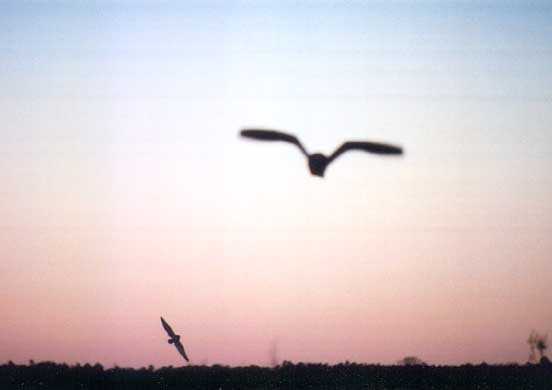
Eddie Ray took these three photos (above) at the Sabine Mining Co./Pleasant Hill Church area in Harrison County. The top photo was taken during the January 19, 2002, field trip. The group (including several folks from the Nacogdoches-area Pineywoods Audubon Society ) got to see Northern Harriers, Cooper's and Red-tailed Hawks, at least six Short-eared Owls, and the Say's Phoebe that's been there for two winters now. A Merlin also was spotted by some along the road that approached this location.
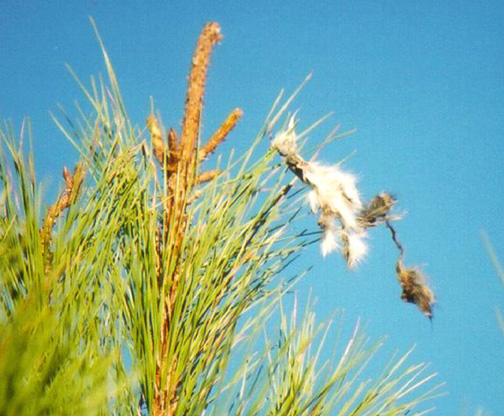
Regarding the bottom right photo (taken on January 14), Eddie said, "I suspect this is the remains of two Short-eared Owl pellets. Two observers saw an owl regurgitate a pellet while sitting in the top of a young pine. Investigation of the area (near the road) revealed nothing on the ground. Maybe the pellets caught on the pine needles and became un-compacted by the weather? Note that the top of the tree appears to have been used frequently as a perch."
All photos on this page by Eddie G. Ray. Copyright © 2001-2003.
All rights reserved.
No part of this Web site may be reproduced or published elsewhere
without permission.
Page last
updated: November 10, 2003.