Norma Elizabeth Boyd
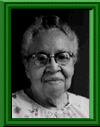
        Norma Elizabeth Boyd was born in Washington, D.C. and attended
public school in that city.  From a very early age, her devout mother
instilled in her the religious principles which were to guide her throughout
life.  She entered Howard University College of Arts and Sciences in
September, 1906, In February 1908, she was admitted into the newly formed
Alpha Kappa Alpha Sorority without initiation, one of seven students in the
sophomore class so honored.  She majored in mathematics and graduated with a
Bachelor of Arts degree in 1910.
        Always eager for further training, Ms. Boyd enrolled in graduate
courses in education and public relations at Columbia and New York
Universities; the University of California, Berkeley-, Middlebury Spanish
School, Vermont-, the University of Mexico; and American and George Washington
Universities in Washington, D.C, Ms, Boyd taught mathematics in the Washington
schools for more than 30 years and retired from Banneker Junior High School
in 1948.
        Ms. Boyd was one of two women who was both a founder and an incorporator
of Alpha Kappa Alpha, In 1913, she joined Nellie Quander and Minnie Smith on
the committee formed to incorporate the sorority.  She was named to the
position of epistoleus on the first Directorate, and following that time, held
many positions of honor in Alpha Kappa Alpha.  She served as North Atlantic
regional director, twice as basileus of Alpha Chapter, and as charter member
and basileus of Xi Omega Chapter. in addition, she chaired the first committee
to raise funds for the Mississippi Health Project.  Many individuals believe,
however, that her greatest contribution to the sorority was the establishment
of the Non-Partisan Council on Public Affairs in 1938.
        The Non-Partisan Council, which produced the first full-time
congressional lobby for minority group rights, was designed to secure full
citizenship for all members of our society.  It promoted cooperative social
action to eliminate discrimination at all levels of government and thus to
ensure a fully integrated society.  In her statement of intent for the lobby,
Ms. Boyd said, ". . . We can ask for and support such measures as will assure
for our people decent living conditions, permanent jobs, and a voice in
determining the conditions under which they live and work.  We can effect
these objectives only by making our power felt in the halls and floors of
Congress, and activity toward this end begins with participation in the
primaries of our land."
        The council was in existence for ten years.  During that time,
Ms. Boyd developed the program of social and legislative action which was to
win national and international respect for the sorority, and would lead to
the establishment of the American Council on Human Rights.  The council was
the first sorority or fraternity organization recognized as an accredited
observer by the United Nations.
        Ms. Boyd was awarded a citation as "Woman of the Year in the Field of
Legislation" from the National Council of Negro Women on June 13, 1948.
        Ms. Boyd long recognized the interdependence of all peoples.  She
served on numerous committees with an international focus including the
Advisory Committee to the American Delegate to the Inter-American Council of
Women, the Pan-American Liaison Committee, and the East-West Association.
She served as president of the Washington chapter of the international House
Association.  In 1949, Ms. Boyd was an accredited observer at the Inter-American
Commission of Women in Buenos Aires, Argentina, where she represented the
United Nation's Non-Government Organizations, the International House Association,
the People's Mandate Committee, and the Women's International League for
Peace and Freedom.  While in South America, she organized the International
House chapter in Brazil.
        Realizing the importance of a world perspective for her students, she
took officers of the junior high school student councils of Divisions 10-13
of the District of Columbia public schools to congressional hearings, and
sponsored 25 students on a visit to the United Nations' Assembly in New York.
        Partly as a result of her activities as an observer at the United
Nations, and partly as a result of her religious convictions, Ms. Boyd became
very interested in the implementation of Principle 10 of the Declaration of
Human Rights - the rights of children.  In 1959, she organized and became the
first president of the Women's International Religious Fellowship.  The
fellowship, composed of women representing the world's religions and cultures,
is dedicated to safeguarding children's rights where and however they might
be violated.
        During World War 11, Ms. Boyd initiated and chaired two important
conferences at Howard University-. a three-day symposium on "Labor and Women
in the War Effort," and a five-day institute on "Defense Planning for the
Future."
        She was a member of professional organizations including the National
Council of Mathematics Teachers, the American Federation of Teachers, and the
American Teachers' Association.  She was also a member of the International
Committee of the Temple of Understanding, and a member of the Audio-Visual
Committee of the Federation of Churches, Ms, Boyd was a member of All Saints
Unitarian Church of Washington, D.C. and chaired its World Fellowship
Inter-Faith Committee during 1958 and 1959.
        Ms. Boyd traveled extensively throughout the United States, Canada,
Mexico, South America and the British West Indies.  Her travels, contributions,
career in education, the suffrage movement and human rights are chronicled in
her autobiography, A Love That Equals My Labor Women of vision, integrity and
dedication are found throughout the story of Alpha Kappa Alpha.  Ms. Norma
Boyd, the longest living of the founders, exemplified all these virtues and by
the example of her life, served as an inspiration to many.  A founder and
incorporator of the sorority and founder and director of the National
Non-Partisan Council on Public Affairs, she combined the ideals of service to
others with a warmth and humanity recognized and appreciated wherever she was.
        Norma Elizabeth Boyd died in Washington, D.C. on January 4, 1985.