 The Actual ComputerThe Actual Computer
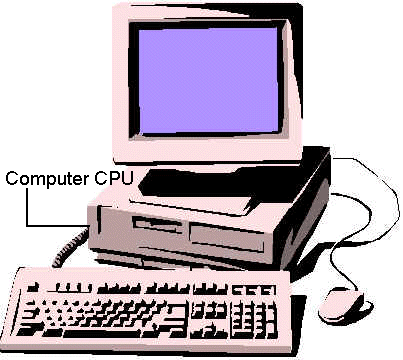
Your "computer" is a collection of devices that function as a unit. The most basic set of parts include a computer console, a monitor, a keyboard, and a mouse. The computer console is a rectangular cabinet that sits on your desktop (called a "Desktop Case") or next to your knee under the desk (called a "Tower Case").
Central Process Unit
The computer's console contains the Central Process Unit or CPU which is actually a small electronic device inside the case. The CPU is the heart and brains of the computer. It performs all the calculations, makes decisions, runs all the programs and manages all the interactions between the hardware components. CPU names vary by manufacturer, but usually include a model name (like cars Chevy, Buick or Lexus) and a model number that refers to the generation of the CPU (similar to the automobile year). Some current CPU names include, Intel Pentium IV, AMD Anthlon, and Power PC.
CPUs are also classified by speed. The speed of a CPU is measured by the number of program instructions that can be processed in one second. Computers have significantly increased in speed with each generation. Today, CPU speed is measured in gigahertz (GHz). A computer that operates at 1 GHz processes 1,000,000,000 (billion) instructions per second. The increased speed at which a CPU can process programs has made it possible to view movies, listen to digital sound, and look at realistic images and pictures. These technologies provide us with a wide variety of programs that can now run on the personal computer. Today's computers can play music, create, edit and show videos, act as a telephone, and provide lifelike multi-dimensional games.
This is an example of what a CPU might look like.

Memory
The computer's memory is closely associated with the CPU. There are two types of memory. RAM (Random Access Memory) is where the computer stores data and programs as they are needed. The computer uses RAM when it needs to remember data, programs, information about the hardware,and other important items. ROM (Read Only Memory) is where the computer stores special programs and data that are permanent and cannot be changed or altered. This memory is used primarily at the time the computer is turned on so that it knows what to do when it starts up.
Memory is measured by how much data can be stored. The smallest unit of memory is one character like the letter A or a "?". The amount of memory necessary to store a single character is called a byte. The size of the computer's memory is measured in bytes. Memory sizes are often expressed in kilobytes (kb) or megabytes (mb). One kb is equal to 1,024 bytes and one megabyte is equal to 1,048,576 bytes. One megabyte is also equal to 1,024 kilobytes. Today's computers often come with 256kb or 512kb of memory.