Indigenous-based & Commercial Ecotourism In La Mosquitia
 The Pech indigenous peoples live in small villages near the headwaters of the Rio Platano, including the villages, aldeas, or suburbs of Las Marias: Baltiltuk, Waiknatara & Pujulak. And in the Olancho communities of El Jocomico, Culuco, San Pedro de Pisijiri, Las Marias, Santa Maria del Carbon (El Carbon), Agua Cerca, Agua Amarilla, Las Campanas and Subirana. The Pech village within the Department of Colon is Silin, near Trujillo. They practice basic subsistence farming and fishing and most still speak a South American sub-dialect 'Chibcha.'
Please read more below, including a map of Las Marias, Rio Platano
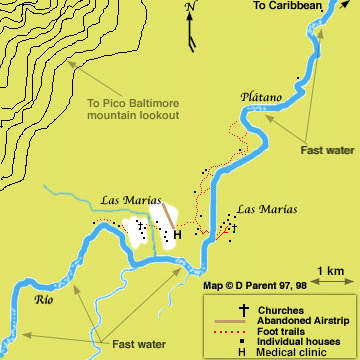 Pech income in the Department of Gracias A Dios is suplemented through tourism guiding (El Comite de Ecotourismo, Las Marias, Rio Platano) and the sale of miniature wooden carvings of pipantes (dugout canoes), paddles, small bags of packaged cocoa and small scale washing of gold from the tributary rivers which feed the Rio Platano. Las Marias, being the most often visited village within the Rio Platano Biosphere, was founded, according to some of the oldest villagers, around 1945. Francela Carington, a Miskito indigenous of the village of Barra Patuca, is said to be the Las Marias west sector's first settler. She came here as a single woman, alone, approximately fourty-five to fifty years ago clearing the land around the village's highest elevations with her own hands and a machete. According to Nolan Swenson, Las Marias' eldest Pech inhabitant, the majority of Pech indigenous came downriver from the traditional village of Buena Vista (good view) prior to 1949 -- which may have been the oldest Pech village on the lower Rio Platano. The Pech mostly settled the east bank sector (several homesteaders occupied plots upriver; see the map herein) of what they called "Cocalito." The name "Las Marias" then replaced "Cocalito" in 1950 when the older village of "La Maria", further downriver, lost its school and most of its inhabitants to this burgeoning area of agriculture and gold washing. La Maria then fell into tropical torpor after losing most of its inhabitants and importance.
A new series of trails links Ibans Lagoon with Las Marias village 04/98
Los Angeles photojournalist Barbara Grover and I recently had the chance to explore the myriad trails linking the southwest side of Laguna Ibans to the Pech/Miskito village of Las Marias. We chartered a motorized dugout canoe from the Raista butterfly farm piloted by Ricardo and, within 25-minutes, arrived at the farm of our local guide Sergio Bodden. After a wonderful meal and sleep, we packed his 20-foot dugout canoe/sailboat and slipped precariously along the Ibans southern shoreline for 40-minutes, eventually putting in at the old pre-United Fruit Company/Decker Lumber Company embarcadero. After four intense days of a tropical El Norte storms, we were warned that mosquito (the insect) populations were swarming along the trail. We took appropriate precautions smearing on insect repellent and tying bandanas around our necks and buttening our longsleeve jungle shirts, tucking jungle pants into socks, etc....
The first three hours of "trail" was intermittently covered by patches of swamp roughly a foot deep and clouds of mosquitos so thick that we were swallowing them when drawing breath. We eventually encountered entire sectors of forest floor the size of football fields flooded some times up to our knees and deeper - in the near hundred-degree steaming jungle. There was no getting around this, without hip-wader fishing boots, we were totally soaked in water and muck from toe to waist. We passed the old rusting hulk of the 1890 Fruit Company steam engine in the dense jungle underbrush - out of commission since about 1920. Sergio, our guide, kept up a brisk pace, but for myself carrying about 25-lbs of equipment and water, and Barbara, hauling about 25-lbs of Nikon camera gear, film and equipment, it was very tough going. After crossing numerous rivers without the aid of bridges and a flood-plain pantanal, four hours later we rested and ate lunch. It was nice to strip off the wet hiking boots, clothing and backpacks in the little caserio (one hut village) of Paru.
It was about 2:00 p.m. when we put out partially dried clothing and boots back on and hit the trail. What we didn't know was that we were still 6-hours trek from the village of Las Marias. After balancing across a 40-foot-long ten-inch diameter thin log span, bridging the deep fast-flowing Guapinijari river a dizzying 25-feet below, we were climbing the foothills of the Rio Platano mountain range. Two-and-a half hours later, we were taking a break on the summit of a small knoll called "Buena Vista."
Passing through some of the old growth forest, we encountered the tropical cedar, san juan rosita (rosewood), and giant mahogany trees. Sergio pointed out one of the clandestine logging trails which cut east to west, leading to the Rio Negro/Rio Paulaya. We could see where several precious hardwood timbers had been hacked down and extracted by "pirates."
We'd heard some monkeys chattering 150 or-so feet up in the trees but couldn't see them from the forest floor through the thick double canopy. I'd spotted several species of humming birds and heard a cha cha laca squacking in the thick verdure. Crossing the Pantanal, we'd spotted numerous pecary or wild pig tracks and a set of what looked to be jaguar paw prints. The cat was likely hunting the wild pecary.
Descending the Buena Vista knoll, we found our way to the broad and deep Quebrada Tiro, the last major river crossing before intersecting with the Rio Platano. Apparently, the main log bridge span had been washed away. Sergio took us on a roughly two kilometer detour - ending at a tree trunk on which we used to cross over. It was already getting dark and we were still two hours and-a-half from Las Marias.
Within an hour, we intersected with the Rio Platano and were on our way along the river-side trail. As the pitch black of night fell, we reached the outskirts of Las Marias and an hour after dark, reached the Village center and Ovideo Martinez's guest house. We were given several 20-gallon buckets of water to wash with and fed a relatively substantial meal of local fish, fried bread, beans, rice and fruit juice - all we could drink.
This story is illustrated with numerous slides and black & white images
The Olancho Pech
Income of the Pech living within the Department of Olancho is derived primarily from selective sustainable logging to supply the lobster trap construction industry and the construction of furnature for resale through the "Centro de Capacitacion" in El Carbon. Beautiful hammocks and handbags are also produced for resale to the tourist trade through the Center de Capacitacion in El Carbon. Currently, a grant from USAID is providing the funds to build two guest houses in the village of El Carbon, Olancho. These guest houses will provide accommodations for travelers who wish to experience the Pech way of life and will provide a base for hikes to a nearby waterfall and large ruin site. All hikes are conducted by the El Carbon Pech community organization "Comite Ambiental WUATA".
Some anthropological studies on the Pech communities within the boundaries of the Rio Platano Biosphere Reserve indicate that there are perhaps only 20-30 unmixed Pech descendents surviving in this area; although some 1500 inhabitants within the 5000+sq kilometer Platano Biosphere boundaries state that they are of Pech origin. Outside the boundaries of the Rio Platano Biosphere there are perhaps several thousand Pech indigenous practicing their ancient customs such as the "kesh" (a ritual custom carried out by the village shaman after the death of a community member) and bush medicinal practices to cure snakebites - also called a "kesh" (presided over by the village curandero).
Planeta Platica Article: Ecotourism in El Carbon - Kevin Postma and Kate Thomson; This Olancho site has great potential as an eco/ethnic tourism website, run
by the Pech themselves 1997
Planeta Platica Article: Ecotourism in El Carbon - Kevin Postma and Kate Thomson; This is the final report on the Peace Corps ecotourism infrastructure efforts culminating this year in El Carbon 05/1998
Tourism and Biodiversity Preservation in Honduras by Eric Greenquist; an article published by the El Planeta Platica. Part of a strategy to promote conservation in the Rio Platano Biosphere.
Sources of reference: Herlihy, Peter H., and Hobson, Laura H. La Herencia Cultural de La Biosfera del Rio Platano. Un Area de Confluencias Etnicas en
la Mosquitia; Postma, Kevin. Peace Corps, El Carbon, Olancho: 1997, 1998; Nolan Swenson, Las Marias 1996; Fidelia Arisa, Las Marias 1996.
Non-indigenous Controled Ecotourism In La Mosquitia
Ecotourism into La Mosquitia and the Rio Platano Biosphere Reserve (RPBR) is limited because of the lack of tourist facilities, insufficient transport (air and water, though additional reliable air services & schedules are now being added) and narrow window of opportune weather (dry season January to middle May) conditions. But for the low impact environmentally conscious, hardy and prepared ecotraveller with the right attitude and guide, it would rank as an ecoeducational experience equal to those in any of the remote pristine biospheres of South or Central America.see A Detailed Guide Book To The Honduran Mosquitia. The typical cost of a 7-day ecotour into the Rio Platano Biosphere (price does not include return air from USA or Canada to Honduras) includes 3 meals/day (not gourmet), return local flight into La Mosquitia, guide, dugout transport, accommodations (village huts): 4-8 day jungle excursions to points of interest is $350.00-$1000.00US per person (4 persons per group). A 10-14 day expedition would be approximately $1300.00-$2200.00US per person (4 persons per group) these prices last updated on October 15th 1997. A fair portion of this revenue should go directly into the pockets of the indigenous Pech, Miskito and Garifuna communities visited. This might not be the case with some ecotour operators in the area. Investigating before you pay will help stop indigenous exploitation by unscrupulous ecotourism operators. Remember that the ecotourism concept was established to provide economic support and incentive to the host indigenous cultures as an alternative to hacking down the rainforests for cattle pastures, banana plantations and slash-and-burn farming.
(c) Derek A Parent 1994, 1995, 1996, 1997, 1998. All rights reserved


This web page last updated on December 12th 97. I invite any and all comments, suggestions and criticisms to improve this resource, and/or questions from people contemplating travel to La Mosquitia at:
Email: derekp@generation.net All graphics, text and content (c) copyright Derek A Parent 1996, 1997, 1998; all rights reserved.