WHO WROTE THE BIBLE
?We often say that the Bible is the Word of God. Yet, as you’ve learned, it was written by men. How can this be? The Bible itself answers that question.
1. There are hundreds of places in the Old Testament where we can read words like these:
"And the Lord spoke unto Moses, "Go to Pharaoh, and say to him, This is what the Lord says, ‘Let my people go so that they may serve me . . . ‘" (Exodus 8:1)
"For the Lord God, the Holy One of Israel says in returning and rest shall ye be saved; in quietness and in confidence shall be your strength; and ye would not." (Isaiah 30:15)
Over and over, in almost all of the Old Testament books, we find such statements. Look through the book of Exodus and count how many chapters begin with something like this: "And the Lord said to Moses." You could do the same in the books of Leviticus and Numbers. Then you could turn to the books of the prophets and find that each one of them has said many times, "This is what the Lord says."

2. Jesus, Himself, believed the writings of the Old Testament and quoted from them frequently. Read the Gospel stories and see how many times He refers to the prophets and the Law of Moses. While He was still with His disciples, Jesus made it clear to them that His words were to be remembered also. This makes them scripture for us just as much as the Old Testament writings were scripture for Jesus and the Jews of His time. Look at two references:
Jesus replied, "If anyone loves me, he will obey my teaching. My Father will love him, and we will come to him and make our home with him. He who does not love me will not obey my teaching. These words you hear are not my own; they belong to the Father who sent me. "(John 14: 23-24)
3. The New Testament writers believed the writings of the Old Testament were from God. Here are a few scriptures that make us know this:
"All Scripture is God-breathed and is useful for teaching, rebuking, correcting and training in righteousness, so that the man of God may be thoroughly equipped for every good work." (2 Timothy 3:16-17)
"Above all, you must understand that no prophecy of Scripture came about by the prophet’s own interpretation. For prophecy never had its origin in the will of man, but men spoke from God as they were carried along by the Holy Spirit." (2 Peter 2:9)
From these two apostles, we learn that the scriptures were inspired by God. That word really means "God-breathed." It tells us that God spoke to them, and they wrote what He wanted them to say. Paul wanted Timothy to know that he could put his trust in the scriptures. And that is what Peter was telling us in his letter. The writer of Hebrews also told us we could believe that God spoke to us through His Son.
"In the past God spoke to our forefathers through the prophets at many times and in various ways, but in these last days he has spoken to us by his Son, whom he appointed heir of all things, and through whom he made the universe." (Hebrews 1:1-2)
HOW WAS THE BIBLE WRITTEN?
Bibles are everywhere. We can go to almost any store where books are sold and find a Bible. You may have several Bibles in your home. There are many different kinds of Bibles.
Bibles weren’t always like this, however. Nearly 40 different men wrote the books of the Bible and it took over 1,400 years. Yet, not one of their writings looked like the Bibles we use today.
WRITING MATERIALS
 Papyrus
Old Testament wrote on a material called papyrus (pah PI rus). Our word "paper" comes from the word "papyrus." Papyrus is the name of a plant that grows in the Nile River Valley in Egypt. It has long straight stalks with three sides, like a triangle. There’s a kind of bristle that sticks out at the top, but the plant doesn’t have leaves.
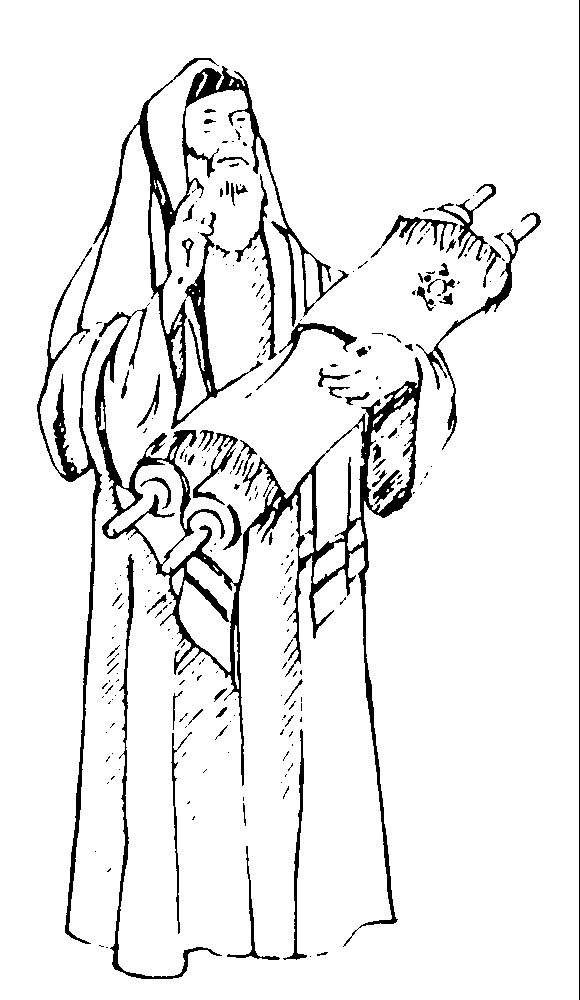
The writing material was made from the stalk of the plant, which was cut into sections. The tough, green, outer layer was stripped off the stalk. Then the inner part (pith) was sliced into thin strips. The strips were laid side by side, overlapping, slightly, to make a single layer. A second layer was laid on top of the first one, but it was placed in the opposite direction. Then these layers were pounded with a heavy mallet to make them begin to fuse together. Next, the entire piece was carefully laid between squares of linen cloth and squares of wool. Pressure was applied, usually by placing a large stone on top. After several days the papyrus strips became fused together into a thin, single sheet. It was white and limp at first, but gradually it became crisp and light brown from exposure to the air. These small sheets were usually joined together to make one long sheet. The shorter ones could be folded, but longer ones were rolled. Sometimes they were attached to rods to make rolling them easier. These were called "scrolls."
Parchment
Parchment was first made by the Greeks about 200 years before the time of Christ. When one of the Egyptian kings became jealous of the Greek libraries, he refused to sell the Greeks any more papyrus. He didn’t want them to have libraries larger than his own. So the Greeks had to find something else for writing material. They began to experiment with animal skins, and finally, they developed parchment.
The animals used for this material were usually sheep and goats. It could take as many as 25 sheep to make one scroll. The best quality of parchment was made from young animals-kids, lambs, calves. This is called vellum (VEL uhm). It was very expensive. That’s why it was used for only the most important documents.
Sheets of parchment were difficult to join together to make scrolls, but the Greeks discovered that they could attach the sheets along one side by sewing them together. This was called a codex (KOdeks). It was the beginning of books with pages. Gradually, better and better ways of binding sheets together were developed.
SCROLLS
A scroll (skrol) was a long sheet of papyrus (or other writing material) which had a wooden rod attached to each end. The paper wound around the rods as they were turned toward the center of the sheet. Sometimes ivory or bronze was used for the rods. The ends of rods that stuck out from the writing material were often made into knobs or handles. They protected the edges of the papyrus roll and helped the reader handle the heavy scroll. Sometimes they were beautifully decorated.
PEN AND INK
Since the time that man learned to write, he has managed to find some kind of material with which to put it down. At first, he used a sharp piece of bone or a stick to scratch on stone or soft clay. Later, he covered a piece of wood with a layer of wax. When papyrus was invented, he needed ink. He learned how to mix the soot from burned bricks or lamps with a little oil. This worked well, and he could have it with little cost or effort. The Egyptians sharpened a hollow reed to use for a pen. Other people used feathers. These were called quills. Goose quills were best, and they were used for writing until late in the 1800s.
It’s surprising how well the ink lasted on the old parchment scrolls. Since parchment was expensive, it was sometimes used more than once. The old ink would be taken off and new writing put on. And yet, Bible scholars who have found such copies have been able to take off the top writing and read the original copy. In many cases, the first writing was far more valuable to us than the second.
THE WORK OF THE SCRIBESThe work of those inspired men who first wrote down the word of God was very important. The scrolls on which they wrote were probably protected very carefully. And yet, not one of the original writings has ever been found. The scrolls that have been found are copies of copies of copies. The scribes who copied the scriptures were usually the best educated men of their time.
 The Hebrew language made it even more difficult to copy. There were no vowels
or spaces between words. If our English language were like that, Psalm 23:1 would look
like this:
The Hebrew language made it even more difficult to copy. There were no vowels
or spaces between words. If our English language were like that, Psalm 23:1 would look
like this:
THLRDSMSHPHRDSHLLNTWNT
Many scribes worked alone, copying and copying day after day. Sometimes, the scribes worked in a scriptorium. This was a room in which there might be a dozen or more men sitting at desks. He had to copy one letter at a time, looking from copy to copy. In some places, a reader sat at a desk in the front of the room and read the scripture aloud very slowly. All the men listened and wrote down the words they heard. There was absolutely no talking or noise of any kind. Could you copy one page of material without making any mistakes? These men did it all day.
About 500 years after Christ, a group of people called Massoretes (MAS o rets) took over the copying of the Old Testament manuscripts. These men were well-trained and took great care to copy exactly. Just to be sure they had not left out letters or added extra ones, they counted the letters on each page. The Massoretes also added dots and lines under the consonants to show where vowel sounds should be. They corrected the mistakes which had shown up in earlier manuscripts, too. Their text became the Hebrew Old Testament that was finally printed and handed down to us.
By God’s guidance the Bible was preserved from error. Only 19% of the whole Bible has any variations. Most of these deal with minor things: Jesus Christ instead of Christ Jesus, etc. No doctrine of Scripture is affected at all.
The Dead Sea Scrolls and Qumran (KOOM rahn)Sometimes scribes would risk their lives to copy the scriptures and keep them safe. One example of this was a group of Jews called the Essenes (ES enz). These people lived about the time that Jesus was here on earth. Some of them gave all their time and attention to the copying of the Old Testament. In order to be undisturbed in their work, one group of Essenes built a small community near the Dead Sea in southern Israel.
The ruins of their small community still stand today. One of the buildings was a scriptorium where the scribes worked on the manuscripts. We know this because a table and inkwells with dried ink still in them were found there. Another building was a workshop where the people made large clay jars in which to store the manuscripts.
In A.D. 68, the Roman army marched across Israel. When the Essenes heard the Romans were coming, they acted very quickly. Their beloved manuscripts were sealed into the large clay jars and taken to the caves in the cliffs. When the Roman army came, the people were all killed, but the scriptures were safely hidden. In fact, the manuscripts weren’t found until early spring of 1947.

In the spring, there’s enough rain in Israel to cause some grass to sprout. A few shepherds take their sheep and goats to graze in this area near the Dead Sea. In 1947, one young shepherd lost a goat in the rugged hills and went to find it. He saw one of the caves and thought the goat might have fallen into it, so he threw a stone into the hole. When he heard the sound of breaking pottery, he climbed down to see what it was. On the floor of the cave he saw some large clay jars. In the broken ones he could see leather scrolls. He took some of the jars and scrolls to a shopkeeper in Jerusalem. This man kept them in a room over his shop for several months before he told anyone else. Finally, however, the scrolls reached the hands of a Bible scholar. Since that time they have been studied by many people.
More scrolls were found in other caves. All the scrolls had been kept in very good condition for over 1,900 years. One scroll was the whole book of Isaiah. It was 10 inches wide and 24 feet long. Parts of almost all the books of the Old Testament were found in the caves. These precious scrolls are called the Dead Sea Scrolls. They’re important because they’re the oldest copies of scriptures that have been discovered. Also, when they were compared with the Massorete copies, only a few little unimportant differences were found. This helps us to feel even more confident about our scriptures. Now we know that they are as accurate as they can possibly be.
HOW DID "THE BOOKS" BECOME "THE BOOK"?
To answer this question we must learn some new words: canon (KAN uhn) and canonizing. The word ‘canon’ means "a list of books thought to be inspired by God." The word "canonizing" means "the bringing together of such a list." In our Bible we have two canons - the Old Testament Canon and the New Testament Canon. They came to be canonized at different times and in different ways.
THE OLD TESTAMENT CANON

Most of the books of the Old Testament were considered sacred from the time they were written. The Book of Moses (Torah or Pentateuch) was written about 1400 B.C. Then came the prophets and other writings. Most of them were treasured by the Jews from the beginning. There never was any question about their being from God. The list kept growing until about 400 B.C., when the book of the prophet Malachi was written.
Between 200 B.C. and A.D. 100, other writings appeared. Some Jews accepted them, but many didn’t believe they were inspired by God. In A.D. 90, an important meeting called the Council of Jamnia, was held. At this Council, the Jewish leaders established the Hebrew canon. It included the 39 books of our Old Testament just as we have them today. Malachi was the latest book to be included. All the newer books were left out. There were just too many questions about them. That group of books is called the Apocrypha (uh POK ri fuh).
THE NEW TESTAMENT CANON
When the Gospels and letters of the New Testament began to appear, they were sent from church to church. Scribes made copies so that more churches could have them. They were copied and recopied. Eventually, the originals were lost. However, with so many copies around, it was possible to keep checking and comparing to find errors and correct them.
The New Testament canon wasn’t fixed until the fourth century. By this time, there had been a great many writings. There were also people coming into the churches who were teaching things that were wrong.
In A.D. 303, a Roman ruler passed a law demanding that all sacred Christian books be destroyed. Some Christians were giving their lives to protect these books. It was time for a decision to be made about what was inspired by God and what was not. The first list of the 27 books as we have them in our Bible was found in a letter written in A.D. 367. Thirty years later, the Council of Carthage decided that these same 27 books would be the New Testament Canon. It has never changed.
It is good to know that the Holy Spirit was guiding the Church leaders in both of these councils. They made the selection of the books that have become our Holy Bible.
HOW DID THE BIBLE GET INTO OTHER LANGUAGES?
The Greek language was spoken in all the countries of the Bible world. It began to spread to other countries during the time of the warrior ruler Alexander the Great. He conquered many countries in Africa and Asia. Before long, Greek ideas and ways began showing up everywhere. Long before Christ came, many Hebrew people had moved to other countries. Like everyone else, they learned to speak Greek. Many of them couldn’t even read Hebrew anymore. This made them want to have their sacred scriptures in the Greek language.
Seventy men were chosen to come to a meeting. This Old Testament in Greek was called the Septuagint (sep TOO uh jint). It comes from the word for "seventy." The Septuagint became quite popular. It was probably the book used by the New Testament writers and read in the early Church. The Greek language had to add vowels and spaces between words, and this made it much longer than the Hebrew copy. It was necessary to use two scrolls for some of the longer books. That explains why we have two books of Samuel and Kings and Chronicles.
More years went by. The Roman army conquered the countries around the Mediterranean Sea. The language of the Romans was Latin. In Rome, a man called Jerome was asked to translate the Scriptures into Latin. To do this work, he went away from Rome and lived in Bethlehem in Israel. It took him 15 years. He worked from Hebrew and Greek manuscripts. Then he went back to Rome and presented his translation to the Church. At first the Christians did not like the Latin Bible and would not accept it. Jerome died broken-hearted. A few years later, however, it was not only accepted but became their official Latin Bible. It was called the Latin Vulgate. The word "vulgate" means "everyday speech."
THE DARK AGES
The countries of Europe entered a period of nearly 1,000 years called the Dark Ages. From A.D. 500 to 1500, there was almost constant fighting all over Europe. Because of this, little or no learning took place. Very few people could read or write, so books weren’t important to most of them. The precious scripture manuscripts seemed to disappear.
And yet, God wouldn’t let this happen. Here and there, around western Europe, were groups of men who loved God and wanted to serve Him. They were called monks, and they went to live in places called monasteries far away from the towns.
Many of these men were skillful at writing. They spent their lives copying page after page of scripture. They worked long hours in very uncomfortable conditions. They had poor light, and the tiny rooms in which they worked were cold in winter and hot in summer. In spite of this, they tried to make their work the best it could possibly be. They began to make their copies beautiful as well. Around the margins they painted designs in red and blue and gold. Sometimes the first letter of a page or chapter would be made very large. The letter would then be surrounded with tiny angels or birds or perhaps a whole scene from the story. These decorated manuscripts were said to be "illuminated." Even in the Dark Ages, God was keeping His Word alive. It was the one bright light that still shone in the darkness.

The Bible carries the story of God’s love for all human beings. It’s a message of life and peace and joy. Every person needs to hear this message. And yet, it has taken many miracles for it to reach us. As the years passed, the Roman Catholic Church became very strong in Europe and England. Many leaders of the Church were greedy for power and money. They weren’t interested in real Christianity. Only the Church leaders and a few rich people could have a Bible. At church services, the Bible was read in Latin and only a few people knew Latin. The leaders wanted the people to depend upon the Church for everything. They didn’t want the people to read or hear the Bible. "It’s too sacred for the common man," they said.
JOHN WYCLIFFE
In the 1300s a man named John Wycliffe grew up in England. He became a teacher at Oxford University. When he saw what the Church was doing, he wanted to do something about it. He started making speeches about the bad things that were going on in the Church. Of course, this made the leaders very angry.
They became even more upset when Wycliffe sent a group of preachers from town to town to read the Bible aloud to the people. Then he started translating the Latin scriptures into English. He wanted the people to hear the Bible in their own language. Before long, his friends started making copies of his English translation. The common people were very excited about the "new" Bible. The king and the Church leaders hated Wycliffe. A law was passed which said, "No person may keep, copy, buy, or sell anything written by John Wycliffe." Any person who broke this law would be put to death.
THE PRINTING PRESS

The Bible could now be read in English, but only a few people could afford one. Copying was still expensive and slow. It took even the skillful scribes four or five months to copy 200 pages. All the time, there were people trying to find a cheaper way to have books. Some carved words on blocks of wood and spread ink on them. Then they pressed the block onto a sheet of paper. It was messy and slow, but more than one copy could be made this way.
Finally, a man named Johann Gutenberg (YO hahn GOO ten berg) figured out a way to do it better. He lived in Strassburg, Germany. When he was still a young man, he started working in the printing business. He had good ideas, but he didn’t have any money with which to buy supplies to try his ideas. To keep going, he often had to borrow money. He kept getting more and more in debt. And yet, he knew his idea would work. He made metal letters from a mold. This made it possible to make as many letters as he needed. In 1450 he began printing the world’s first book, using movable type. It was a Latin Bible. It took him five years. The job was still slow. The words for each page had to be spelled out, inked, and pressed onto the paper. After that, the titles and beginning letters were printed in red by hand. But there were 200 copies! Now the Bible could be read by everyone. Newer translations continued to appear.
