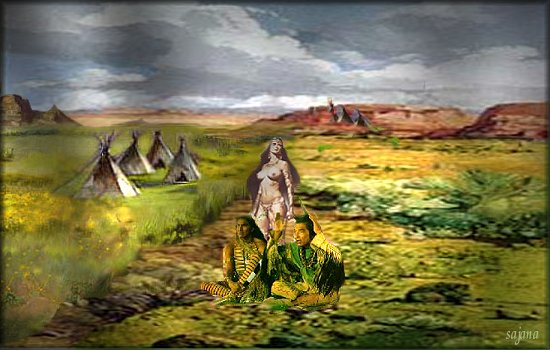
Barrens: The Barrens are
vast tracts of rolling grasslands east of the Thentis Mountains.
There are no large bodies of water and rainfall is reduced.
The grass can grow to heights of several feet. In the winter
there can be terrible blizzards and in the summer, extreme
heat and droughts. There may also be sudden storms, tornadoes,
flash floods, and hail storms. The Barrens are the home of
the Red Savages, similar to the Native Americans of North
America. No white man has ever penetrated to the eastern edge
of the Barrens. The Red Savage culture is nomadic, based on
the kaiila. There are a few tribes that have not mastered
the kailla and some tribes that use tarns. They depend on
the kailiauk for their lives, for food, clothing, shelter,
tools and weapons. Almost all tribes hate whites.

Kailiauk is also the name
of the last Civilized outpost of White Settlement. It is described
as being east of the Thentis Mountains. The Ihanke is the
term for the border between Civilization and the Barrens.
It is also known as the line of wands.
The Tribes
that make up the Red Savages are the Fleer, The Kaiila, The
Yellow Knives, The Dustlegs, the Sleen, The Kinyanpi and the
Kailiuk, also The sub tribes of the Kaiila, the Isanna, the
Isbu, the Casmu and the Napoktan, and the Wismahi tribes.
Traditionally the Kaiila and the Dustlegs are allies, and
their language is closely related. The Kaiila is hostile to
the Fleer. The Fleer is allied with the Yellow Knives and
the Kinyanpi. The Dustlegs have trade with the Sleen, who
also trade with Fleer and Yellow Knives.
John Norman focused most heavily on the Kaiila Tribe and more
so on the Isbu literally the "Little Stones" band.
The tribes incidentally have little regard to the regal Free
White Women of Gor, indeed the sign for a White Free woman
and for a white female slave are identical. This seems to
imply that all White Women regardless of their status on Gor,
are fit only to be slaves.
Structure
of Red Savage Government hierarchy is they typically have
three levels of Chiefs, The Civil Chief, The War Chief, and
the Medicine Chief.
The Tribes also honor Gor's
system of slavery, there is no hope of an escaped slave slipping
away to the Barrens to find freedom among the Red Savages.
Indeed any white woman would soon find herself in a beaded
collar and at the feet of a Red Savage Master.
The Medicine Chief who because
of his knowledge of the Medicine World is a powerful figure
in the society. He handles the prayer and granting the blessing
of Medicine World figures. His function is like that of the
Initates in the rest of Gor.
Below these Chiefs are the Blotanhunka (war party leaders),
who report directly to the War Chief, below them are the Akicita
(Warriors). Next come the native Free Women, then native children.
Lastly comes the slaves both native and white. As in all of
Gor slaves are mere animals.
The Insanna keep their mostly white slaves in herds. Called
a girl herd. Typically each herd might contain 40 to 50 females.
They are common slaves where most are traded off just before
winter. Although some if sufficiently pleasing are kept in
the lodges through the winter. Isanna youths tend the girl
herds with whips and sticks. Male slaves both native and white
are used to tend the kaiila herds.
One particular type of slave
is the Winyanpi. These people are slaves without collars.
They provide the Red Savages with labor, corn, squash and
other vegetables. The Winyanpi are also known as the "Sames"
in that they live in a commune type camp of lodges. They are
typically white. Male and female are dressed the same in long
grey drab dresses. The female though is considered to be in
higher status then the male. The reason is given as the men
fail to assert their manhood, and someone must be in charge.
There are no white settlements
in the Barrens, save for one called Selbar's Holding, which
is made up of former Waniyanpi.
Blood Brothers of Gor page
474
The Civil Chief handles the
day to day affairs of the tribe and functions much like an
Administrator would in a civilized Gorean town or city. The
War Chief handles battle strategies and planning of attacks.
His civilized counterpart would be the Ubar. One man cannot
be both Civil Chief and War Chief at the same time. He may
hold each title seperately how ever. There can be more then
one War Chief in a tribe.
Blood Brothers of Gor page
34-35
The Red Savages limit the
excursion into their lands with a practice which is known
as a law of the Red Savages. "No more then two kailia
are to be brought by any single white man into the Barrens.
Too, no party of white men in the Barrens is permitted to
bring in more then ten kaiila."
Savages of Gor page 137
The Tribes also hunt kailiauk,
which is described as a large lumbering shaggy trident horned
ruminant with four stomachs and an eight valved heart. It
is dangerous and gregarious, with small eyes and a short temper.
Adult males can stand as high as twenty to twenty-five hands
at the shoulder, and weigh as much as four thousand pounds.
Blood Brothers of Gor page
10
The Red Savages also practice
the "art" of scalping their enemies. This is done
not only to count in their coup system (a ranking, or way
to attain honor and status), but also to in their belief system
of the hereafter known as the Medicine World. Typically enemies
have their arms and legs hacked off in the belief that this
will prevent them from taking revenge on the victorious warrior.
Savages of Gor page 160