[an error occurred while processing this directive] Diodes, Resistors, and Transistors
This is kinda cool, has diagrams and how PN junctions work (the heart of diodes), resistors, transistors, etc..


Semi-ConductorsP-N Junctions
Atom StructureDiodes
Covalent BondingTransistors
Electron Flow in Semi-ConductorsResistors
IonsCapacitors
Electron-Hole Theory


Back to Top
Semi-Conductors
Ok, before jumping into diodes, I will have to explain how diodes work.
Most use a manufacturing process that creates a "P-N Junction".
Before I can explain how a P-N Junction works, I'll have to start out with the basics...
How Semi-Conductors work.


Back to Top
Simple Atom Structure
I'm assuming you know what an atom is, so I will just jump in.
An atom is made of 3 parts:
A neutrally charged atom has the same number of protons and electrons.
Neutrons don't matter here since they have no charge, all they do is add weight.

The electrons orbit in rings (planes) around the nucleus, but there's a certain number per ring...
Starting from nucleus out, here's how many electrons per ring:
If say there were 14 Electrons (like in the Silicon atom), the rings would be like this:
The outermost ring (3rd on Silicon) is called the "Valence Ring".
The Valence ring is the only ring that can shed or gain electrons.

Back to Top
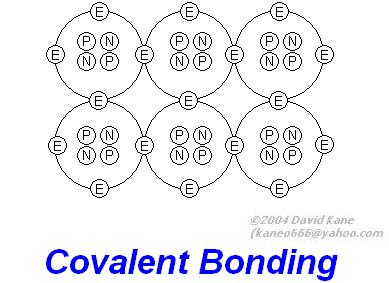
Covalent Bonding is when there is a cluster (crystal structure) of atoms where the electrons can bond with other electrons (creating a lattice type crystal structure).
In the case of Silicon and Germanium, there are 4 electrons in the Valence ring.
This allows them to bond exactly (8 electrons) with other Silicon or Germanium atoms.
The valence electrons don't move about easily like this.

Back to Top
Electron flow in Semi-Conductors. At room temperature or lower, semiconductor electrons do not flow easily, so they are insulators. Above room temperature, the electrons start to flow, and it becomes a conductor.

Back to Top
Ions. When an electron leaves an atom, that atom that was neutral now becomes a positivly charged ion. When an electron arrives at an atom, the atom becomes a negativly charged ion. If the whole structure is a semi-conductor, the whole thing is still neutral due to equal number of protons and neutrons.

Back to Top
Electron-Hole Theory. It used to be thought that charges moved from positive (+) to negative (-), which is known as Conventional Current Flow. It is now known that it is opposite of that and current flow is from negative (-) to positive (+), known as Electron Flow.
The Electron-Hole Theory is that when an electron leaves an atom (making a positive ion), it creates a hole which another electron can fill, which makes the atom where that electron just left a positive ion, which another electron fills to try to keep everything neutral. So if you get it, current flow is from - to +.


Back to Top
P-N Junctions
Ok, still have a few more things to explain, so hang on...

Doping is intentionally adding impurities. It makes semi-conductors either P (positive, +) or N (negative, -). Remember that semi-conductors have 4 valence electrons, and remember the magic number is 8... Donor Atoms have 5 valence electrons and create N-type when a semi-conductor is doped with it. Acceptor Atoms have 3 valence electrons and create P-type when a semi-conductor is doped with it.
When you join a P-Type material with an N-Type material, you have created a P-N Junction.
Since N-Type can donate and P-Type can accept electrons, they combine and make a Junction Field.
The outer parts still have extra (N-Type side) and missing (P-Type side) electrons.


By placing an electric charge at the N-Type side, the Junction Field remains small and current will cause the electrons on the N-type side to cross over to the P-Type side and out the P-N Junction.
If you reverse the connections and place a charge on the P-Type side (hook the - side of the power source to the P-Type side), the Junction Field will grow larger and not allow current to flow. This is the operating principle of a Diode.


Back to Top
Diodes
Jump To: General Purpose  Zener Diodes  SCR's

A Diode is a device that allows current to flow in one direction only. A diode is simply a P-N Junction (just like above, just add leads), but has a LOT more atoms than pictured.

The Cathode is the P-Type side, Anode is the N-Type.
When current is applied to the Cathode side, the Junction Field remains small and allows the current to flow. Switch and place current on the Anode side, the Junction Field will grow larger and not allow current to flow.

The electrical symbol for a diode is an arrow pointing away from the current flow (reason: the symbol was designed back when conventional current flow was still around) at a line. You could say the line is where current flowing in the direction of the arrow is blocked.


Diodes come 3 ways: General Purpose (above), Zener Diode, and Silicon Controlled Rectifier (SCR).


Back to Top
Transistors
Jump To: UJT's  J-FET's  BJT's

Transistors are made from different arrangements/combonations of P-N Junctions.


Back to Top
Resistors
Jump To: Fixed  Potentiometer  Rheostat  Color Codes

Resistors are made to oppose current flow. Resistance of is represented in Ohms (Ω).


This resistor has 27,000Ω (27kΩ) of resistance.
This resistor is rated at 27,000Ω (27kΩ), has a tolerance of 10% (may vary between 24,300Ω - 29,700Ω).
This particular resistor has a reliability level per 1000 hours, or failure rate, of 0.001%, so very good.
Resistor Color Codes (Bands 1-3)
Color
Significant Figures (Bands 1-2)
Multiplier (Band 3)
Black
0
1
Black
Brown
1
10
brown
Red
2
100
Red
Orange
3
1,000
Orange
Yellow
4
10,000
Yellow
Green
5
100,000
Green
Blue
6
1,000,000
Blue
Violet
7
10,000,000
Violet
Gray
8
100,000,000
Gray
White
9
1,000,000,000
White
Resistor Color Codes (Bands 4 and 5)
Color
Resistance Tolerance (Band 4)
Reliability Level per 1000hrs (Failure Rate - Band 5)
Brown
1%
1%
Brown
Red
2%
0.1%
Red
Orange
3%
0.01%
Orange
Gold
5%
0.001%
Gold
Silver
10%
-
Silver
No Color
20%+
-
-


Back to Top
Capacitors
Capacitors store energy for release at a later time, even if power source is removed.


As of Sep 5, 2004, finshed unless I find more to add, which means:
>>>Still under construction<<<


All this was done in Windows , yay!
Email me at kaneo666@yahoo.com if you would like to use these pictures, thanks.
Last Modified: Monday, 06-Sep-2004 00:14:01 EDT.
Where you came from: (none).
If arriving from a search engine, you searched for: (none)