3. The
Happiness of an Architect
In 1948 at the age of fifty-seven,
and with an established architectural career behind him,
Michelucci resigned from the chair of the Florentine
Architectural Faculty where he had been teaching for twenty
years. In an open letter entitled "The Happiness of an
Architect" (La Felicità dell’Architetto) expressed his
uneasiness at the situation in the faculty.43 This is a
largely overlooked treatise that provides a key to understanding
Michelucci's work that followed. In this document Michelucci
retraced the reasons for his resignation in his search for a
different outlook on architecture: this demanded an enunciation
of his own principles concerning the architect's craft, and how
he saw his own role as an architect in society.
Was there a change in Michelucci's
thinking though? In 1980, writing about "The Happiness of an
Architect" Michelucci commented that the ideas he had
expressed at the time had been a "constant"44 in
his whole life and work, which suggests therefore there was no
great "about face". If the basic principles were the
same, then the character of his work after the war was certainly
very different to that before it.
At what point then did the
character of Michelucci's work change, and why? Well in effect
the whole period from 1941 to 1948 constituted one of research in
which he was engaged with issues of the "new city", and
at the same time of nature. More than anything though, from 1941
onwards Michelucci's work reflected the position of an architect
working after the outbreak of war: after the Fascist projects had
ceased. Moreover, the change in character of Michelucci's work
reflected a return to his native Tuscan environment and his
involvement with projects of a very different nature.
The New City
The task of post war
reconstruction involved a great deal of soul searching for
Italian architects, resulting in a succession of ideologies.
Rationalism by its association with the collapsed regime was
viewed to have compromised its integrity. As Giancarlo DeCarlo
remarked, "it was no longer a question of struggling with
the empty question of academic culture but of preparing to solve
problems that were real, urgent and of an unprecedented scale...
it called for an overhaul of historic criticism which would
permit the past to be reinterpreted objectively and integrated
with the present in a fruitful way".45
The liberation and consequent
destruction of sections of Florence with the German retreat, had
a profound affect on Michelucci, and the issue of reconstruction
was one he involved himself deeply with. He saw a chance for a
positive regeneration of the city and the chance to
"remorselessly eliminate everything from the past that
people were no longer willing to accept... and which made people
intolerable of each other."46 And from out of a
melting pot Michelucci described (in "The Happiness of an
Architect") how new forms would "testify in their unity
to the understanding of a people, without mistaking their own
reality and to the trust in the validity of their own time."47
As a result he actively
participated in the rekindled debate on the dialectic between
architecture and the notion of history and tradition, which was
to characterise the subsequent course of Italian architecture.48
This could be argued as the first time in his career since the
dawn of Fascism that he had adopted a polemical stance, which led
in 1946 to the establishment of a new periodical La Nuova
Città (The New City), inheriting a void left by
Pagano's Casabella49. It was to reflect
Michelucci's ideas on the city but was nonetheless constrained by
local boundaries, reflecting a renewed loyalty to his native
Tuscany.
Although Michelucci worked from
1945-47 on proposal sketches for the reconstruction of the area
around the Ponte Vecchio he did not figure in the 1947
competition due to ensuing disagreements with the academics
involved in the project (disagreements that directly resulted in
his resignation in 1948). This led to what Michelucci termed
"superficial reproductions of the Medieval atmosphere"
and a "fear of the new gave birth to the idea of
reconquering what had been lost... but this was not an idea, it
was a lack of ideas."50 There is a suggestion then
that it was not the outbreak of war, nor the collapse of Fascism,
nor even the destruction of Florence that instigated a change in
Michelucci's output, but it was a reviling of a compromised
approach to reconstruction.
Michelucci's sketches for the
first time suggested an urban form modelled by, what Manfredo
Tafuri termed, the "interwoven fluctuations of
existence",51 and a form that Michelucci referred to
in "The Happiness of an Architect "as" born with
the urgency and evidence of a vital fact.52 It was an
architecture closely bound to the needs of a better society
"not an undifferentiated, amorphous community, thought of as
an anonymous whole, but a community of single, separate persons,
each with his individual needs, problems, desires, hopes".53
Herein lies an apparent ambiguity
between Michelucci's view of the physical city and the city (as
described above). Of men who marked "the true city limits,
which are not limits of material extension but of the intensity
of relations" the "dimension that makes a great city of
a small place, while a so-called metropolis can be infinitely
peripheral."54 And at the same time the physical city
that he viewed as "an organic unity" not "defined
house by house, street by street, square by square" where
"the buildings are not isolated as single elements but are
within a real and proper system of relations".55
This notion of a fusion of city
and building that Bruno Zevi was later to term
"urbatecture"56 extended to a general rejection
of urban planning (possibly as a result of his experiences with
Rome University and E.U.R.) because, as Michelucci argued in 1946
"we do not have a clear concept of life (because if we
did the city would grow spontaneously, naturally, neatly in
spaces and volumes, and would be the result of the community's
work)."57
So for Michelucci there was no
ambiguity, architecture for him was to be "born from the
observation of everyday life. From great historical processes
that come from the small things which relate to the psychological
habits of the particular, natural, social, and physical
circumstances." It was to be an architecture of a
"changeable reality which fits the individual and collective
needs and changes as they change."58
Learning from Nature
For Michelucci, 1941 to 1948 were
years of introspection where he seems to have begun by seeking
refuge from a world abnormalised by war, journeying into the
countryside to sketch from nature.59 He later recounted
that one day "I was in front of a superb oak-tree and I
could feel that the drawing wasn't going too well. It was an off
day. So I abandoned it and went up to the oak, for a conversation
with the tree, to talk to it. I peeled off one of those crusts
from its bark. And what was underneath? [Life]: tiny insects
running around and away in all directions. So you see, of course
the drawing was going badly. I was only examining the profile,
the surfaces, without noticing the life palpitating and moving
around inside, underneath those surfaces... I don't understand
anything about nature, nor do [I draw] trees any more. Because I
feel that the drawing renders nothing of that complexity... So to
succeed in understanding architecture I have to get to know this
world of nature first."60
Nature was to become a recurring
theme in Michelucci's writings, which have often confused a
reading of his work, by associating him with the organic
movement. Paolo Portughesi remarked that, evident from this point
forth was a "desire to learn from nature"61
which did not constitute a gravitation towards an "organic
architecture" which in itself suggested a style. Organic
architecture was for Michelucci (according to Portughesi) only a
valid description of a process, in the manner that a tree grows,
aware of its own environment.
Michelucci in referring to
"nature" in a spiritual sense (as did Frank Lloyd
Wright), "as an indispensable means of orientation"62
managed to make an association with the city, believing that
"nature, through the metaphors of myth and architecture, can
be transferred into the mind and thereby into the city".63
He did not however advocate a return to nature "that swiftly
does away with habits and situations that have developed in the
city and in its history" warning that the outcome of
"the citizens return to nature would be devastating."64
For Michelucci retrieving nature
through architecture was not a "matter of returning to
nature through its most superficial and picturesque aspects, not
through a process of forced mimesis, but with an intention to
discover a capacity, which is also within us, for creating
reciprocal relations among the most apparently disparate
situations."65 And it was this idea of the all
encompassing qualities of nature at all scales, in offering
"a global answer to a specific problem", that was to
inform his thinking throughout the 1950s.
Returning from America in 1945,
Bruno Zevi had established the APAO (Organic Architecture
Association) and passionately preached the teachings of Frank
Lloyd Wright, claiming Organic architecture to be "for the
human being, shaped to the human scale and following the
spiritual psychology and contemporary needs of man as a part of
society",66 echoing in many ways Michelucci's views.
However, the APAO encountered resistance soon after its inception
since Zevi proposed Organic architecture as an antithesis to the
Rationalist legacy. A social program involving the
"INA-Casa" social housing schemes (where projects were
often exiled from the city) was to further weaken the APAO and it
dissolved in 1949.
Although Organic architecture did
not particularly take root, as Joseph Rykwert acknowledged in
1956 "soon the word organic succeeded `rational', first used
as a stylistic description but the ideas which it suggested,
particularly the interest in the psychological function of
architecture, had a very strong influence on many projects
connected with reconstruction."67
One such reconstruction project
(although a rural one) began in 1945 when Michelucci began
discussions with parishioners of Collina di Pontelungo (a village
close to Pistoia) and commenced work the following year on a
church that occupied him until 1953, his first major project
since the E.U.R. constructions of 1941. As the site was immersed
in the countryside the church commented on its desolation,68
indicating the need for a human presence. This led Michelucci to
adopt the theme of the farmhouse which he referred to as
"the house of everyone".69 Initially this idea
was at odds with many of the villagers who viewed the church as
something that should be unique, whereas Michelucci employed
plain white plastered walls inside, mono-pitched roofs, and
bricks commonly used in rural vernacular buildings. The result
was a poverty and modesty to the architecture which was as much a
response to the economic constraints of the post war period,
which also affected his subsequent churches such as the Chiesa
delle Sante Maria e Tecla alla Vergine in Pistoia (1947-56).
Such interventions in rural areas
suggested a regressive, almost romantic vision of the
"community" as opposed to the anonymous metropolis. It
was an approach where Michelucci's "new city" found a
counterpart in the ideology of the neighbourhood, the urban
sub-unit.70
Interestingly the distinctive
character of the Collina church had been anticipated much earlier
in a small informal chapel for the villa "il
Poggiolino"71 (near to Pistoia) that Michelucci built
in the grounds of the gardens he began designing in 1940 (at the
time Italy entered the war), even before the collapse of the
E.U.R. project. Generally overlooked, the project seems to
indicate a continuum from the open air theatre in Rome and
associated studies on city gardens, whilst at the same time
harking back to Michelucci's earliest project, a small chapel in
Caporetto, undertaken whilst he was a soldier in Caporetto in
1916.
A Striving for Reality
The years between 1951 and 1958
marked a turning point in the history of Italian architecture,
referred to by Vittorio Gregotti in 1968 as a "striving for
reality".72 This entailed a striving for an
understanding of history and tradition, and architects such as
Franco Albini, Carlo Scarpa and Ignazio Gardella (the latter two
who worked with Michelucci on the re-planning of the Uffizi
gallery in Florence 1953-56) began to be absorbed with an
expression of materials and "craftsmanship" which
produced polite and modest buildings, and were able to sew
together torn urban fabrics. It was a commitment to renewal
rather than the defense of an organic or Neo-Realist ideal which
Michelucci pursued to great effect.
 Michelucci, through a series of urban interventions
such as the Borsa Merci (1948-50) in Pistoia (a commodities
market later demolished in favour of the "Cassa
Risparmio" (1957-65) also by Michelucci), and an
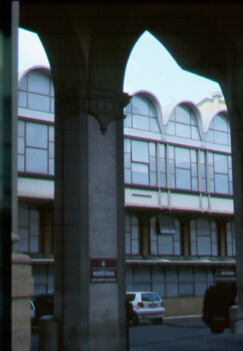
"INA-Casa" housing project (pictured right) near to the Ponte Vecchio (1954-58) in Florence,73
dealt with the problems of locating buildings within Tuscan
Renaissance contexts. The proportions and relationship between
frame and infills, and the balance of volumes, achieved exemplary
inclusions within the Medieval contexts without resorting to a
mimicry of the surroundings. The approach, although skilful was
sober in comparison to Florence's station twenty years earlier.
Michelucci, through a series of urban interventions
such as the Borsa Merci (1948-50) in Pistoia (a commodities
market later demolished in favour of the "Cassa
Risparmio" (1957-65) also by Michelucci), and an
"INA-Casa" housing project (pictured right) near to the Ponte Vecchio (1954-58) in Florence,73
dealt with the problems of locating buildings within Tuscan
Renaissance contexts. The proportions and relationship between
frame and infills, and the balance of volumes, achieved exemplary
inclusions within the Medieval contexts without resorting to a
mimicry of the surroundings. The approach, although skilful was
sober in comparison to Florence's station twenty years earlier.
One of the most successful
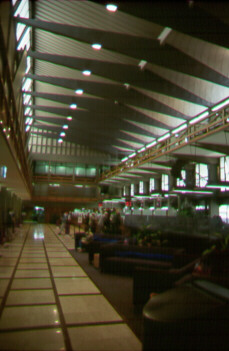
projects of the 1950s was the Cassa di Risparmio in Florence
(1953-57). It was a new banking hall entered from the street
through an old "palazzo" atrium with only one facade
visible through a rear courtyard (pictured below). It was therefore an almost entirely internal
experience, which contributed to its success and further
illustrates that at this moment in time, Michelucci's
architecture achieved the greatest success with public buildings
such as churches and banks. These busy complex interiors which
demanded a special quality of space, as cities in miniature,
began to achieve the goals he had set out in 1947.
In the "Happiness of an
Architect" Michelucci had explained that only an acceptance
of the artisan's reality of work could bring about the
"architect's happiness". He explained, "it was a
pleasure for me to read that Stravinsky, when he began to
compose, set himself the target of being in his profession what
the classical masters had been; in other words, like them, a
craftsman... This goal mentioned by the musician is the only one
acceptable to me, as the mental and moral position of the artist
towards his work".74
This was Michelucci's
understanding of his role as an individual, humbly translating
the needs of civilised society into form, not the romantic vision
of a solitary artist, detached and possibly even misunderstood by
the civilised assembly to which he belongs. His concept of
craftsmanship was an intricate one, not retraceable to the
reassuring formula of "craft" typical of some of his
contempories.
In the "Happiness of an
Architect" Michelucci stated "I don't much believe in
the imagination, but I do in fantasy"75
and we can interpret `fantasy' as `invention', relating to the
notion of craftsmanship. The issue here however can not simply be
referred to as a contrast between the craftsman and the artist as
there can be no invention or craftsmanship in isolation,
certainly invention alone does not create architecture. Nor can
great ideas alone represent ethical ideals. The "Craft"
for Michelucci was therefore the obligatory term in the passage
between civil values and architecture. As he said "I have
stood stood increasingly aloof from certain speculative interests
and from a polemical world, and have moved closer to a more
positive world and, out of professional necessity, to the craft
itself".76
For Michelucci, to construct an
architectural language and appropriate forms demands a
relationship between "life" and architecture. The
"life" is seen as a complex factor of the political and
social life of a city undergoing transformation, and the manner
in which man, by his actions appropriates spaces created by
architecture. In this regard Michelucci's architectural forms
attempt to translate a social pledge and transform city life into
architecture.
Maurice Cerasi wrote of
Michelucci's buildings that "great importance is attached to
the organisation of the plan, i.e. to the organisation of all the
routes and places together, with precise qualities of closure or
participation, looking out or recessing; [at the same time] the
choices of style, taste and design which inevitably attach to
environmental elements, remain autonomous, [if even] of no
interest at all".77 And as Michelucci nonchalantly
described in "The Happiness of an Architect"
:"after a form evolves "a taste will then shape
itself on the form".78
It seems therefore that precisely
Michelucci's indifference to "style" made it possible
(and was almost a necessary condition) in his mind, for the
relationship between architecture and "life" to exist.
The examination of two contrasting projects completed over a
decade apart can help clarify this: The "Borsa Merci"
already mentioned (1948-50) and the Osteria del Gambero Rosso
(1958-63), a restaurant set within a landscaped park that in many
ways was a prototype of stylistic themes employed at the Chiesa
dell'Autostrada.
The two buildings are allied by a
deep sense of unity of the architecture to their respective
environments. Michelucci for example when referring to the Borsa
Merci acknowledged that it is "in any case difficult to
imagine spontaneous conversationsconversations between people
looking out from the balcony on the first floor... and those
pausing on the pavement. Rather the whole constitutes an
expressive fact. Through the suggestion of a possible fruition,
it modifies the meaning of the interior".79 In the
same way the large seats at the Gambero Rosso not only suggest,
but permit the creation of a sense of place.
The relationship between the
architectural language and "life", is in both cases
very precise and independent from the stylistic nature of the
buildings. From this a conclusion can be drawn, for although
Michelucci turned towards a more singular style after the Borsa
Merci, closer to an expressionistic view of architecture (where
he began to express a will to destroy form), it was an entirely
secondary matter. And in many ways this indifference to
"style" had been aired as early as 1932 in his Domus
articles, where he demonstrated the linguistic similarities
between a rural farmhouse and a modern villa despite their formal
differences.
When asked why his buildings
seemed to resist categorisation Michelucci replied "look,
the important thing is to know nothing. There is a danger of
applying a preconceived form to the object that we're studying,
and this is already a problem".80
