If the messengers are faulty, then you can get unregulated division - or cancer.
If the messengers are faulty, then you can get unregulated division - or cancer.
All receptors have to:

Some faulty receptors are called constitutively active, where a receptor signals continously.
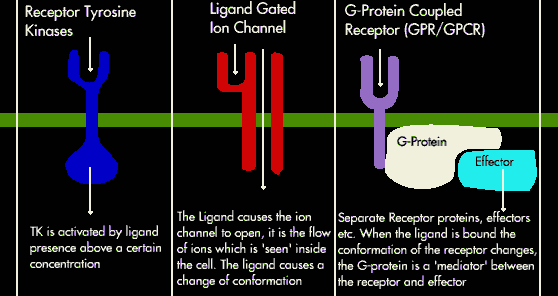
all have the same basic subunits (see above).
Effects mediated by G-Proteins - G=Guanine Nucleotide Binding Regulatory Protein.
heterotrimeric GTPases
The trimer consists of three different subunits:
Many different G-Proteins have been identified. The main difference is in the alpha subunit. Despite the differences in structure all the G-Proteins function in the same way.
Adenylate Cyclases (A.C.) also called Adneylyl Cyclases
This is a membrane bound enzyme (although iso-enzymes exist).

The switch off mechanism is Phosphodiesterase. You can increase the cAMP concentration by either activating Adenylate Cyclase or inihibiting cAMP-PDE - Coffee performs this latter action, which is one of the reasons it gives you a ‘buzz’
When the alphai subunit is involved it stimulates the receptor but inhibits the adenylaste cyclase, the alphar stimulates both the receptor & the adenylate cyclase.
PKA is activated by cyclic AMP, it phosphorylates specific Serine and Threonine residues:
Arginine - Anything - Serine/Threonine
It consists of 4 subunits, 2 regulatory and 2 catalytic:


Origin of Impulses in The Optic Nerve from the Retina of the Eye
Note that PDE activates signal not terminates signal as with cAMP
a phospholipase C (PLC) - activation of PIC requires two messengers:
PKC (requires Ca2+, PS) + DAG ---> Increase in PKC Activity --->
Inorganic Pn of substrates in cell ---> Effects
The concentration of Calcium inside cells is generally around 1mM, but most is bound to protein, etc.
Calmodulin is a 17kDa ‘ubiquitous’ protein, with 4 calcium (2+ binding sites.

For example, and increase in AC, PDE and Ca2+ ATPase. - It serves as a Ca2+ activated switch
Vasopressin (Angiotensin II) -> Increase in PIC activity -> Increase in [Ca2+]
and, Calcium + Calmodulin increases Glycogen Phosphorylase Kinase activitu leading yo Glycogenisis.
What reasons are there for such a complex enzyme cascade? It gives amplification; at each and every step 1 will activate many, giving extraordinary amplification.