Counterfeit Wingless Quackers
I have been hearing from a few sources that counterfeit
Wingless Quackers are currently making the rounds. They started
appearing on the Beijing markets early in May, so it is reasonable
that many have already hit the States. I do not have a sample of one
yet, but from what I am hearing, the fakes have the second version
tush tag with the red printing on them. Wingless Quackers was only
made with the black/white tush tag, so anything else is
incorrect.

Libearty
It is very difficult to determine whether or not
Libearty is counterfeit. The counterfeit version is modeled after the
Libearty that has the word "Beanie" correctly spelled on the tush
tag, NOT after the "Beanine" version. The nose is also a darker brown
instead of matching the color of Valentino's nose. The ribbon on the
fake Libearty is almost identical to the authentic ribbon and is
stitched directly to the Beanie Baby under the chin, which does occur
on some of the authentic Ty Beanie bears.
The fabric on Libearty has the same tendency as the material on other
fakes to feel rough, not as plush or smooth when brushed against the
nap. The tush tag is pale and slightly wider than the authentic Ty
tags. There are no readily identifiable faults with the swing tag
except that the yellow star is not a bright yellow, and the printing
within the star is printed too small and positioned too high within
the star. There is a minor imperfection on the inside of Libearty's
tag -- the word freedom almost looks like it had originally been
spelled "freedem" and then corrected.
 This is what a counterfiet Libearty's tag looks like.
COUNTERFEIT ERINS
It should come as no surprise to hear that counterfeit Erin Beanie
Babies are now available. They started appearing in the Beijing
markets about the beginning of April. Fortunately he is not as hard
to determine authenticity on as Princess is.
1. The most noticeable difference, if one has another Erin to compare
it to, is that the counterfeit is lighter in color (more lime green)
than the authentic Erin.
2. Additionally, the counterfeit has the less plush fabric which
"wrinkles" when brushed against the nap – a common fault of many of
the counterfeit Beanies.
3. On this version Erin, there is no swing tag, but there are some
problems with the tush tag. The tag is orangish in color, the ®
markings are indistinct, and the TM marking is shortened.
4. The shamrock on the fake is not as distinct as on the authentic
Erin. On the real Erin, the shamrock is made up of three distinct
hearts. On the fake, the shamrock has a fat heart on each side, with
a partial heart at the top middle.
5. This particular fake has a green ribbon on it – Erin is NOT
supposed to have a ribbon. Even if he did, the ribbon used on the
fake is too wide and single sided, unlike that which is normally used
on Ty products.
6. The pellets in the fake Erin are not round. Instead, they are
cylindrical with flat tops and bottoms which can be felt through the
fabric.


1997 TEDDYS
There are a couple versions of counterfeit 1997 Teddy Beanies making
their way into the secondary market. The most obvious difference
between the Counterfeit 1997 Teddy and the authentic ones is the
color of the fabric. The fakes are noticeably lighter in color, and
tend to be smaller in overall size. Below are some features that are
common to a couple of them. Keep in mind that a fake 1997 Teddy will
not necessarily have all of the faults that are listed as they will
vary according to the material available.
Counterfeit #1
1. Fabric is lighter in color
2. The eyes are dull instead of glossy
3. The nose is flat instead of slightly rounded, and the fake nose
is darker brown than the authentic Teddy
4. The scarf fabric is thinner material and shows lines in the
fabric
5. The ball of the hat is less white, bigger and less uniform in
size, and not as well sewn on
6. The tush tag is wider, and there is no spacing between the
words "OAKBROOKIL,USA"
7. The swing tag is poorly cut, has wide, brassy foil and is
slightly larger in size than an authentic Ty swing tag
8. The star on the front of the tag is a dull yellow instead of a
bright yellow.
Counterfeit 1997 Teddy #2
1. The fabric is lighter in color (similar to Spunky’s)
2. The hat and scarf are darker red than authentic Teddy
3. The hat is sewn on with tan instead of white thread
4. The ball of the hat is less white, bigger and less uniform in
size, and not as well sewn on
5. The pellets are smaller than in the authentic 1997 Teddy
6. Both the swing and tush tags look good on this particular
counterfeit. There are no distinguishing faults
COUNTERFEIT PRINCESS
With so many other counterfeit Beanie Babies on the market it was
just a matter of time before counterfeit Princesses started making an
appearance too. Princess hit the Russian market in Beijing early in
March, and has since made her way to the United States.
Unfortunately for the inexperienced collector, the fake Princess is
difficult to tell apart from the authentic Princess. The fake
Princess that is showing up indicates that it is made in China and
has the PVC pellets. Its swing tag is a copy of the swing tag version
where there is no double spacing between any of the 4 lines regarding
the Memorial Fund. (Please note that there are two different
legitimate Ty swing tags -- one that has a double space between the
2nd and 3rd lines of the profits statement, and one that does not.)
The material on the fake Princess is slightly lighter in color and
looks more like flannel than plush. Fabric used on counterfeit
Beanies tends to be not as plush and smooth as the material used on
authentic Ty Beanies. When brushing lightly back and forth across the
fabric, the authentic material is smooth and gives little resistance,
even when going against the nap. On the material for the fake
Princess, when going against the nap, the fabric feels rougher and
tends to "wrinkle." The neck ribbon is also well done, but has one
flaw to it – the ribbon on the authentic Princess is double-faced,
meaning that the material is satin on both sides. On the fake, one
side has the satin material, but the other side is dull.
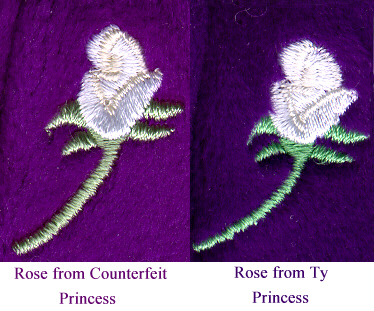
There are also some minute differences in the embroidered rose, but
not enough to be able to distinguish the fake from the real.
Counterfeit Shipment of Smoochy, Flash and Bruno Seized
The following article by Graeme Zielinski, Tribune Staff Writer, appeared in the Chicago Tribune March 27, 1998:
When U.S. Customs Service agents a few weeks ago inspected a shipment
to O'Hare International Airport that originated in China, they were
searching for drugs. What they found instead was Smoochy the Frog,
Bruno the dog and Flash the Dolphin. "These are worth a lot more,"
customs inspector Eddie Gross said, fingering a gimpy rip-off version
of Smoochy, a popular Beanie Baby that law enforcement officials said
was part of a counterfeit shipment worth a flea market value of
almost half a million dollars.
Customs agents on Thursday displayed a small sample of the thousands
of counterfeit Beanie Babies it said were part of a larger delivery
scheme by two Streamwood couples. "See The appendages on the frog are
rather flawed," Gross said, showing a reporter just how bad things
were. In an affidavit filed with the U.S. District Court in Chicago,
the agents estimated the value of the 8,596 stuffed animals, popular
among kids and collectors, at $434,600.
Customs agents claimed the shipment--seized Tuesday at a warehouse in
Rolling Meadows--was part of an effort by the two couples, dating
back to last year, to distribute the fraudulent knockoffs. Law
enforcement officials said many of the bogus babies are resold at
some flea markets around the country. Assistant U.S. Atty. Brian
Havey said no charges had been filed against the individuals listed
in the affidavit, but said the investigation was ongoing. An attorney
representing Ty Inc., the Oak Brook manufacturer of the popular
stuffed animals, said the bust was one of about a dozen in over the
past year involving counterfeit Beanie Babies...
 Left-Authentic Ty Peking ... Right-Counterfeit
I want to take a moment to share a letter I received today from
someone about the fake Pekings currently out in the market. Following
the letter will be additional information on how to identify these
problem pieces.
I want to thank you for the comprehensive information you are keeping
on your Web page about counterfeit beanies. It saved me tremendously
this week-end.
Before, I share the details of my experience, I want to alert Beanie
Baby collectors from metropolitan Detroit, MI and Ann Arbor MI that
this area is flooded with counterfeit beanies. There are Wingless
Quackers, Pekings, Righty, Lefty, Kiwi's, and on and on and on.
People are being duped here not by the small secondary market
dealers, but by the retail and collectable stores that sell the
retired beanies. They are all over, I believe, for two reasons. Since
this is the corporate home of the Big Three automotive giants, there
are many corporate business trips to China, and family members are
buying Beanie Babies, perhaps innocently, and bring them back here to
resell. Also, this is a large hub for Northwest Airlines, and many of
the airline personnel also bring back lots of fake Beanies from China
and also reselling them.
Last week I was contacted by someone who worked for the airlines, who
told me they had 6 Pekings to sell. Naturally I was very excited, and
wanted to believe that they were authentic, but in my heart I highly
doubted it. Since I don't own a Peking yet, I was very worried about
my ability to detect a fake. The person told me they had had many
more Pekings Lefty's and others that they had already sold to a
collectibles store in Ann Arbor. She told me the store paid her $50
for her Pekings, which was more than she ever imagined she would get.
Stores are buying these up for $50 to $500 apiece, and less than an
hour later selling many of them for over $3,000. She said others she
knows who are selling them don't know anything about Beanie Babies,
but know they can make a lot of money if they buy them in China and
bring them back and resell them. She said half of the stores they
contact tell them they are real and half tell them they aren't, so
they are confused and don't know what to believe.
In our collection we have some colored Teddy's, so I had sample
first, second, and third generation tags to bring with me. I also,
immediately went to your Web page for all the information I could
gather about the fake Pekings that were showing up. I also went to a
store where I felt reasonably certain had an authentic Peking to
sell, to examine it closely, before my daughter and I went to meet
this person and examine her Beanies. I will tell you these fakes were
very, very, good. We examined the tags a long time, and the beanie,
before absolutely deciding it was a fake. And yes, I realized nobody
would really have in their possession multiple authentic Pekings,
especially that were purchased recently, but I wanted to believe it
might just be possible, and this was my lucky day.
Even with the information on your Web page, it still was difficult to
immediately ascertain these were fakes. I couldn't tell any
difference in the white color being brighter, and the tags were a
very good reproduction. There were none of the things I keep hearing
about, such as bumps, uneven cut, being able to detect the impression
of the gold line from the back side of the tag, or the seam going
down the back being more prominent. There were two things which stood
out that I felt really convinced me. The ears were definitely squared
and not rounded, and the Beanie itself was very flat, and had hardly
any beans in it. You could hold it in the middle facing upward and
you could have the front and back fabric literally touching each
other. My daughter said there were no beans whatsoever in the feet. I
wanted her to sell them all to me as fakes, just to prevent them from
getting into the wrong hands and being passed on as real to some
other unsuspecting Beanie Baby collector. She only would sell me one
of them for $10.00, just so I could have it to use as an example of
the quality of the fakes. She wanted to keep the rest of them though.
Once again, thanks so much for your helpful Web page, because it
certainly saved me from an unfortunate and costly mistake. I hope you
can spread the word alerting the Detroit and Ann Arbor Mi collectors
to be especially careful in the Beanie Baby collecting on the retired
pieces.
As mentioned in the previous letter, the market is currently being
flooded with counterfeit Pekings. An ad in Sunday's (Feb. 8, 1998)
Chicago Tribune advertises Peking "seconds" for $200 with tag, $100
without tag. Sorry folks, but there is no such thing as Peking
"seconds." If there were, two big questions need to be asked which no
one seems to be able to supply the answer to: (1) Where have these
"seconds" been hiding for the past 2-1/2 years when Ty has been
unable to keep up with market demand? (2) How many "seconds" do you
see or hear of in any product that has so many multiple things
totally wrong with them as these Pekings do?
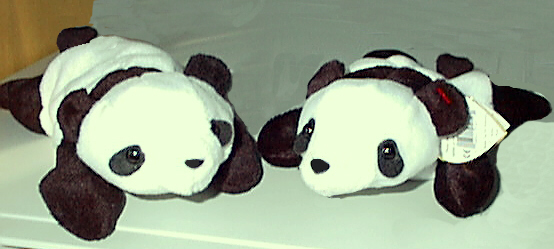
There are several factors for determining if a Peking is counterfet.
Some are "subjective" and could be considered manufacturing variances
such as the material is a brighter white, rougher texture, the
positioning of the felt pieces under the eyes is wrong (they are all
aimed down instead of out to the sides), the ears are squared off
instead of rounded, and there is considerably less stuffing and
pellets in the fakes. Other factors though are quite definitive and
can not be explained away are:
On the fake ---
1. The snout is too elongated
2. The nose is too big
3. The eyes are larger, duller, and more rounded -- meaning they
stand up more, whereas the real ones are much flatter.
4. The inside stem of the eye where it attaches into the Beanie is
longer and pointed than the real one which is shorter and flat.
(Current Beanies have these same shorter, flat stems for the
eyes.)
5. The tush tag is fractionally wider - common in counterfeits
6. The pellets are the wrong size. The older Beanies have
noticeably smaller pellets in them.
7. The swing tag is quite good, except that they forgot to put the
umlaut punctuation above the U in Nurnberg. (")
8. The imprint from stamping the gold foil onto the tag can be
seen from inside the tag. This is common in counterfeits, and
does not appear on Ty tags.
 Left-Authentic Ty Peking ... Right-Counterfeit
First it was Grunt...
now you need to check your
Kiwi and Chops
 Ty original Kiwi on the left
 TY original Chops on the left
Hi, I thought you might be interested in this. I just received 4 fake
kiwis and 3 fake chops in a trade. The kiwis are smaller in size and
the beak is a BIG indicater that it's fake. The blue on Kiwi is a LOT
lighter in color and the it is an inch shorter in length. The swing
tags are getting better though. Both of the swings are the same (on
kiwi and chops).They use gold foil instead of ink like on the grunts
I also got. The foil is a tad darker than the gold on the real ones.
Also, here are tiny bumps in the foil, not smooth like the real ones.
When you open the swing up you can see where the gold foil outline
is. I mean...it is embossed in the inside from the foil on the
outside. Does that make sense??? The foil is uneven on some of the
swings also. The tush tags are pretty well done...some have a
slightly different font but other than that they look fine. Chops has
a different nose. The fake nose is more round. Kiwi is about half to
three quarters of an inch shorter in height too.
TY original Chops on the left
Hi, I thought you might be interested in this. I just received 4 fake
kiwis and 3 fake chops in a trade. The kiwis are smaller in size and
the beak is a BIG indicater that it's fake. The blue on Kiwi is a LOT
lighter in color and the it is an inch shorter in length. The swing
tags are getting better though. Both of the swings are the same (on
kiwi and chops).They use gold foil instead of ink like on the grunts
I also got. The foil is a tad darker than the gold on the real ones.
Also, here are tiny bumps in the foil, not smooth like the real ones.
When you open the swing up you can see where the gold foil outline
is. I mean...it is embossed in the inside from the foil on the
outside. Does that make sense??? The foil is uneven on some of the
swings also. The tush tags are pretty well done...some have a
slightly different font but other than that they look fine. Chops has
a different nose. The fake nose is more round. Kiwi is about half to
three quarters of an inch shorter in height too.
Watch out for Grunt!
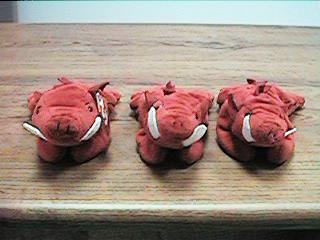

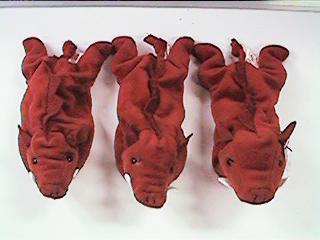
I have a normal Grunt and 2 Factory Rejects. Some things to look for:
The rejects are a lot smaller, and the normal Grunts have a forehead
about 1 3/4" wide as measured from eye to eye. The rejects are less
than an inch wide. The rejects have scrunched up noses. Also one of
the rejects has all kinds of threads sticking out of him. Thank you
Rod for sharing these photos!
I'm also hearing of problems with Grunts swing tag. Please read on...
Lisa writes ... I just received a COD shipment of 10 Grunts today and
they are all counterfeits. I could tell right away that something was
wrong because the plush fabric was all wrinkled. The hang tag was
very similar to ty's except that it was not printed clearly on the
inside of the tag, not cut well, and the gold around the edges of the
heart were printed gold ink, not the shiny foil that ty uses. Though
it might be able to fool novice collectors. Just thought that this
was newsworthy... I would hate for someone to be taken by this scam.
We were able to stop payment on our check, (thankfully I didn't lay
out cash!) but I am sure that there must just be hundreds (?) of
these in circulation as the post for them was on the AOL board last
weekend. Anyone who ordered these inexpensive Grunts from that board
better be alerted to expect fakes and to refuse delivery.
Also be aware of fake Spookys and Garcia showing up. These appear to
be especially prevalent on the West Coast. The Spooky's have tags
similar to the fake Grunts showing up on the market as well as poorly
cut out mouths. The Garcias showing up do not have beans in their
arms but stuffing.
Please make sure that you purchase Beanies from reputable dealers. I
strongly suggest if you are dealing with a new Beanie contact that
you check references prior to your purchase. Also ... please be sure
to carefully check your Beanies at Beanie shows and swaps.
Counterfeits have also been found at shows.
The following are scans I received from a recently purchased Spooky. I've been told that the Beanie itself looked fine except for being a bit "thin".

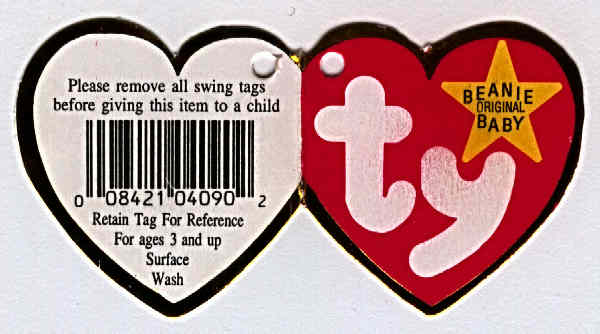
This is how the swing tag looks phony:
1.The edges are roughly cut
2.They red ink in very low gloss and a different color
3.Red ink smears
4.Ty on front is not smooth
5.Ghost spelled Glost
6.Red star is different
7.Gold trim is un-even
