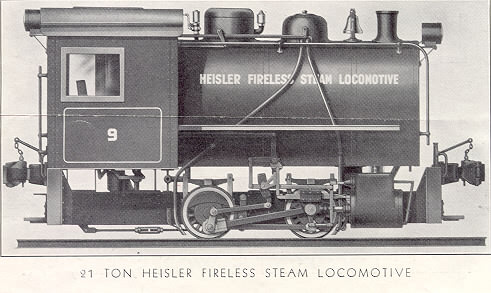
Charles L. Heisler was the inventor of the Heisler Geared Locomotive. He was a mechanical engineering genius and enjoyed inventing things; he was by no means a railroader. After graduation from Cornell University, he worked for the Dunkirk engineering Company in Dunkirk, NY. At Dunkirk, Heisler learned of the need for geared locomotives. His design benefitted from the improvements over existing designs such as the Lima Shay, the Climax and the Gilbert. After the death of an associate at Dunkirk, Heisler looked for another producer, ending up with the Stearns Manufacturing Company which manufactured logging equipment and felt a geared locomotive was a natural addition to the line. Heisler then disassociated himself from the design, going on to other projects at Alco, GE, the Army and Navy with some teaching and consulting at Penn State. At the time of his death in 1931, he had secured over 60 patents. Heisler's interest was inventing and not financial gain.
Campbell Limestone #9 was donated to the chapter at the Christmas banquet in 1979. It was donated by Vulcan Materials, the successor company to Campbell Limestone. (Southern E8A #6901 also came to the Chapter at the same time.) #9 is one of 35 Heislers left out of approximately 625 built. It was built in 1923 by the Heisler Locomotives Works, who had taken over the Stearns' locomotive business
All three are representative of geared locomotives. The Shay locomotive, designed in 1872 and patented in 1881, and its two variants -- the Climax and the Heisler -- employ small high-speed steam engines geared down to axles on four-wheel trucks. They were suited to slow and heavy hauling with high-tractive effort on the rough and temporary tracks of the lumber and mineral industries. They hauled heavy loads through difficult terrain from about 1890 to 1960 until replaced by highway trucks.
The Heisler locomotive was built by Stearns Manufacturing Company (Erie, Pa.) in 1899. It is a 37-ton locomotive regarded as powerful for its weight, economical on fuel, and easy to maintain. Heislers often burned sawdust waste from sawmills. The Tuolumne is the oldest Heisler type operating, having worked for the Hetch Hetchey & Yosemite Valley Railway during the Gold Rush days and then at the West Side Flume and Lumber Company in Tuolumne, Calif. It was originally called the Thomas S. Bullock.
The Shay locomotive was built by Lima Locomotive Works (Lima, Ohio) in 1912. The Dixiana -- a two-truck, 42-ton Shay, originally owned by Alaculsy Lumber Company -- served on six shortline railroads in the Smoky Mountains before moving west. It was named for a narrow-gauge mining railroad out of Dixiana, Virginia.
The two-truck Climax locomotive was last of its type built by Climax Manufacturing Company in 1928. It was purchased from the Carroll Peak and Western Railroad, is being restored in Los Angeles, and will be returned to the Santa Cruz, Big Trees & Pacific Railway Company.
Type: Heisler
Number: 1494
Wheel Arrangement: 0-4-4-0T
Builder: Heisler manufacturing Co, USA
Year Built: 1924
Weight: 25 Tonnes
Coal Bunker Capacity: 1 tonne
Water Capacity:
Boiler Pressure: 160 psi
Specifications for Campbell Limestone #9
Class:
55-8-38*
Code Word for size of Locomotive:
Artful**
Weight with full tender:
121,000 lbs.
2 cylinders-Dia. & stroke:
15 1/2" x 14"
Number of Drivers:
8
Diameter of Drivers:
38"
Rigid wheel base:
61"
Total wheel base:
27'1"
Total Length:
36'6"
Total Height over Rail:
11' 10 1/2"
Extreme Width:
9' 11"
Capacity-Water:
1800 gals.
Capacity-Coal:
7300 lbs.
Capacity-Wood:
2 cords
Capacity-Oil:
716 gals.
Sharpest practical curve:
85' Radius
Sharpest advisable curve:
95' Radius
Advised weight of rail:
50 lbs. per yd.
Minimum weight of rail:
45 lbs. per yd.
Maximum Boiler Pressure:
200 p.s.i.
Working Pressure:
180 p.s.i.
Tractive Force:
24,160 lbs.
* Class represents weight in tons,
averaging working order, number of drivers and size of drivers.
** Every class of Heisler had a marketing
name that started with the letter "A".

 HOME
HOME