
Introduction -
The Thirty Years' War lasted from 1618 to 1648 and involved almost every country in Western Europe. The war was initially based primarily on religious antagonism but later involved other issues such as dynastic rivalry. This period of controversy, which was one of Europe's most destructive, can be divided into four phases:
Phase One: Palentine-Bohemian (1618-1625) -
During the reign of Holy Roman Emperor Rudolf II many Protestant churches in Germany were destroyed, Protestant's rights to worship were restricted, and the signing of the Treaty of Augsburg which was the basis of increase in Roman Catholic power. In 1608, a group of Protestant princes and cities formed a defense called the Evangelical Union. In the following year the Catholic League, an organization similar to the Union, was formed to counter the Protestants. The first attack was made by the Bohemian section of the Evangelical Union. Outraged by the aggressiveness of the Catholic authorities, they demanded that Ferdinand II, king of Bohemia, intercede. Being a Catholic himself, the king denied the request. On May 23, 1618, Protestants of Prague invaded the royal palace and threw two of Ferdinand's ministers out the window. This attack, also referred to as the Defenestration of Prague, marked the beginning of the Protestant rebellion. Under the leadership of Count Heinrich Matthias von Thurn, the Union had many initial successes and advanced to other parts of Habsburg. Even Vienna (capital of Habsburg) was threatened by the Protestant forces for a brief period on 1619. In August of that year the Bohemians bestowed the crown of Ferdinand upon Frederick V, the elector of the Palatinate. Several sections of the Union consisting mainly of Lutherans withdrew from the rebellion because Frederick was a Calvinist. Taking advantage of the Protestant conflicts, Frederick promptly assumed the offensive. A Catholic League army, under the command of Johann Tserclaes, attacked the Bohemians at Weisserberg (near Prague) on November 8, 1620. Bloody retaliations were inflicted on the Bohemians after this victory and Protestantism was outlawed. The Evangelical Union eventually disintegrated but Frederick along with a few of his allies kept the struggle alive in the Palatinate. The Protestants conquered Tilly's army in April of 1622, but later suffered successive disasters. The Palantinate had been awarded to Maximilian I was later forcibly returned to the Roman Catholics.
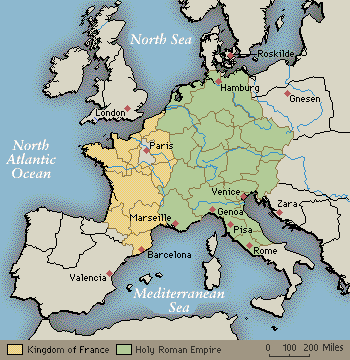
Phase two: Danish (1625-1629) -
The war progressed to international involvement when several German Protestant states sought assistance against the Catholics. The increasing strength of Habsburg shocked several European countries. Two of these countries, France and England, who were allies against Spain, initially avoided involvement in the war because of domestic dilemmas. However, Christian IV, king of Denmark and Norway, agreed to be of help to the Germans. His territorial aspiration was his main motivation. With the aid of Lutheran and German princes, Christian built a large army and invaded Saxony in early 1625. In the meantime a great army, constructed by Albrecht von Wallenstein (duke of Friedland), a joined the commission of Ferdinand II. These mercenaries had their first victory at Dessau, Germany in April of 1626. At Lutter am Barenberge, Tilly annihilated a majority of Christian's army on April 27, 1626. Later the following year Christian, under the pursuit of Wallenstein, was forced to retreat into the Jutland Peninsula. On March 6, 1629 Ferdinand officially declared total victory with the issuing of the Edict of Resolution, a document that abolished Protestants' rights to all Roman Catholic property that was dispossessed since the Peace of Augsburg. The end of the second phase of the Thirty Years' War was marked when Christian accepted the Treaty of Lübeck, depriving him of many holdings in Germany.
Phase three: Swedish (1630-1635) -
Ferdinand's success in the second phase of the Thirty Years' War strengthened the anti-Habsburg attitude of the French cardinal and Richelieu, the chief minister of King Louis XIII. The chief minister was unable to intercede because of recurring problems. However, Richelieu did make proposals to Gustav II Adolph of Sweden, who was an earnest Lutheran and had already been petitioned by the North German Protestants. Because of the Germans' persistence and several other reasons, Gustav joined the controversy. In the summer of 1630 Gustav lead a skilled army to the shores of Pomerania. The leaders of Pomerania, Brandenburg, and Saxony couldn't make up their mind on whether or not they should get involved in the Swedish endeavor and drastically delayed the campaign. Meanwhile, Tilly, having received control over Wallenstein's army, bombarded Magdeburg, Germany, which had revolted against the Holy Roman Empire. On the 20th of May, 1631, Imperial forces captured the city and massacred its Protestant inhabitants while fires destroyed the city. In September that year, the Saxon army supported Gustav in the Battle of Breitenfeld but they broke ranks, exposing Gustav to the enemy. Gustav, who nearly lost the battle, managed to regroup his troops but lost about 6,000 men. The campaign in the following spring brought about many victories, mainly the defeat of Tilly on April 14, 1632. Ferdinand therefore returned command to Wallenstein who immediately recruited a new army and invaded Saxony towards the end of the year. On November 16 the Swedes attacked the imperial army and then reinforced their own at Lützen, Germany. In the following battle Gustav was killed but Wallenstein and his forces were forced to retreat. Bernhard, the duke of Saxe-Weimar, took command of Gustav's army and stormed Bavaria after this victory. However, Wallenstein struck successive blows on the Swedish fortresses in Silesia. In the end of 1633, Wallenstien began a peace movement among leading groups in the imperial armies, but was removed from command because of suspicion of treason. He then entered peace negotiations with the Protestants. On February 25, 1634 Wallenstien was assassinated because of his relations with the Protestants.
In the next year the Peace of Prague brought an end to the third phase of the war and provided for modifications of the Edict of Restitution.
Phase four: French (1635-1648) -
In the last phase of the war, conflict for superiority broke out between Habsburg and France. This phase opened in May of 1635 when France declared war against Spain. On October 4, 1636 Johan Banér (Swedish general) overthrew the allied armies of Saxon and Austria, physically harming the Habsburg position in Germany. The Habsburg position was further damaged as a result of being attacked by the Duke of Bernhard. The imperial armies were then forced into surrendering their strongholds in Europe. Between the years of 1642 and 1645 a Swedish general named Lannart Tortensson won many victories, conquering Denmark (previously allied with the empire) and demolishing large portions of Germany and Austria. A general named Condé moved a Spanish army to Rocroi, France. The French were defeated the following November but thereafter the forces of Habsburg had few successes in war. The combined forces of Condé and another general named Turenne mutilated a Bavarian army in August of 1644. After another defeat in 1645 the empire and the anti-Habsburg organization began conducting peace talks. These negotiations were centered around relief to the "war-weary" people of Europe but remained fruitless for a prolonged period of time. Finally, after Bavaria was invaded in 1647, Maximilian I of Bavaria signed the Truce of Ulm with Sweden and France. However, Holy Roman Emperor Ferdinand III would not cooperate and conflict continued throughout the remainder of the year. Then, in the end of 1647, Maximilian joined the empire and defeated another army of Austria and Bavaria. This defeat forced Ferdinand to agree to the peace conditions of the victors.
Conclusion -
The result of this forced agreement resulted in the signing (October 24, 1648) of the Peace of Westphalia and significantly influenced the history of Europe. This treaty weakened the Holy Roman Empire and resulted in France advancing to the chief power on the Continent. Durring the Thirty Years' War the economy suffered great losses. In fact, modern reports estimate that the overall population was decreased by 15 to 20 percent. Economic activity declined throughout Germany and feelings of fear and uncertainty remained in the hearts of Europeans for centuries.
