All photographs and
text content reproduced by kind permission of
PETER MILFORD
St
Vincent College
The Weather Deck
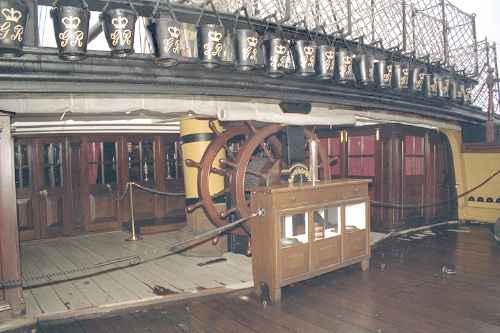
HMS Victory - the wheel and quarterdeck
 photocredit : Peter Milford :
St Vincent College, February 1997
The weather deck was where Victory was navigated, sailed and directed
in action. The quartermaster and his mates turned the wheel to keep the
ship on course - or to alter course as directed by the officer of the watch
or the sailing master (a senior warrant officer responsible for sailing
the ship). Two compasses were kept in the cabinet in front of the wheel
- illuminated at night by a dim lantern. Turning the wheel took up and
released rope connected to the tiller (a long lever) below - this moved
the tiller from side to side and turned the rudder. On either side of the
wheel are officer's cabins - the sailing master to port and the captain's
secretary to starboard. Behind the wheel is the entrance to the captain's
day and night cabins.
photocredit : Peter Milford :
St Vincent College, February 1997
The weather deck was where Victory was navigated, sailed and directed
in action. The quartermaster and his mates turned the wheel to keep the
ship on course - or to alter course as directed by the officer of the watch
or the sailing master (a senior warrant officer responsible for sailing
the ship). Two compasses were kept in the cabinet in front of the wheel
- illuminated at night by a dim lantern. Turning the wheel took up and
released rope connected to the tiller (a long lever) below - this moved
the tiller from side to side and turned the rudder. On either side of the
wheel are officer's cabins - the sailing master to port and the captain's
secretary to starboard. Behind the wheel is the entrance to the captain's
day and night cabins.
Above and astern of the quarterdeck is the poop deck, above the Captain's
quarters. From the poop deck the officers took navigational sightings and
directed the flying of signal flags. Midshipmen with telescopes kept a
sharp eye out for signals flown by other ships - and decoded their meaning
using signal code books.
During battle, the Admiral directed the action from either the poop
or quarter decks. Admiral Nelson was on the quarterdeck when he was shot
by a French marksman at the Battle of Trafalgar (1805). Wounded by the
musket ball, he was carried below where he died from his wounds three hours
later.
 |
The quarter deck was lined with 12 pounder cannon - the
heavier cannon were mounted lower down where their weight would stabilise
the ship. Hammocks were lashed up and stowed in the nets above the bulwarks
each morning - in action the rolled hammocks provided some protection against
splinters and shrapnel. Boarding pikes were stowed around the masts - within
easy reach when the ship came alongside an enemy in battle. |
|
photocredit : Peter Milford :
St Vincent College, February 1997
|
|
The ships boats were stowed forward of the quarter deck - over the open
space above the upper gun deck. In action these would be a dangerous source
of flying splinters so they were often lowered over the side and towed
astern.
Fo'csle deck - ship's bell and the galley chimney,
boarding pikes around the mast

|
|
photocredit : Peter Milford :
St Vincent College, February 1997
|
Starboard carronade - a smasher firing a
68 pound ball
 |
|
photocredit : Peter Milford :
St Vincent College, February 1997
|
Two carronades are mounted at the forward end of the upper deck - one to
port and one to starboard. These massive guns were known as 'smashers'
due to the effect of the 68 pound ball that they fired. They were used
to devastating effect in close quarters and could also fire a large quantity
of grapeshot. From their elevated position, they would hurl a huge quantity
of small balls down and across the deck of an enemy, wiping the decks clear
of men before the boarding party swung across to capture the ship.
Page creation: Peter Milford - St Vincent College,
February 1997