| |
Learner's
Notes
SOLAR CELL
A solar cell is
formed by a light sensitive P-N juction semiconductor, which when
exposed to
sunlight are bombarded by the photons in light (Photons are particles
of light, like we have atoms as
particles of an element). Every photon has a energy. If
the energy of the photon, hitting an electron
of an atom in the semiconductor, is greater than or equal to the
energy required to release the electron from its non-conducting
position in the atom to the free conducting state, it will contribute
to
the output of the solar cell.
The
free electrons generated, find a path
towards the P-type semiconductor (As the rule goes " unlike
charges
attract each other " ), through an external path. |
 |
If an external
path is
not there, the process of generating free electrons stops. The more
the amount of light falling on the cell's surface, more is the probability
of photons releasing electrons, and hence more electricity generated.
SOLAR PANEL
An average
sized solar cell with sufficient light, produces around 0.3V. Solar
cells are generally
stacked up together in series or parallel, and sold as solar panels.
A solar panel may consist of 300
or more solar cells. If these cells are arranged in series combination,
they yield a larger voltage(sum
of cell voltages). If they are arranged in parallel combination,
they yield a larger current (sum of cell currents).
In the panel
connections shown, the top portion of the cells(represented by circles)
is marked as
positive, and the bottom portion is marked as negative. In the series
connection, if one cell can
generate v volts, then the total or rated voltage available at the
terminals is v x n volts; where
n - no. of cells.
In the parallel connection, if one cell can supply I amps to the
external circuit, then the total or rated
current that can be supplied is I x n amps; where n - no. of cells.
ENERGY
WASTED
When
the cell is exposed to the solar spectrum, a photon that has an
energy less
than the band gap Eg. makes no contribution to the cell output.
A photon that has an energy greater
than Eg contributes an energy Eg. to the cell output. A photon that
has an energy greater than Eg.
contributes an energy Eg. to the cell output. Energy greater than
Eg. is wasted as heat.
TYPES OF SOLAR
CELLS
The solar
cells are classified into three different types depending upon their
manufacture.
They are,
1) Homojunction cells
2) Schottky Barrier Solar Cells
3) Heterojunction and Thin Film Cells.
HOMOJUNCTION CELLS
Homojunction
cells are those whose P & N type materials are made of the same
crystal as
shown.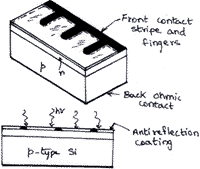
Examples. : Silicon cells and Gallium Arsenide (GaAs) cells.
The
conversion efficiency of a
Si P-N junction solar cell decreases less rapidly with temperature
because of the higher band gap of GaAs. However, a serious problem
with GaAs is that because of its direct band gap the value of a
is high.
As a consequence, the electron-hole pairs are created very near
the
surface and are lost by surface recombination before reaching the
junction depletion region. Thus, a very thin N-region is required
on the
P-type base. The most important use of Si solar cells has been
in space satellites where no other satisfactory energy sources are
available.
SCHOTTKY BARRIER CELLS
|
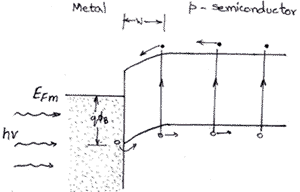
In a
Schottky barrier solar cell, a thin metal film is deposited on the
semicondutor. Figure below shows the energy band diagram of a cell made
on a P-type semiconductor. When light is incident on the front
surface, photon with energy hm>qfe
can excite holes from the metal over the barrier into the semiconductor.
The main advantage of Schottky barrier solar cells is that they
do not require high temperature processing like diffusion, and thus,
the processing cost is reduced.
|
HETEROJUNCTION AND THIN FILM CELLS
Heterojunction
solar cells have some advanta
ges over the conventional homojunction cells. If the top
layer semiconductor has a larger band gap Eg1
than the
band gap Eg2 of the base region, then photons
with
energy hm>Eg1
are largely absorbed in the top layer.
The top layer, however, acts as a window for the
low energy photons that will be absorbed by the second semiconductor.
This will enhance the short
wavelength response. The main difficulty in obtaining a heterojunction
solar cell is to find
semiconductors that have a good lattice match. Two such semiconductors
are AlAs and GaAs. AlAs
has a wider band gap(2.2eV) than GaAs. Thin film solar cells are
fabricated using films of semicond
ucting materials deposited on electrically active or passive substrates
like glass, ceramic, graphite,
or a metal. Because of the availability of inexpensive materials
and lower processing costs, thin film
solar cells have the advantage of low cost. However, these cells
have low efficiencies.
CONVERSION EFFICIENCY
|
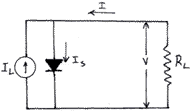
From the
equivalent circuit, the
conversion efficiency of a P-N junction solar cell is derived as
hc
= (Im Vm)
/ Pin
where,
Vm
Im - values of voltage and current
at maximum power
condition
Pin-
Incident power.
hc
= (FF IL Vcc) /
Pin
Vcc-
Open circuit voltage
IL-Full
load current
FF = Fill factor of the cell = ( ImVm
) / ( ILVoc
)
|
To increase
efficiency, IL, Voc,
FF should be maximized.
A plot of conversion efficiency (hc)Vs
band gap (eV) is as shown in figure below.
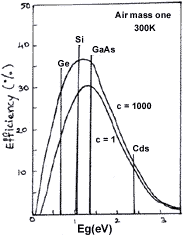  |
From the graph, it is seen that, semiconductors with band gaps between
1 and 2eV have a theoretical efficiency in excess of 20percent,
and all of
them can be considered solar cell materials.
However, because of
technological and other considerations, the choice has to be made
between Si and GaAs.
Although GaAs offers the possibility of higher
efficiency and power output, Si is widely used in P_N junction cells
because of its more advance technology and lower cost. |
DESIGN
CONSIDERATIONS
The light is transmitted
through the
semiconductor.
The monochromatic
light, as it passes through the semiconductor, decays exponentially, and is a
function of the wavelength (known as
absorption coefficient). i.e., the ability of a material to absorb
light is
measured by its absorbtion coefficient.
Figure, shows a
plotted as a
function of photon energy for a number of semiconductors. Note that
for a given
photon energy the larger the value of Eg, the lower the
absorption coefficient.
REASONS
FOR LOW EFFICIENCY AND IMPROVEMENT
The
solar cell has a very low efficiency (about 30-40%).
A photon has got quite a large supply of energy but a low momentum.
A major reason for the low efficiency of a solar cell is the fact
that
each photon, irrespective of its high energy, generates one electron
hole pair. The electron and hole quickly thermalise or relax back
to the edges of the respective carrier
bands emitting 'Photons', a fundamental particle which, unlike a
photon, has low energy but relatively high momentum.
The energy thus wasted is dissipated as heat. Excessive recombination
of carriers
(electron and hole) in the semiconductor bulk and at the surfaces
reduces efficiency.
Only the electron
hole pair generated near the P-N junction contributes to light generated
current. Carriers generated
well away from the junction have the tendency to recombine before
these complete their travel from
the point of generation to the solar cell terminal. Loss occurs
due to reflection of incident light too. Bare silicon
chip is quite reflective.
However, anti-reflection coating reduces
such loss from 30 to 10
percent. It is necessary to provide a metal terminal on the chip
for making electrical contact. This
reduces the active surface area of the semiconductor exposed to
sunlight. This blocks 5 to 15 %
of the incoming light. If the cell is not thick enough, a part of
the incident light will not be absorbed,
and it passes out at the back. Power output and efficiency decrease
with increasing operating
temperature. Power output of silicon solar cell decreases by 0.4
to 0.5 percent per degree Celsius.
Semiconductor material, metallic electrical contacts, and interconnection
have series resistance.
Leakage
across the P-N junction also causes shunt resistance. All these
resistance waste energy,
thus decreasing the efficiency. The performance of solar cells has
also been improved by reducing
the reflection of the incident light from the surface. This has
been achieved by surface texturing using chemical etchants.Some
slow etchants are found to selectively etch theSi surface and produce
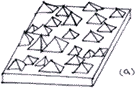 |
 |
pyramidical tetrahedra
of highdensity that are
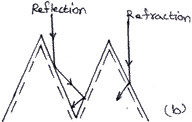
uniformly distributed over the surface[fig.] Surface
texturing has two advantages.
First, the multiple
reflections reduce the amount of light reflected
back from the surface. Second, the light gets
refracted as it enters Si and travels obliquely
through the cell causing its absorption closer to
the junction.
|
TODAY'S
SCENE IN THE INDUSTRY
Efforts
are being made to reduce the cost of electricity produced by using
solar panels, by
reducing
the wastage, and by making more efficient cells. Also, there are several
other approaches
towards making solar power economical compared to other sources of
power.
I Approach : By using solar concentrators, more light can be
focussed on to a cell thereby increasing
the output. (Note that this approach is already being used for solar
heating.)
II Approach : By using tracking system, which track the relative
movement of the sun to the earth
and tilt the solar module towards the sun.
III Approach : The solar beam is split into two or more parts
of different wavelengths (i.e., of
different colours). Each of this spectrum of light is then foccussed
on a separate solar cell most
sensitive to it. IV Approach : The sunlight is allowed to pass through
thin cells of different materials
lying above one another. The topmost cell absorbs and is activated
by photons of higher energy. The
next cell is activated by photons of lesser energy, and the last cell
absorbs light rays of greater
wavelength.
V Approach : Concentrated solar energy is used to heat a radiator
surface to a very high
temperature of 18000C at this temperature, the hot radiator surface
emits photons to a range where
most of them are close to minimum excitation threshold of the silicon
cell. Kindly note that by the time
you may be reading this line, the above approaches may have been modified,
bettered, and put to
commercial usage.
CONCLUSION : Solar cells have become much more feasible, due
to enormous development in electronics industry. It is expected that
solar power will cost lesser than the conventional energy sources
in a few more years.
|


