
Our Mission | The Company | Future Shows and Events | Past Shows and Events
Festivals | Donors | Related Sites
THE NORMAL HEART
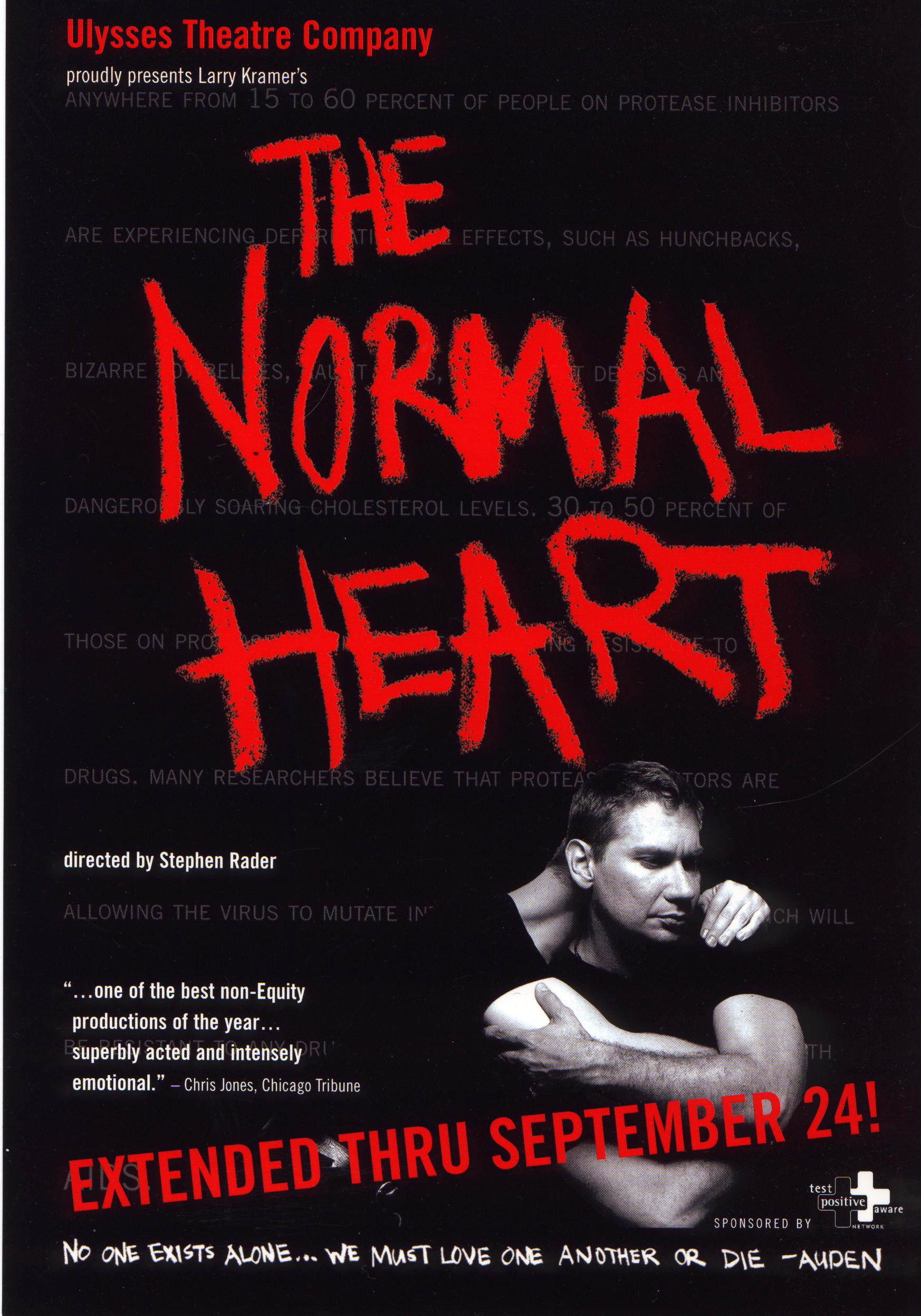
Ulysses' production of The Normal Heart by Larry Kramer was directed by founding company member Stephen Rader and featured fellow members; Jennifer Byers, Michael Kass, Trey Maclin and Patrick Rybarczyk. Receiving rave reviews, this production was extended at The Athenaeum Theatre. Patrick Rybarczyk won an After Dark Award for his portrayal of reporter, Felix Turner.
THE CAST
The Shattered Globe Theatre
| Ned Weeks | - Michael Ryczyk |
| Felix Turner | - Patrick Rybarczyk |
| Ben Weeks | - Michael Pacas |
| Bruce Niles | - Tim Vaughn |
| Mickey Marcus | - Trey Maclin |
| Tommy Boatwright/David/Doctor | - Steve Wrobleski |
| Hiram Keebler/Grady/Doctor | - Kevin Rich |
| Dr. Emma Brookner | - Jennifer Byers |
The Athenaeum Theatre
Cast as above with the following changes:
| Bruce Niles | - Aaron Christensen |
| Hiram Keebler/Grady/Doctor | - Michael Kass |
 The Normal Heart was sponsered by Test Positive Aware Network.
 You can order a copy of The Normal Heart through Barnes and Noble or Amazon.com.
 If you are interested in the issues explored in The Normal Heart, we recommend that you read Larry Kramer's novel - Faggots. You can order this book through Barnes and Noble or Amazon.com.
Click here to attend The Normal Heart closing night party!
REVIEWS
The Chicago Reader
Unlike his inept 1988 farce Just Say No, Larry Kramer's 1985 masterwork - a memoir of the early days of the AIDS crisis - refuses to date. Rooted in credible crisis of believable character, it remains a call to arms against government apathy and an antidote to the self-doubt of reluctant reformers. And as Stephen Rader's urgent staging conveys, the emergency is far from over: the actors cover a chalkboard with updates on the failure of the new AIDS medicines and warnings about gays returning to unsafe sex.
Kramer, here represented by activist Ned Weeks, roots his story in the turbulent time when gays discovered that sexual freedom - or promiscuity - had sped the virus (Kramer's attack on the bathhouses made him an instant pariah). Adding to the burden of Ned's conscience-driven attacks on Mayor Koch and his own organization, Gay Men's Health Crisis, are his private ordeals with an initially hostile brother and a lover stricken with AIDS.
Though sometimes skittish in the strident scenes, Michael Ryczek roots Ned in a bedrock decency that explains and excuses his excesses. As his lover, Patrick Rybarczyk conveys the panic of embattled innocence. And, in a powerful cameo, Trey Maclin plays an AIDS activist who finds himself beset by "bereavement overload." Fortunately, the play is not.
--Lawrence Bommer
The Chicago Tribune
RAVE
Unlike their European counterparts, contemporary American playwrights have not been an especially political bunch. Aside form the work of Tony Kuschner and various dissections of the war in Vietnam, the typical American play of the 1980s was relationship-driven and did not spend much time exploring the day-t0-day politics of the Reagan years.
Excepting "Angels in America," Larry Kramer's "The Normal Heart" is arguably the best political play of that schizophrenic decade and definitely the definitive dramatic exploration of the early years of the AIDS crisis. This biographical masterpiece had a shattering - and still unforgettable - impact when it first appeared in the major theatrical centers in 1983, an era when Hollywood was as terrified by AIDS as the weak-kneed politicians, media and public health officials who wasted so much time before protecting the citizenry.
But since many consider this drama to be dated, you don't see "The Normal Heart" done much anymore. That has given the Ulysses Theatre Company as fine opportunity. And this fledgling theatre company has responded with a superbly acted and intensely emotional storefront show staged in the tiny Halsted Street crucible of the Shattered Globe Theater.
Stephen Rader's outstanding production not only captures the searing political power of the original intent, but also cleverly contextualizes this play for a different - but equally challenging - time in the painful history of AIDS. This is, without question, one of the best non-equity productions of the year to date.
Rader's cast scribbles directly on the walls of the theatre between the play's episodic scenes, charting AIDS deaths in the 1990s and hammering home the message that the crisis - and the need for safe sex - is very far from over. But the concept would not work without strong acting, and there are some terrific performances. In the lead role of Ned Weeks (a version of the once-acerbic Kramer himself), Michael Ryczek is complicated and intelligent. Tim Vaughn is superb as the closeted Bruce Niles, Week's principal antagonist, and there is especially rich and supportive work from Michael Pacas and Patrick Rybarczyk.
--Chris Jones
The Chicago Sun Times
RECOMMENDED
Larry Kramer's 1985 drama, "The Normal Heart," comes with heavy baggage. This biting story about the birth of AIDS activism is difficult to disentangle from the personality of it's polemical, sarcastic, self-involved and often humorless author.
So I approached this revival by the young Ulysses Theatre troupe with rising trepidation. Is "The Normal heart" really a play? Would it have impact now that the early days of the "gay plague" seem as distant as the civil war? Could a no-budget upstart company pull it off?
The answer to all three questions, it turns out, is a resounding "yes." Kramer's play may actually work better now in the tragic hindsight of history; it serves once again as a clarion wake-up call. Director Stephen Rader and his cast of eight find all the pathos, fear and humor in both Kramer's script and the times he chronicled.
Kramer was a somewhat successful screenwriter-producer ("Women in Love") and novelist (Faggots) when he found himself witness to a series of deaths of young gay men from a mysterious illness.
To combat government indifference to the disease and help his dying and bereaved friends, he founded the Gay Men's Health Crisis. After he was expelled from that group, he founded the more activist ACT-UP and wrote this play as a sort of personal and political memoir.
Kramer remains a colossal ego. But what political intervention took place and what medical research efforts have occurred are due in large part to his single-mindedness. As the Ulysses production shows, Kramer was somehow able to step back enough to see the impossibility – and inherent seriocomic content - of his own character.
Over 2½ hours, Michael Ryczek simmers as the activist everyone loves to hate and hates to love. Patrick Rybarczyk captures the sweetness and conflict of Kramer's lover, a closeted New York Times reporter who ultimately succumbs to AIDS. Jennifer Byers is the doctor who attempts to alert the world about this epidemic. And Trey Maclin, as an early victim of activist burnout, leads a strong supporting cast.
The performers are literally surrounded by Rader and Maclin's design concept: The players mark up the black walls of the Shattered Globe space with chalk statistics and quotations to remind the audience that the AIDS crisis is far from over.
--Andrew Patner
Outlines
STRONGLY RECOMMENDED
“If I have to sit through The Normal Heart on more time,” Larry Kramer told me when I interviewed him in April of 1999, “I think I’d slit my wrists.”
I’d like to think he’d feel differently after sitting through Ulysses Theatre Company’s production of his play at the Shattered Globe Theatre.
Stephen Rader’s crisp and intuitive direction makes good use of the small space, which is alternately a doctor'’ examining room, a lawyer’s office, an apartment, the office of a New York Times writer, and a hospital room, among other places. The set’s black walls don’t stay way for long as the case members enter before any dialogue is spoken and adorn the walls with HIV/AIDS statistics, facts and quotes in pink and white chalk. A tally board is kept throughout he course of the almost three-hour play, beginning (as the play does) in July of 1982 when there were 43 deaths attributed to, and 108 infections liked to, what would later come to be known as AIDS.
As Ned Weeks, the lead character undeniably based on Kramer himself, Michael Ryczek communicates the confusion and frustration experienced by those losing friends and loved ones in the early days of the epidemic. Using the rage in his voice and his expressive body language, Ryczek’s Ned Weeks is a man pulled in many directions, including the direction of love and intimacy.
Jennifer Byers, as Dr. Emma Brookner, the wheelchair-bound voice of reason, brings a much-needed female energy to the play.
However, in this production of The Normal Heart, the stage belongs to Patrick Rybarczyk. As Felix Turner, The New York Times writer who becomes romantically involved with Ned, Rybarczyk shows us every facet of his character in exact and unflinching detail. We believe the transitions that Turner makes (from conservative and reluctant closeted gay man to lover and fighter to dying man with dignity) because Rybarczyk’s portrayal is totally honest and connects easily with the audience. Almost 15 years since it was written, The Normal Heart, like Angels In America, remains an important piece of work in the ever-expanding canon of AIDS literature and deserves an attentive audience.
--Gregg Shapiro
If you would like to make a donation or want to be added to our mailing list, please click here to print our mail form.
Our Mission | The Company | Future Shows and Events | Past Shows and Events
Festivals | Donors | Related Sites
