 |
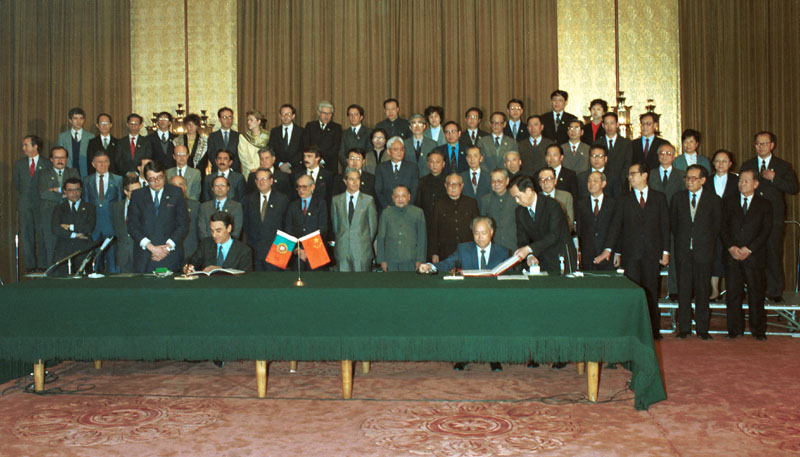
JOINT DECLARATION OF THE GOVERNMENT OF THE PEOPLE'S REPUBLIC OF CHINA AND THE GOVERNMENT OF THE REPUBLIC OF PORTUGAL ON THE QUESTION OF MACAU |
|||
|
. . |
The Government of the People's Republic of China and the Government of the Republic of Portugal have reviewed with satisfaction the development of the friendly relations between the two Governments and peoples since the establishment of diplomatic relations between the two countries and agreed that a proper negotiated settlement by the two Governments of the question of Macau, which is left over from the past, is conducive to the economic growth and social stability of Macau and to the further strengthening of the friendly relations and cooperation between the two countries. To this end, they have, after talks between the delegations of the two Governments, agreed to declare as follows: The Government of the People's Republic of China and the Government of the Republic of Portugal declare that the Macau area (including the Macau Peninsula, Taipa Island and Colane Island, herein after referred to as Macau) is Chinese territory, and that the Government of People's Republic of China will resume the exercise of sovereignty over Macau with effect from 20 December 1999. The Government of the People's Republic of China declares that in line with the principle of "one country, two systems", the People's Republic of China will pursue the following basic policies regarding Macau: In accordance with the provisions of Article 31 of the Constitution of the People's Republic of China, the People's Republic of China will establish a Macau Special Administrative Region of the People's Republic of China upon resuming the exercise of sovereignty over Macau. The Macau Special Administrative Region will be directly under the authority of the Central People's Government of the People's Republic of China, and will enjoy a high degree of autonomy, except in foreign and defence affairs which are the responsibilities of the Central People's Government. The Macau Special Administrative Region will be vested with executive, legislative and independent judicial power, including that of final adjudication. Both the Government and the legislature of the Macau Special Administrative Region will be composed of local inhabitants. The chief executive will be appointed by the Central People's Government on the basis of the results of elections or consultations to be held in Macau. Officials holding principal posts will be nominated by the chief executive of the Macau Special Administrative Region for appointment by the Central People's Government. Public servants 8including police) of Chinese nationality and Portuguese and other foreign nationalities previously serving in Macau may remain in employment. Portuguese and other foreign nationals may be appointed or employed to hold certain public posts in the Macau Special Administrative Region. The current social and economic systems in Macau will remain unchanged and so will the life-style. The laws currently in force in Macau will remain basically unchanged. All rights and freedoms of the inhabitants and other persons in Macau, including those of the person, of speech, of the press, of assembly, of association, of travel, and movement, of strike, of choice of occupation, of academic research, of religion and belief, of communication and the ownership of property will be ensured by law in the Macau Special Administrative Region. The Macau Special Administrative Region will on its own decide policies in the fields of culture, education, science and technology and protect cultural relics in Macau according to law. In addition to Chinese, Portuguese may also be used in organs of Government and in the legislature and the courts in the Macau Special Administrative Region. The Macau Special Administrative Region may establish mutually beneficial economic relations with Portugal and other countries. Due regard will be given to the economic interests of Portugal and other countries in Macau. The interests of the inhabitants of Portuguese descent in Macau will be protected by law. Using the name "Macau, China", the Macau Special Administrative Region may on its own maintain and develop economic and cultural relations and in this context conclude agreements with states, regions and relevant international organisations. The Macau Special Administrative Region Government may on its own issue travel documents for entry into and exit from Macau. The Macau Special Administrative Region will remain a free port and a separate customs territory in order to develop its economic activities. There will be free flow of capital. The Macau Pataca, as the legal tender of the Macau Special Administrative Region, will continue to circulate and remain freely convertible. The Macau Special Administrative Region will continue to have independent finances. The Central People's Government will not levy taxes on the Macau Special Administrative Region. The maintenance of public order in the Macau Special Administrative Region will be the responsibility of the Macau Special Administrative Region Government. Apart from displaying the national flag and national emblem of the people's Republic of China, the Macau Special Administrative Region may use a regional flag and emblem of its own. The above-stated basic policies and the elaboration of them in Annex I to this Joint Declaration will be stipulated in a Basic Law of the Macau Special Administrative Region of the people's Republic of China by the national people's Congress of the People's Republic of China, and they will remain unchanged for 50 years. The Government of the People's Republic of China and the Government of the Republic of Portugal declare that, during the transitional period between the date of the entry into enforce of this Joint Declaration and 19 December 1999, the Government of the Republic of Portugal will be responsible for the administration of Macau. The Government of the Republic of Portugal will continue to promote the economic growth of Macau and maintain its social stability, and the Government of the People's Republic of China will give its cooperation in this connection. The Government of the People's republic of China and the Government of the Republic of Portugal declare that in order to ensure the effective implementation of this Joint Declaration and create appropriate conditions for the transfer of Government in 1999, a Sino-Portuguese Joint Liaison group will be set up when this Joint Declaration enters into force, and that it will be established and will function in accordance with the relevant provisions of Annex II to this Joint Declaration. The Government of the people's Republic of China and the Government of the Republic of Portugal declare that land leases in Macau and other related matters will be deal with in accordance with the relevant provisions of the Annexes to this Joint declaration. The Government of the People's Republic of China and the Government of the Republic of Portugal agree to implement all the preceding declarations and the Annexes which are a component part of the joint declaration. This Joint Declaration and its Annexes shall enter into force on the date of the exchange of instruments of ratification, which shall take place in Beijing. This Joint Declaration and its Annexes shall be equally binding.
Done in duplicate at Beijing on April 15, 1987 in the Chinese and Portuguese languages, both texts being equally authentic.
For the Government of the Republic of Portugal Anibal Cavaco Silva For the Government of the People's Republic of China Zhao Ziyang
ANNEX I
ELABORATION BY THE GOVERNMENT OF THE PEOPLE'S REPUBLIC OF CHINA OF ITS BASIC POLICIES REGARDING MACAU
The Government of the People's republic of China elaborates the basic policies of the People's Republic of China regarding Macau as set out in paragraph 2 of the joint Declaration of the Government of the people's Republic of China and the Government of the Republic of Portugal on the Question of Macau as follows:
I
The Constitution of the People's republic of China stipulates in Article 31 that "the state may establish special administrative regions when necessary. The systems to be instituted in special administrative regions shall be prescribed by laws enacted by the National People's Congress in the light of the specific conditions". In accordance with this Article, the People's Republic of China shall, upon the resumption of the exercise of sovereignty over Macau on 20 December 1999, establish the Macau Special Administrative Region of the People's Republic of China. The national People's Congress of the People's Republic of China shall enact and promulgate a Basic law of the Macau Special Administrative Region of the People's Republic of China (hereinafter referred to as the Basic Law) in accordance with the Constitution of the People's Republic of China, stipulating that after the establishment of the Macau Special Administrative Region the socialist system and socialist policies shall not be practised in the Macau Special Administrative Region and that the current social and economic systems and life-style in Macau shall remain unchanged for 50 years. The Macau Special Administrative Region shall be directly under the authority of the Central People's Government of the People's Republic of China, and shall enjoy a high degree of autonomy, except in foreign and defence affairs which are the responsibilities of the Central People's Government. The Macau Special Administrative Region shall be vested with executive, legislative and independent judicial power, including that of the final adjudication. The Central People's Government shall authorise the Macau Special Administrative Region to conduct on its own those external affairs specified in Section VIII of this Annex.
II
The executive power of the Macau Special Administrative Region shall be vested in the Government of the Macau Special Administrative Region. The Government of the Macau Special Administrative Region shall be composed of local inhabitants. The chief executive of the Macau Special Administrative Region shall be appointed by the Central People's Government on the basis of the results of elections or consultations to be held in Macau. Officials holding principal posts (equivalent to Assistant-Secretaries, procurator-general and principal officer of the police service) shall be nominated by the chief executive of the Macao Special Administrative Region for appointment by the Central People's Government. The executive authorise shall abide by the law and shall be accountable to the legislature.
III
The legislative power of the Macau Special Administrative Region shall be vested in the legislature of the Macau Special Administrative Region. The legislature shall be composed of local inhabitants, and the majority of its members shall be elected. After the establishment of the Macau Special Administrative Region, the laws, decrees, administrative regulations and other normative acts previously in force in Macau shall be maintained, save for whatever therein may contravene the Basic Law or subject to any amendment by the Macau Special Administrative Region legislature. The legislature of the Macau Special Administrative Region may enact laws in accordance with the provisions of the Basic Law and legal procedures, and such laws shall be reported to the Standing Committee of the National People's Congress of the People's Republic of China for record. Laws enacted by the legislature of the Macau Special Administrative Region which are in accordance with the Basic Law and legal procedures shall be regarded as valid. The legal system of the Macau Special Administrative Region shall consist of the basic Law, the laws previously in force in Macau and the laws enacted by the Macau Special Administrative Region as above.
IV
Judicial power in the Macau Special Administrative Region shall be vested in the courts of the Macau Special Administrative Region. The power of final adjudication shall be exercised by the court of final appeal in the Macau Special Administrative Region. The courts shall exercise judicial power independently and free from any interference, and shall be subordinated only to the law. The judges shall enjoy the immunities appropriate to the performance of their functions. Judges of the Macau Special Administrative Region courts shall be appointed by the chief executive of Macau Special Administrative Region acting in accordance with the recommendation of the independent commission composed of local judges, lawyers and noted public figures. Judges shall be chosen by reference to their professional qualifications. Qualified judges of foreign nationalities may also be invited to serve as judges in the Macau Special Administrative Region. A judge may only be removed for inability to discharge the functions of his office, or for behaviour incompatible with the post he holds, by the chief executive acting in accordance with the recommendation of a tribunal appointed by the president of the court of final appeal, consisting of not fewer than three local judges. The removal of judges of the court of final appeal shall be decided upon by the chief executive in accordance with the recommendation of a review committee consisting of members of the Macau Special Administrative Region Legislature. The appointment and removal of judges of the court of final appeal shall be reported to the Standing Committee of the National People's Congress for the record. The prosecuting authority of the Macau Special Administrative Region shall exercise procuratorial functions as vested by law independently and free from any interference. The system previously in force in Macau for appointment and removal of supporting members of the judiciary shall be maintained. On the basis of the system previously operating in Macau, the Macau Special Administrative Region Government shall make provisions for local lawyers and lawyers from outside Macau to practise in the Macau Special Administrative Region. The Central People's Government shall assist or authorise the Macau Special Administrative Region Government to make appropriate arrangements for reciprocal juridical assistance with foreign states.
V
The Macau Special Administrative Region shall, according to law, ensure the rights and freedoms of the inhabitants and other persons in Macau as provided for by the laws previously in force in Macau, including freedom of the person, of speech, of the press, of assembly, of demonstration, of association (e.g., to form and join non-official associations), to form and join trade unions, of travel and movement, of choice of occupation and work, of strike, of religion and belief, of education and academic research; inviolability of the home and of communication, and the right to have access to law and court; rights concerning the ownership of private property and of enterprises and their transfer and inheritance, and to obtain appropriate compensation for lawful deprivation paid without undue delay; freedom to marry and the right to form and raise a family freely. The inhabitants and other persons in the Macau Special Administrative Region shall all be equal before the law, and shall be free from discrimination, irrespective of nationality, descent, sex, race, language, religion, political or ideological belief, educational level, economic status or social conditions. The Macau Special Administrative Region shall prospect, according to law, the interests of residents of Portuguese descent in Macau and shall respect their customs and cultural traditions. Religious organisation and believers in the Macau Special Administrative Region may carry out activities as before for religious purposes and within the limits as prescribed by law, and may maintain relations with religious organisations and believers outside Macau. Schools, hospitals and charitable institutions attached to religious organisations may continue to operate as before. The relationship between religious organisations in the Macau Special Administrative Region and those in other parts of the People's Republic of China shall be based on the principles of non-subordination, non-interference and mutual respect.
VI
After the establishment of the Macau Special Administrative Region, public servants (including police) of Chinese nationality And Portuguese and other foreign nationalities previously serving in Macau may all remain in employment and continue their service with pay, allowances and benefits no less favourable than before. Those of the above-mentioned public servants who have retired after the establishment of the Macau Special Administrative Region shall, in accordance with regulations currently in force, be entitled to pensions and allowances on terms no less favourable than before, and irrespective of their nationality or place of residence. The Macau Special Administrative Region may appoint Portuguese and other foreign nationals previously serving in the public service in Macau or currently holding Permanent Identity Cards of the Macau Special Administrative Region to public posts (except certain principal official posts). The Macau Special Administrative Region may also invite Portuguese and other foreign nationals to serve as advisers or hold professional and technical posts. The Portuguese and other foreign nationals holding public posts in the Macau Special Administrative Region shall be employed only in their individual capacities and shall be responsible exclusively to the Macau Special Administrative Region. The appointment and promotion of public servants shall be on the basis of qualifications, experience and ability. Macau's previous system of employment, discipline, promotion and normal rise in rank for the public service shall remain basically unchanged.
VII
The Macau Special Administrative Region shall on its own decide policies in the fields of culture, education, science and technology, such as policies regarding the languages of instruction (including Portuguese) and the system of academic qualifications and the recognition of academic degrees. All educational institutions may remain in operation and retain their autonomy. They may continue to recruit teaching and administrative staff and use teaching materials from outside Macau. Students shall enjoy freedom to pursue their education outside the Macau Special Administrative Region. The Macau Special Administrative Region shall protect cultural relics in Macau according to law.
VIII
Subject to the principle that foreign affairs are the responsibility of the Central People's Government, the Macau Special Administrative Region may on its own, using the name "Macau, China", maintain and develop relations and conclude and implement agreements with states, regions and revelant international or regional organisations in appropriate fields, such as the economy, trade, finance, shiping, communications, tourism, culture, science and technology and sports. Representatives of the Macau Special Administrative Region Government may participate, as members of the delegations of the Government of the People's Republic of China, in international organisations or conferences in appropriate fields limited to states and affecting the Macau Special Administrative Region, or may attend in such other capacity as may be permitted by the Central People's Government and the organisation or conference concerned, and may express their views in the name of "Macau, China". The Macau Special Administrative Region may, using the name "Macau, China", participate in international organisations and conferences not limited to states. Representatives of the Macau Special Administrative Region Government may participate, as members of delegations of the Government of the People's Republic of China, in negotiations conducted by the Central People's Government at the diplomatic level directly affecting the Macau Special Administrative Region. The application to the Macau Special Administrative Region of international agreements to which the People's Republic of China is or becomes a party shall be decided by the Central People's Government, in accordance with the circumstances of each case and the needs of Macau Special Administrative Region and after seeking the views of the Macau Special Administrative Region Government. International agreements to which the People's Republic of China is not a party but which are implemented in Macau may remain implemented in the Macau Special Administrative Region. The Central People's Government shall, according to the circumstances and the needs, authorise or assist the Macau Special Administrative Region Government to make appropriate arrangements for the application to the Macau Special Administrative Region of other relevant international agreements. The Central People's Government shall, in accordance with the circumstances of each case and the needs of the Macau Special Administrative Region, take steps to ensure that the Macau Special Administrative Region shall continue to retain its status in an appropriate capacity in those international organisations of which the People's Republic of China is a member and in which Macau participates in one capacity or another. The Central People's Government shall, according to the circumstances and the needs, facilitate the continued participation of the Macau Special Administrative Region in an appropriate capacity in those international organisations in which Macau is a participant in one capacity or another, but of which the People's Republic of China is not a member. Foreign consular and other official or semi-official missions may be established in the Macau Special Administrative Region with the approval of the Central People's Government. Consular and other official missions established in Macau by states which have established formal diplomatic relations with the People's Republic of China may be maintained. According to the circumstances of each case, consular and other official missions in Macau of states having no formal diplomatic relations with the People's Republic of China may either be maintained or changed to semi-official missions. States not recognised by the People's Republic of China can only establish non-governmental institutions. The Republic of Portugal may establish a Consulate-General in the Macau Special Administrative Region.
IX
The following categories of persons shall have the right of abode in Macau Special Administrative Region and be qualified to obtain Permanent Identity Cards of the Macau Special Administrative Region: the Chinese's nationals who were born or who have ordinarily resided in Macau before or after the establishment of the Macau Special Administrative Region for a continuous period of 7 years or more, and persons of Chinese nationality born outside Macau of such Chinese nationals; the Portuguese who were born in Macau or who have ordinarily resided in Macau before or after the establishment of the Macau Special Administrative Region for a continuous period of 7 years or more and who, in either case, have taken Macau as their place of permanent residence; and the other persons who have ordinarily resided in Macau for a continuous period of 7 years or more and have taken Macau as their place of permanent residence before or after the establishment of the Macau Special Administrative Region, and persons under 18 years of age who were born of such persons in Macau before or after the establishment of the Macau Special Administrative Region. The Central People`s Government shall authorise the Macau Special Administrative Region Government to issue, in accordance with the law, passports of the Macau Special Administrative Region of the People's Republic of China to all Chinese nationals who hold Permanent Identity Cards of the Macau Special Administrative Region. The above passports and travel documents of the Macau Special Administrative Region shall be valid for all states and regions and shall record the holder's right to return to the Macau Special Administrative Region. For the purpose of travelling to and from the Macau Special Administrative Region, inhabitants of the Macau Special Administrative Region may use travel documents issued by the Macau Special Administrative Region Government, or by other competent authorities of the People's Republic of China, or of other states. Holders of Permanent Identity Cards of the Macau Special Administrative Region may have this fact stated in their travel documents as evidence that the holders have the right of abode in the Macau Special Administrative Region. Entry into the Macau Special Administrative Region by inhabitants of other parts of China shall be regulated in an appropriate way. The Macau Special Administrative Region may apply immigration controls on entry into, stay in and departure from the Macau Special Administrative Region by persons from foreign states and regions. Unless restrained by law, holders of valid travel documents shall be free to leave the Macau Special Administrative Region without special authorisation. The Central People's Government shall assist or authorise the Macau Special Administrative Region Government to negotiate and conclude visa abolition agreements with the states and regions concerned.
X
The Macau Special Administrative Region shall decide its economic and trade policies on its own. As a free port and a separate customs territory, it shall maintain and develop economic and trade relations with all states and regions and continue to participate in relevant international organisations and international agreements, such as the General Agreement on Tariffs and Trade and agreements regarding international trade in textiles. Export quotas, tariff preferences and other similar arrangement obtained by the Macau Special Administrative Region shall be enjoyed exclusively by the Macau Special Administrative Region. The Macau Special Administrative Region shall have authority to issue its owns certificates of origin for products manufactured locally, in accordance with prevailing rules of origin. The Macau Special Administrative Region shall protect foreign investments in accordance with the law. The Macau Special Administrative Region may, as necessary, establish official and semi-official economic and trade missions in foreign countries, reporting the establishment of such missions to the Central People's Government for the record.
XI
After the establishment of the Macau Special Administrative Region, the monetary and financial systems previously practised in Macau shall remain basically unchanged. The Macau Special Administrative Region shall decide its monetary and financial policies on its own. It shall safeguard the free operation of the financial institutions and the free flow of capital within, into and out of the Macau Special Administrative Region. No exchange control policy shall be applied in the Macau Special Administrative Region. The Macau Pataca, as the legal tender of the Macau Special Administrative Region, shall continue to circulate and remain freely convertible. The authority to issue Macau currency shall be vested in the Macau Special Administrative Region Government. The Macau Special Administrative Region Government may authorise designated banks to perform or continue to perform the function of its agents in the issuance of Macau currency. Macau currency bearing references inappropriate to the status of Macau as a special administrative region of the People's Republic of China shall be progressively replaced and withdrawn from circulation.
XII
The Macau Special Administrative Region shall draw up on its own its budget and taxation policy. The Macau Special Administrative Region shall report its budget and final accounts to the Central People's Government for the record. The Macau Special Administrative Region shall use its financial revenues exclusively for its own purposes and they shall not be handed over to the Central People's Government. The Central People's Government shall not levy taxes on the Macau Special Administrative Region.
XIII
The Central People's Government shall be responsible for the defence of the Macau Special Administrative Region. The maintenance of public order in the Macau Special Administrative Region shall be the responsibility of the Macau Special Administrative Region Government.
XIV
Legal leases of land granted or decided upon before the establishment of the Macau Special Administrative Region and extending beyond 19 December 1999, and all rights in relation to such leases shall be recognised and protected according to law by the Macau Special Administrative Region. Land leases approved or renewed after the establishment of the Macau Special Administrative Region shall be dealt with in accordance with the relevant land laws and policies of the Macau Special Administrative Region.
ANNEX II
ARRANGEMENTS FOR THE TRANSITIONAL PERIOD
In order to ensure the effective implementation of the Joint Declaration of the Government of the People's Republic of China and the Government of the Republic of Portugal on the Question of Macau and create appropriate conditions for the transfer of Government of Macau, the Government of the People's Republic of China and the Government of the Republic of Portugal have agreed to continue their friendly cooperation during the transitional period between the date of the entry into force of the Joint Declaration and 19 December 1999. For this purpose, the Government of People's Republic of China and the Government of Republic of Portugal have agreed to set up a Sino-Portuguese Joint Liaison Group and a Sino-Portuguese Land Group in accordance with the provisions of paragraphs 3, 4, and 5 of the Joint Declaration.
Sino-Portuguese Joint Liaison Group
The Joint Liaison Group shall be an organ for liaison, consultation and exchange of information between the two Governments. It shall not interfere in the administration of Macau, nor shall it have any supervisory role over that administration.
The functions of the Joint Liaison Group shall be:
to conduct consultations on the implementation of the Joint Declaration and its Annexes; to exchange information and conduct consultations on matters relating to the transfer of Government of Macau in 1999; to conduct consultations on actions to be taken by the two Governments to enable the Macau Special Administrative Region to maintain and develop external economic, cultural and other relations; to exchange information and conduct consultations on other subjects as may be agreed by the two sides
Matters on which there is disagreement in the Joint Liaison Group shall be referred to the two Governments for solution through consultations. Each side shall designate a leader of ambassadorial rank and four other members of the group. Each side may also designate experts and supporting staff as required, whose number shall be determined through consultations. The Joint Liaison Group shall be established on the entry into force of the Joint Declaration and shall start work within three months after its establishment. It shall meet in Beijing, Lisbon and Macau alternately in the first year of work. Thereafter, it shall have its principal base in Macau. The Joint Liaison Group shall continue its work until 1 January 2000. Members, experts and supporting staff of the Joint Liaison Group shall enjoy diplomatic privileges and immunities or such privileges and immunities as are compatible with their status. The working and organisational procedures of the Joint Liaison Group shall be agreed between the two sides through consultations within the guidelines laid down in this Annex. The work of the Joint Liaison Group shall remain confidential unless otherwise agreed.
Sino-Portuguese Land Group
The two Governments have agreed that, with effect from the entry into force of the Joint Declaration, land leases in Macau and related matters shall be dealt with in accordance with the following provisions: Leases of land granted previously by the Portuguese Macau Government that expire before 19 December 1999, except temporary leases and leases for special purposes, may, in accordance with the relevant laws and regulations currently in force, be extended for a period expiring not later than 19 December 2049, with a premium to be collected. From the entry into force of the Joint Declaration until 19 December 1999 and in accordance with the relevant laws and regulations currently in force, new leases of land may be granted by the Portuguese Macau Government for terms expiring not later than 19 December 2049, with a premium to be collected. The total amount of new land, including fields reclaimed from the sea and undeveloped land to be granted under section II, paragraph 1(b) of this Annex shall be limited to 20 hectares a year. The Land group may, on the basis of the proposals of the Portuguese Macau Government, examine any change in the above-mentioned quota and make decisions accordingly. From the entry into force of the Joint Declaration until 19 December 1999, all incomes obtained by the Portuguese Macau Government from granting new releases and renewing leases shall, after deduction on the average cost of land production, be share equally between the Portuguese Macau Government and the future Government of the Macau Special Administrative Region. All the income so obtained from land by the Portuguese Macau Government, including the amount of the above mentioned deduction, shall be used for financial landing development and public works in Macao. The Macau Special Administrative Region Governments share of land income shall serve as a reserve fund of the Government of the Macau Special Administrative Region and shall be deposited in banks incorporated in Macao and, if necessary, may be used by the Portuguese Macau Government for land development and public works in Macau during the transitional period with the endorsement of the Chinese side. The Sino-Portuguese Land Group shall be an organ for handling land leases in Macau and related matters on behalf of the two Governments.
The functions of the Land Group shall be
to conduct consultations on the implementation of Section II of this Annex: to monitor the amount and terms of land granted, and division and use of income from land granted in accordance with the provisions of Section II, paragraph 1 of this Annex; to examine the proposals of the Portuguese Macau Government for drawing on the Macau Special Administrative Region Governments share of income from land and to make recommendations to the Chinese side for decision.
Matters on which there is disagreement in the Land Group shall be referred to the two Governments for solution through consultations. Each side shall designate three members of the Land Group. Each side may also designate experts and supporting staff as required, whose number shall be determined through consultations. Upon the entry into force of the joint declaration, the Land Group shall be established and shall have its principal base in Macau. The Land Group shall continue its work until 19 December 1999. Members, experts and supporting staff of the Land Group shall enjoy diplomatic privileges and immunities or other privileges and immunities as are compatible with their status. The working and organisational procedures of the Land group shall be agreed between the two sides trough consultations, within laid down in this Annex.
MEMORANDA EXCHANGED BETWEEN THE CHINESE AND PORTUGUESE SIDES
MEMORANDUM
In connection with the Joint Declaration of the Government of the People's Republic of China and the Government of the Republic of Portugal on the Question of Macau signed this day, the Government of the People Republic of China declares: The inhabitants in Macau who come under provisions of the Nationality Law of People's Republic of China, whether they are holders of the Portuguese travel or identity documents or not, have Chinese citizenship. Taking account of the historical background of Macau and its realities, the competent authorities of the Government of the People's Republic of China will permit Chinese nationals in Macau previously holding Portuguese travel documents to continue to use these documents for travelling to other states and regions after the establishment of the Macau Special Administrative Region. The above-mentioned Chinese nationals will not be entitled to Portuguese consular protection in the Macau Special Administrative Region and other parts of the People's Republic of China. Beijing, April 13, 1987. MEMORANDUM In connection with the Joint Declaration of the Government of the Republic of Portugal and the Government of the People's Republic of China on the Question of Macau signed this day, the Government of the Republic of Portugal declares: In conformity with the Portuguese legislation, the inhabitants in Macau who, having Portuguese citizenship, are holders of a Portuguese passport on 19 December 1999 may continue to use it after this date. No person may acquire Portuguese citizenship as from 20 December 1999 by virtue of his or her connection with Macau. Beijing, April 13, 1987.
|
|
||