
Reactions take place both in and across membranes, respiratory chain ATP synthesis in cells, Photosynthetic ATP synthesis in some bacteria and plants, and also photophosphorylation.
The membranes involved are the inner mitochondrial membrane, the cytoplasmic membrane of bacteria and the thylakoid membrane of chloroplasts.
The proton motive force is called the Central Energetic Intermediate. PMF is the energy currency, and is also involved in the movement of substances across membranes.
Always involves light driven charge separation across membranes and ATP synthesis. Sometimes (not always so in bacteria) involves NADP reducion.
ATP is used to drive energy requiring reactions, sometimes (in green plant chloroplasts) ATP & NADPH are used together to fix CO2
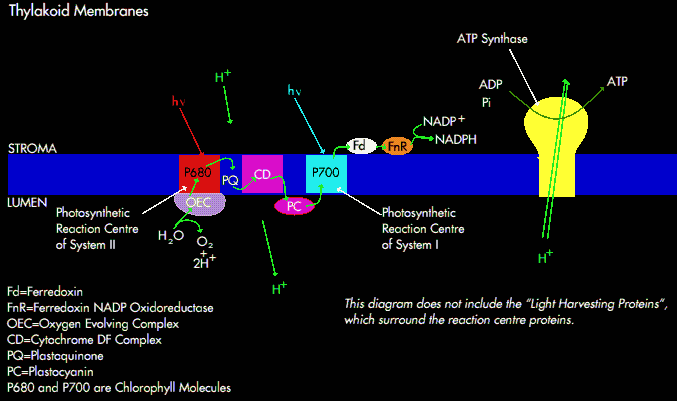
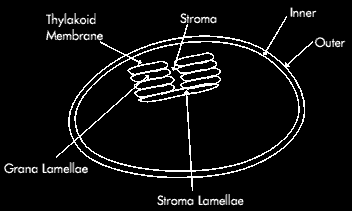 The thylakoid membrane has an unusual composition; it is a bilayer, but it doesn't consist of phospholipids, instead it contains Galactosyl Diacyl Glycerols. It contains all the chlorophyll, cytochromes, quinones and ATPSynthase. Indeed, isolated thylakoids will carry out light-driven ATP synthesis and NADP reduction.
The stroma holds all the enzymes for CO2 fixation - it contains the chloroplast-DNA; some chloroplast enzymes are made in the cytoplasm.
Crossover Points
State 3 to state 4 transition is accompanied by inhibition of electron transport, therfore is should be possible to observe crossover points between those components of electron transport chain where there is energy conservation. The number of crossover points should correspond to the number of energy conservation steps; Crossover points were shown at:
 Addition of Mitochondria to incubation medium (no ADP) causes a short-lived inital burst of respiration - then a low state 4 rate.
This is due to the small amount of ADP in mitochondria which is soon phosphorylated to ATP when deltaGp equilibrates with deltaµBARH+.
Subsequent state 4 respiration occurs because the inner membrane is not completely impermeable to H+.
State 4 respiration is automatically regulated so that the rate of H+ extrusion by the respiratory chain balances the rate of H+ leak back across membrane.
The rate of respiration is controlled by the extent of disequilibrium between redoxpotential spans across the H+-Translocating regions of the respiratory chain and deltaµBARH+
ATP Synthesis is Strictly Controlled
Mitochondria only synthesis ATP when there is a demand mediated by ADP translocation into mitochondria, as ATP -> ADP in cells, maintaining metabolic functions.
In state 4 respiration and ATP synthesis are in Thermodynamic Equilibrium, therefore work done by redox the system (deltaGOX) is matched by the back pressure of the phosphate potential (deltaGp):
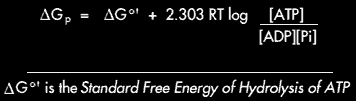
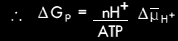
According to the chemiosmotic hypothesis, this equilibrium is mediate vta the bulk phase deltaµBARH+.
Addition of ADP -> state3 and lowers ![[ATP]/[ADP][Pi]](atpovadp.gif)
 Lowers deltaGp
ATP Synthesis occurs until deltaGp is in equilibrium with deltaGox via deltaµBARH+
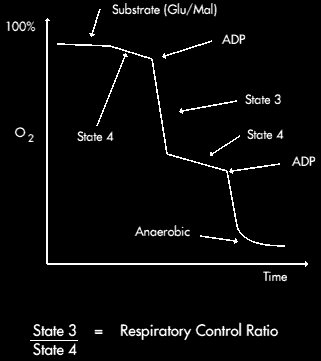
The P:O ratio is a measure of the number of ATP formed per 2 electrons passed along the ET chain from substrate to O2
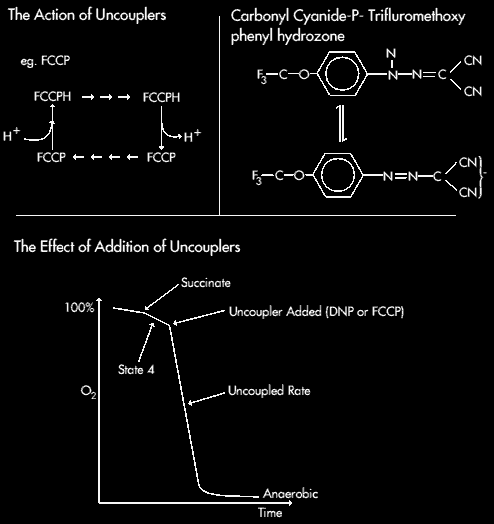
There are a variety of inhibitors of Oxidative Phosphorylation:
The effects of of inhibition of ATP synthesis are readily distinguishable from those of uncouplers; adding an ATP synthesis inhibitor changes State 3 to State 4, but does not affect an uncoupled rate..
