API
Full Length Drifting
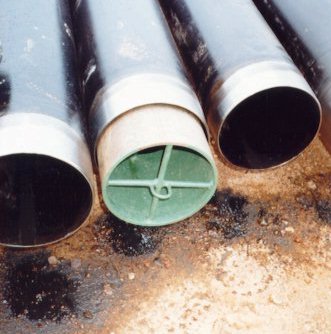 Drifting
is the process in which a pipe
is checked internally to verify that
the Inner Diameter of the pipe is
within the specifications as laid down
by the American Petroleum Institute (API). This
is to ensure that when the actual
drilling operations are carried out , specified
size drill bits and instrumentation will
go through the line.
Drifting
is the process in which a pipe
is checked internally to verify that
the Inner Diameter of the pipe is
within the specifications as laid down
by the American Petroleum Institute (API). This
is to ensure that when the actual
drilling operations are carried out , specified
size drill bits and instrumentation will
go through the line.
The process involves
the passing of a Machined mandrel through
the pipe with it's diameter in conformance
with specifications as laid down by
end-user. The length of the mandrel is
also specified. This would ensure that the
inner diameter is at least bigger than
or equal to the specified inner diameter
and any bends on the pipe would
not cause jams.
This also eliminates
casing which would have got mashed
due to handling or transportation.
Plastic
Drifts
Some pipes which are
plastic coated cannot allow the passage
of metal drift for obvious reasons
and in such cases Plastic Drifts
are used.

End
Drift
When the coupling is
bucked-on to the casing , there is enormous
torque applied and this may result
in the distortion at the end. This
would cause the ends to be non-circularly
aligned resulting in no-drift condition.
Thus to avoid the
above problem , the casing is normally end-drifted
after buck-on for a distance of approx.
24 inches.
Please contact Tuboscope
, Indonesia for further information.


Web
Site created and maintained by
Jayesh Bhatt at Tuboscope , Indonesia.
Copyright
© 1998 [Tuboscope]. All rights reserved.
Revised:
January 01,1998