 |
|
 |
|
 |
From humble beginnings as a compact and inexpensive means to delay video signals, the charge-coupled device (CCD) is now close to realizing the dream of a solid-state imager: ruggedness, high sensitivity and image quality, demand for little power, and resistance to wear-out of imaging tubes of the past. CCD imagers have made tremendous strides in a short time. |
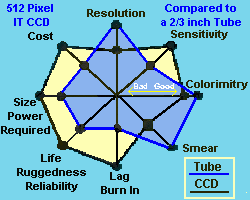
A comparison of 2/3-inch 510-pixel IT-type CCD and 2/3-inch pick-up tube. |
|
| The first CCD imagers didn't measure up to the
Plumbicon - one of the best pick-up tubes that technology had to offer.
Pick-up tubes excelled in colorimetry, resolution and management of
strong highlights. The relative merits of an early IT CCD imager with 510 horizontal picture elements (above) differs from the performance of a current CCD imager, using 980 horizontal picture elements (right). Each is compared with a pick-up tube - the standard of reference. With the growing advantage of CCDs over pick-up tubes, these solid-state imagers are now displacing the tubes in even the most demanding application - a high-definition TV camera, such as the Sony HDW700A or HDC750A |
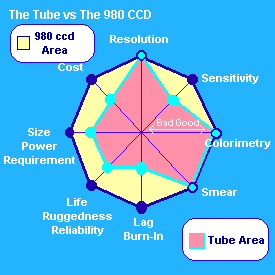 |
A comparison of 2/3-inch 980-pixel FIT-type CCD and 2/3-inch pick-up tube. |
|
 |
|
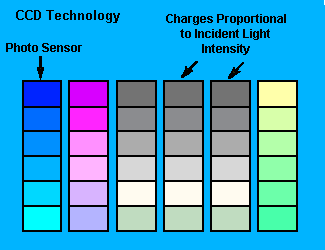
The basic CCD imager array. The imager cells are arranged in a rectangular matrix. For use with the NTSC system with 512-21=491 active scan lines, a CCD array with a minimum of 491 horizontal rows is required. |
The CCD imager evolved from a low-cost memory element in 1970, called a charge-coupled device (CCD). The CCD is an integrated circuit (IC)with the unique property that a charge held in one cell of the IC can be shifted to an adjacent cell by applying a suitable shift pulse. Information defined by the amount of charge can be shifted from cell to cell with virtually no loss. When it was further discovered that the construction could be altered so that individual cells also responded to incident light while retaining the ability to shift charges, the dream of a solid-state imager was born. |
 |
The design of the most basic CCD imager
now becomes clear. Many charge coupled cells or picture elements are arranged
in a rectangular array. Each picture element, also called a pixel of the
array, converts incoming light into a charge directly proportional to the
amount of light received. This charge is then clocked (shifted) from cell
to cell, to be finally converted to a video signal that represents the original
image, at the output of the CCD.
|
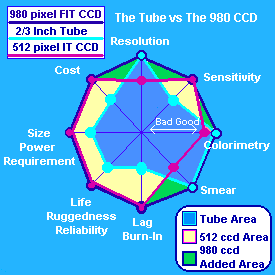
A comparison of 2/3-inch 512-pixel IT-type CCD, 980-pixel FIT-type CCD and 2/3-inch pick-up tube. |
|
| This most basic CCD imager is useful in the least demanding application -an electronic still camera. Similar to a photographic still camera, a mechanical shutter exposes the optical image to the CCD sensor array for a specific interval. The information gathered by the CCD imager can then be shifted out and stored in a storage device, typically a small magnetic disk. The mechanical shutter is not incidental, but intrinsic to the proper operation of this type of CCD. The charge packets generated in each picture element are passed from pixel to pixel during the read-out process. If the imager is exposed to light, additional charges will be added during the transfer process, and the charge pattern of the original image will not be preserved. | IT, FIT The new terminology - IT and FIT - identifies the types of CCD imagers currently in use. The name reflects the different design approaches to optimize the performance of the CCD imager. Each design approach has positive and negative aspects. In practice, each camera manufacturer has optimized these different design approaches, and the type of CCD used rarely determines overall camera performance.
|
IT type CCDs |
|
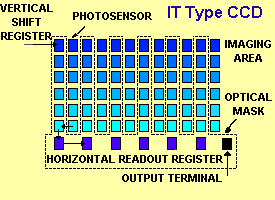 In the IT CCD, storage cells use part of the optical image area. Because the sensing and shifting functions are separated, each structure can be optimized for its particular use. The only significant limitation remaining in current IT imagers is an artifact called vertical smear with extreme highlights. Because of the proximity of the sensing and storage elements, extreme highlights may affect the content of the adjacent storage register, creating a vertical line passing through the highlight. |
To avoid using a mechanical shutter, the interline
transfer (IT) CCD structure was developed. Separate registers are protected
from light with an optically opaque aluminum mask. Charges in proportion
to scene content are accumulated in each element of the sensor array. During
the vertical interval, the charge packets in the sensor array are shifted
sideways to the adjacent storage array. The now-empty sensor elements capture
the next TV field while the information in the storage array is clocked out
to form the output video signal.
|
FIT type CCDs |
|
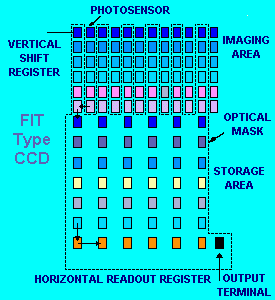
| The frame interline transfer (FIT) CCD combines
the best features of the older Frame Transfer ccd imagers and the more recent
IT CCD imagers. The upper part of this device operates like an IT CCD. However,
because it is still within the vertical interval, the charges are quickly
shifted from the interline storage register to the fully protected storage
register below. The charge packets are held in the interline register only
for a short time, and any contamination from a highlight is reduced by a
factor of 60 compared with the IT type.
The FIT structure offers the best overall performance available today. However, it is complex and uses a larger chip area because of the separate storage area. It is therefore significantly more expensive to manufacture than the IT or FT types. |
 |
| We've examined only the most basic characteristics of these two types of imagers. CCD imagers - particularly the IT and FIT types - can provide many other features in a camera that are impossible with pick-up tubes. For example, sensitivity of current CCD cameras has improved to f/9~11 at 2,000 lux - almost three to four f/stops faster than the most sensitive pick-up-tube cameras. CCD cameras now also offer an electronic shutter with a range of speeds to capture fast action. Another set of features- Clearscan /Extended Clearscan - allows precise control of the electronic shutter at low speeds to capture a clear image of most computer screens. CCDs provided a real turning point in camera development. CCD imager performance has improved continuously, and there is every reason to expect this improvement to continue. | |
| Peter Gloeggler - Sony Electronics Inc. 1992 |
Updates on CCD History -
|
| It should be noted here that this information was NEW in 1999. Now a little over ten years later, we have HD sensors and beyond. We are working on updated information on the newer and faster CCD and other types of sensors. But for now, this is all we have. The basic information is still very valid and can be applied to most all CCD image sensors of today. as well as yesterday's image sensors. | |
 |
|