Michael Caine
had originally signed a five-picture-deal (7 years). After Billion
Dollar Brain he didn't want to return anymore as Harry Palmer. Harry
Saltzman, the producer, had already let Caine out of the contract.
The next film
after Billion Dollar Brain should have been 'Horse Under Water'.
Christopher
Plummer was originally considered for the lead role in The Ipcress
File but dropped out to star in The Sound of Music(1965)
(IMDB)
Palmer is the
first action hero to wear glasses (Caine is myopic in real life). (IMDB)
Though Harry Palmer has become one of
the most famous of fictional secret agents, his creator, Len
Deighton, didn't name him when he wrote his spy novel, The Ipcress
File. "The problem with it was that he wrote it in the first person
so Harry had no name…" recalls Caine. So Ipcress File producer Harry
Saltzman, who also co-produced the James Bond films at the time, and
Caine set out to find an innocuous name for their bureaucratically
battered secret agent. "I made a rather bad social blunder,
because
he said, 'What's the dullest name you can think of?' And I said,
'Harry.' And he said, 'Thanks very much.' And then he said 'What's a
dull surname?' And…the most boring boy in our school was called
Palmer, Tommy Palmer. So he said, 'All right, we'll call him Harry
Palmer." (From an article by Len P. Feldman - read the whole
interview click here
)
Mike
Myers, the actor and creator of Austin Powers, thought of Harry
Palmer when he gave Austin his glasses.(see pic)
WENN reports:
"MICHAEL CAINE wants to
bring back his most famous character for one last mission."
14 September 2009
The veteran actor played Cold War spy Harry Palmer in three
movies in the 1960s - The Ipcress File, Funeral In Berlin and
Billion Dollar Brain. Now he wants to drag the cockney hero
out of retirement for a new movie. He said: "I have a script
called Cold War Requiem, which is Harry retired and he's
living out his fantasy in some middle class area in London and
the guys who he screwed have now got rich and they've decided
to come and kill him. "I would like to get that done but we
haven't got that financed yet." Just gossip or?
Read the original article
MTV.com reports:
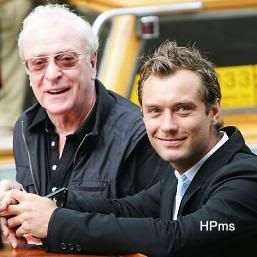
"Michael
Caine Thinks Jude Law Should Be The Next Harry Palmer"
8 April 2009
"I’m too decrepid to play
[Harry Palmer],” Caine told MTV News. “I could play an old
villain. I might sit there with a Siamese cat or something.
”As an alternative, Caine suggested a more youthful actor who
was mentioned as a contender to follow Pierce Brosnan as James
Bond.
“Jude
Law can play Harry Palmer as long as he’s got the
glasses,” the Oscar-winning actor said. As for which novel he
would pick to jump-start the franchise’s revival, he has a his
eye on a candidate there as well.“Len [Deighton] wrote a
fabulous book and I loved the title,” Caine explained. “It was
called ‘An Expensive Place to Die.’” The 1967 title takes
place in Paris, grabbing its title from an Oscar Wilde
quotation.
Caine first appeared as Harry
Palmer in the 1965 film “The Ipcress File” and most recently
reprised his role in 1996’s “Midnight in Saint Petersburg. So
is Harry Palmer suited to reappear in 2009? Caine thinks the
timing would be perfect. “Yes,” he offered, “because they’re
reinventing the Cold War anyway.”
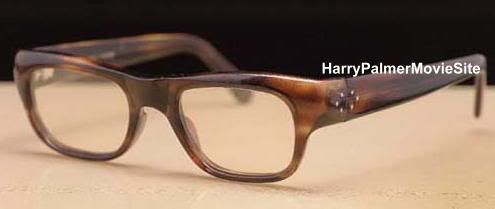
First of all: they were dark
brown in colour - contrary to the widely held view that they were
black.
There are two versions of the story about the
origin of the glasses:
A ) Some say this is the
origin:They are a style called "Teviot 74" manufactured by a company
called 'UK Optical'. These were an absolutely basic,standard
model issued free of charge on the National Health Service in
Britain at that time. Apparently they weren't issued free on the NHS
but became popular at the time for being a stylish though
inexpensive alternative to those issued free and were easily fitted
with NHS lenses.That UK Optical range have been described by some as
the first affordable 'designer' frames available in the UK.
B )
But according to a film auction seller in England this was the
origin:
A pair of spectacles by Curry & Paxton, Ltd of London, with
prescription lenses and imitation tortoiseshell frames, one arm
marked inside YVAN -- supplied to Michael Caine as Harry Palmer in
The Ipcress File, 1965; Funeral In Berlin, 1966; and Billion Dollar
Brain, 1967; with original card box labelled inside CURRY & PAXTON,
LTD., Dispensing Opticians...London, the lid of the box inscribed
variously in ballpoint pen Michael Caines glasses "IPCRESS FILE"
"FINALE [sic] IN BERLIN", Alice, General office Ross's, 2 Pairs
Glasses M.. [remainder of inscription indistinct] and MICHAEL
CAINE'S GLASSES; accompanied by two black and white stills, one from
Funeral In Berlin, the other from Billion Dollar Brain, both --
8x0in. (20.3x25.4cm.) (4) (see photo above)
The vendor, who was the production accountant on Billion Dollar
Brain, purchased these glasses post-production and recalls that they
were kept in the safe of the Pinewood Prop Stores. Although more
than one pair of glasses may have been supplied for the films, the
fact that they were kept in the prop store safe indicates that they
were those worn by Michael Caine, and the numerous inscriptions on
the box indicates useage in all three films.
(Thanks
to Mark Isaacs)
It's interesting to note that author Len
Deighton wore an identical pair at this time (refer to the classic
on set photo of him and Caine in Harry's kitchen preparing for the "egg
cracking" shot"
see this photo here).These
glasses have been long out of production and the nearest modern
equivalent available today is a style called "Grant" by 'Oliver
Peoples'. (Thanks to Mark Isaacs)
Harry's
three-quarter length raincoat has long been a style icon in Britain.
Harry wears a different raincoat in each of the three films. The "Ipcress"
one is of a check (or plaid) similar to a style referred to as 'Prince
of Wales'. The "Funeral in Berlin" and "Billion Dollar Brain" ones
are very similar in style but appear to be of a slightly different
shade of beige to one another. A London based vintage clothing
expert is sure that the coats came from top British outfitters "Aquascutum".
The "FIB" one was definately from "Aquascutum". (Thanks
to Mark Isaacs)
Bob Engesser added this on the
messageboard, interesting enough to add here: "I recall a press
release from the late 1960s stating that Harry Saltzman would
produce Horse Under Water with Nigel Davenport and not Michael Caine
as Harry Palmer. Poor box office from Billion Dollar Brain the movie
and not poor sales from Horse Underwater the book probably killed
this project. Davenport costarred with Caine in the underrated war
film Play Dirty which was produced by Saltzman."
Rob Mallows excellent site on
Len Deighton contains great stuff about the author and
everything around him. Check it out regularly. Below some
additions which are of interest for Harry Palmer fans...
The following is taken from his site:
1) In March 2011, Len
Deighton kindly agreed to grant the Deighton Dossier an
exclusive interview in a question & answer format. The questions
included some suggested by readers of this website and the
accompanying blog. Together, this forms Len's first 'interview'
for nearly three years, so is somewhat of an exclusive. Deighton
also talks about the Palmer films, Horse under Water and the
role of Michael Caine: Go to Deighton Dossier websiteor download the .pdf of the interview here!
2) Eat
Soup was a short lived supplement to original UK 'lad's
mag' Loaded, when it was a serious-enough magazine and had yet
to turn into a parody of itself. In November 1996 the magazine
secured an exclusive interview with Michael Caine. The piece
inter-twined a look back at his iconic movie characters with
Caine's status as a restaurateur and lover of fine
food.Inevitably, part of the discussion focuses on his Harry
Palmer role and the character's status as a metaphor for the
shift in thinking by men about food in the 'sixties, something
which Len Deighton anticipated and preciptated with his
Action Cook Book. To wit, at the end of this article is a
feature by Len explaining how he turned Harry Palmer into an
on-screen gourmet.
Eat Soup interview
3) Russian spies used to study
Michael Caine's movies and marvel at the cleverness of his
characters.The British actor was flattered when he learned
Russian leader Vladimir Putin used to watch his Harry Palmer
films in the late 1960s with his comrades.
Russian spies studied-Caine-Harry-Palmer
4 ) A song
featuring Harry Palmer and the Berlin Wall has been voted 2 in
the top 10 list of Canadian Synth Pop tracks: Rational
Youth, “Dancing on the Berlin Wall” (1982)
References to the atom bomb and Len Deighton’s fictional spy
Harry Palmer make this a synth-pop meditation on the Cold War
Three pairs of
glasses were used by Michael Caine during The Ipcress File. When all
of these were broken during filming, production was held up for a
day, until replacements had been found. After that, the prop
department was stocked with 20 extra pair of the Harry Palmer model
glasses.
Two large Victorian terrace houses, at
28 and 30 Grosvenor Gardens, London (almost adjoining Victoria
Station in London, see also
Filmlocations), were used as
filmstudios for The Ipcress File. The two houses were converted into
one huge house containing 40 rooms. These were enlarged or divided
according to requirements. Fourteen room were used as studios. Other
rooms were turned into dressing rooms, wardrobe department,
hairdressing, make-up, production offices, a property department and
a self-contained restaurant capable of feeding and seating 120
people! This all was kept secret to keep away sight-seers and
autograph hunters. Even Michael Caine was driven to work in an
inconspicuous car and had to sneak in the back way. As a 'front' for
the real purpose, a large sign was painted at the entrance to the
film studios. The sign read:" The Dalby Employment agency".
Sidney J. Furie (director The Ipcress
File) was fired directly after shooting The Ipcress File. He and
Harry Saltzman (producer) had fierce arguments about what the film
should look like. Harry Saltzman couldn't come to terms with the 'strange
camera angles' Sidney J. Furie used in the film. Peter Hunt had to
do the editing without the director.
On the first day of shooting The Ipcress
File (at Pinewood Studios, London) Sidney J. Furie, director,
gathered the cast and set fire to the script. "That's what I think
of it", he said in front of a stunned audience. Later, the cast was
asked to write their own dialogue !
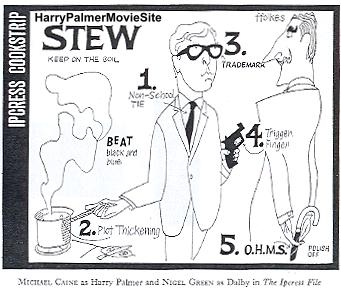
Len Deighton, author of the Harry Palmer
books (although the name Harry Palmer is never mentioned in the
books), is also a very good good cook. Besides writing novels Len
also had a cookery comic strip in The Observer. These cookery strips
can be seen in The Ipcress File. The walls of the kitchen of Harry
Palmer are full of these strips.
In The Ipcress File Harry Palmer makes
an omelette and breaks two eggs at the same time, with one hand !
Michael Caine couldn't perform this trick. The hands you see,
breaking the eggs simultaneously, are Len Deighton's (who was an
experienced cook) ! You can see the difference by watching the
hands. Michael Caine has blond hairs on his hands and Len Deighton
has black hairs, which are seen during a this shot.
Have a look a this promotional contest, especially made for
newspapers:
In a 1995 interview
Caine told Deighton that wearing glasses in "The Ipcress File"(against
the express wishes of Harry Saltzman) meant that he could see
clearly on set for the first time in his career. Interestingly
though, in a 1967 interview Caine explains that Harry's glasses are
made of ordinary glass as real lenses reflect the studio lights too
much!! You can certainly notice quite a bit of light reflecting on
Harry's glasses in "Ipcress", particularly in Harry's office scenes
with Ross and Dalby. (Thanks
to Mark Isaacs)
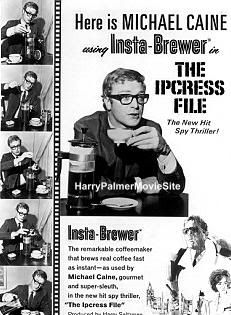
Harry Palmer
makes coffee in a special coffee pot in the beginning of the movie.
Charles Kasher, executive producer, had a special deal with the
manufacturers to promote the thing. See below for the very rare
promotional still and the ad.
Joan Collins (she
became famous in Dynasty) had been considered for the role of Jean.
In the scene in
the parking garage where the money is counted by one of Bluejays'
men, you can see the money counted very fast. The filmmakers hired a
professional bankteller to do this scene.
Sidney J. Furie
used large quantities of Scotch in his coffee whilst making the
film. He said that "a lot of scenes have benefitted from it...".
When The Ipcress
File was shown at the famous filmfestival in Cannes, Sidney J. Furie
was banned from the festival by Harry Saltzman.
18 year old Rita
Davies, a girl from London, wanted Michael Caine's autograph and
asked for it during the filming at Grosvenor Gardens. Instead she
was offered a screentest for a role as secretary. She was only
interested in the autograph and she turned down the offer.
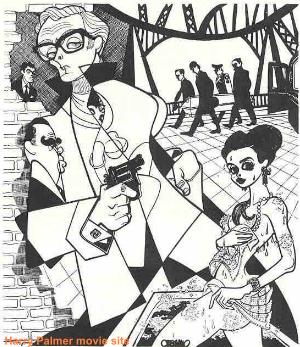
Cartoon from a
newspaper.(thanks to Mark Isaacs)
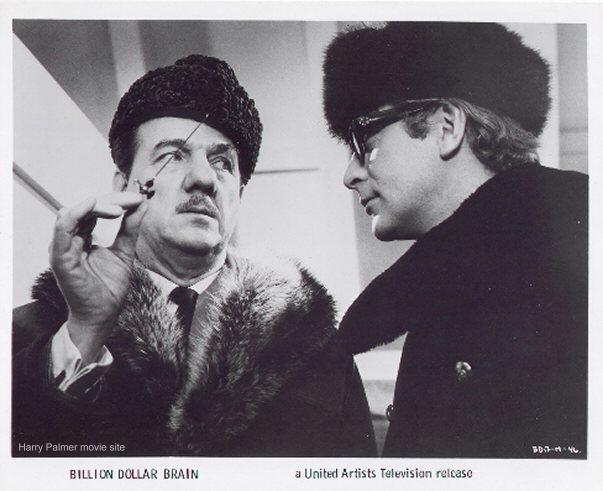
Michael Caine
(as Harry Palmer, reluctant spy) plays with a Minox B that he's
handed by his old British Military Intelligence boss, who asks him
to microfilm the Ipcress file behind his new boss's back. Notice
Caine's finger is planted neatly in front of the lens. Charlie
Trentleman says there's no scene like this in the original book.
(Found on site made by Marcus
Brooks)
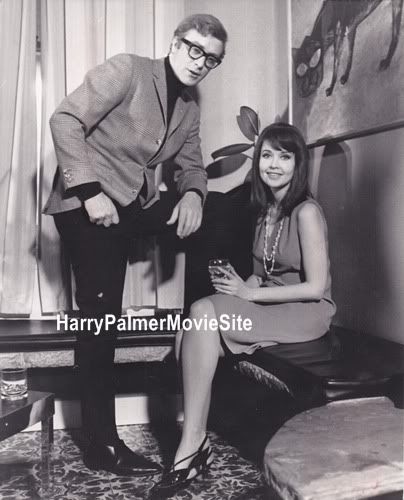
Funeral in Berlin
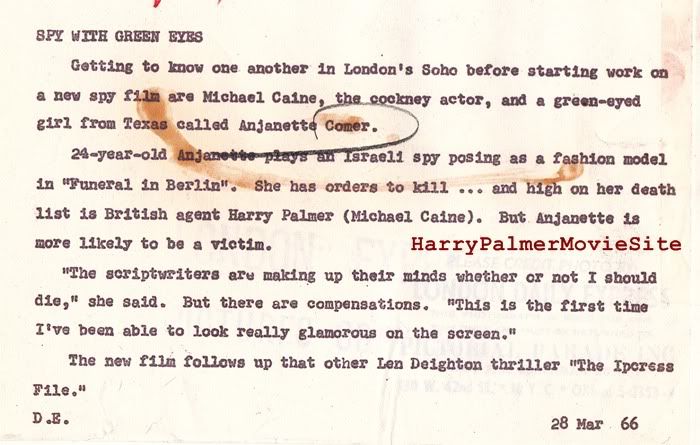
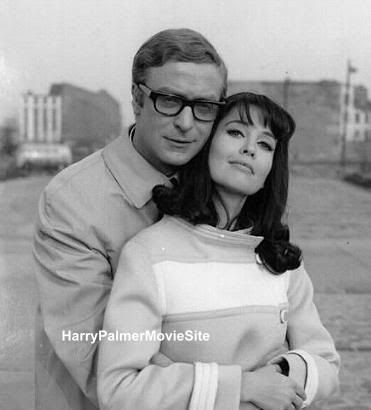
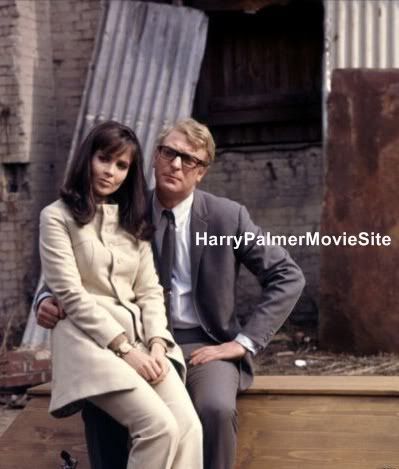
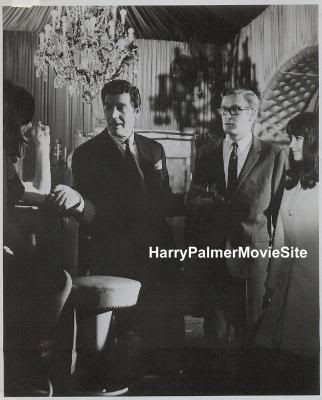
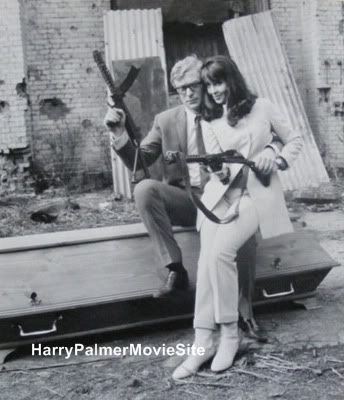
Eva Renzi was
not scheduled to play in Funeral In Berlin. The part of Samantha
Steel had been assigned to Anjanette Comer (IMBD info),
but due to illness she couldn't continue. Some scenes have been shot
apparently with Anjanette. The first photo is taken in London;
according to the text (see below) the scriptwriters were still doubting
whether or not to kill Samantha....See these very rare publicity
stills.
Russian soldiers
on the east side of the Berlin wall "flashed" the camera's with the
sunlight using mirrors, while the crew was shooting Funeral in
Berlin. The scene where Harry Palmer walks to Checkpoint Charlie
(the longshot) for the first time had to be taken from a big
distance for that reason.
Special art for papers:
This was on the messageboard,
interesting enough to add here: Paramount messed up on their "Funeral
In Berlin" DVD release by using a "textless" print of the film's
trailer. Much of the trailer deals with the superimposed names of
the actors and title, as well as an epilogue of text that fills the
remaining thirty seconds or so. You'll see the difference in the
Spyguise video that features "Berlin's" trailer, as well as a
secondary review trailer. Paramount has shown a considerable lack of
care, just like those MGM Bond DVDs that don't feature the necessary
subtitles. (Thanks to Alan
Spencer)
Morten Sagen added this on the
messageboard: I recently watched Funeral in Berlin on Norwegian TV2.
I noticed that the title sequence was different from my American
edition VHS. On the American version the actual lettering is white,
while the ones on TV where black with narrow white borders around
each letter. It was also in widescreen. Anyone out there who knows
why they made two versions?
Special envelope to promote the
bookversion of Funeral in Berlin:
Promotional matches, handed out on
airplanes, see right
Billion Dollar Brain
Stanley Caine,
Michael's kid brother, made his screen debut in Billion Dollar Brain
(although he had appeared on British television) as the G.P.O.
delivery boy.
Ken Russell was contractually obligated to direct Billion Dollar
Brain. He didn't like to do it, but 'it was shoved down his throat'.
Francoise
Dorleac, Anya in Billion Dollar Brain, died in a road accident in
the same year that Billion Dollar Brain was released. Director
Russell called her a classic screen beauty "like Marlene Dietrich".
Michael Caine
performed most of his own stunts. During the final ice floe scene in
Billion Dollar Brain, he almost slipped and fell into freezing
water.(IMDB)
Len Deighton
received $ 250,000 for the filmrights of Billion Dollar Brain. Harry
Saltzman, the producer, wanted to pay $ 100,000, and was very angry
about Deighton's price. He slammed down the receiver when he heard
Len Deighton's demands. Eventually Saltzman called back to say he
agreed. Len Deighton's comment:" I like the sound of 'quarter
million'...".
A special tie-in
ad for Billion Dollar Brain (see pic)
When Palmer comes out of the woods and
catches the Latvian train, "VR" can be seen on the sides of the cars.
VR stands for State Railways in Finnish and is an obvious sign that
the scene was filmed in Finland. (Thanks
to Toni from Finland)
31 seconds of the original movie are
missing on the official MGM release of 2004. The licensing rights of
the Beatles song "A hard day's night" (which can be heard in the
scene where Harry meets Basil) were said to be too expensive so they
cut the whole scene...
Andrew S. added: "Actually
The Beatles themselves (or more accurately Apple Records) who
actually made the use of that song in the film too expensive. Apple
(The Beatles company) still owns the rights to their recordings,
while Michael Jackson owns the publishing rights. So if you wanted
to use a recording of The Beatles, you would have to get their
permission (and of course Michael Jackson would get a slice of the
money). However if you just wanted to use a Beatles song but have
somebody else record it, then you would only need to get permission
from Michael Jackson's company. This is what happened in that Sean
Penn film "I Am Sam". The producers wanted to use actual Beatle
recordings, and I believe that Ringo, Paul and Yoko had all agreed,
but they were waiting on George's agreement. But at the time he was
very ill with cancer so they never actually got his go-ahead. So as
a result, they couldn't use Beatle recordings so they just licenced
a number of Beatle songs and got other people to record them.
Julien Comelli from France reports: the
French version of Billion Dollar Brain contains a very little
segment who is not in the original French exploitation copy: the
last word of Harry Palmer (200£ is allright..), who has been, for
the dvd, dubbed today by another actor.
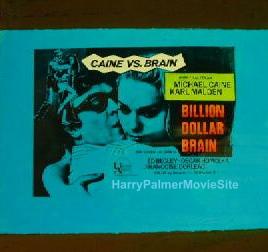
See below: promotional slide for Billion
Dollar Brain, probably used as advertisement before other movies.
Director Ken Russell has recently
started writing a weekly article for the (London) Times newspaper in
which he recalls his life in the movie business. This week the theme
was his many battles with the British Board of Film Censors. About
‘Billion Dollar Brain’ he writes:
“With my next movie it was the camera operator who put me in
jeopardy. There was a rough-and-tumble between the hero Michael
Caine and the beautiful spy Francoise Dorleac. I couldn’t use stunt
doubles as a lot of the fight was in close-up. Neither could Caine
really lay into his leading lady, so it was the camera that did the
roughing up, with the operator hand-holding it at all angles as he
followed the sparring couple all over the bedroom. This the censor
found too violent by proxy, and the scene was cut heavily.”
(Thanks
to Mark Isaacs)
Karl
Malden, the Academy Award-winning actor died Wednesday 1 July 2009.
He was 97.He played the part of Leo Newbegin in Billion Dollar
Brain.
Malden died of natural causes surrounded by his family at his
Brentwood home, they told the Academy of Motion Picture Arts &
Sciences. He served as the academy's president from 1989-92.
While filming Billion Dollar Brain (1968) at Pinewood Studies with
Michael Caine, Malden's London hotel room was burgled and his cash
stolen, but his travellers' cheques were left untouched. The
incident persuaded him to become the face of American Express
travellers' cheques a few years later for a long-running series of
commercials with the punchline "Don't leave home without them".
Bullet to Beijing
Sue Lloyd returns in her role as Jean after 30 years in Bullet to
Beijing (1995). She had played this role in The Ipcress File as well.
In Bullet To Beijing Harry Palmer refers to the good old days and
they have a nice little rendez-vous. This last scene is NOT in the
shorter version of Bullet To Beijing. (see pic)
In Bullet To
Beijing there is nice scene in the train to Beijing where Nicolai (Jason
Connery) tells about the profession of his father. He tells his
father worked for British Intelligence... As Jason's real father,
Sean Connery, became famous as James Bond 007, this must have been
some sort of incrowd joke ??!?
Mia Sara, leading
lady (Natasha) in Bullet To Beijing, is married in real life to
Jason Connery, her co-star in the movie.
They live with their baby in the Borders
of Scotland.
Bullet to Beijing was released under the
name "Beijing Express" in French Canada.
While shooting in Moscow and
St.Petersburg, crew members were repeatedly targeted by logal thugs
and Michael Caine received death threats from Russian ganglords.
Midnight in St.Petersburg
Insiders say that Midnight in St.
Petersburg was made almost entirely from out-takes on the cheap and
completed in 6 weeks.
Tanya Jackson, Tatania in the movie, is
the wife of the director (...) of Midnight in St.Petersburg, Doug
Jackson.

 General
 Michael Caine
had originally signed a five-picture-deal (7 years). After Billion
Dollar Brain he didn't want to return anymore as Harry Palmer. Harry
Saltzman, the producer, had already let Caine out of the contract.
Michael Caine
had originally signed a five-picture-deal (7 years). After Billion
Dollar Brain he didn't want to return anymore as Harry Palmer. Harry
Saltzman, the producer, had already let Caine out of the contract. because
he said, 'What's the dullest name you can think of?' And I said,
'Harry.' And he said, 'Thanks very much.' And then he said 'What's a
dull surname?' And…the most boring boy in our school was called
Palmer, Tommy Palmer. So he said, 'All right, we'll call him Harry
Palmer." (From an article by Len P. Feldman - read the whole
interview
because
he said, 'What's the dullest name you can think of?' And I said,
'Harry.' And he said, 'Thanks very much.' And then he said 'What's a
dull surname?' And…the most boring boy in our school was called
Palmer, Tommy Palmer. So he said, 'All right, we'll call him Harry
Palmer." (From an article by Len P. Feldman - read the whole
interview