  What's New! Detailed Sitemap All images © by Roberto Piperno, owner of the domain. Write to romapip@quipo.it. Text edited by Rosamie Moore. |
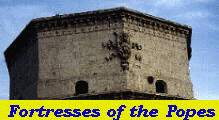 FORTRESSES OF THE POPES FORTRESSES OF THE POPES
Where they are 
This map shows the towns where the Popes built the fortresses you will see in this exhibition (Castiglione del Lago and Spoleto - a separate exhibition are further north). Very often these fortresses are called la "Rocca", this name being used when the castle is on top of a hill. Northern Latium and Umbria are the areas where almost every town has a Rocca. Some of them have been used until very recent times as prisons. Narni
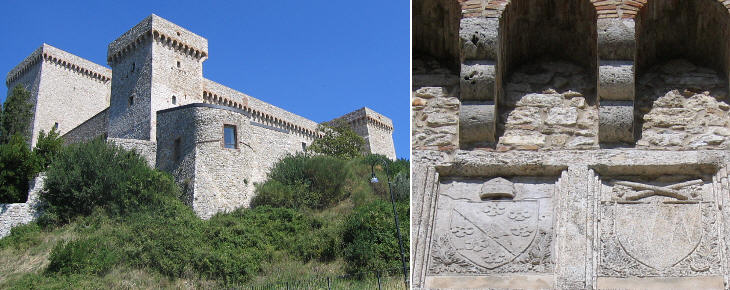
During the period when the Popes left Rome for Avignon most of the towns of their Italian possessions fell under the rule of local families as was the case in other parts of central and northern Italy. Cardinal Gil de Albornoz was charged with the task to reconquer at least the areas closest to Rome to pave the way for the return of the Pope. He did not only achieve this, but he also laid down the basis for keeping his conquests by building fortresses in strategic positions. Narni, an important medieval town worth a visit, commands a narrow gorge of the Tiber key to Central Umbria and here Cardinal Albornoz built an imposing fortress which still retains the coats of arms of Pope Urban V and Gregory XI, the last two Popes who lived in Avignon. Compare the tower of this fortress with that of the Palace of the Popes in Avignon. The coats of arms, among the oldest one can find, show both the keys and the triregnum (the crown of the pope), although as separate entities. Ronciglione
On the border of the small Lake of Vico, one of the three volcanic lakes of Northern Latium, Ronciglione has an open view from the sea to the inner valleys. A domain of the Anguillara family, it was reunited to the Papal State in 1469 and Pope Sixtus IV erected in the center of the little town this menacing fortress and left several coats of arms with his oak to remind of the glory of the Della Rovere. Viterbo
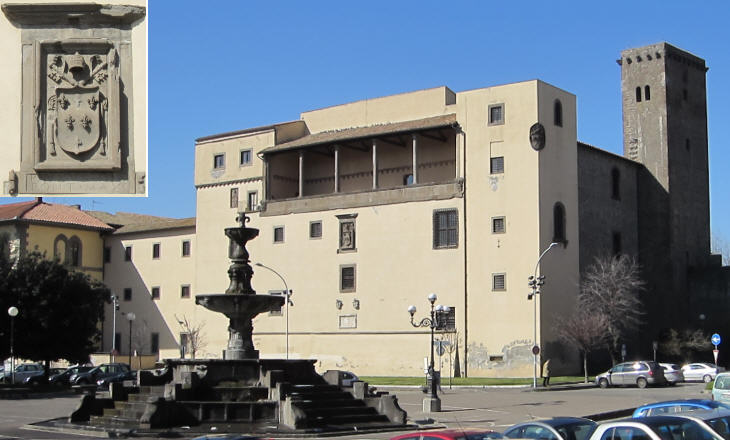
Viterbo in the second half of the XIIIth century is perhaps the most important town in the Papal State. Viterbo, a town protected by imposing walls, was where the Popes spent long periods of time and where they often were elected. Cardinal Albornoz built here another Rocca, which we can now see after Renaissance restorations and embellishments as the loggia clearly shows and the coat of arms of Pope Paul III confirms. Civita Castellana
This fortress of Civita Castellana was also known as "The Bastille of the Popes" as Italian patriots were imprisoned here in the XIXth century. On the Tiber Valley, immediately north of Monte Soratte this fortress was built by Pope Alexander VI and completed by Julius II who entrusted Antonio da Sangallo (the Elder) with the erection of the octagonal keep. It's a masterpiece of military architecture, still very well preserved. Civitavecchia
Civitavecchia is the port of Renaissance and today's Rome while Ostia was the port of Ancient Rome. Julius II asked Donato Bramante to design a brand new fortress to protect the harbour. The work was completed by Antonio da Sangallo (the Younger) during the pontificate of Paul III. The result is of great elegance and the Farnese symbols, although incongruous to a fortress, add to it. Tivoli
Tivoli, an important town under the Emperors, retained its role of sentinel of the East also during the Popes' rule. The castle was built by Pope Pius II and retains the name of Fortezza Pia. The five little moons of the Piccolomini are one of the most intriguing coats of arms. Ostia
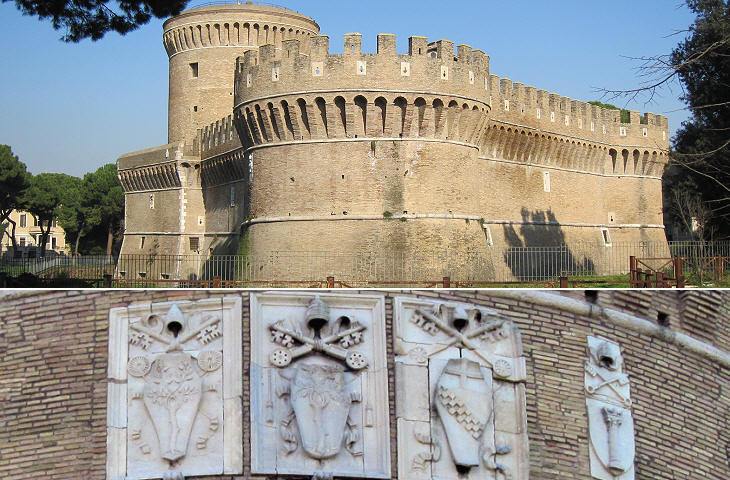
Ostia the gateway to Rome coming from the sea hosts this castle built at the end of the XVth century by Baccio Pontelli for Julius II (at the time Cardinal Giuliano Della Rovere). The enemy here was the Saracen. Wherever you are on the shores of Italy you can see a tower or a castle and once you reach one another one comes into view. The Saracens (Arab corsairs and later on Turkish corsairs) were the terror of the people who lived along the coast for nearly a thousand years. Rome itself was sacked in 846 by the Saracens who landed in Ostia and the Popes were scared this could happen again, so they all contributed to the security of Rome by reinforcing its early defence in Ostia. Here you can see the coats of arms of (left to right) Sixtus IV, Julius II, Innocent VIII and Martin V. You can learn more about this fortress in  Nettuno
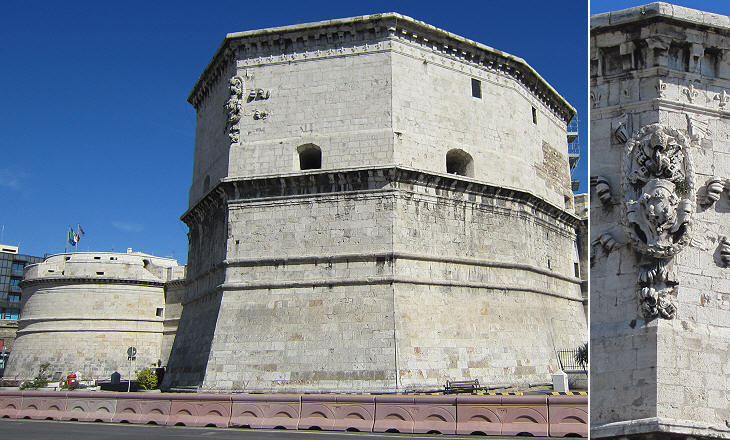
The area between the Albano Hills and the sea, south of Rome, was covered by marshes. Nettuno on the sea at the very edge of the marshes assured defence on this flank. Alexander VI entrusted Antonio da Sangallo the Elder with the task of tranforming an existing tower into a fortress. Castel Sant'Angelo
Originally the tomb of Emperor Hadrian (la Mole Adriana), it became one of the fortresses of Rome during medieval times (another one was the Colosseum) and eventually the fortress of the Pope, due to its proximity to the Vatican. A direct link (il Passetto) allowed the pope to seek refuge here. Alexander VI was one of the Popes who most contributed to the reinforcement and embellishment of the fortress. However his coat of arms on the exterior of the building was erased by the French troops in the early XIXth century. So to see the Borgia's heifer (the cow shown in his coat of arms) one has to go inside the building (now a museum) where several of his coats of arms are displayed. Castiglione del Lago
Castiglione del Lago lies on a little hill on the shores of Lake Trasimeno, close to the border with Tuscany. Pope Julius II strengthened an existing medieval fortress to prevent attacks from Florence. His coat of arms can still be seen near the highest tower. Today the olive trees all around the ancient walls speak of peace.
You may wish to see my pages on the 
SEE THESE OTHER EXHIBITIONS (for a full list go to my detailed index)    |