  What's New! Detailed Sitemap All images © by Roberto Piperno, owner of the domain. Write to romapip@quipo.it. Text edited by Rosamie Moore. Page revised in May 2009. |
Collegio Germanico (Book 9) (Map C2) (Day 4) (View C6) (Rione Ponte) and (Rione Sant'Eustachio)
In this page:
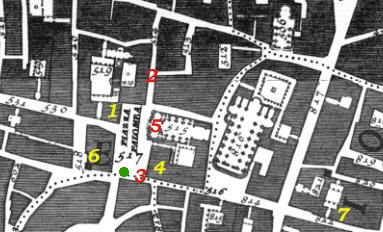
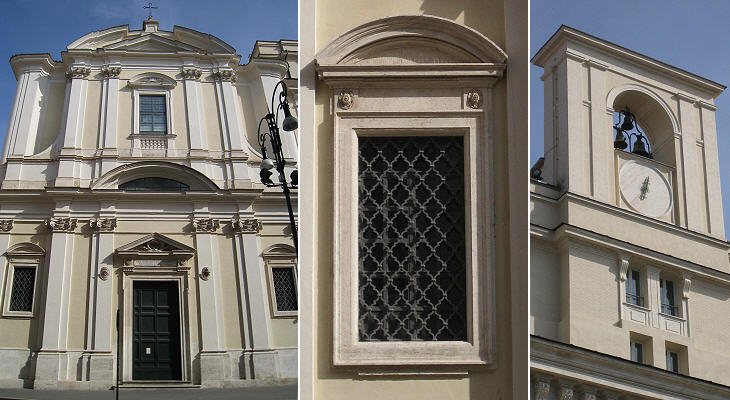
The church of S. Apollinare and the palace of Collegio Germanico had just been almost completely rebuilt by Ferdinando Fuga when Vasi represented them in this plate. The view is taken from the green dot in the 1748 map below. In the description below the plate Vasi made reference to: 1) Palazzo Altemps; 2) Street leading to Via dell'Orso; 3) Street leading to S. Agostino. The map shows also 4) Collegio Germanico; 5) S. Apollinare; 6) Tor Sanguigna; 7) Palazzo Baldassini. The dotted line in the small map delineates the borders between Rione Ponte (left) Sant'Eustachio (lower part of the map) and Rione Campo Marzio (top).
Today
The German Seminar has lost its proportions, because of the additional floor on the top. The clock on the roof is also of poorer design. In the late XVIIIth century the German Seminar was enlarged with a new building near S. Luigi dei Francesi. Palazzo Altemps is almost unchanged (a balcony has disappeared).
Inside S. Apollinare and Collegio Germanico
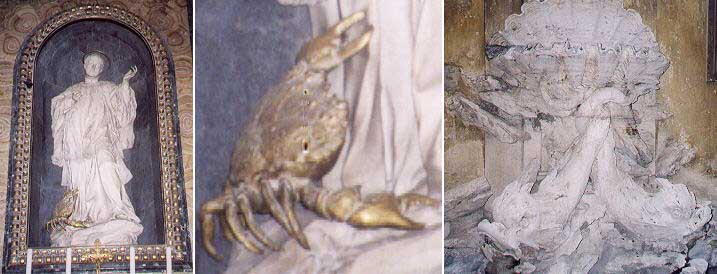
S. Apollinare retains some of the works of art of the old church (you may wish to see it as it appeared in a 1588 Guide to Rome), which were rearranged into new chapels. The statue of St Francis Xavier is a fine work by Pierre Legros. The metal crab at the foot of the saint is a reference to an episode of his travels in the Far East: St Francis lost a crucifix at sea during a storm and the crab brought it back to him (the statue was completed by a wooden crucifix, held by St Francis). Collegio Germanico has several courtyards, in one of which there is a Baroque fountain of Bernini's school. Collegio Germanico has also another Baroque fountain which you can see in a page devoted to fountains in the courtyards of Rome. The building is now a property of Opus Dei, a modern organization of the Catholic Church. Palazzo Altemps
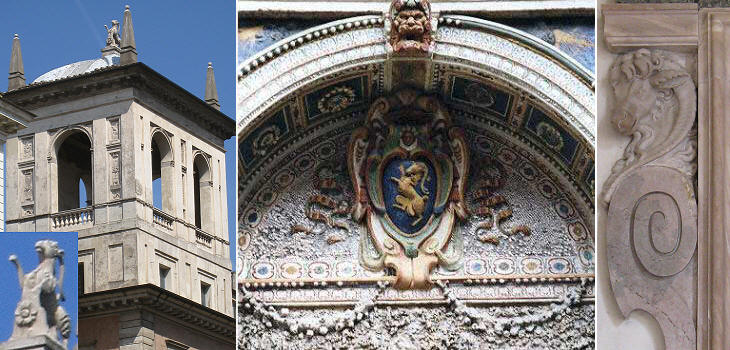
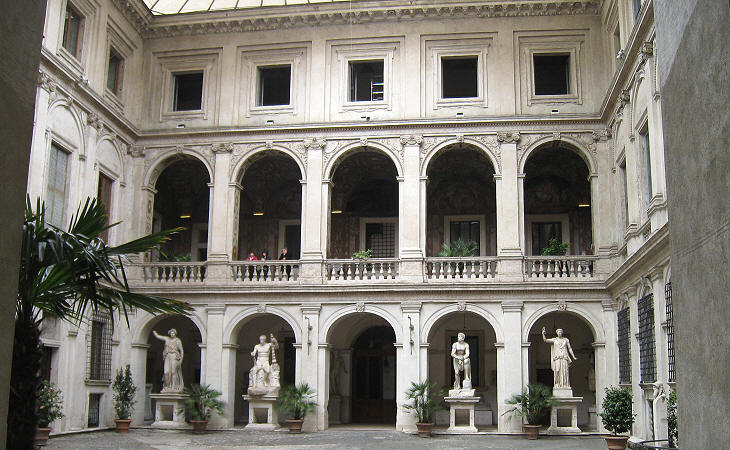
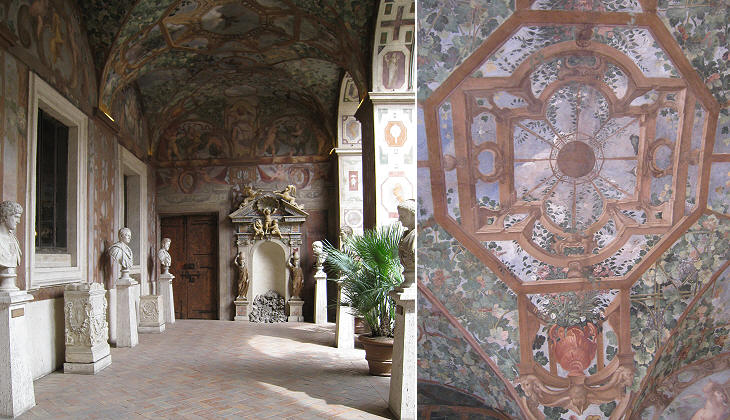
Marco Sittico Altemps was the son of Count Wolfgang Hohenems and Chiara Medici, sister of Pope Pius IV. He bought the palace in 1568 and he placed the heraldic symbol of his family (a rampant goat) almost everywhere; in a few instances the goat was associated with the rose of the Orsini, because of the marriage of Roberto, Marco's son, to Cornelia Orsini in 1576. The palace was renovated between 1577 and the end of the century. Altemps is an Italian distortion of Hohenems.
The life of Marco Sittico Altemps (who was a cardinal) was marred by a family tragedy: his son Roberto abducted a young woman; usually such a crime was covered up by providing the woman with a dowry and a husband, but in this case Pope Sixtus V decided to show his determination to strengthen the rule of law in the Papal State and he sentenced Roberto to death.
Vainly the old father invoked papal mercy by throwing himself at Sixtus' feet. For the soul of his son he built a chapel in Santa Maria in Trastevere in honour of Madonna della Clemenza. At his death in 1595, the palace was inherited by his grandson Giovanni Angelo. Today Palazzo Altemps houses a section of Museo Nazionale Romano, and in particular some important statues of the collection which embellished Villa Ludovisi.
Note: several of the Roman statues shown in the museum were "completed" by Gian Lorenzo Bernini and Alessandro Algardi. Tor Sanguigna
Sanguigna means sanguine, but the name of this medieval tower is not associated with bloody events; it is just named after its owners, the Sanguigni family. The tower shows a structure made of layers of bricks and of layers of small blocks of tufa. The Sanguigni had embellished the old church of S. Apollinare, but when it was rebuilt in the XVIIIth century the family was extinct and these embellishments were lost. The palace opposite the tower has one of the finest XVIIIth century Madonnelle of Rome. Palazzo Baldassini
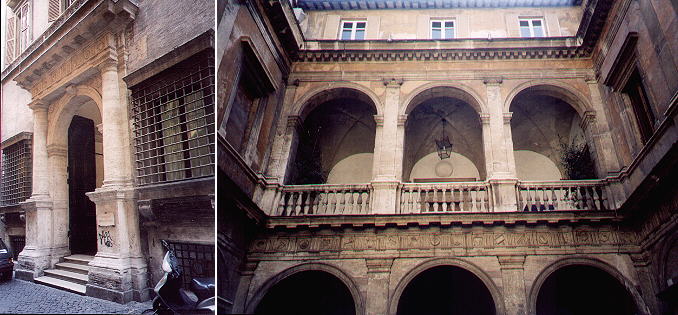
Palazzo Baldassini was quoted in what is considered the first detailed description of Renaissance and Baroque Rome, Filippo Titi's 1674 Studio di Pittura, Scoltura et Architettura, but it was forgotten in most of the guides which followed. In part this is due to the narrowness of the street which does not permit a proper view of the palace, designed by Antonio da Sangallo the Younger for Melchiorre Baldassini a counsellor of Pope Leo X at the beginning of the XVIth century. The courtyard has a fine loggia, typical of Renaissance buildings. Excerpts from Giuseppe Vasi 1761 Itinerary related to this page:
Next plate in Book 9: Collegio di Propaganda Fide Next step in Day 4 itinerary: Chiesa di S. Simeone Profeta Next step in your tour of Rione Sant'Eustachio: S. Salvatore alle Coppelle Next step in your tour of Rione Ponte: S. Maria della Pace |