  What's New! Detailed Sitemap All images © by Roberto Piperno, owner of the domain. Write to romapip@quipo.it. Text edited by Rosamie Moore. Page revised in October 2009. | Piazza di Colonna Trajana (Book 2) (Map B3) (Day 3) (View C8) (Rione Trevi) and (Rione Monti)
In this page:
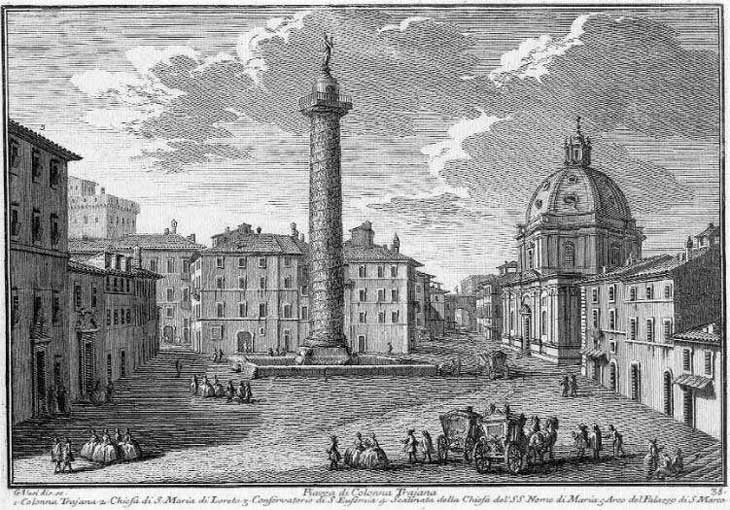
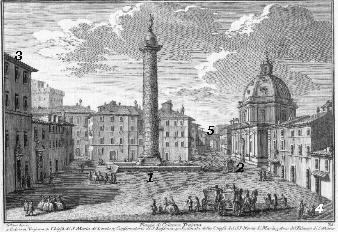
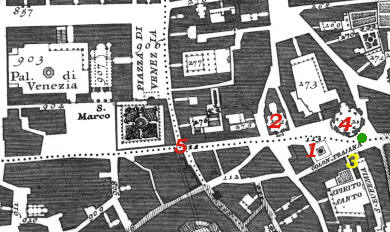
The column erected to celebrate Emperor Trajan's successful wars against the Dacians was the first monument of ancient Rome to be freed from later additions, excavated and protected from further damage. The view is taken from the steps of Santo Nome di Maria on the lower right corner of the etching (see the green dot in the 1748 map here below) and it shows on the opposite corner the northern side of Campidoglio with the (now lost) tower built by Pope Paul III Farnese. The arch leading to the church of S. Marco (between the column and S. Maria di Loreto) is another detail of XVIIIth century Rome which is lost. In the description below the plate Vasi made reference to: 1) Colonna Trajana; 2) S. Maria di Loreto; 3) Conservatorio (nunnery) di S. Eufemia; 4) Steps leading to SS. Nome di Maria; 5) Arco del Palazzo di S. Marco. 3) and 5) are covered in other pages. The dotted line in the small map delineates the borders between Rione Trevi (upper half) and Rione Monti (lower half).
Today
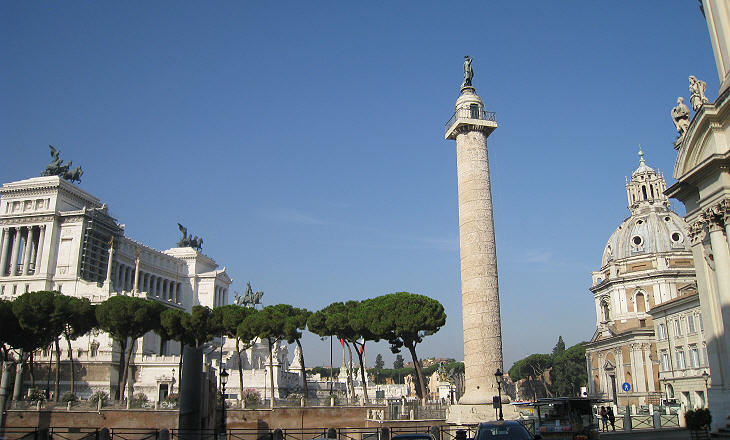
The right side of Vasi's view is almost unchanged whereas the houses on its left side have been wiped out. The first changes occurred between 1812 and 1815 when the buildings to the left of the column were pulled down to excavate Trajan's Forum; in the late XIXth century the appearance of the Campidoglio hill was entirely redesigned to make room for the Monument to King Victor Emanuel II: this entailed the loss of the Farnese tower; finally in the 1930s the medieval buildings at the foot of the hill were pulled down to open two new large avenues (Via dei Fori Imperiali and Via del Mare). Trajan's Column
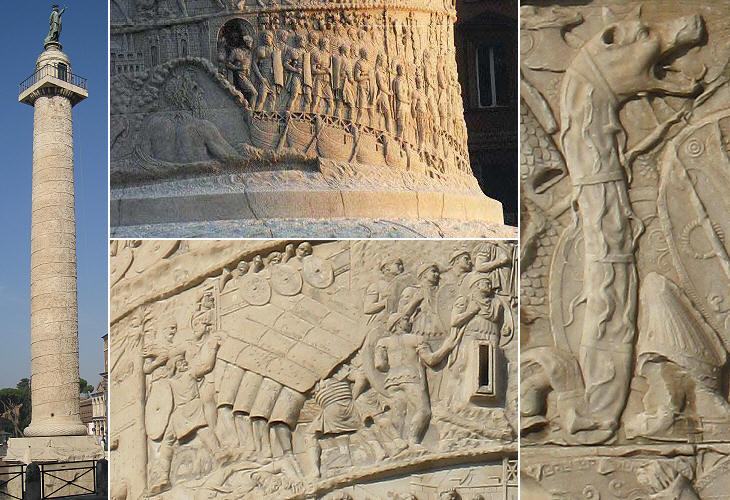
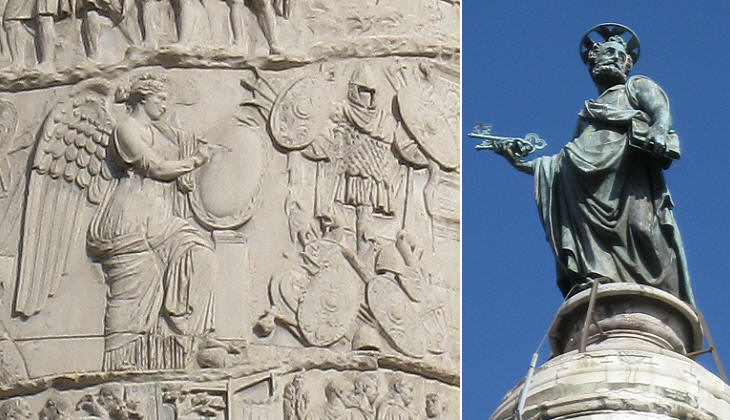
The column with its 660 ft. spiral band gives a detailed account of Trajan's wars against the Dacians. The reliefs are fascinating especially early in the morning with the rising sun (see the column at dawn). At the time of Trajan the column was amidst tall buildings from which all the details of the strip were clearly visible. Pope Sixtus V (1585-90) placed on the top of the column a statue portraying St Peter, thus safeguarding the ancient monument. A spiral stair inside the column leads to a small balcony from which in the past foreigners used to watch the Colosseum (including J. W. Goethe on July 23, 1787). The reliefs had a great influence on Renaissance and Baroque artists. The first artist who studied them in depth was Antonio Averlino, known as il Filarete, who worked in Rome in 1443-45 at the decoration of the main door of St. Peter's. At the beginning of the XVIth century Jacopo Ripanda, a painter from Bologna, made a series of drawings of the reliefs, including those at the top of the column, which he saw suspended in a cane basket. At that time most houses had a painted façade and the reliefs inspired many artists: this is still visible in Palazzo in Via della Maschera d'Oro. The detailed study of the reliefs showed that in origin the fighters held bronze weapons. This had an influence on the XVIIth century statues of the Apostles put on the top of St. Peter's: each saint holds a bronze symbol of his martyrdom. Plaster copies of the lower parts of the column were made by several artists in the XVIth century. In the XVIIth century Pietro da Cortona copied most of the column.
The reliefs show the wars Trajan waged against the Dacians and an image of Victory divides the accounts of the two campaigns. This image influenced many Baroque funeral monuments including that from which the icon of this website (first image on all pages) was developed. King Louis XIV, who saw himself as the "Trajan of France", ordered a full plaster copy of the reliefs for the French pupils of the Accademia di Francia in Roma he founded in 1666. A second copy was sent to Paris. To learn more about the reliefs of the column see a page on Two Roman Wars. The Churches
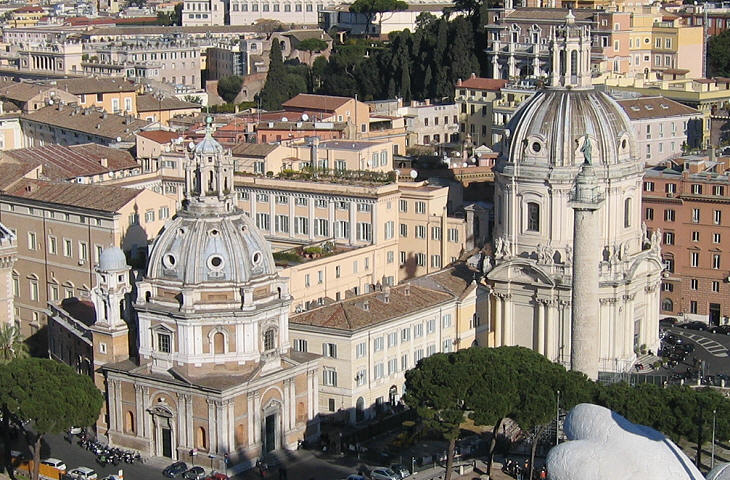
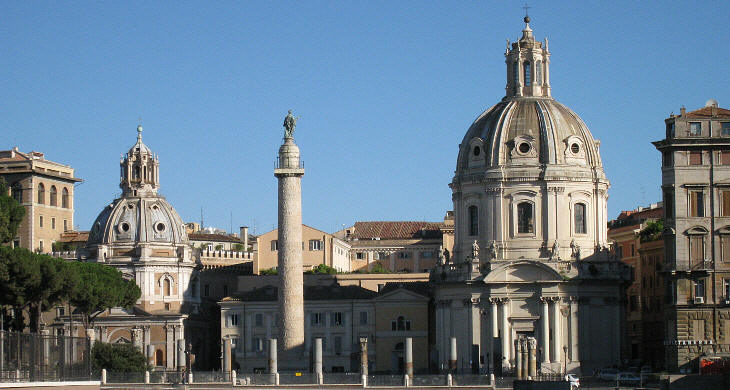
Similar to S. Maria dei Miracoli and S. Maria in Montesanto in Piazza del Popolo, these two churches have a similar appearance, but the histories behind their construction are very different. S. Maria di Loreto (left) was built in the XVIth century by the guild of the bakers (see a list of churches belonging to a guild). Antonio da Sangallo completed the lower part of the church in 1534; in 1573 Jacopo del Duca, a scholar of Michelangelo, built the high drum and the dome including the almost baroque lantern (you may wish to see it in a 1588 Guide to Rome). Santo Nome di Maria (right) was built in 1735-1751 based on a project by the French architect Antoine Derizet who ensured the new church had some consistency with S. Maria di Loreto. The celebration of the Holy Name of Mary was instituted in the XVIth century, but it became a major feast after the 12 September 1683 victory of the Polish King John Sobiesky on the Ottomans who were laying siege to Vienna; the victory was attributed to the intervention of the Virgin Mary.
Excerpts from Giuseppe Vasi 1761 Itinerary related to this page:
Next plate in Book 2: Piazza S. Marco Next step in Day 3 itinerary: Palazzo Colonna Next step in your tour of Rione Trevi: Palazzo Odescalchi Start your tour of Rione Monti: next stop: Sepolcro di Caio Publicio Bibulo |