 Back to Index
Cloning
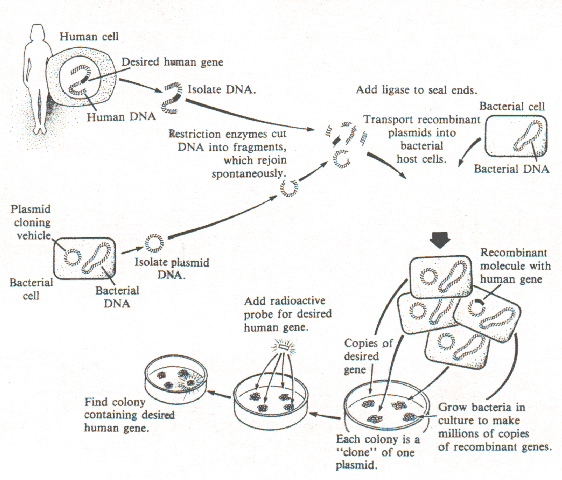
Cloning often gets referred to in the same breath as genetic engineering. It is the process of essentially copies the entire genetic complement of a nucleus or a cell. Cloning had been done to animals, plants and even scientists are now considering cloning human.
The most successful cloning that had been done in this century is the cloning of a sheep called Dolly. To know more of this cloning, see the The Cloning of Dolly.
Besides, in the latest news, two high-powered committees in Britain proposed that scientists be allowed to produce human embryo clones for medical research. Under the proposals, it involves transferring the nucleus of the cell to be cloned, which can come from any part of the body, to an unfertilised egg whose own nucleus has been removed. An embryo created from this egg then contains all the genetic information originally in the donor cell.
To help in medical research, the embryo—tiny bundles of cells called blasyocysts—would not be allowed to develop into foetuses, but destroyed to obtain stem cells. The stem cells, found inside blastocysts, have the power to differentiate into all the other cells of the body. Research into their development and function offers the hope of creating spare-part tissue. The procedure could possibly be used to repair the brain and other organs, or to treat disorders such as Parkinson’s and Alzheimer’s disease.
The cloning process had been improving and now it also involves in cloning human organs. To know how the cloning process is done, see the Cloning Process.