2. Fascists and
Rationalists
Michelucci was born into an
artisan family of architectural ironworkers and the family
foundry made an important impression upon him (he worked there
before affirming his vocation, returning to help for a short
while after the war). As a result, his belief in a
"modernism" which did not dismiss craftsmanship was
instilled at an early age and was to condition his thinking for
the rest of his life.
At the same time Michelucci's
Tuscan birthplace of Pistoia, despite its size, was a lively
artistic and literary town in the first decades of the twentieth
century, to the extent that in 1913 the futurist Filippo Tommaso
Marinetti held a conference on Futurism which the young
Michelucci attended.6 A keen advocate of the modern
spirit, Michelucci involved himself in the debates amongst
artist's groups whilst at University in Florence and Futurist
publications such as the Pistoian "Bianco e Nero" (in
which issues such as traditionalism vs. progressionism were
voiced). And it was precisely this futurist fervour that incited
Michelucci to participate in the First World War.
The Rise of Fascism
In 1919 the
"war-mongering" Futurist manifesto lay in tatters and
Italian architecture was "born and painfully developed"7
in a climate, for the most part Anti-Futurist. Returning from the
war, Michelucci would have experienced the economic depression
and the rise of Socialism which terrified industrialists,
landlords and the conservative middle classes with strikes. In
this social climate, the figure of Benito Mussolini, attracting
support from those fearful of a "Bolshevik" revolution,
rose from obscurity in 1921 as the leader of a political movement
known as "Fascism" that was to dominate the political
and cultural scene for the following twenty years.8
In approaching the subject of the
relationship of modern architecture to Fascist Italy, it is
important to keep in mind the evolution of Fascism itself. From
Mussolini's seizure of power with a triumphant "March on
Rome" in 1922, and the subsequent destruction of the
democratic state with a totalitarian regime in 1926. Ethiopia was
invaded in 1935, and an Empire declared the following year, but
the demise of the regime began with Italy's somewhat reluctant
entry into the Second World War in 1940. Mussolini was ousted in
1943 but German occupation followed until liberation in 1945.
This serves as a reminder that,
with the nature of Fascism constantly changing, the meaning of
"collaboration" with Fascism changed as well, so the
earliest encounters between architects and the regime should not
be prejudiced with the knowledge of events that had not yet taken
place.
Claudia Conforti remarked that
after the Second World War major changes in attitude towards
Fascism occurred and the importance of Michelucci's projects for
the regime were suppressed if not "silently censured".9
Generally people or movements who had flirted with the regime
were disapproved of. Throughout the 1930s however, architects on
the whole had tacitly accepted the regime by participating in
projects to glorify the Fascist revolution.10 As Ernesto
Rogers explained in 1961,11 the majority belief at the
time was: "Fascism is a revolution, modern architecture is
revolutionary, thus it must be the architecture of Fascism."12
Michelucci was to be intimately
involved with some of the most important Fascist projects from
1932 to 1940 and whether he was a "Fascist" or not (he
was actively involved with the local PNF party in Pistoia in the
1920s)13 may seem of little consequence to us now. However
it certainly mattered up until the 1960s to a generation of
younger architects, which explains in part the "silent
censuring" of his early projects.
The Emergence of Rationalism
1926 saw the establishment of
"Gruppo 7" who coined the term "Rationalism"
in favour of "Modern",14 which they felt had
been abused by predecessors such as the Futurists. The movement
quickly gathered momentum and after a successful first exhibition
in 1928 "went on the offensive"15 at the Second
Italian Exposition of Rational Architecture in Rome in 1931, with
two clear intentions. Firstly they argued for an official
identification of Rationalist architecture with Fascism,
claiming: "Our movement has no other moral consequence than
to serve the Revolution in hard times", asking for
"Mussolini's faith" to realise this.16 Secondly
and more contentiously however, they attacked recent projects
that had met with their disapproval in a "panel of
horrors" alongside the exhibition of their own work, proving
to have serious consequences for the polemical cause of the young
movement and creating a bitter atmosphere in Rome.
At the inauguration of the
exhibition on the 30th March 1931, Mussolini was handed a
manifesto revealing profound personal reasons that were prompting
many of the Rationalists to take Fascism seriously: "We are
fifty young architects who, in the midst of the incomprehension
and the systematic opposition of those who will not assign work
to us, have only constructed six houses in four years."17
One of those houses, the Villa Valiani was by Michelucci (who at
forty was hardly "young"). Nonetheless, the inclusion
of the exhibit by Michelucci represented an act of solidarity,
rather than an active participation with the Rationalists.18
The "panel of horrors"
which satirised the recent work of architects including Marcello
Piacentini led to a scandal, and the Rationalists, in failing to
win official recognition from the state, were forced into a
compromise. Ironically this entailed a merger of the Rationalist
movement (MIAR) with Piacentini's own Fascist Architect's
Syndicate. The very architect they had attacked would provide
them with support, but on his terms now.
Marcello Piacentini was to become
the "official" architect of the establishment and wield
increasing power until the final collapse of the regime in 1943.
As a result many historians have since painted him as an
archfiend.19 This however is for the most part an unfair
portrayal and Michelucci himself formed a long working friendship
with Piacentini, after their initial contact in the mid 1920s.
Piacentini had argued in 1923 for
an architecture that fused tendencies arising from a response to
new materials and customs, with a traditional more contextual
response.20 A view that met with the accordance of
Michelucci, who was soon to offer his own contextual response,
when towards the end of 1932 he led a group who were judged, by a
panel including Piacentini, as the winners of a national
competition for the design of a new station for Florence.
Earlier in 1932 Michelucci had
published a series of essays in Domus illustrating the
notion that tradition transforms itself through an abstraction of
formal qualities that bear a resemblance to the past. Entitled
"Contacts between Ancient and Modern Architecture"
Michelucci argued that there existed a sympathy between old
"minor" architecture, "simple forms, not born from
a decorative concept, but determined by the requirements of
life" and the modern spirit "ordered by an absolute
sincerity of expression". And for Michelucci the lessons
gleaned provided a context for Rationalist architecture: "a
new, a true image of architecture; it makes us feel part of a
context, it orients us."21 And it is the phrase
"determined by the requirements of life" in particular
that suggests that Michelucci had already begun to formulate some
of the ideas that he voiced after the war.
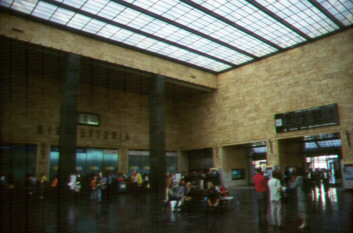
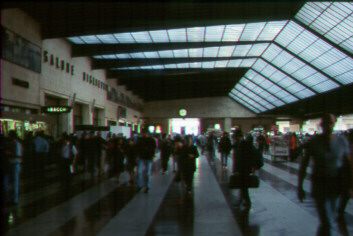
 The competition for a new railway station for
Florence (right
and below) had arisen, after
the influential figure of Romano Romanelli had discredited a
previous design. He argued that for the delicate location behind
the church of Santa Maria Novella it should have the "most
inconspicuous, the least offensive, and the least visible form
possible", whilst at the same time suggesting the "idea
of the train or of mechanics".22
The competition for a new railway station for
Florence (right
and below) had arisen, after
the influential figure of Romano Romanelli had discredited a
previous design. He argued that for the delicate location behind
the church of Santa Maria Novella it should have the "most
inconspicuous, the least offensive, and the least visible form
possible", whilst at the same time suggesting the "idea
of the train or of mechanics".22
Michelucci led the group, and he
was credited with the project, but in reality it was Italo
Gamberini a student of Michelucci's, whose thesis project formed
the basis of the competition entry.23 The "Tuscan
Group"24 comprising of Michelucci, his teaching
assistant and four graduating students (including Gamberini)
achieved Romanelli's criteria with a low horizontal building, of
parallel lines of slightly raised stone work and a dramatic
cantilevered canopy. At the same time it achieved the required
sense of dynamism, and the most contextual solution of all the
competition entries, employing large walls of pietra serena
reminiscent of those of the Florentine convent of San Marco that
Michelucci had published earlier that year in the Domus articles,
and had praised for their "large, pure,"25
simple surfaces, with few openings.
The Rome Projects
During and after the station
competition Michelucci fraternised to a greater degree with the
Rationalists, co-organising the third Rationalist exhibition in
Florence in 1932 with Adalberto Libera. And later that year,
along with six others including Giuseppe Pagano, Michelucci was
invited by Piacentini to collaborate on the new Rome University
campus design (Città Universitaria). Piacentini, Arts Secretary
of the Italian Academy since 1929, had been selected by Mussolini
to direct the project, and established a design criteria, with a
desire to guarantee a visual unity with the individual buildings.
In doing so Piacentini consciously defined the modernism
appropriate for the Fascist state. This was based upon the
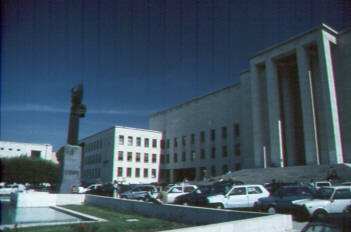
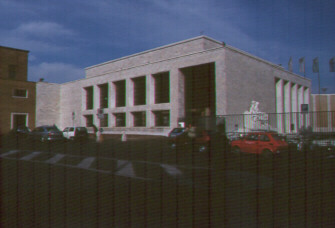
stripped classicism of his own Post Office building in Brescia. (Below right- Piacentini's
library, Michelucci's Mineralogia building in the background).
 Michelucci had already moved to Rome in 1926, partly
motivated by his friendship with Piacentini that had begun back
in 1923, when he had praised Piacentini's work in a magazine
article. The influence of Piacentini had been particularly
evident in a series of sober Neo-Classical country villas that
Michelucci worked on during the early 1920s, which reflected a
vernacular "Novecento" style. The importance of this
move to Rome was described by Michelucci as "of the deepest,
the utmost importance... At first I had been convinced that
Florence had all the elements to be defined as the city, a
beautifully constructed city. I had this conviction."
However, for Michelucci, it was Rome that "revealed
architectural space."26
Michelucci had already moved to Rome in 1926, partly
motivated by his friendship with Piacentini that had begun back
in 1923, when he had praised Piacentini's work in a magazine
article. The influence of Piacentini had been particularly
evident in a series of sober Neo-Classical country villas that
Michelucci worked on during the early 1920s, which reflected a
vernacular "Novecento" style. The importance of this
move to Rome was described by Michelucci as "of the deepest,
the utmost importance... At first I had been convinced that
Florence had all the elements to be defined as the city, a
beautifully constructed city. I had this conviction."
However, for Michelucci, it was Rome that "revealed
architectural space."26
In 1934 Mussolini defended the
modernists who were bombarded by a wave of hostile criticism in
the Chamber of Deputies regarding two recent state competitions,
including Florence station.27 This was not necessarily
representative of Mussolini's views on Rationalism but of the
special status he accorded to the station, representing his
modernising drive, believing it to be "a mirror of the
progress of the nation."28 Pagano however viewed
Mussolini's invitation of those architects involved in the
projects to the Palazzo Venezia29 in Rome, as a sign that
finally, Rationalist architecture had been accepted and that
Michelucci was recognised as a leading member of that movement.
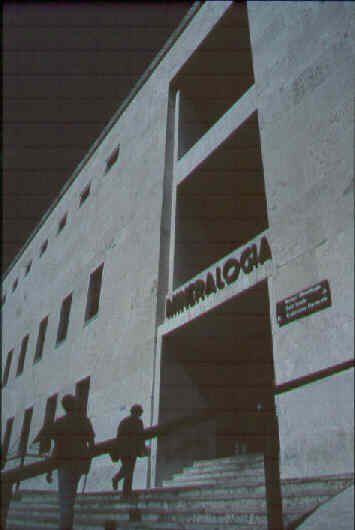
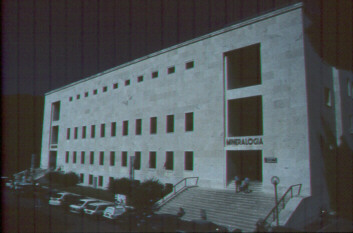
Michelucci, on the other hand,
whilst involved simultaneously with the University buildings and
the construction of the station, began to detach himself from the
latter, criticising that the station "lacked the
architectural discipline of the Città
Universitaria".30
His disconnection from the project
was further evidenced by the greater involvement he devoted to
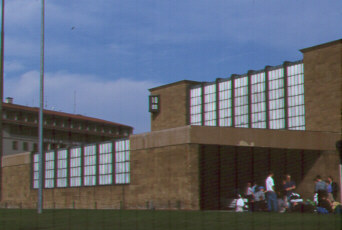
the station's Royal Pavilion (below right), which was closer in character to the University
buildings (such as his Mineralogy Institute (above left and right) (1932-35) with Travertine marble as
opposed to the pietra serena of the station).
 Michelucci's reservations were then further
confirmed by the expression of subsequent projects, such as the
Town Hall in Arezzo (1936-39) where he illustrated his
unwillingness to interrupt a dialogue with tradition, justifying
statues which he placed on its roof as functional not decorative.
He seems to have been searching for a "third path",31
between Piacentini's reductive monumentalism and the virulence of
the Rationalists with their abstract rhetoric, by distancing
himself from the achievements of the station.32 All this
seems to indicate that Florence station was in a fact an anomaly
for Michelucci, the product of a collaboration with his former
students, and not the most representative project of his early
career.
Michelucci's reservations were then further
confirmed by the expression of subsequent projects, such as the
Town Hall in Arezzo (1936-39) where he illustrated his
unwillingness to interrupt a dialogue with tradition, justifying
statues which he placed on its roof as functional not decorative.
He seems to have been searching for a "third path",31
between Piacentini's reductive monumentalism and the virulence of
the Rationalists with their abstract rhetoric, by distancing
himself from the achievements of the station.32 All this
seems to indicate that Florence station was in a fact an anomaly
for Michelucci, the product of a collaboration with his former
students, and not the most representative project of his early
career.
Indeed Michelucci had vehemently
argued against minimum space ideals associated with Rationalism
in the 1930s, believing it was the right of every person to a
suitable environment. At the end of the decade, in a letter dated
21st December 1940, Michelucci wrote to a friend Roberto Papini.
He wrote, "according to spiritual needs the most rational of
the architectural works is the most beautiful in which the spirit
rests, and not in those architectural works which are
industrially perfect because such perfection is surpassed every
day and therfore not perfection".33 It was this
course that he was to pursue.
In January 1937, after the
completion of the university, Piacentini commissioned a group
(once again including Pagano) to produce a plan for an ambitious
new city, to the south of Rome called "E.U.R."34
This was to stage an International exhibition scheduled for 1942,
to commemorate the twentieth anniversary of fascist rule. However
as the decade had progressed (particularly after the Ethiopian
war and the declaration of Empire) the mood had turned
increasingly towards overt allusions to Imperial Rome, and
Piacentini had reflected this with his own eclectic "stile
littorio" (Lictorial style) developed through the University
project.35 This involved a "gradual drift towards
heavy, oppressive classicism as a metaphorical celebration of the
new Roman Empire".36 Bruno Zevi later remarked that
with this developed of an official style in 1934, "the
possibility of modern architecture in Italy was brought to a
close".37
Initially Pagano reported that the
group worked together in a spirit of great optimism and
innovation, but as time passed Piacentini took an increasingly
tight hold on the project until the group were dismissed in 1940.
With his dismissal Pagano turned on Piacentini, condemning him as
an "artificial Vitruvius",38 and attacking all
those who had accepted the drift into classicism in an article
entitled "Can we save ourselves from false traditions and
monumental obsessions".39
Michelucci however remained
intimately involved with the project until its demise (once Italy
entered the war). His own design for an open air theatre was
never completed, and what was built was demolished after the war.
His "Palace of Water and Light" competition entry also
for E.U.R. while never built, is still regarded by Francesco Dal
Co as one of his best projects of the decade.40
Within the polemical climate of
the 1930s Michelucci had managed to maintain an unconstrained
position, a balancing act between Rationalist culture and the
academic and authoritarian culture of Piacentini. Later in his
life Michelucci remarked peculiarly that, "I was on
excellent terms with Piacentini, who was an intelligent
architect. With him I formed a genuine friendship, although there
was no possibility of our agreeing on matters of
architecture".41 It can only be concluded that this
was Michelucci's own criticism of Piacentini's later position,
and so it was that from Piacentini's shadow, more than anyone
else's, that he emerged after the collapse of the regime.
This emancipation allowed
Michelucci to return once again, after many years of what can
only be termed as a "digression", to the aspirations of
his youth: a modern architecture from within which
"tradition" could find new means of expression, a
reconstitution of architecture, ambiguous, elusive and
multiplicitious.
After 1941 and the collapse of
E.U.R., Michelucci returned from Rome to Florence (with his wife
Eloisa) and stayed with Eugenio Ventura's family at the
Angiolieri tower near to the Ponte Vecchio.42 It was here
that it seems Michelucci sensed a need make clear choices and was
to abandon the ambivalent and experimental approach his projects
had taken to date.
