The Life Pyramid: A Method for Life Re-Design

Contents of this page:

Why Did I Re-Design My Life?

I'm an active, creative person. Currently, I have several "open projects" in my life, as well as other responsibilities as a father, citizen, and friend. I want to do so many things, but there's never enough time. In my past, pressures from employers, co-workers, spouse, and children made prioritizing all of the parts of my life very difficult. I wanted to help them all, and I also wanted to listen to my own voice. I needed a way of sorting out what everyone wanted, and then putting together a plan to address the most important ones. I made a big leap in progress and satisfaction when I decided to look at my overall life-planning-and-management process. In a nutshell, it needed an overhaul. My life needed to be re-designed, this time by me—a conscious adult, not by parents and society and other often subconscious, insidious factors.

A Conceptual Framework

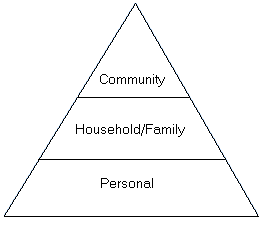
I've tried several ways of managing my diverse and often conflicting wants, responsibilities, and resulting priorities. The most useful one--in terms of productivity and overall happiness—is represented in the following pyramid.


  • Receiving benefits of community.
  • Contributing via work/projects.
  • Household-member interactions & support.
  • Resource management (like finances, clothing, vehicles).
  • Health maintenance (sleeping, eating, recreating, hygiene).
  • Self-esteem (assessment, celebration, forgiveness).
  • Self-empowerment (knowledge, skills, habits, etc.).
  • Self-definition (beliefs, values, wants, including spirituality).
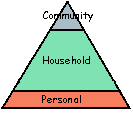
I explain pyramid parts later, after I say why I use the pyramid metaphor.

Why a Pyramid?

I chose the pyramid because it has a wide base, and the top is smaller (but reaches higher) than the other parts. I think it also has some sort of additional significance to Egyptians, but I have no idea what that is. I just like the shape.
"Personal" Is the Base
This portion of the pyramid is its base, its foundation. It is what the upper parts are established upon. Without this base, they would collapse. This base has the largest area of the triangle components. I think of this largest area as representing the highest importance & urgency, and is the first (and last) in the sequence of daily actions. It is where I focus my initial exploration and planning efforts, and where I later return for assessment, celebration, and rejuvenation.
"Household" Is Next
I define this part of my pyramid to include my immediate family (currently my three sons and me, and of course my cats) and our living space. It is the second area I focus on, after personal and before community. Without a supportive household, I wouldn't feel as safe or prepared for interacting with and contributing to the community.
"Community" Is Last, but Perhaps the Highest
The uppermost part of the diagram I define as cooperative relationships and interactions between people in groups such as neighborhoods, towns, states, countries, and continents. I include in it both people and the environment, as well as the "sense of community" which we feel when we're working together in cooperative, harmonious groups. I can best do community things when I have a strong personal component and supportive household.

I believe that the community needs are higher than individuals' needs. I also strongly believe that these needs can be harmonious, not mutually exclusive trade-offs!

Applying the Life Pyramid—Four Examples

On my website's homepage, I presented one pyramid which showed my recent life re-design. I've also used my Life Pyramid to understand my past experiences, to assess my present situation, and to formulate more detailed life re-designs (one-year and life-time versions). Here is a chronological listing of these four pyramid applications: Note that you can begin applying the Life Pyramid at any of these levels, in any order.


Example 1: Understanding My Background / Personal History

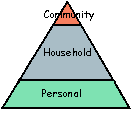
Community: Good neighborhood connections; few community contributions.

Household: Small, close, middle-class family.

Personal: Low self-image, but creative... and determined to learn.

What do you notice first about this pyramid?
Colors?
Red = needing change, highest priority.
Grey = dull & boring, perhaps overwhelming.
Green = OK (no change needed, just maintain).
Relative sizes of three components?   (base, middle, & top)
Larger = important, time-consuming.
Smaller = not as important or time-consuming.
Phrases after the life areas?   (such as Community:)
I use short phrases to characterize this area of my life.
Here's an explanation of how I've used colors, sizes, and words in the "Understanding My Background" pyramid above. I hope it helps you understand the process better.
The Community part of my background / personal history:
I use size to show that I did not spend a very large percentage of my early years in community interactions or mind-set. (It's not tiny because I spent a lot of time with neighbor kids and friends.) I use grey to indicate that it was not great and not bad. The text says that I did have neighborhood connections/interactions, but that they were not as much "community participation" as I would have liked.

The Household part my background / personal history:
This life area is relatively large in size because I spent a lot of time with my family, and that it was important to us to have a strong household. I use green to indicate that this area of my life was enjoyable.

The Personal part of my background / personal history:
This area of my early years was not that enjoyable. I show it as relatively small, because I didn't spend much time (nor did many of my generation) getting to know myself and develop a strong sense of self and purpose. I use red to indicate that I needed changes in this life area.

See the "Using the Pyramid Process to Understand Yourself" page for more information.


Example 2: Assessing a Current Life Situation (Summer 2003)

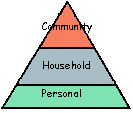
Community: Lacking! (Too few connections & contributions.)

Household: Overwhelmed? (My life is dominated by remodeling—solitary time.)

Personal: OK. (Solid health; clarified beliefs & values.)
OK. Now can you guess what I've presented with this pyramid? My "community" life area was way too small. I needed some big changes. I was bored with the huge percentage of my time & energy that I spent in my "Household" area (finishing up a large remodel of my residence). I was worn down and under-stimulated! I felt really good about the "Personal" area of my life, because I'd spent a lot of time in the last few years clarifiying my beliefs, developing skills, and creating visions and plans for my life. It did (and still does) feel like a very solid basis for the rest of my life.

See "Using the Pyramid Process to Assess Life Situations for more information.


Example 3: Re-Designing My Life (One-Year Timeframe)

Community: Big break-throughs! (Network; write articles + eBook.)

Household: Mostly follow-through. (Finish remodel, then build eco-house.)

Personal: Just maintain. (In spare time: Learn new natural-food recipes.)
You saw in the pyramid/assessment above that I was overwhelmed with my remodel, and bored with so much solitary work. What did I do? I decided to tap into several of my strongest beliefs, and use my favorite skills to express those beliefs. I'm now doing a lot of writing (including this website), as well as designing a new eco-friendly home. Unfortunately, I haven't yet completed my current remodel, but I am hiring out some of the work so that I can focus more on what brings me energy and joy.

See "Using the Pyramid Process for Life Re-Design" for more information.


Example 4: My Long-term LifeDesign (Life Mission)

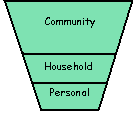
Community: Contribute to world health/sustainability.

Household: Loving family; eco-house.

Personal: Strong spirituality & health.
So now that you've seen three other uses of this Pyramid Process, you have probably already guessed that it's great for helping you to develop life missions, or long-term plans. I see this as a great way to explore and enhance your spirituality--which I see as how you view the "big picture", which likely extends past your earthly lifetime. Note also that I have colored all of the areas as green, because I want all to have been addressed by what I've done during my life. Note also that I've changed the top of the pyramid to more of a flat area, which I use to symbolize that this area of my life has produced a lot for my communities, as well as symbolizes that I can "stand on top of the pyramid" comfortably now.

See "Using the Pyramid Process for Life Missions" for more information.


Want Some Help Getting Going?

Now you've seen a bit about assessing where you are at in your life areas and developing life re-designs for organizing your life-improvement efforts. Some people can do this sort of work on their own, and others do much better with at least some help in getting started and developing new habits. In my case, I think I would have made progress more quickly and consistently if I'd had someone to help me clarify wants, brainstorm ideas, and keep the momentum going. I've summarized the process I use in my life coaching page. You may be able to apply it yourself, or you may want to get a bit of help from me to get going faster.