Home

BERT'S A-10'S/BOMBER'S EH!
Formation photo's F-22 L3
Formation Flying
My Book's Mig 1.42
Ricky's F-22/F-14 Page
STARS Mig-29 Falcrum
Thunder's F/A-18 Page
Mongol's JSF Page
Siver Bullets B2 pictures
Lt.'s F/A-22 Air Dominance Fighter
Stars Picture Page
Pics of Sound barrier
Mig VS F15
F-15 Pics and Spec.
Skin Page
Downloads
F-16 Spec.
Mig-29 VS F-16
Migs Spec.
Photo's
177th Fighter Wing Air Superiority Fighters
Mongol's JSF Page

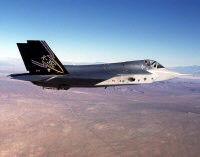
X-35 Joint Strike Fighter (JSF)

Constructor: Lockheed-Martin
Length: 15m41
Height: 4m07
Span: 10m00
Max Speed: Mach 1.5
Weight Max: 22700 kg
Crew: 1
Ceiling: 19700 m
Range: 1000 km (Combat radius)
Primary Function: strike fighter
Engines: 1
Armament: 20 mm cannon ,2 internal weapon bays, 5900 kg max payload
Unit cost: $28M-$38M

The Joint Strike Fighter (JSF) is going to be the mass produced 5th generation aircraft of the 21st century.Until 26 October 2001 there was an ongoing competition between Lockheed Martin ( the X-35) and Boeing (the X-32). The winner of this competition will produce the F-16's replacement. Unlike the F-22, the JSF will be a relatively low cost aircraft. The U.S. Air Force, U.S. Navy and Royal Navy, and the US Marine Corps will use the JSF.Overall the airframes will be alike with a few exceptions; the U.S. Air Force version will be a conventional takeoff multi-role fighter.The U.S. Navy's version of the JSF will be similar to the Air Force version except with a stronger internal structure, landing gear, and arresting hook to allow carrier landings. The U.S. Marine Corps and Britain's Royal Navy version (X-35B) will have a short takeoff and vertical landing (STOVL) capability thus allowing this version of the JSF to land almost anywhere.The JSF will use many of the advanced technologies employed in the F-22 yet still remain a low cost 5th generation fighter. It is scheduled to enter service in around 2012.

The 1993 Bottom-Up Review (BUR) determined that a separate tactical aviation modernization program by each Service was not affordable and canceled the Multi-Role Fighter (MRF) and Advanced Strike Aircraft (A/F-X) program.Acknowledging the need for the capability these canceled programs were to provide, the BUR initiated the Joint Advanced Strike Technology (JAST) effort to create the building blocks for affordable development of the next-generation strike weapons system. After a review of the program in August 1995, DoD dropped the "T" in the JAST program and the JSF program has emerged from the JAST effort.Fiscal Year 1995 legislation merged the Defense Advanced Research Projects Agency (DARPA) Advanced Short Take-off and Vertical Landing (ASTOVL) program with the JSF Program. This action drew the United Kingdom (UK) Royal Navy into the program, extending a collaboration begun under the DARPA ASTOVL program.

Key design goals of the JSF system include:

Survivability radio frequency/infrared signature reduction and on-board countermeasures to survive in the future battlefield--leveraging off F-22 air superiority mission support.

Lethality integration of on- and off-board sensors to enhance delivery of current and future precision weapons.

Supportability reduced logistics footprint and increased sortie generation rate to provide more combat power earlier in theater.

Affordability focus on reducing cost of developing, procuring and owning JSF to provide adequate force structure.

Propulsion Baseline: Pratt & Whitney F119-PW-100 derivative from F-22 Raptor ; Alternate Engine: General Electric F120 core.

Inventory Objectives U.S. Air Force 2,036 aircraft;U.S. Marine Corps-642 aircraft;U.S. Navy-300 aircraft;U.K. Royal Navy-60 aircraft.


x-35c_01.jpg x-35c_02.jpg x-35c_03.jpg x-35c_04.jpg x-35c_05.jpg
x-35c_06.jpg x-35c_07.jpg x-35c_08.jpg x-35c_09.jpg x-35c_10.jpg
x-35c_11.jpg x-35c_12.jpg x-35c_13.jpg x-35c_14.jpg x-35c_15.jpg
x-35c_16.jpg x-35c_17.jpg x-35c_18.jpg x-35c_19.jpg x-35c_20.jpg
x-35c_21.jpg x-35c_22.jpg x-35c_23.jpg x-35c_24.jpg x-35c_25.jpg

Lockheed F-35 Joint Strike Fighter (JSF)

Role: multi-role strike fighter
Builder: Lockheed Martin
Variants: F-35A, F-35B, F-35C
Operators: USAF, US Navy, US Marine Corps,
Royal Navy/Royal Air Force (UK)
(Netherlands, Turkey, Italy, Israel, Australia)

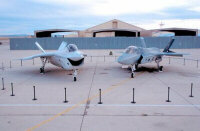
The F-35 will be the result from the Joint Strike Fighter program. The aim of the program is to develop an affordable next generation stealth strike aircraft for the US Air Force, US Navy, US Marine Corps and the United Kingdom as well as other US allies. The program enables various forms of participation for the candidate export countries, ranging from 'informed partner' to 'major participant'. Boeing and Lockheed Martin were the two competitors in the Concept Development Phase (CDP). The Boeing Corp. designed and built the X-32 prototype and the Lockheed Martin team developed the X-35. The X-35 concept by Lockheed Martin was selected as the winner and the program has now entered the Systems Development Demonstration (SDD) phase of the JSF program.

Lockheed Martin leads a development team including Northrop Grumman, BAE Systems, and Pratt & Whitney. Lockheed Martin brings in advanced technology experience, stealth technology and other technologies and experience which it has gained during F-22 research and development. Northrop Grumman offers tactical aircraft knowledge, stealth technology and carrier suitability. BAE System provides expertise and experience with short take off and vertical landing (STOVL) technology as well as advanced subcontract management. Pratt & Whitney is the builder of the engine which will power the JSF which is based on the F-119 turbojet from the F-22.

To forfill the demands of the main contractors three different variants are developed. All versions will have a common structure and have the same fuselage and internal weapons bay. They will all three be powered by a F-119 modified engine. All variants will carry the standard designation F-35.

The F-35A is the standard variant with conventional take off and landing developed for the US Air Force, the biggest JSF customer. The F-35A will replace the F-16 and the A-10 aircraft currently operated by the USAF. The F-35A will probably also be the most exported variant. Possible export countries for the F-35A include all current F-16 Fighting Falcon, F-4 Phantom, F/A-18 Hornet operators, such as the Netherlands, Belgium, Denmark, Norway, Turkey, Greece, Israel, etcetera.

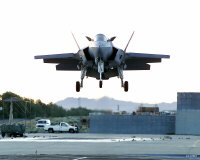
The F-35B is the STOVL variant of the JSF. The F-119 is modified using the experience of BAE Systems based on the Rolls-Royce Pegasus engine from the AV-8 Harrier. Unlike the Air Force variant the F-35B carries no internal gun and the air refuelling probe is located on the right side of the forward fuselage instead of receptacle on the top surface of the aircraft. The main customers for the F-35B will be the USMC to replace the F/A-18 Hornet ands the AV-8B Harrier IIs and the United Kingdom to replace the Royal Air Force/Royal Navy combined Harrier force of Sea Harriers and GR.7s. Other customer include Spain and Italy which also operate the Harrier.

The F-35C is a modified design which enables the JSF to operate from aircraft carriers using conventional carrier landings and capapult take off. The F-35C internal structure and landing gear have been strengthened to handle the loads associated with catapult launches and arrested carrier landings. It has a larger wing area than other JSF types with larger control surfaces for better low speed handling. Like the F-35B is has a refuelling probe instead of a receptacle. The US Navy will be the biggest customer of this variant. The F-35C will complement the US Navy fleet of F/A-18E/F fighters by replacing the F/A-18 A+ and C Hornet currently in service.

Other variants might include two seat trainers of each variant and possible modifications for export customers.


Joint Strike Fighter program logo


picture courtesy of Lockheed Martin
X-32 and X-35 prototypes

picture courtesy of Lockheed Martin
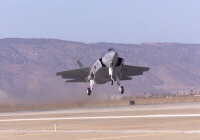
First Flight of the X-35

picture courtesy of Lockheed Martin
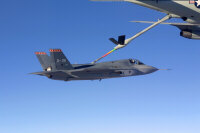
X-35A ready to refuel

picture courtesy of Lockheed Martin
X-35B STOVL in hover

picture courtesy of Lockheed Martin
Navalized X-35C

Enter supporting content here