| Revision (with additions), pages 8-9 (September 17, 2017; thanks to John McLeod (host of the Card Games web site) and others:
“Bower” and
“march” – two other strange terms of euchre (besides the word “euchre” itself) – have German roots, “Bauer”
and “Marsch.” “Bauer”
is German for “farmer,” or peasant, colloquial for the jack in a deck of cards (this
derivation is widely known; some euchre players yet spell the trump jack
“Bauer”). “Marsch” is German for both
“march” and “marsh”; so you can say that, when one side takes all the tricks in a round (that’s a “march” in euchre), the victors have “marched”
through the vanquished (I’m told that that’s what the Germans meant,
but it might as well mean “marsh,” since the vanquished are “swamped”).
Further
confirmation of the origin of euchre in or about Alsace is found in the
game Bauern, still played in Saarland and the Hunsrück region of the
Rhineland, just up the road in Germany (less than 100 kilometers from
Strasbourg). Both areas use 32-card decks ranked as for euchre. The Hunsrück version is closer to euchre, but has two teams of three players each. Both versions are scored downward – winners are the first to zero. . . .
[Further description of Bauern from Mr. McLeod (not in the book): In Saarland, four players are dealt eight cards each.
The first player has to choose tump after getting the first four
cards, and the maker's team needs to take five of the eight tricks to
win a point. In a variant with a 20-card deck (eliminating 7's through 9's), players get only five cards each.
[The game in Hunsrück is for six players in two teams of three players each. Five cards are dealt to each player in batches of three and then two, and one of the two remaining cards is turned up. If no one wants this trump, trump can be named (as in euchre).
[The Saarland game starts at 8 points and goes to zero; the Hunsrück game, at 5 and to zero.
If the trump makers take more than half the tricks, they subtract
a point from their score; if not, they add a point and the opponents
subtract one.]
[back to the book:] Henry Anners’ book Hoyle’s Games (1845)
had a four-page section on euchre, calling it “a German game”; but it is not
commonly played in Germany – even Jucker seems to have been limited to
Alsace, and Bauern to southwestern Germany.
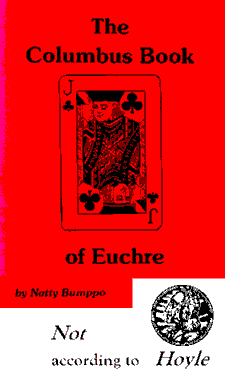
See reviews of books on euchre published before and after The Columbus book of Euchre:
Additions and revisions, pages 8-9 and 72 (March 17, 2009, and February 25,
2006; thanks to J. T. Martin, David Parlett, and Philip R. Neill):  Five pages of printed instructions on euchre were found in a book published in 1844,
A Whist Player’s Hand Book, by Thomas Mathews (Isaac M. Moss, publisher,
Philadelphia). That’s two years
earlier than the earliest published reference found by the Oxford English Dictionary, an
1846 reported Mississippi court case (in which the name of the game was spelled
“uker”). And Hoyle’s
Games, published in 1845 by Henry F. Anners, also of Philadelphia, had a
four-page section on euchre (which it called “a German game”), also beating the
Mississippi case. Both publications
further discredit the notion that the French brought euchre to America, up the Mississippi
River; and they further confirm the theory that the game originated in America with the
Pennsylvania Dutch (who were not Dutch, but southwest Germanic peoples, including
Alsatians, who played the game of Jucker in the Old World).
Five pages of printed instructions on euchre were found in a book published in 1844,
A Whist Player’s Hand Book, by Thomas Mathews (Isaac M. Moss, publisher,
Philadelphia). That’s two years
earlier than the earliest published reference found by the Oxford English Dictionary, an
1846 reported Mississippi court case (in which the name of the game was spelled
“uker”). And Hoyle’s
Games, published in 1845 by Henry F. Anners, also of Philadelphia, had a
four-page section on euchre (which it called “a German game”), also beating the
Mississippi case. Both publications
further discredit the notion that the French brought euchre to America, up the Mississippi
River; and they further confirm the theory that the game originated in America with the
Pennsylvania Dutch (who were not Dutch, but southwest Germanic peoples, including
Alsatians, who played the game of Jucker in the Old World).
Also published in 1844, reported by David Parlett in The Oxford Guide
to Card Games, was Thirty Years Passed Among the Players in England and
America, a memoir by the English actor Joe Cowell, in which he spoke of seeing both
“Poker” and “Uker” being played on a steamboat journeying from
Louisville to New Orleans in 1829.
Parlett has written that he thinks the odd spelling “euchre” might have been
coined by someone hearing the German word “Jucker” – the name of
the Alsatian game from which euchre derived – and comparing it to the sound and
spelling of the Eucharist.
Other old books solely about euchre, not previously reported in The Columbus Book of
Euchre or in Catherine Perry Hargrave’s History of Playing Cards and Bibliography,
have surfaced on the internet: The Game of Euchre, and its Laws (T. B.
Peterson & Bros., Philadelphia, 1850, author unsaid); The Law and Practice of the Game
of Euchre (title page, but Euchre and Its Laws on the cover), by “A
Professor” (134 pp., Peterson, 1862 – an 1877 edition with 10 additional
pages was titled The Law and Practice of the Game of Euchre to Which Is Added the Rules
for Playing Draw Poker); Euchre – How to Play It (123 pp., ca.
1886, Griffith, Farran, Okeden & Welsh, London and Canberra, author unsaid), and Euchre
and How to Play It (34 pp., 1897, United States Playing Card Company, Cincinnati,
author unsaid) – in addition to the previously reported John W. Keller’s
The Game of Euchre (1887), Berkeley’s Écarté and Euchre (1890), and
Progressive Euchre (ca. 1890).
And the “Professor” turns out to be Charles Henry Wharton Meehan, law librarian of
the Library of Congress.
Reviews of several new books on euchre also have been added:
The Complete Win at Euchre, by Joseph D.
Andrews (2004); Euchre
Strategies, by Fred Benjamin (2007); Euchre for Dummies, by Barry Rigal (2004); Euchre Anyone? Euchre Solitaire, by Richard Buchko (2009); The Think System: A Light-Hearted Guide to Serious Double Deck Bid Euchre, by Bob Baiyor and Kevin Easley (2012); Euchre Explained, by Nick Buzzy (2010); Euchre for Beginners, by “COBER101” (2016,) and Power Euchre, by Eric Zalas (2016).
Revision (February 12, 2009; thanks to Lyle Filkins):
On pages 44-45, there was an error in description.
The entire section on the “finesse,” initially added to the book on July
5, 2003, was revised to read as follows:
Finesse: The dictionary calls a finesse
an attempt to win a trick with a card lower than one out against you.
More precisely it is a calculated guess that the card that can overtake your candidate
is not on your left.
Say you pick up the jack of diamonds to go with ace of diamonds, ace of hearts, and two
little clubs, one of which you dump as your partner takes the first trick with the ace of
spades. Your partner then leads the queen
of diamonds, and the opponent on your right plays the king.
If the left bower is on your left, you catch it going up with the right only if it’s
unguarded. But if you play your ace,
you’ll take the trick if the left is on your right or buried; you’ll take the left
on the next trick if your right-hand opponent has it with no second guard, and you’ll
sweep if you or your partner has a winning club.
In bridge or spades it’s about 50-50 where the hurter is, without other indications; but
in euchre the odds are better because it could be buried.
And even if the left comes down on your ace, you’ll get an “end play”
on the next trick, and with a tenace if you have two trump left.
A finesse may give you your best protection against a euchre, also; and it can work on
defense, too, particularly when the maker is on your right.
Think of the finesse as an end play with a risk.
You’re in the middle.
Correction and addition (December 22, 2008; thanks to Paul
McCreary):
On page 39 (in later printings; it’s on page 40 in earlier printings, on page 60 in
the first edition), under “Don’t go alone with 8 points,”
hands to go alone on with 8 points (in games to 10 without “lapping” of points
to the next game and without money premiums on points):
An excuse for going alone at 8 is having five nearly sure tricks (having five sure tricks
is no excuse) and needing to keep your partner out of the lead. One example is when
you have the lead and the left, ace and king of hearts, in trump, and two aces outside.
If your opponents have the right bower, you are not going to sweep anyway; but if your
partner has it and no trump to lead back, one of your aces could get ruffed.
Another example: As dealer you hold
right-left-queen of hearts and ace-king of clubs outside.
You don’t want your partner trumping the first trick and unable (or too unwise) to
lead trump to the second. In both examples
your partner is more likely to squelch the sweep than to support it. | |