  What's New! Detailed Sitemap All images © by Roberto Piperno, owner of the domain. Write to romapip@quipo.it. Text edited by Rosamie Moore. Page added in 2002. |
  Castelrosso (Karistos) Castelrosso (Karistos)
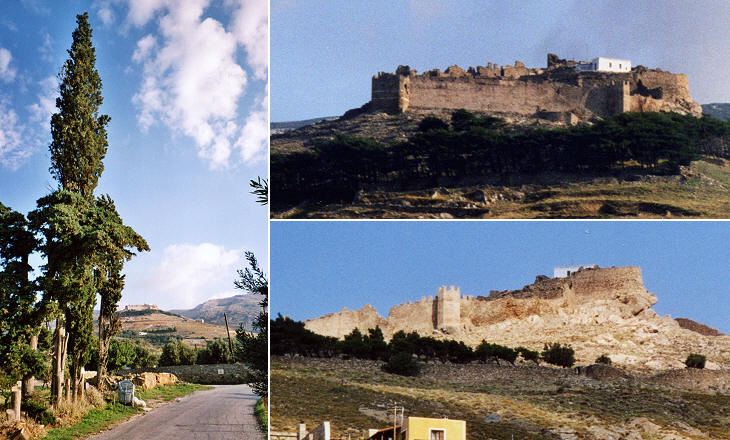
Key dates: 1204 Venice acquires the island of Euboea (at the time called Negroponte) as a consequence of the fall of the Byzantine Empire 1470 The Turks seize the island and this gain is confirmed by the peace treaty signed at the end of the first Venetian-Turkish war (1463-79) 1688 Vain attempt by Francesco Morosini to conquer the island The town of Karistos, located at the southern tip of Euboea, had little importance at the time of Ancient Greece. In the IInd century AD its importance grew as a consequence of the discovery of a particular kind of marble, which was largely used by the Emperor Hadrian when he enlarged Athens (see the Library he built there) and built his Villa near Tivoli. The marble was green with white streaks and in the Renaissance it was called cipollino ("onionish"), because the section of a column made of cipollino shows white and green layers resembling a cut onion. The marble was shipped to Rome, Athens and other locations from a little harbour a few miles off Karistos, which is still called Marmaris. Columns made of cipollino can be found in many Baroque churches of Rome. Karistos was located on a hill a few miles from the sea.
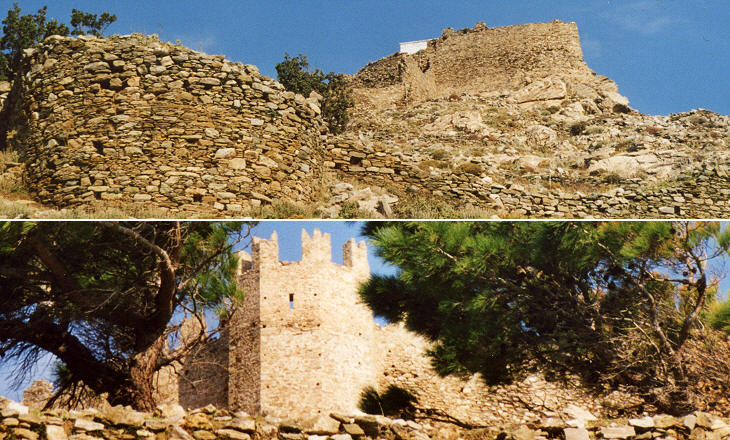
The Venetians made the bay of Karistos a key station in their trade with Constantinople and the other ports of the Aegean Sea. The convoys from Venice circumnavigated the Peloponnese and reached Karistos where the ships parted company and reached their specific destinations. Karistos was protected by walls and by a castle. In addition the Venetians built a tower near the sea line.
Karistos was called Castelrosso (red castle) by the Venetians most likely because of the reddish colour of the clayey ground upon which it was built. It is not to be confused with Castelrosso (d'Asia).
The castle and the fortifications were built by the Venetians to protect Karistos from being attacked by the Genoese. Venice and Genoa in the XIIIth and XIVth centuries were interested only in destroying each other's commercial interests. The walls and the towers of Karistos were not upgraded to the needs of artillery warfare and Karistos was conquered by the Turks in 1470.
The view from the fortress takes in the whole bay and on a clear day also Attica and some islands of the Cyclades can be seen.
The tower protecting the bay shows some "boxes" projecting beyond the walls. They were used to throw stones and hot oil upon the assailants. The background of this page shows a modern winged lion standing on a column in the main square of Karistos. Introductory page on the Venetian Fortresses Pages of this section: On the Ionian Islands: Corfù (Kerkyra) Paxo (Paxi) Santa Maura (Lefkadas) Cefalonia (Kephallonia) Asso (Assos) Itaca (Ithaki) Zante (Zachintos) Cerigo (Kythera) On the mainland: Butrinto (Butrint) Parga Preveza and Azio (Aktion) Vonizza (Vonitsa) Lepanto (Nafpaktos) Atene (Athens) On Morea: Castel di Morea (Rio), Castel di Rumelia (Antirio) and Patrasso (Patra) Castel Tornese (Hlemoutsi) and Glarenza Navarino (Pilo) and Calamata Modon (Methoni) Corone (Koroni) Braccio di Maina, Zarnata, Passavà and Chielefà Mistrà Corinto (Korinthos) Argo (Argos) Napoli di Romania (Nafplio) Malvasia (Monemvassia) On the Aegean Sea: Negroponte (Chalki) Castelrosso (Karistos) Oreo Lemno (Limnos) Schiatto (Skiathos) Scopello (Skopelos) Alonisso Schiro (Skyros) Andro (Andros) Tino (Tinos) Micono (Mykonos) Siro (Syros) Egina (Aegina) Spezzia (Spetse) Paris (Paros) Antiparis (Andiparos) Nasso (Naxos) Serifo (Serifos) Sifno (Syphnos) Milo (Milos) Argentiera (Kimolos) Santorino (Thira) Folegandro (Folegandros) Stampalia (Astipalea) Candia (Kriti) You may refresh your knowledge of the history of Venice in the Levant by reading an abstract from the History of Venice by Thomas Salmon, published in 1754. The Italian text is accompanied by an English summary. Clickable Map of the Ionian and Aegean Seas with links to the Venetian fortresses and to other locations (opens in a separate window) |