|
BURNCHURCH CASTLE
Map Reference: S476474
The 15th century castle at Burnchurch was built by the Fitzgerald Family and continued to be occupied until the beginning
of the 19th century.It is six storeys high and has many chambers and passages, including a secret chamber which is reached
by descending from the fourth floor. At this floor there is a very fine fireplace and a round chimney. There are excellent
crenellations and the narrow sides of the building are carried up a storey higher than the other sides to provide two long
turrets. The castle had a walled courtyard attached and the 12.5m high round turret of this survives.

ST MARY'S CHURCH, CALLAN
Map Reference: S414436
St Mary's Church was originally a cruciform building but the transepts are now missing. The chancel and choir are roofed but
are not now accessible. Inside the choir is a good square font and there is a fine east window. There is a good west tower.
The broad aisles have arcades with four arches. There are some good tomb-chests in the church but no effigies. One of these
tombs depicts a very faint skeleton and another has some good examples of vaulting and window tracery. There are good N and
S doorways with decorated hoods and label stops. Both doorways have carvings of angels and above the N doorway is the carved
head of a woman in medieval head-dress.

CALLAN AUGUSTINIAN PRIORY
The ruins of the Augustinian Priory consist of a rectangular building with a central tower. A spiral stairway leads above
the tower crossing and there are three storeys above that. In the N wall of the church at the W end is a large arch which
may have led to a transept. At the E end of the church in the S wall is a very fine triple sedilia. The decorated hood features
birds, dogs and dragons as well as foliage. Beside the sedilia is a good piscina with a quatrefoil basin. There is one tomb-chest
at the east end of the church but it is very plain. There is some carving on the outside of the doorway.

FRESHFORD
Map Reference: S406648
St Lachtain founded a church here in 622. The present church dates from 1730 but in the west gable is a fine 12th century
Romanesque doorway. It has three orders and is very deep. Some figure sculpture can be seen on either side but it is greatly
weathered. There is also some key pattern. The doorway is surmounted by a plain triangular hood which may be more recent.
Above this is a round window with chevron decoration.

GOWRAN
Map Reference: S633536
St Mary's Church is a fine rectangular structure the east end of which is roofed and still in use by the Church of Ireland.
A large tower is centrally placed and the west end is ruinous. The north wall is crenellated and the north aisle arcade of
four arches is intact. There are traces of a possible S transept. The church has many niches particularly in the south wall
where there are four tomb niches and a piscina. The east window of the south aisle is a fine two-light structure with a decorated
hood. The church has many carved masks. There are some good tomb chests and coffin lids. In particular there are two effigy
slabs, a man and a woman standing on serpents. In the W corner is a tomb chest the lid of which is carved with a shrouded
corpse. Some of the panels feature the instruments of the Passion and one of the end panels has a Crucifixion. It is dated
1626.

GRAIGUENAMANAGH
Map Reference: S709437
The Cistercian abbey of Duiske was founded in 1207. During the 1970s a large portion of the abbey church was restored and
is now used by the local parish. The present level of the floor is about 2m above the original level. In the baptistry, just
off the S aisle, there is a very fine doorway of 13th century date, and the effigy of a knight of similar date is preserved
in the church. In the graveyard there are two crosses. Figured scenes on the north cross include David, the Sacrifice of Isaac
and the Fall of Man. The cross has a solid ring and is about 2.3m high with a high base. The south cross, which is about 2m
high, also has a solid ring and is carved with a Crucifixion and panels of interlace.


GRANAGH CASTLE
Map Reference: S575144
This castle is built on the bank of the River Suir and the earliest portion may date from the 13th century. There are three
round flanking towers with joining walls which may be the fortifications of the original castle. The square tower within the
wall may date from the 14th century but there are 15th century additions. The fine oriel window high up on the S wall is 17th
century. There are many narrow defensive loops and some mullioned windows. To the west of the tower was a two-storey hall.
One of the upper windows of this is finely decorated, both inside and outside. The sculptures include St Michael the Archangel
weighing souls on the Day of Judgement.

GRANGEFERTAGH
Map Reference: S308696
The monastery here was probably founded by St Ciaran of Seir in the 6th century. The 30m Round Tower is the only remnant of
its later phase. Part of the cap still remains and there is a simple round-headed doorway. The tower was burned in 1156 by
Murtagh MacNeale, the High King. Drawings of the early 19th century suggest that it had a round top. This was removed later
in the century by a local farmer who, thinking that the stones were fireproof, had them unsuccessfully fitted as firebricks
in his kitchen. Near the tower is the ruin of a church and within it is a very fine tomb-chest. One of the long panels of
this depicts examples of vaulting and window tracery. On the tomb is the duoble effigy of John MacGillapatrick and his wife.
The tomb was sculpted in 1511 by Rory O'Tunney

JERPOINT ABBEY
Map Reference: S573402
Like many of the Cistercian abbeys of Ireland Jerpoint was originally a Benedictine foundation. It was colonised by monks
from Baltinglass in 1180. There are some very good traces of the original 12th century church but most of the existing buildings
date from the 15th century. The layout is typical of the Cistercians with a large cruciform church and a south cloister with
its associated buildings. The capitals of the pillars in the aisle arcades are richly decorated and within the church are
some fine tomb-chests with weepers and effigies. In the chancel is a triple sedilia and a double piscina.The large traceried
east window replaces some earlier lancets. At the NE corner of the cloister is a carving of St Christopher. The 15th century
cloister-arcade as been renconstructed in the south and west. The arches are round and in groups of three. Many of the pillars
of the arcade are decorated with high-relief carvings of clerics, knights and grotesques as well as other figures. Some of
the capitals and bases of the pillars are also decorated.

KELLS PRIORY
Map Reference: S499433
This is a fine example of a fortified Augustinian priory. It is divided into two wards, the upper ward having four towers
with connecting walls. The walls are well provided with defensive loops and there is a fine gateway with a machicolation.
The corner towers have machicolations over the doorways and the tower at the E has two fireplaces and a mural stairway. A
fifth tower guards the bridge over the moat which runs along the wall dividing the wards. There is another tower in the wall
of the lower ward. Within this ward are the remains of a church and other buildings including a residential tower of about
four storeys. The church is greatly ruined.

KILFANE
Map Reference: S598451
The tower at the east end of this small church may have housed the sacristy in its lower storey and provided residential accommodation
in the upper two storeys. The main item of interest within the church is the larger-than-life effigy of a knight with crossed
legs. The date of the sculpture is uncertain but if it is mid-13th century it may be the effigy of Thomas Cantwell. When the
church was re-used as a school in the 19th century bad boys were made to kiss the stoney lips of 'Long Cantwell' as a punishment.

KILKEERAN
Map Reference: S422273
There are two complete crosses here and two fragments. They are similar in style to the crosses at Ahenny, Co Tipperary. The
west cross has some damage to the ring and the decoration is greatly weathered. The flat surfaces are covered with interlacing
and spiral patterns. The edges have twisted rope decoration. The cross has a conical cap. The east face of the base has a
panel featuring eight horsemen. Unfortunately a modern railed grave enclosure has been erected very close to this cross and
makes examination of the carving very difficult. The rest of the base is covered with interlacing. Beside it is part of the
shaft of another decorated cross. A short distance away a third cross stands on a circular base. It has lost its ring and
most of its arms. A fourth cross is similar in shape to the west cross but has no decoration. At the east end of the graveyard
there are two bullaun stones and a holy well.

KILLAMERY
Map Reference: S375360
At Killamery there is a very fine High Cross with curvilinear ornamentation and a finial. There are also some figured scenes
and some intertwined beasts. It has been dated to the 9th century. Beside it is a large bullaun stone and a boulder with a
20cm wide perforation. There is also a small perforated stone and a good cross-inscribed slab. In the adjoining field is a
holy well.
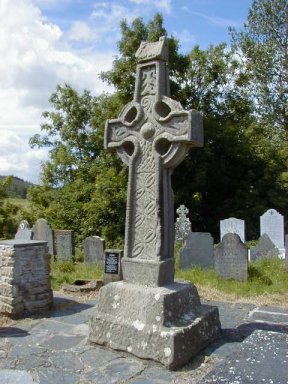
KILREE
Map Reference: S496412
The Round Tower at Kilree is about 29m high and has a good round-headed doorway. It stands beside the ruin of a large church
with antae at the W end. There are indications that there were also antae at the E end where a later extension was built.
There is a lintelled W doorway. In the field to the west of the church is a very fine High Cross. It has five bosses on the
west face and one boss on the east face.The cross is covered with spirals and other ornamentation. There is some figure carving
but it is very faint.

TULLAHERIN
Map Reference: S591478
The monastery at Tullaherin may have been founded by St Ciaran of Seir. The main remnant of the early foundation is the 22.5m
high Round Tower. The doorway is now blocked and its original shape is not clear because many of the stones have been robbed
from the tower. The church was probably pre-Norman with a later added chancel. Beside it is a defaced Ogham stone.

ULLARD
Map Reference: S724481
The small nave-and-chancel church at Ullard has a fine Romanesque west doorway. This originally had three orders but the inner
order has been completely rebuilt. There is the usual decoration including human and animal heads but it is greatly weathered.
There are some small round-headed windows in the south wall of the nave. The chancel has a later two-light east window and
there is a crypt below the altar. There is a ball-alley attached to the east gable and just outside the SE corner of this
is a greatly weathered High Cross. There is a Crucifixion on one face and some spirals on the base.

|